Camborne-Redruth and St Day Mining District, UK — famed for rich tin-copper lodes, copper-arsenate rarities, and historic Cornish collecting appeal.
Key facts
Camborne-Redruth and St Day is one of the essential names in British mineral collecting: a compact Cornish tin-copper district where Variscan granite, Devonian “killas” country rock, elvan dykes, and repeated hydrothermal pulses produced an astonishing concentration of lodes. For specimen collectors the district has two overlapping identities. The Camborne-Redruth side is the great industrial lode field of Carn Brea, Dolcoath, Cook’s Kitchen, Tincroft, East Pool and Agar, South Crofty, and the Great Flat Lode, with cassiterite, wolframite, arsenopyrite, chalcopyrite, bornite, chalcocite, sphalerite, galena, fluorite, quartz, tourmaline, chlorite, and hematite in a deeply mined, zoned tin-copper system. The St Day-Gwennap side, especially Wheal Gorland and nearby St Day United ground, is the classical supergene copper-arsenate country of old collections: liroconite, clinoclase, chenevixite, cornwallite, chalcophyllite, olivenite, cuprite, malachite, native copper, and a long list of rarities that made Cornish mineralogy famous.
Historically, the district stands at the center of the Cornish mining story. The ore bodies along and around the Carn Brea ridge supported some of the richest eighteenth-century copper mines and nineteenth-century tin mines in the world, while the towns of Camborne and Redruth became engineering, commercial, and mining-intellectual centers. South Crofty, now being advanced again as a modern tin project, preserves the continuity of a mining landscape that had already been worked for centuries before the classic specimen era. To the collector, the district is not just a point on a label; it is one of the places where the vocabulary of copper mineralogy, steam mining, lode geology, and nineteenth-century cabinet collecting all intersect.
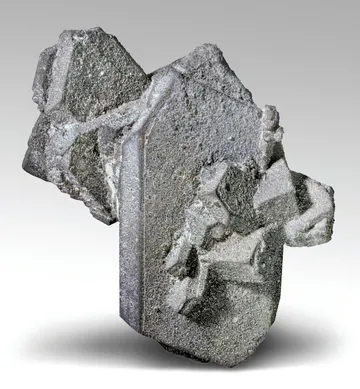
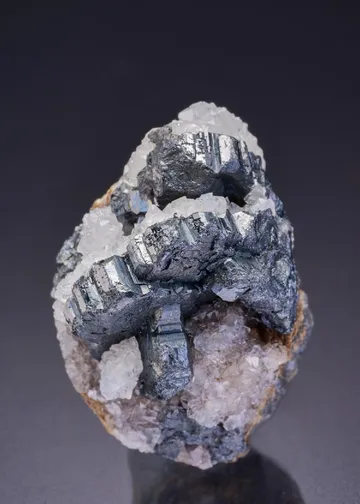
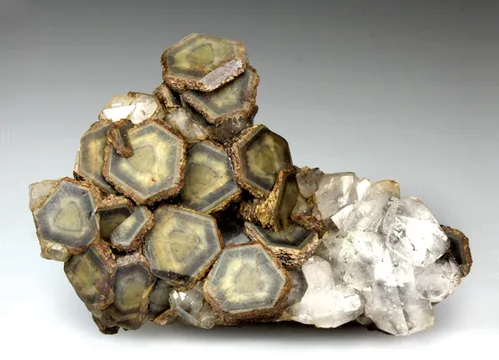
The best specimens have a distinct Cornish look. Chalcocite from the Redruth-Camborne copper lodes is typically metallic grey to black, commonly in squat tabular or pseudohexagonal crystals, twins, compact crystalline groups, or bright druses on quartz-chlorite-sulphide matrix. Native copper specimens from St Day and neighboring copper ground are more prized when old, rich, and three-dimensional, particularly when reddish cuprite crystals cling to coppery seams or arborescent masses. The most coveted cabinet pieces from the district, however, are often the small but intensely colored supergene arsenates: deep blue liroconite in quartz vugs, dark blue-green clinoclase crusts, chalcophyllite plates, and apple- to emerald-green cornwallite and olivenite associations. Fine pieces rarely look large in a modern “showy mineral” sense; their power is precision, color, history, and label pedigree.
Regional View
Country View

Photo: Wikimedia Commons
Wheal Gorland is the mineralogical jewel within the St Day part of the district. It is one of the classic European type-locality mines, and its fame rests on oxidation and supergene enrichment of copper-bearing lodes that also carried arsenic, tin, tungsten, and other metals. The mine’s blue and green copper arsenates were already old collection material when many modern classic localities were still unknown. Even today, a provenanced Wheal Gorland label adds immediate seriousness to a Cornish specimen, especially for liroconite, clinoclase, chenevixite, cornwallite, kernowite, chalcophyllite, olivenite, cuprite, or copper.

Photo: Wikimedia Commons
Search for specimens: View all specimens from Camborne-Redruth and St Day Mining District, UK
The Camborne-Redruth and St Day district lies in west Cornwall, around the Carn Brea ridge, Camborne, Pool, Redruth, St Day, and the adjoining Gwennap mining ground. In mineralogical locality usage it groups a dense set of historically separate mine setts, shafts, lodes, and amalgamated companies into a single great mining district. The principal geological setting is the Cornubian batholith system and its satellite granites, especially Carn Brea and Carn Marth, with lodes cutting both granite and the surrounding metamorphosed Devonian sedimentary rocks. Elvan dykes occupy many of the same structural trends as the lodes, and the district’s mineralization is best understood as a long-lived, multi-stage hydrothermal system rather than one simple vein event.
The lodes are classically polymetallic but zoned. Higher-temperature cassiterite, wolframite, arsenopyrite, quartz, tourmaline, and related minerals are strongest in or near the granite margins and in deeper parts of the system, while copper, zinc, lead, antimony, and other sulphides are prominent in cooler or upper portions. Around South Crofty the main lodes trend west-southwest to east-northeast and dip steeply; they carry cassiterite, wolframite, arsenopyrite, chalcopyrite, quartz, tourmaline, chlorite, hematite, and later sulphides such as galena and sphalerite. The Great Flat Lode, south of Carn Brea, is a different collector’s phrase altogether: a broad, relatively low-dipping tin-bearing structure worked by several famous mines, with cassiterite-bearing tourmaline-chlorite-quartz rock and steeply pitching ore shoots.
Supergene enrichment is crucial to the specimen story. In the upper copper lodes, weathering and descending copper-bearing solutions produced oxidized enrichment zones with cuprite, tenorite or “melaconite,” malachite, and a great variety of secondary arsenates and sulphates. Below the water table, reducing conditions favored secondary copper sulphides such as chalcocite and bornite. This explains why the old copper mines around Redruth, Camborne, and St Day yielded both rich ore and attractive specimens: metallic chalcocite and bornite in one part of the enriched system; cuprite, native copper, malachite, liroconite, clinoclase, chalcophyllite, olivenite, and related arsenates in another.
The historically important mines are numerous. Dolcoath, the “Queen of Cornish Mines,” worked copper first and later tin, ultimately becoming Cornwall’s largest and deepest mine before closure in 1921. South Crofty incorporates a long history of older setts and worked copper in its earlier life before becoming a major tin mine; modern South Crofty is being advanced by Cornish Metals as a permitted tin project, with dewatering, shaft refurbishment, and pre-production development under way, and first tin production presently guided for the middle of 2028. East Pool and Agar grew from older copper workings into one of the great Pool-area producers, with surviving beam-engine houses now interpreted by the National Trust. Carn Brea and Tincroft United, Cook’s Kitchen, Wheal Peevor, Basset Mines, Wheal Grenville, West Frances, South Wheal Frances, Wheal Uny, and King Edward Mine belong to the dense Camborne-Redruth tin-copper landscape.
St Day’s mineralogical fame is anchored by Wheal Gorland and its satellite ground, including Wheal Muttrall and the St Day United and Poldice-associated area. Wheal Gorland’s recorded working began in 1792, though the lodes were likely known earlier. Its ore shoots were irregular, but when rich they were spectacularly rich; nineteenth-century accounts and later summaries emphasize the mine’s extraordinary native copper and secondary copper mineralization. Production figures for the 1815-1851 period include more than 40,000 tons of copper ore, with smaller recorded outputs of black tin and arsenic, and early twentieth-century reworking produced tungsten and tin. Mineralogically, Wheal Gorland is the type locality for chenevixite, clinoclase, cornwallite, kernowite, and liroconite, a distinction that places it among the most important old mineral localities in Europe.
Collectors should treat the district as a historic mining landscape rather than a casual collecting ground. Many old mine sites are built over, landscaped, fenced, preserved as heritage sites, or on private land. East Pool Mine is a National Trust site visited for its industrial archaeology, not for specimen extraction. Much of Wheal Gorland is built over or otherwise inaccessible, and the old specimen-producing zones are not open collecting places. Mine dumps in Cornwall can contain arsenic, heavy metals, unstable ground, hidden shafts, and protected archaeological or ecological features. Any field collecting requires explicit permission, careful attention to local designations, and a conservative approach; for most serious collectors, the practical route to Camborne-Redruth and St Day specimens is old collection material, reputable dealers, auctions, and well-provenanced museum deaccession or duplicate material when legitimately available.
The notable finds that built the district’s reputation are mostly historical. At Redruth and Camborne, chalcocite was common enough and characteristic enough that the old name “redruthite” became attached to the mineral. Specimens from mines such as Cook’s Kitchen, Camborne Vean, Carn Brea, Dolcoath, and related copper lodes may show metallic tabular crystals, compact sulphide masses, or chalcocite partly altered to bornite. At Wheal Gorland, the best cabinet pieces came from vuggy and gossanous portions of copper-arsenic lodes, where quartz cavities and iron-rich gossan hosted blue liroconite, dark clinoclase, chalcophyllite, cornwallite, olivenite, cuprite, native copper, and later-recognized kernowite. These pockets are effectively historical events now; modern pieces with credible nineteenth- or early twentieth-century provenance are much more desirable than loose “Cornwall” copper secondaries with vague or optimistic labels.
Chalcocite from the Camborne-Redruth and St Day district is one of the defining old Cornish copper sulphides, so characteristic of the Redruth area that the historical name “redruthite” was long used for the species. District specimens range from massive and compact ore to metallic grey, blackish-grey, or tarnished tabular and pseudohexagonal crystals, commonly twinned, in quartz, chlorite, and sulphide matrix; good crystallized examples are usually thumbnail to small-cabinet pieces, with individual crystals often only a few millimetres but occasionally reaching centimetric size. The best pieces are bright, sharply formed, and visibly crystallized rather than merely heavy black ore, and associations with bornite, chalcopyrite, cuprite, native copper, quartz, or other secondary copper minerals can give a specimen both paragenetic interest and classic Cornish character.
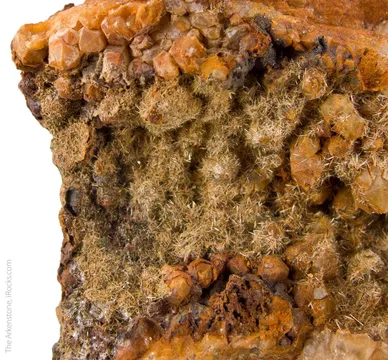
Native copper from Camborne-Redruth and St Day is most prized from the St Day copper ground, especially Wheal Gorland and neighboring workings, where old accounts record remarkably rich supergene copper ore and where native copper is classically associated with cuprite, chalcocite, malachite, limonite, quartz, and copper arsenates. Specimens may appear as seams, irregular masses, hackly or dendritic copper, small crystalline areas, or copper partly coated by red to deep red cuprite octahedra; cabinet pieces with abundant copper and sparkling cuprite are far more desirable than dull, corroded, massive fragments. A good district copper should look convincingly old and mineralogical rather than merely “metallic”: rich copper color beneath oxidation, firm matrix or cuprite contrast, locality-specific association, and ideally an old label tying it to Wheal Gorland, Wheal Unity, Carn Brea, or another named mine within the district.
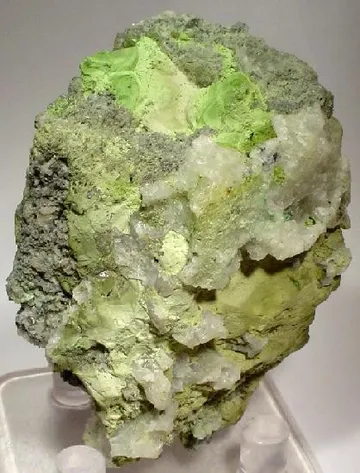
Beyond chalcocite and copper, the district is extraordinary for copper arsenates and related supergene species. Wheal Gorland is the type locality for chenevixite, clinoclase, cornwallite, kernowite, and liroconite; the last of these is especially celebrated in old cabinets as blue to blue-green flattened bipyramids in quartz vugs, with world-class examples documented from the mine. Clinoclase occurs as dark blue to blue-green crusts, sprays, and microcrystalline aggregates; chenevixite and cornwallite are classic green arsenate species; and kernowite was recognized in the twenty-first century from material long labelled as liroconite. The wider district also records cassiterite, wolframite, scheelite, arsenopyrite, chalcopyrite, bornite, sphalerite, galena, fluorite, quartz, tourmaline, cuprite, malachite, azurite, olivenite, chalcophyllite, pharmacosiderite, scorodite, ceruleite, langite, and metazeunerite, among many others.
Provenance is the first test for serious Camborne-Redruth and St Day specimens. The district name covers many mines, and old labels often use shifting historical geography: Wheal Gorland may be labelled Gwennap, St Day, St Day United, Poldice, or simply Cornwall; South Crofty material may include older mine sections absorbed into the later South Crofty sett; and Redruth-area chalcocite may be labelled under historical names such as redruthite. A precise mine label, especially if old, is much more valuable than a broad “Cornwall” or “Redruth” attribution.
Mislabelling is common. Generic Cornish copper arsenates are sometimes promoted as Wheal Gorland because that name carries a premium, and blue-green microcrystalline material may be casually called liroconite, clinoclase, cornwallite, or olivenite without analysis. Kernowite adds a modern complication: it was recognized from old Wheal Gorland-type material and is visually close to liroconite, so visual identification alone is not enough for fine species-level claims. For rare arsenates, insist on credible provenance, old labels where possible, and analytical support when the species is valuable or visually ambiguous.
Chalcocite condition needs close inspection. It is relatively soft, can be edge-worn, and may show dulling, bruising, or partial alteration to bornite or other copper minerals. Good specimens should retain metallic luster and crystal definition; heavy black massive pieces without visible form are better regarded as ore samples unless the label is historically important. Native copper can be naturally oxidized, but collectors should watch for recently cleaned, lacquered, oiled, or polished material. Bright metallic copper on a supposedly old Cornish specimen is not automatically wrong, but an unnatural shine should prompt questions.
Secondary copper arsenates from St Day are often small, delicate, and matrix-bound. Avoid washing them aggressively. Liroconite, clinoclase, chalcophyllite, and related species should be kept dry, stable, and away from unnecessary handling. Many district specimens also contain arsenic-bearing minerals such as arsenopyrite, scorodite, pharmacosiderite, olivenite-group minerals, and other arsenates; normal cabinet storage is safe, but do not grind, trim, lick, acid-clean, or generate dust from them. Uranium-bearing species such as metazeunerite are documented in the district, so any bright green radioactive-looking micro material from old Cornish mine dumps should be treated with appropriate caution and, if necessary, checked.
Market availability is uneven. Broad-district chalcocite and copper appear periodically, but truly sharp Redruth-Camborne chalcocite with good crystal form is much less common than massive ore or mediocre old fragments. Native copper with cuprite from Wheal Gorland or St Day commands a strong premium when aesthetic and well provenanced. The most desirable Wheal Gorland liroconite, clinoclase, chalcophyllite, cornwallite, and olivenite specimens are old-collection classics; they can be expensive even at small sizes, and the best examples are usually already in major private or museum collections. In this district, a small, honest, labelled piece is often preferable to a larger but vague one.
Wheal Gorland’s best stories sound almost exaggerated, but they fit the geology of the place: supergene copper enrichment so rich that ordinary ore handling became a security problem. At times in the early working of the mine, ore wagons were guarded because the copper ore was so valuable. In 1813, native copper from Wheal Gorland was reportedly being sent to the smelters packed in fish casks, an image that captures St Day at its most vivid: not just green and blue cabinet minerals in later collections, but heavy native metal coming out of the ground in quantities substantial enough to be barrelled like trade goods.
The mine’s fortunes were irregular from the start. Recorded working began in 1792, an engine was planned in 1795, and the lode was followed deeper even though regular ore shoots were elusive. The early years could be disappointing, with rich patches followed by barren ground, but when the mine was good it was exceptionally good. By the nineteenth century, Wheal Gorland stood close behind the giants of the Cornish copper world in reputation and profit. That irregularity matters to collectors: the finest minerals came not from a uniform ore body but from pockets and enriched zones, the kind of discontinuous geology that makes great specimens rare and local.
At East Pool and Agar, the story turns from pocket mineralogy to industrial drama. East Pool reopened in February 1835, and at only 16 fathoms—about 29 metres—miners struck a large copper lode. The mine expanded, deepened, and by 1887 installed Michell’s Whim, a 30-inch beam winding engine designed by Francis Michell of Redruth and made by Holman Brothers of Camborne. It ran fast, at 17 strokes per minute, hauling ore for decades. Nearby Wheal Agar had a more troubled existence, repeatedly threatened by flooding and costs. In 1896, Agar’s shareholders switched off their pumping engine to save money. Water began flooding into East Pool; men were laid off; and the two mines were forced toward a hard bargain. After Lord Robartes, the mineral lord, intervened, a deal was made on 10 March 1897. East Pool and Agar United was born, the pumps went back on, and it took £16,000 and a full year to drain the flooded workings.
The 1921 collapse at East Pool shows how abruptly mining fortunes could change. Tin prices fell in a global depression, and East Pool shaft suffered a destructive underground movement that wrecked the electric pumps and disabled Michell’s Whim. The company wrote off the old shaft and sank Taylor’s Shaft instead, reaching 380 metres by 1923. When mining finally ended in 1945, Taylor’s Engine did not simply stop; it kept pumping because South Crofty next door depended on it. The survival of the machinery later became a story of salvage: scrap was sold to pay debts, but Taylor’s Engine was purchased by Dr Greville Bathe, a steam-engine historian from America, and passed through the Cornish Engine Preservation Society before East Pool came into National Trust care in 1967.
Dolcoath supplies the district’s darker underground episode. On 20 September 1893, miners were working at the 412-fathom level, nearly half a mile underground, strengthening a timber stull that held back an enormous mass of waste rock. The lode at the accident site was about 30 feet wide and rich enough in tin ore that the full width had been stoped away, leaving a great open cavity above the level. Sixteen men were engaged in the work. At about one o’clock in the afternoon the stull failed. Eight men died, and eight others escaped injury by the narrowest margin. One survivor, Davis, was entombed for 36 to 40 hours before release. For collectors holding a Dolcoath label, the mine’s fame as the “Queen of Cornish Mines” should sit beside the physical reality of those depths: ore, engineering, profit, and risk intertwined in the same narrow levels.
Camborne’s mining world also produced inventions that travelled far beyond Cornwall. In 1801, Richard Trevithick’s high-pressure steam carriage, the “Puffing Devil,” made its Christmas Eve run from Camborne up what is now Fore Street and Tehidy Road toward Beacon. It was a mining engineer’s machine before it was a transport icon: high-pressure steam had grown from the need for compact, powerful engines in mines. Three decades later, William Bickford, working at Tuckingmill near Camborne, watched rope-making and adapted the idea to blasting. His safety fuse, devised in 1830 and patented soon after, gave miners a predictable burn and saved “countless lives… and fingers.” That phrase belongs in the district’s story as surely as any mineral name, because the same lodes that produced chalcocite, copper, cassiterite, and liroconite also drove the technologies that reshaped mining worldwide.