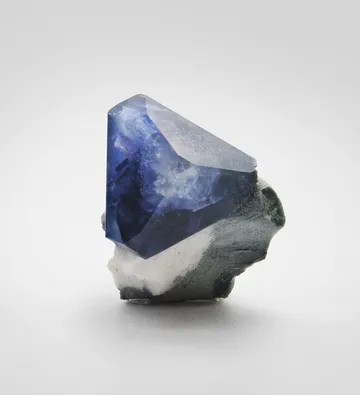
California State Gem Mine, USA — type locality for benitoite; gem-quality blue benitoite with natrolite and neptunite, highly prized by collectors.
Key facts
The California State Gem Mine is the classic American locality for benitoite: a small, remote, geologically peculiar deposit near Santa Rita Peak in the southern Diablo Range of San Benito County, California, where blue BaTiSi3O9 crystallized with black neptunite, white natrolite, and honey- to orange-brown joaquinite-group minerals in altered blueschist enclosed by New Idria serpentinite. For collectors, its importance is out of proportion to its physical size. It is the type locality for benitoite and several rarer barium-titanium silicates, the source of the finest gem-quality benitoite yet recovered, and one of the few places in the world where a specimen can combine a major gemstone species with textbook mineralogical rarity and immediate visual drama.
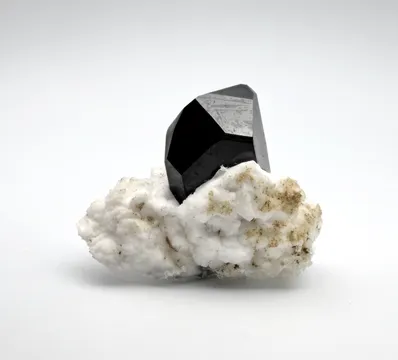
The mine’s signature specimen style is unmistakable: triangular to triply terminated benitoite crystals, usually violet-blue to sapphire-blue with pale or whitish centers, set on snow-white natrolite or rising from dark bluish glaucophane-crossite schist, often accompanied by lustrous black neptunite prisms. The best pieces have the high-contrast geometry collectors remember across a room: blue triangular benitoite faces, lacquer-black neptunite spears, and pale natrolite seams that have been carefully etched just enough to reveal the crystals without stripping away all sense of matrix.
Regional View
Country View
Geologically, the deposit is not a conventional zeolite occurrence, nor a simple pegmatite-like pocket system. Benitoite and its associates occupy narrow natrolite-bearing veins and altered zones in blueschist blocks tectonically enclosed in serpentinite. The enclosing blueschist is far older than the benitoite mineralization; the famous vein assemblage is interpreted as a later hydrothermal-metamorphic event, much younger than the Jurassic-Cretaceous Franciscan host rocks. This helps explain why the locality feels so mineralogically improbable: elements that rarely meet in crystallized, gemmy form—barium, titanium, sodium, lithium, iron, rare earths, and silica—were concentrated in a small structural and chemical trap.

Photo: Wikimedia Commons
The locality is also historically layered. It was discovered in 1907 by prospector James Couch, developed by R. W. Dallas and the Dallas Mining Company, known for decades as the Dallas Gem Mine or Benitoite Gem Mine, and later worked intermittently by lessees, collectors, serious specimen miners, and commercial operators. Its modern collecting identity includes both the historic mine site and the public screening operation run by Benitoite Mining Company, where material from the mine is brought to a separate collecting area rather than allowing the public into the original workings.

Photo: Wikimedia Commons
Search for specimens: View all specimens from California State Gem Mine, USA
The California State Gem Mine is the famous Gem Mine/Dallas Gem Mine/Benitoite Gem Mine occurrence near Santa Rita Peak, at the headwaters of the San Benito River in San Benito County. The mine lies in the New Idria district, a sparsely populated part of the southern Diablo Range long known for serpentinite, mercury, chromium, asbestos minerals, unusual barium silicates, and rare collector minerals. The benitoite deposit itself is hosted by glaucophane-bearing blueschist within a larger serpentinite body; the mineralized zone is described as a hydrothermally altered portion of blueschist with natrolite veining, recrystallized amphibole-pyroxene assemblages, and local albite dissolution.
The ore is specimen ore and gem ore rather than a bulk industrial ore. Benitoite occurs in and along natrolite veins that cut the altered blueschist, commonly where the veins narrow, end, or lie against favorable wall-rock surfaces. Neptunite, joaquinite-group minerals, apatite, albite, jonesite, serandite-related material, and small copper sulfides may occupy the same vein system. In many pieces the benitoite and neptunite were fully enclosed by later white natrolite. This encasement is central to both mining and specimen preparation: the natrolite protected crystals during geologic weathering and recovery, but it also hid them, forcing miners and preparators to either break, saw, or acid-etch the rock before knowing whether a handsome specimen lay inside.
The deposit was discovered in 1907, when James Couch, prospecting in the hills south of the New Idria mines, noticed a white rock exposure carrying bright blue crystals. The material was first thought by some to be sapphire or another known blue gem, but George D. Louderback of the University of California recognized it as a new mineral species and named it benitoite for San Benito County, the San Benito River, and the nearby San Benito Range. R. W. Dallas financed and controlled the early development, and the Dallas Mining Company worked the property during the first boom years. Early production came from an open cut and short underground workings in the benitoite-bearing blueschist.
The first mining period, from 1907 into the early 1910s, produced both gem rough and mineral specimens, but many specimens were destroyed by the recovery methods of the day. Before acid preparation became standard practice, miners commonly broke natrolite-rich vein material to liberate blue gem nodules, and specimen aesthetics were secondary to gemstone recovery. Mining slowed and stopped after about 1912, followed by long intervals of inactivity, casual collecting, and short leases. The property was later worked by B. Suit of the San Benito Gem Company, M. Dunn in the 1930s, M. F. Hotchkiss in the early 1950s, and C. L. Cole of Oakland from about 1952 into the 1960s. In 1967, Bill Forrest and Elvis “Buzz” Gray took up the lease; they and later owners produced important specimens and refined the understanding of the deposit.
A major modern phase came from 2000 to 2004, when Benitoite Mining, Inc., affiliated with Collector’s Edge Minerals, processed old dumps, eluvial material, and remaining known in situ vein material. That operation treated tens of thousands of yards of material, used washing, screening, jig concentration, hand-picking, and magnetic separation, and recovered gem rough down to small sizes. Large mineralized boulders were stockpiled or sent for controlled laboratory preparation. This period also produced many of the clean, etched benitoite-neptunite-natrolite specimens that define the modern market.
The original mine site is not a casual public collecting ground. Access to the workings is restricted for safety, environmental, and land-management reasons, including naturally occurring serpentine/asbestos concerns and the hazards of an old mine in rugged country. Public collecting today is conducted through Benitoite Mining Company’s separate screening area, where ore from the mine is brought to visitors. Collectors work through dumped material with supplied tools, water, screens, and ultraviolet lights rather than entering the historic mine or underground openings.
Notable specimen finds span the entire history of the mine. Early plates preserved in major collections show the classic association in its freshest form. The “Wreath,” about 6 cm wide, is one of the best-known benitoite specimens and is in the Natural History Museum of Los Angeles County collection. The famous Josie Scripps benitoite specimen is a much larger historic plate, about 18 cm wide. Modern preparation has also revealed choice miniature and small-cabinet specimens with triangular blue benitoite, doubly terminated neptunite crystals, and minute orange-brown joaquinite on or in white natrolite. In this locality, “pocket” is often less literal than in pegmatite collecting: the memorable finds were commonly natrolite-filled seams, altered blueschist boulders, or pieces from weathered vein material that only became specimens after careful exposure.
Benitoite from the California State Gem Mine is the locality’s defining mineral and its type-locality species, occurring as euhedral flattened triangular to triply terminated ditrigonal-dipyramidal crystals attached to vein walls or disseminated in altered blueschist; typical crystals are about 1 to 1.5 cm, 2.5 cm is already large, and exceptional crystals have been reported to 5.6 cm across. Most specimen crystals are translucent to gemmy blue with white or colorless cores and stronger blue rims, while the finest examples show saturated violet-blue to sapphire-blue transparent corners or full crystals with sharp faces, strong luster, and minimal etching damage. The classic association is white natrolite with black neptunite and tiny joaquinite-group crystals, but some benitoite is also seen against dark blueschist or crossite-rich matrix. The most desirable specimens are balanced miniatures to cabinets where benitoite crystals are isolated, undamaged, visibly triangular, and positioned in high contrast with natrolite or neptunite; ordinary pieces tend to have chalky, fractured, partly dissolved, or heavily included benitoite, or crystals still mostly buried in natrolite.
Neptunite at the California State Gem Mine forms the great black counterpoint to benitoite: lustrous monoclinic prisms that appear jet-black but are actually very deep red-brown in strong transmitted light, commonly attached by one end to the vein wall or lying partly exposed from white natrolite. Average crystals are commonly up to about 2.5 cm, while exceptional examples from the mine reach several centimeters and crystals to about 7.5 cm are known. Doubly terminated crystals are not unusual here when they grew from a prism face rather than a single end, and crossing twins reminiscent of staurolite are a prized specialty. Fine neptunite specimens from this locality have sharp terminations, glassy to submetallic luster, freedom from broken tips, and an architectural relationship with benitoite or natrolite; lesser pieces may be isolated black splinters, partly corroded prisms, or crystals whose terminations were lost during mining or acid preparation.
Natrolite is the white vein-filling mineral that makes the California State Gem Mine specimens possible and, paradoxically, often has to be partly removed for the specimen to be seen. It commonly occurs as massive to opaque white material filling narrow veins in blueschist and coating earlier-formed benitoite, neptunite, joaquinite, and related minerals; in open spaces it can show atypical ridged, coxcomb-like, roof-shaped aggregates rather than the familiar acicular natrolite sprays from basalt cavities. Crystals and aggregates at the mine have been described up to about 2 cm, but the collector value of natrolite here is usually as matrix: clean, snowy, sculptural natrolite that frames blue benitoite and black neptunite without overwhelming them. A good natrolite-rich specimen retains enough white matrix to give contrast and locality character, while over-etched examples can look skeletal, harsh, or artificially stripped of the deposit’s natural vein texture.
Joaquinite-(Ce) and closely related joaquinite-group minerals from the California State Gem Mine are classic type-locality rarities, usually appearing as tiny yellow-brown to orange-brown equant crystals, commonly no more than a few millimeters and often much smaller, on or near natrolite with benitoite and neptunite. Their scale is microscopic to miniature rather than cabinet-spectacular, but their importance is high because they are part of the same barium-titanium-rare-earth mineralizing event that made the mine famous. Joaquinite is most satisfying on specimens where the orange-brown crystals are distinct, sharp, and not merely rusty specks, especially when they sit between blue benitoite and black neptunite on white natrolite. Since ordinary matrix staining, altered amphibole, and tiny unidentified brown grains can be misleading, the best joaquinite-bearing pieces are those with strong provenance, clear magnification-visible crystals, or analytical confidence.
Beyond the four headline species, the mine’s mineral list is unusually rich for such a small deposit. Type-locality minerals include benitoite, joaquinite-(Ce), orthojoaquinite-(Ce), bario-orthojoaquinite, jonesite, and barioperovskite. Jonesite is among the great micromount rarities of the locality, occurring as minute colorless crystals or sprays associated with benitoite, natrolite, joaquinite, and anatase. Other documented species include actinolite, aegirine, albite, analcime, anatase, andradite-melanite, apatite, aragonite, baotite, calcite, chalcocite, chrysocolla, chrysotile, covellite, crossite, delindeite, digenite, diopside, djurleite, fresnoite, glaucophane, morimotoite, native silver, perovskite, pyrite, serandite, vesuvianite, and several unnamed Ba-Si-Ti or Ba-Ti phases. For most collectors these are supporting or micro-only minerals, but for systematic collectors the mine is one of the essential American rare-species localities.
The most important authenticity question is locality, not species. Blue benitoite itself is readily separable from lookalike gemstones by experienced gemologists, and the California State Gem Mine association is distinctive: triangular blue benitoite in or on white natrolite with black neptunite, orange-brown joaquinite-group crystals, and blueschist/crossite matrix. Still, mislabeling can occur because the mine has carried several names—Dallas Gem Mine, Gem Mine, Benitoite Gem Mine, California State Gem Mine, and Benitoite Mining Company—and because nearby San Benito County prospects such as Mina Numero Uno, the Victor claim, Santa Rita Peak occurrences, and the Junnila claim can be confused with the classic mine. Old labels are valuable and should be preserved even when they use obsolete names.
No widespread, well-documented manufactured specimen-fake problem defines the locality, but assembled, repaired, or aggressively prepared pieces deserve close inspection. A benitoite perched perfectly on a neptunite crystal can be natural, as the locality did produce spectacular juxtapositions, but suspicious glue lines, mismatched luster at contact points, unnatural acid halos, and matrix discontinuities should be checked under magnification. Because natrolite is routinely dissolved with hydrochloric acid to expose crystals, acid preparation is not automatically a defect; it is part of the locality’s collecting history. The distinction is quality of preparation. Good preparation leaves coherent matrix, crisp crystals, and believable relief. Poor preparation rounds natrolite, undercuts crystals, exposes fragile roots, or leaves chalky residues in crevices.
Condition is critical. Benitoite has no cleavage and can be durable for its hardness, but specimen crystals are often thin, flattened, zoned, and partly included; edge bruising, broken tips, chipped triangular corners, and cloudy interiors all affect value. Neptunite is more vulnerable than its dark color suggests: terminations chip, long prisms snap, and repaired tips may hide against the black surface. Natrolite matrix can be friable, porous, or acid-softened. Joaquinite is tiny and easily overlooked, rubbed, or mistaken for staining. Always inspect with both white light and magnification.
Fluorescence is a useful and enjoyable feature. Benitoite from the mine fluoresces blue-white under shortwave ultraviolet light, and zoned crystals may show brighter responses in pale cores than blue rims. Under longwave ultraviolet, pale cores can fluoresce a dull red while blue rims may be weak or non-fluorescent. Fluorescence can help find small grains in screening material and can support field identification, but it should not replace morphology, matrix, provenance, and, for high-value stones, gemological testing.
Market availability is paradoxical: the locality is famous, and specimens are always circulating, but truly fine pieces are scarce. Small etched fragments and modest benitoite-on-natrolite specimens appear regularly. Fine miniatures with sharp blue crystals, attractive neptunite, and clean white natrolite are much less common. Cabinet specimens, historic plates, specimens with large undamaged benitoite crystals, and pieces with both aesthetic value and rare-species significance are major acquisitions. Faceted benitoite above 1 ct is already select, stones above 2 ct are scarce, and fine blue stones above that size are firmly in the specialist gem market.
The discovery story still has the feel of a California prospecting tale, but with an ending no gold hunter could have predicted. In 1907, James Couch left the Coalinga area after being grubstaked by R. W. Dallas and rode into the country south of the New Idria mines. Near the headwaters of the San Benito River he made camp where grass and water were available. In the morning he noticed a rocky exposure on the north side of the canyon: a white pocketed rock with bright blue crystals scattered through it. Couch later remembered that “blue crystals were lying all over the ground.” He collected material, returned to Coalinga, and soon made the three-day horseback trip to Hollister to file a federal mining claim.
The blue crystals first excited the imagination because they looked like something already famous. Sapphire was considered; so were other blue gems. But the material would not fit the expected identity. George D. Louderback at the University of California studied it and, in 1907, announced a new mineral species. The name benitoite tied the mineral to its county, river, and mountain setting, and almost immediately the remote claim became a destination for miners, gem dealers, and mineralogists.
The early Dallas years were productive but hard on specimens. Mining chased gem rough, not museum plates. Natrolite concealed the blue crystals, and without the later culture of careful acid preparation, workers broke open the white vein rock and knocked off promising lumps. Thousands of stones were reportedly broken during recovery. What collectors now view as matrix-protected specimens were then often obstacles between miner and gem.
After Dallas stopped work, the mine entered a long, strange afterlife. The old road passed close enough that collectors sometimes stopped and hauled away natrolite boulders studded with broken benitoite crystals. One family’s rock garden at Sawmill Creek reportedly included such material; after a forest fire destroyed the cabin, the garden was forgotten until benitoite became valuable, by which time the place had been lost under brush. Another fire burned the log cabin and corrals at the mine itself.
The mid-century stories are full of names that still attach themselves to old labels. M. Dunn reopened the property in 1933. M. F. Hotchkiss bulldozed old dumps in the early 1950s, seeking veined blueschist that could be treated with muriatic acid. C. L. Cole of Oakland took a lease around 1952, reopened the original pit, and showed large plates of benitoite in the windows of his Oakland rock shop. Local families and schoolchildren learned of the mine through such connections; one school field trip produced a memorable tale of a child finding a spectacular specimen in the bushes.
By the late 1960s, the mine had passed into the hands of people who valued specimens more systematically. Bill Forrest and Buzz Gray began serious work after acquiring the lease in 1967 and later purchased the property. They recovered important benitoite and neptunite specimens, and the deposit’s identity matured from gem curiosity to world-class specimen locality. In 1985, benitoite was designated California’s official state gemstone, an unusually appropriate state symbol because the mineral’s finest occurrence is so tightly bound to California geology.
The Collector’s Edge period at the start of the 2000s brought industrial discipline to a very small, very stubborn gem deposit. Material was sticky, muddy, and full of clay that trapped stones. The operation processed old dumps and weathered in-place material, used washing and screening, removed specimen pieces by hand, ran smaller material through jig systems, and even took advantage of benitoite’s slight magnetic response to separate it from other concentrate. The numbers tell the scale: roughly 30,000 yards of material were processed in 2000–2004, including about 20,000 yards of existing dump material, yet only a few percent of “potential specimens” ultimately produced good benitoite or neptunite specimens after preparation.
The modern visitor experience is different from the old mine. Collectors do not wander into the historic workings or pry at the original veins. Instead, material is brought down to a controlled screening field, where people shovel, screen, wash, and sort, then use ultraviolet light to pick out the small glowing prizes. The work can feel humble compared with the lore—dust, buckets, screens, and patience—but it preserves the old excitement in miniature: somewhere in a white-coated piece of vein rock or a small concentrate grain may be the state gemstone of California.