Calaveras Mine, USA - Sierra Nevada skarn locality famed for red-brown andradite garnet in green epidote, with quartz cavities and striking collector specimens.
Key facts
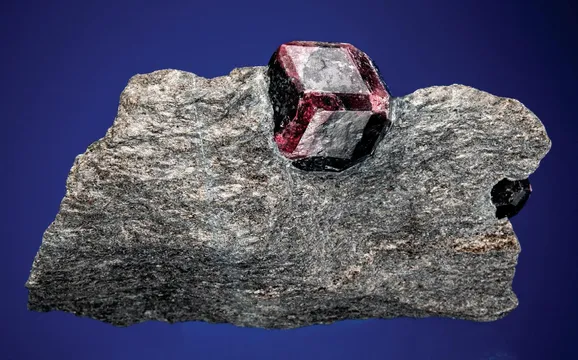
Calaveras Mine, USA, as represented by the classic garnet–epidote specimens in collections, belongs to the Garnet Hill mine group of northern Calaveras County, California: a small but unusually specimen-rich tungsten skarn on the crest of Garnet Hill, just south of the Mokelumne River and near Moore Creek. The locality is not famous because it was a large ore producer. Its reputation rests on an elegant contact-metasomatic assemblage—reddish-brown andradite garnet, dark green epidote, quartz, scheelite, molybdenite, chalcopyrite, and associated calc-silicate minerals—formed where carbonate-rich roof-pendant rocks were altered beside Sierra Nevada granodiorite. For collectors, the best pieces are instantly recognizable: brilliant root-beer to reddish-brown garnet crystals, commonly dodecahedral to trapezohedral, set in coarse green epidote skarn; stout, lustrous epidote prisms; quartz-lined cavities; and locally bizarre epidote or quartz pseudomorphs after garnet.
Regional View
Country View
The locality sits in the Sierra Nevada foothill belt, but mineralogically it is quite different from the better-known Mother Lode gold-quartz vein camps nearby. Here the collectible minerals are calc-silicate skarn products rather than free gold or gold tellurides. The old geologic literature already singled out Garnet Hill for the “size and beauty” of its minerals, noting white quartz, green epidote prisms several inches long, and brilliant brownish-red garnets. Later tungsten work showed that scheelite was scattered through tactite bodies, but the cabinet appeal of the locality remained the contrast between red-brown garnet and green epidote.

Photo: Wikimedia Commons / Rob Lavinsky, iRocks.com
Search for specimens: View all specimens from Calaveras Mine, USA
The collector locality commonly treated under Calaveras Mine labels is best understood as the Garnet Hill Mine or Rheona claim area on Garnet Hill, Calaveras County, California, with related material also recorded from the nearby Miracle Mountain and Moore Creek workings on the same hill. Geologically, it is an oxidized tungsten skarn developed in a roof pendant within hornblende-biotite granodiorite. The original calcareous beds were converted first to marble and calc-silicate bimetasomatic skarn; later, iron-rich infiltration skarn produced the garnet-rich bodies, and still later hydrous alteration introduced or overprinted epidote, actinolite, chlorite, and related minerals.
The ore bodies are tactite lenses and bands rather than veins in the normal Mother Lode sense. At Garnet Hill the most extensive tactite body lies on the west side of the hill, is reported as nearly 800 feet long, and ranges roughly 20 to 35 feet in width; other major tactite bodies occur farther east, with smaller bodies scattered nearby. The rock around them is chiefly medium-grained gneiss, with lesser quartz-mica schist and granodiorite. Scheelite occurs irregularly in the tactite, commonly in very fine disseminations, but locally as well-formed crystals; molybdenite and chalcopyrite occur in smaller and erratic amounts. The specimen matrix collectors know—massive garnet, epidote, quartz, and calc-silicate rock—is essentially the gangue of this tungsten-bearing skarn.
Mining history was brief compared with the locality’s collecting history. The area may have been prospected for copper during the 1860s, but the earliest enduring fame came from its garnet and epidote crystals. It was prospected again during World War I, visited by many mineral collectors through the 1920s and 1930s, and investigated for tungsten during World War II by several parties, including the Garnet Hill Tungsten Syndicate, L. A. Smith, and Marsman and Company. The U.S. Geological Survey also examined the property for the Reconstruction Finance Corporation, but no wartime production is recorded for that phase.
Commercial tungsten mining finally took place in 1953 and 1954, when the North American Tungsten Mining Company, headed by A. L. Damon, operated the Garnet Hill Mine. Ore was taken from an open pit on the west tactite body, hauled to the Church gold mine mill near Placerville for flotation treatment, and the concentrates shipped to Bishop. Workings included surface cuts and underground openings, including a 270-foot adit near the north end of the tactite-body open pit. Operations ceased in 1954, and the mine has been idle apart from assessment or intermittent minor activity since that period.
The adjacent Moore Creek mine, about half a mile southwest of Garnet Hill, helps explain the district context. It produced tungsten-molybdenum-copper ore in the mid-1950s, with scheelite, molybdenite, chalcopyrite, pyrite, and bornite in discontinuous tactite bodies, and at one point operated a small concentrator. But the best mineral specimens in the collecting market are overwhelmingly known for the Garnet Hill visual signature: dark green epidote, brown-red andradite, quartz, and occasional scheelite.
Collecting access today should be treated conservatively. Published locality summaries place the Garnet Hill workings on National Forest land, but mineral rights, active claims, seasonal road conditions, closure orders, and safety restrictions can change. The old workings include pits, cuts, loose skarn blocks, steep terrain, and underground openings; serious collectors should verify current land status with the managing agency and county records before visiting, avoid underground workings, and assume that removing material may require permission or be restricted. Field accounts also indicate that practical access became more difficult around the early 2000s, and modern visits are more often described as hikes to observe the geology than as productive collecting trips.
The most important specimen finds fall into several recognizable groups. Old-time garnet pieces include lustrous, reddish-brown compound crystals and plates of sharp dodecahedral to trapezohedral andradite. The locality also produced unusually stout epidote crystals, including a small 2011 find of about thirty sharp crystals, with the best individuals praised for textbook form and luster despite their opacity. A later-noted suite of pseudomorph specimens includes epidote after andradite and quartz “snowball” replacements after garnet; these are not typically pristine, but they are among the most mineralogically interesting pieces from the hill.
Andradite is the defining collector mineral of Calaveras Mine/Garnet Hill material: reddish-brown to deep root-beer crystals in garnet-rich skarn, commonly showing dodecahedral forms modified by trapezohedral faces, with individual crystals documented in the geologic literature at 2–4 cm near the summit and larger compound crystals appearing in old collections. The finest pieces have bright faces, strong color contrast against green epidote, and undamaged crystal edges; ordinary pieces tend to be massive garnetite with partly exposed or contacted crystals. A special subset shows replacement by epidote or quartz, preserving garnet form while changing the mineral substance, and these pseudomorphs are prized for their paragenetic story as much as for display quality.
Epidote from this locality is typically dark green to pistachio-green, opaque to only slightly translucent, and occurs both as coarse skarn-forming masses and as lustrous, sharply formed prismatic crystals associated with andradite and quartz. The old Mokelumne Hill folio described green epidote prisms at Garnet Hill reaching three inches or more, while modern market records document stout single crystals in the 2–3 cm range and larger cabinet combinations with epidote crystals several centimeters long on garnet-rich matrix. The best examples show a complete, well-terminated prismatic habit, high luster, and an aesthetic siting on reddish garnet; replacement pieces, especially epidote after andradite, are more irregular but much scarcer and more intellectually compelling.
Quartz is a subordinate but important visual and paragenetic mineral at Calaveras Mine/Garnet Hill, appearing as white quartz in the skarn, as small crystals in open vugs with epidote and garnet, and as microcrystalline material in the pseudomorph suite. The most distinctive quartz specimens are not large standalone crystals but replacement forms: quartz “snowballs” after garnet and quartz involved with partly hollow or layered epidote-andradite pseudocrystals. Good quartz-bearing pieces from here are those in which the quartz clarifies the replacement story or sharpens the color contrast—red-brown garnet, green epidote, and pale quartz—rather than simply adding massive white gangue.
“Garnet” labels from Calaveras Mine/Garnet Hill almost always refer to andradite-rich calcic garnet, though analytical work has shown zoning within the andradite-grossularite series: colorless, birefringent host garnet with oscillatory zoning and reddish-brown, more andradite-rich replacement zones. This matters to collectors because some specimens are best described as garnet-group skarn pieces rather than simple monomineralic andradite crystals, particularly where coarse garnetite, epidote alteration, and quartz replacement overlap. The strongest garnet specimens combine sculptural crystal form, glossy reddish-brown faces, visible zoning or replacement textures, and a matrix that makes their skarn origin unmistakable.
Beyond the headline garnet–epidote–quartz suite, the documented Garnet Hill assemblage includes scheelite, molybdenite, chalcopyrite, powellite, native gold, actinolite, ferro-actinolite, tremolite, chlorite-group minerals, biotite, apatite, axinite-group minerals, laumontite, riebeckite, talc, titanite, vesuvianite, zircon, calcite, pyrite, bornite, ferrimolybdite, and orthoclase across the broader hill and its sublocalities. No mineral species is known to be a type-locality species from the Garnet Hill/Calaveras Mine skarn itself; the great historical type-locality name in Calaveras County is calaverite from the Carson Hill–Angels Camp gold-telluride district, which is a separate mineralizing system and should not be confused with these garnet-epidote skarn specimens.
The chief authenticity problem with Calaveras Mine material is locality precision, not widespread fakery. Specimens may be labeled “Calaveras,” “Calaveras Mine,” “Garnet Hill,” “Garnet Hill Mine,” “Rheona claim,” “Miracle Mountain Mine,” or simply “Calaveras County, California.” Those labels are not always interchangeable. For EarthWonders purposes the garnet–epidote suite belongs with the Garnet Hill skarn locality; it should not be confused with the Calaveras Mine of the Carson Hill gold district, a Mother Lode gold-telluride property with a very different mineral suite.
No well-known treatment tradition is associated with these specimens. The material is tough enough for normal handling, but many garnet crystals are contacted, partially embedded, or broken out of massive skarn, and epidote prisms commonly show edge wear, back-side contact, or separation marks along the prism. Pseudomorphs are especially prone to rough surfaces, hollow interiors, and broken areas; these features are often natural consequences of replacement and extraction, but condition still matters. On high-grade pieces, look for intact terminations, bright garnet faces, strong red-brown color, and crisp contrast with green epidote.
Scheelite-bearing pieces deserve a separate check under shortwave ultraviolet light. Scheelite typically fluoresces pale blue-white, although response can vary with molybdenum content and alteration; powellite or molybdenum-rich scheelite may shift the response. Do not assume every garnet–epidote piece from Garnet Hill contains scheelite, because much of the tactite is reported to contain little or none. If scheelite is claimed, look for visible grains or crystals and confirm with UV response and, for valuable pieces, analytical testing.
Market availability is intermittent. Small garnet-on-skarn pieces and epidote-garnet combinations appear periodically, while sharp large epidote crystals, sizeable lustrous andradite crystals, and convincing pseudomorphs are much less common. Old labels and provenance can add real value, especially for pieces tied to respected California collections or to the classic pre-2000 collecting era. For advanced collectors, the most desirable specimens are those that show the locality’s sequence in one hand specimen: garnet growth, epidote alteration, quartz in cavities or replacement, and perhaps scheelite as the economic mineral that briefly brought miners back to the hill.
Long before Garnet Hill was treated as a strategic tungsten prospect, it was noticed for beauty. The old Mokelumne Hill folio described the summit deposit as “of no economic importance,” yet remarkable for its minerals: white quartz, green epidote prisms three inches or more in length, and brownish-red garnets with brilliant faces. That is a striking reversal of the usual mining story. The geologists were looking at a hard little mass of calc-silicate rock on a Sierra hilltop, and the ore value was secondary; the crystals were what caught the eye.
The tungsten episode was brief and practical. During World War II, when domestic tungsten was a strategic concern, the hill was examined by private parties and by the U.S. Geological Survey for the Reconstruction Finance Corporation. Names attached to that prospecting period—Garnet Hill Tungsten Syndicate, L. A. Smith, Marsman and Company—give the deposit the flavor of a small wartime scramble. Yet there was no recorded wartime production. Only in 1953 and 1954 did the North American Tungsten Mining Company actually mine the west tactite body, hauling ore away from this remote hilltop to the Church gold mine mill near Placerville and shipping concentrates on to Bishop.
Collectors never really forgot the place. In the 1920s and 1930s, numerous mineral collectors visited the area, and later generations continued to chase the reddish garnets and green epidote. One modern field-oriented account describes the climb to Garnet Hill as an EarthCache hike up a four-wheel-drive road, with a rise from roughly 3,300 to 4,400 feet and a request to leave the site as found. That framing is telling: the locality has moved from mine, to collector dig, to outdoor geology classroom.
One of the most memorable modern specimen stories concerns the pseudomorphs. Mike Keim of Marin Mineral offered a suite of epidote pseudomorphs after andradite from Garnet Hill, later noted in The Mineralogical Record’s online reports. These pieces were not sleek showpieces in the way a pristine gem garnet might be. They were rough, layered, sometimes partly hollow, with dull pistachio-green epidote faithfully preserving dodecahedral garnet forms over 2 cm, and with yellow-brown andradite, green epidote, and microcrystalline quartz intergrown in concentric or overlapping layers. Their appeal is the frozen reaction front: a garnet crystal being mineralogically eaten and remade, yet still keeping its shape.
The 2011 epidote find adds another small chapter. Marin Mineral recorded a group of about thirty sharp epidote crystals mined that year from Garnet Hill. The best examples were not transparent, but they had stout textbook form and strong luster; one 3.3 cm miniature was described as the largest and most perfect crystal of the group. For a locality so often represented by tough skarn chunks and contacted garnets, a small pocket of sharp single epidotes was a notable late find.