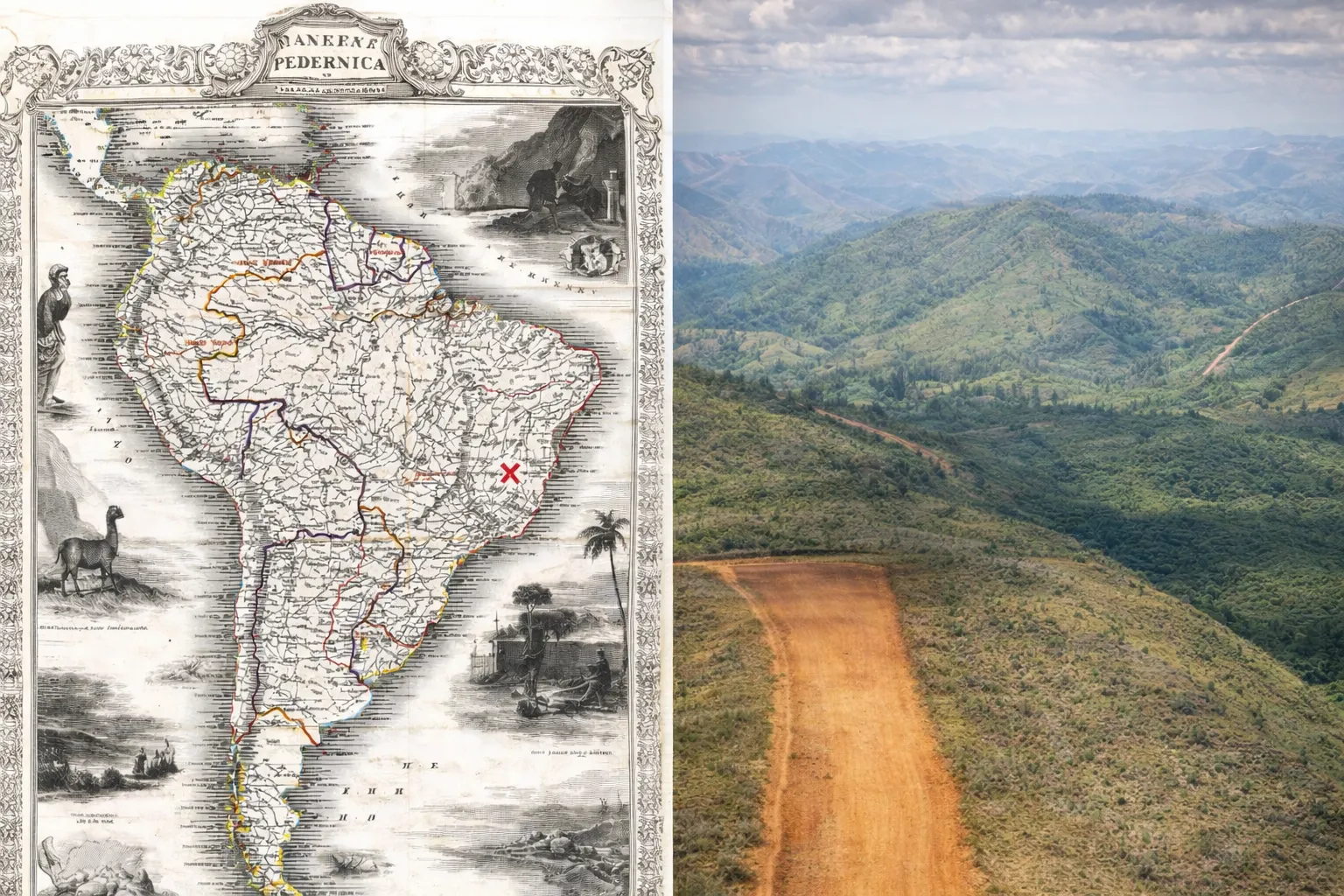
At the Pederneira mine in São José da Safira, Minas Gerais, “Pederneira” is only the first line on the label. For serious collectors, the real provenance is the pocket. That is what makes the mine so intoxicating: not simply that it produced world-class elbaite, but that one pocket can look nothing like the next. Some of the most famous pieces from the mine prove the point perfectly: the same mine, completely different personalities. Pederneira taught collectors to think in pocket signatures.
Mining there goes back to the 1940s, but the modern legend rests on two chapters: the old Dilo’s Tunnel and then the extraordinary run that began in Dada’s Tunnel at the end of 1999. In the first major Dilo era, one early discovery filled the cargo beds of three two-ton trucks, nearly six tons of tourmaline. Over the following decade, the mine yielded tons of tourmaline, morganite, quartz and albite, much of it poorly documented and plenty of it cut. What changed in the late 1990s was not just production, but attitude: the mine increasingly became a specimen source, not merely a gem-rough source.
That distinction matters because Pederneira also teaches a hard collector’s truth: many great specimens are recovered from disaster, not serenity. The tourmaline pockets there are usually found collapsed, with long crystals broken, scattered and separated from their matrix. Repairs are not an embarrassing footnote on Pederneira material; they are part of the mine’s geology and mining history. A good Pederneira collector learns to look less for fantasy perfection and more for the quality of preparation, the honesty of restoration, and whether the finished object still carries the rhythm of the original pocket.
Keké’s Pocket, found toward the end of 1999, is the pocket that announced modern Pederneira to the collector world. It was small, only a few kilograms of specimens, but the look was unforgettable: chrome-green, gem-quality tourmaline paired with hot-pink lepidolite so strong it competes with the elbaite instead of merely framing it. That is one of the defining Pederneira aesthetics. Then came the Giant Quartz Pocket in 2000, which is easy to overlook because it was not really a tourmaline pocket at all, yet it produced exceptional pale citrine quartz on first-rate cleavelandite, including pieces around 60 cm.
The Sharon Stone Pocket was where Pederneira first started to feel almost theatrical. It was about a cubic meter in size and yielded more than fifty fine specimens, with crystal habits that are still easy to spot once you know them. The analogous crystals carry red cores and blue caps; the slender antilogous crystals swing blue and then back to red, ending in terminations that look almost like a calligraphy brush. Close behind it came the Proud Pocket, less mythologized but absolutely worth respect. It produced huge sculptural groups, including the nearly meter-wide Giant, and its own very specific red-to-blue-green zoning that did not really recur elsewhere in Dada’s Tunnel.
If Sharon Stone showed range, the Rocket Pocket showed invention. It was probably only about half a cubic meter, but it yielded more than 350 crystals, including the natural rocket and sceptre forms that made the pocket famous. Those habits were not tricks of preparation; they came from selective dissolution, with a fibrous, corroded zone separating the red rubellite core from the outer green-blue zone. Matrix pieces are few, but they are terrific, flawless quartz, snow-white rose-like cleavelandite, purple lepidolite, and even a morganite pierced by green tourmaline. Right after it came the Afghan Pocket, small enough to fit in a beach ball, but instantly diagnostic for its pastel palette and the transparent colorless band just below the pyramidal tips.
Then came the Porcupine Pocket, where Pederneira stopped being merely excellent and became absurd. It was a very large pocket, likely the biggest yet in Dada’s Tunnel at that point, and it produced long, steely-blue antilogous crystals up to 35 cm, along with named pieces that now read like modern classics. It also forced the operation to professionalize reconstruction because the puzzle had become too large for casual reassembly. That pocket alone would have secured the mine’s reputation.
The 2002 sequence is pure collector bait. The 18% Pocket was not large, but it produced six major reconstructed specimens, with crystals up to 20 cm and unusually large, flawless blue sections. The Morganite Pocket was a small vug, structurally close to Rocket but with greener-yellow and then yellow tips, and it yielded a peach-pink morganite with a green tourmaline poking straight through the top. Big Blue was the opposite kind of shock: a cavity more than 1.5 cubic meters in volume that yielded only four specimens, yet of astonishing quality. Pieces from that pocket set a standard for analogous crystals that many collectors still consider unsurpassed.
By 2004, the mine was working at a ferocious pace. Grandon is basically Rocket’s more disciplined cousin, over two cubic meters, with similar internal architecture, but with a more solid boundary between color zones and without the same exuberant rocket habit. Azul Bien Grande went large in the literal sense, producing 40 cm crystals and matrix pieces up to 62 cm, with material so substantial that it had to be brought to market over the years. Then came Bi-Color Steel, found as a stringer off that zone and collected unusually carefully, so the condition was exceptional. Many collectors regard the best specimen from that pocket as the finest thing ever recovered from Pederneira. The Lunch Break Pocket adds the cautionary tale: one spectacular specimen, nearly destroyed by an overeager miner, and saved only just in time.
The late Dada’s Tunnel pockets read like variations on themes the mine had already established. Lepidolite and Blue, also called End of the Line, returns to Keké’s hot-pink lepidolite but with crystals that start chrome-green, turn blue and finish with opaque yellow-green tips. Green Scepter blends Rocket style fibrous texture with yellower endings. Blue-Green produces long, slender crystals that oscillate blue to green to blue again on the way up. No-Pocket Pocket is one of the strangest stories at the mine: a single achroite-like specimen apparently blown out and found lying on the floor, nearly colorless through most of the body with only a flash of green and then black at the terminations. Burkhard’s carries saturated red-and-blue bicolors, thick white albite, and the only known Pederneira example of a tourmaline completely overgrown by quartz. Violet is exactly what the name promises, true violet, not pink, not magenta. Blue Gem, the last tourmaline pocket in Dada’s Tunnel, was modest in size and mostly fed the cutter, leaving only three or four major specimens. Quartz Finale ended the run not with tourmaline but with a huge quartz chamber, reportedly with crystals nearing a meter and 70 kilos.
The revival of Dilo’s Tunnel after 2005 is more uneven, but a collector who ignores it misses some of the mine’s most characterful late material. Black Pocket I and Black Pocket II were commercial disappointments, though Black II did yield one serious object on a mound of cleavelandite rosettes. Blue Blue was tiny, about half a dozen singles, but very pure in idea: dark, deep blue with almost no green, including one fine doubly terminated crystal carrying star muscovite. Cranberry Blue finally reopened the old Dilo conversation with three major reconstructed pieces, especially Cranberry Crown, whose antilogous crystals are bright cranberry red from top to bottom, while the analogous crystals carry blue cores. Pink and Blue did exactly what the names suggest, though mostly in damaged form. Then Thiago’s Pocket, found in 2012 after years of unrewarded work, delivered the coda: a two cubic meter pocket of deep blue, gemmy tourmaline, including paintbrush bottom crystals and nearly four kilos of first-rate blue rough.
That, to me, is the real reason Pederneira matters. It did not just produce beautiful tourmaline. It taught collectors that locality is not enough. A serious Pederneira specimen should answer a harder question: which pocket, what habit, what color logic, what matrix language, what reconstruction story? Once you start collecting the mine that way, the label stops being a place name and starts reading like a cabinet full of biographies.