






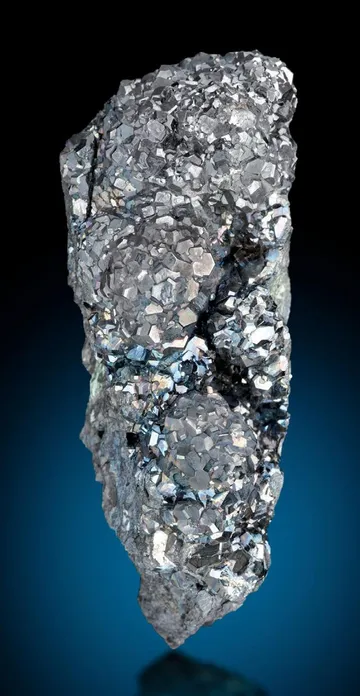
Bou Azzer mining district, Morocco - renowned for cobalt-rich ore and arsenide and carbonate specimens, with vivid erythrite and roselite prized by collectors.
Key facts
Bou Azzer is one of the indispensable names in mineral collecting because it joins two kinds of importance that rarely meet so cleanly: a world-scale primary cobalt deposit and a specimen locality of exceptional colour and mineralogical complexity. The district lies in Morocco’s Central Anti-Atlas, where cobalt-nickel-iron arsenide ores are tied to the Bou Azzer–El Graara ophiolitic belt and especially to contacts, faults, lenses, and veins involving serpentinite, quartz diorite, gabbroic rocks, volcanic rocks, and carbonate-silica gangue. In practical collector language, Bou Azzer is the place where dark metallic arsenides and pale carbonate matrices turn into magenta, raspberry, mauve, cherry-red, and bubblegum-pink display specimens.
Its fame rests first on cobalt minerals. The primary ores include skutterudite, safflorite, löllingite, nickeline, rammelsbergite, arsenopyrite, and gersdorffite, while the oxidation zone produced the brilliant secondary arsenates and carbonates that collectors chase: erythrite, roselite, wendwilsonite, talmessite, cobaltaustinite, nickelaustinite, cobaltlotharmeyerite, picropharmacolite, lavendulan, and cobalt-bearing calcite among them. Good Bou Azzer specimens have a look that is instantly recognizable: saturated cobalt colour against black-gray ore, white to pale pink calcite, dolomite, quartz, or altered serpentinite. The best pieces are not merely colourful coatings; they are sculptural miniatures and cabinets, with bladed erythrite standing in sprays, roselite or wendwilsonite flashing as small gemmy red crystals, and skutterudite forming sharp metallic cubo-octahedral groups.
Regional View
Country View
Historically, Bou Azzer matters because it became the great Moroccan cobalt district in the late 1920s and early 1930s, and it remains an active industrial cobalt source. That continuity gives the locality unusual depth in the mineral market: older European collection specimens with district-level labels sit beside modern material from named mines such as Aghbar, Agoudal, Tamdrost, Bouismas, Aït Ahmane, Ightem, and the Bou Azzer Mine proper. Labels vary in spelling—Bou Azzer, Bou Azer, Bouazer, Bouazzar, and Bouazzer all appear—but “Bou Azzer” is the long-standing mining and collector spelling most commonly used for the district.

Photo: Wikimedia Commons

Photo: Wikimedia Commons

Photo: Wikimedia Commons
Search for specimens: View all specimens from Bou Azzer mining district, Morocco
Bou Azzer is a hydrothermal cobalt-nickel-arsenic district developed in the Central Anti-Atlas of Morocco, south of Ouarzazate and along the Bou Azzer–El Graara ophiolitic belt. Its collector identity begins with its geological peculiarity: unlike most cobalt production worldwide, which is recovered as a by-product of copper or nickel deposits, Bou Azzer has long been worked as a primary cobalt district. The ores are structurally controlled and occur principally as carbonate-quartz-rich lenses, veins, veinlets, pocket-like masses, and breccia-related bodies along contacts between serpentinite and quartz diorite or other country rocks, with additional crosscutting veins and serpentinite-hosted ore lenses now recognized in modern studies.
The essential rock relationship is serpentinite plus structure. The district exposes Neoproterozoic ophiolitic rocks, including serpentinized ultramafic bodies, in a complex Anti-Atlas basement setting. Mineralizing fluids moved through faults and contacts, reacting strongly with serpentinite and precipitating Co-Ni-Fe arsenides in carbonate and silica gangue. At the specimen scale this explains the usual Bou Azzer palette: dark, heavy, metallic arsenides; white to cream calcite, dolomite, or quartz; altered greenish to gray serpentinite; and bright cobalt-bearing secondary minerals where oxidation has remobilized Co, Ni, As, Ca, Mg, Cu, and Fe.
Modern geological work separates the district’s ores into several morphological styles: contact-type ores along serpentinite contacts, serpentinite-hosted massive to disseminated ores, and crosscutting vein-type ores. Important deposits and subdistricts named in the literature and collector trade include Taghouni, Filon 7/5, Bou Azzer East, Aghbar, Tamdrost, Agoudal, Ightem, Oumlil, Bouismas, and Aït Ahmane. These names matter on labels because specimen habits and associations can vary noticeably from mine to mine. Aghbar is especially important for roselite, wendwilsonite, cobalt-bearing calcite, and rare arsenates; Agoudal is strongly represented by later-market cobalt-bearing calcite, roselite, and erythrite; Bouismas has supplied world-class skutterudite; and Aït Ahmane is important in both ore-genesis studies and collector reports of Ni-Co arsenide assemblages and secondary arsenates.
The primary ore assemblage is dominated by arsenides and sulfarsenides. Skutterudite is the emblematic primary cobalt mineral for collectors, but the district also includes safflorite, löllingite, nickeline, rammelsbergite, arsenopyrite, gersdorffite, alloclasite, and related Ni-Co-Fe arsenide phases. Minor to accessory sulfides and metallic minerals include chalcopyrite, bornite, chalcocite, pyrite, pyrrhotite, sphalerite, tetrahedrite-group minerals, native silver, native gold or electrum, and silver sulfosalts. The late and supergene assemblage is what made Bou Azzer visually famous: erythrite, roselite, wendwilsonite, talmessite, cobaltaustinite, nickelaustinite, cobaltlotharmeyerite, lavendulan, picropharmacolite, pharmacolite, arseniosiderite, and numerous additional arsenates and arsenites.
Mining history began with conspicuous cobalt arsenates. Local people knew the bright cobalt minerals before industrial mining, and accounts from the operator describe cobalt arsenates being recognized in Marrakech in 1928, leading attention back to the Bou Azzer outcrops. Economic prospecting followed in 1929, artisanal working began in the early 1930s, and industrial-scale mining was established by SMAG in the mid-1930s. Operations were interrupted during World War II, resumed with improved plant capacity in the 1940s, and later passed through major exploration and production cycles. The Compagnie de Tifnout Tighanimine, now associated with Managem, became central to Bou Azzer’s modern development. Technoexport exploration in 1969–1971 helped define deposits such as Taghouni, Bou Azzer East, and Tamdrost; renewed work in the late 1980s led to the Méchoui discovery; and recent mining has continued to supply cobalt concentrate for hydrometallurgical refining.
The district remains an active industrial mine area, not a casual public collecting ground. Collecting access should be understood accordingly: permission, local relationships, and mine rules govern what is possible, and many fine specimens reach the market through miners, local Moroccan channels, established dealers, old European collections, and auction dispersals rather than through open recreational collecting. Historic reports mention searching dumps at abandoned workings, but conditions, ownership, and safety change; old galleries, arsenic-bearing material, and unstable dumps are not places for casual field collecting.
Specimen production has come in pulses. Classic older material includes sharp skutterudite and lustrous erythrite from the Bou Azzer Mine area and old district labels from the 1970s and 1980s. Aghbar became famous for roselite, wendwilsonite, cobalt-bearing calcite, and rare arsenates, including analysed Mg-rich roselite and pure wendwilsonite specimens. Agoudal supplied striking cobalt-bearing calcite in rosette and lenticular habits, as well as roselite and erythrite, with notable finds in the 2000s, 2010s, and early 2020s. Bouismas has yielded exceptionally sharp, lustrous skutterudite, often with calcite or quartz. The common thread is that Bou Azzer specimens tend to be pocket- and vug-dependent: the best pieces required open space in carbonate or quartz gangue, while ordinary ore is often massive, intergrown, or too damaged to become a high-grade specimen.
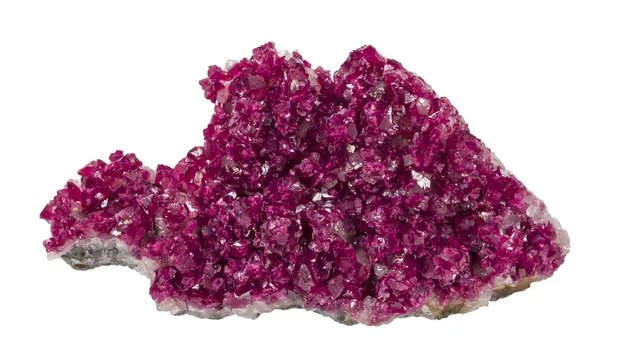
Calcite from Bou Azzer is valued chiefly when it carries cobalt colour or forms a clean aesthetic stage for cobalt arsenates, and the best pieces range from translucent raspberry-pink cobalt-bearing calcite to pale pink or white crystals carrying roselite, wendwilsonite, erythrite, or metallic skutterudite; Agoudal has produced vivid rosette growths of flattened lenticular cobalt-bearing calcite on quartz-rich matrix, with modern specimens commonly in miniature to cabinet sizes and individual crystals around the sub-centimeter scale, while Aghbar is prized for combinations of pink calcite with roselite or wendwilsonite, and Bou Azzer Mine specimens may show calcite associated with skutterudite or erythrite. Good Bou Azzer calcite is separated from ordinary carbonate by saturation of colour, brightness, translucency, undamaged crystal edges, attractive contrast, and an honest label: “cobaltocalcite” is widely used in the trade, but it is best treated as cobalt-bearing calcite rather than a valid species name.
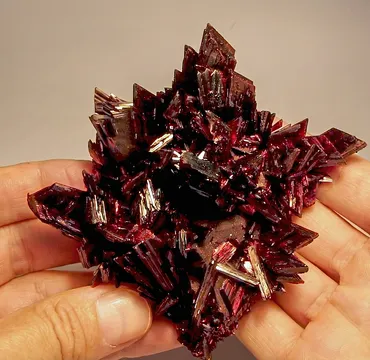
Erythrite is Bou Azzer’s most immediately recognizable secondary mineral: vivid magenta to raspberry, mauve, burgundy, or purple-red crystals formed by oxidation of primary cobalt arsenides, commonly on quartz, calcite, dolomite, skutterudite, roselite-group minerals, talmessite, and altered gray matrix. The classic habits are bladed to tabular crystals, radial sprays, sheaves, rosettes, acicular globular aggregates, and vug-lining clusters; dealer and photo records document ordinary crystals in the millimeter range, fine individual blades around 1–2 cm, and exceptional old descriptions of longer crystals from Vein 7 material, though the largest blades are often duller or more damaged than smaller vivid ones. The best Bou Azzer erythrite is sharp, lustrous, saturated, three-dimensional, and visibly crystallized rather than merely a pink crust; condition is decisive because this soft hydrated arsenate bruises, powders, and loses terminations easily.
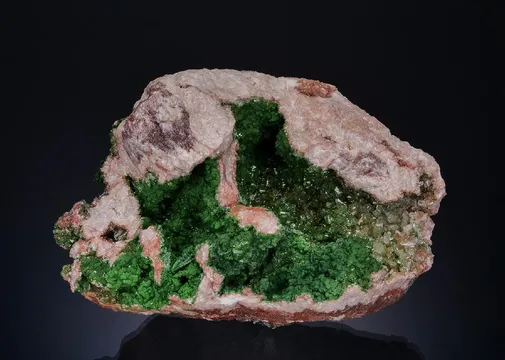
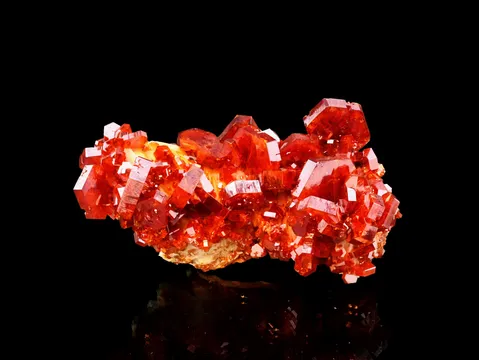
Roselite from Bou Azzer, especially Aghbar and Agoudal material, is among the world’s finest for the species, typically appearing as small but intense red, cherry, mauve-red, magenta, or purple-red monoclinic crystals on white dolomite, calcite, pink cobalt-bearing calcite, quartz-carbonate matrix, or altered serpentinite; Aghbar specimens are noted for gemmy, lustrous, lenticular to curved crystals, many doubly terminated, commonly 1–8 mm and occasionally reported larger, while modern Agoudal pieces include bright drusy and isolated crystals in miniature-sized combinations. Good pieces are judged less by sheer size than by depth of colour, glassy luster, separation of crystals, freshness of the carbonate matrix, and reliable distinction from visually similar wendwilsonite, roselite-beta, erythrite, or talmessite; analysed Mg-rich roselite from Aghbar is especially desirable because chemistry in the roselite-wendwilsonite series cannot be read confidently by eye.
Skutterudite is the metallic backbone of Bou Azzer collecting, occurring as massive ore, granular aggregates, and—at its best—sharp, bright, silvery to steel-gray cubo-octahedral, octahedral, cubic-modified, or pyritohedral crystals on skutterudite matrix, calcite, dolomite, quartz, and cobalt-arsenate-bearing gangue. Bouismas, Tamdrost, Aghbar, Ightem, and the Bou Azzer Mine proper are all represented in the specimen record; Bouismas is particularly admired for lustrous, well-isolated cubo-octahedral groups with calcite, with crystals commonly around 1 cm and some larger examples documented, while older Bou Azzer and district pieces can show excellent metallic luster decades after collection. Top skutterudite specimens are bright, sharp, three-dimensional, and not merely heavy ore; damaged high points, dull oxidation, calcite-filled or contacted vugs, and massive intergrowth reduce value, while intact calcite contrast and credible old provenance increase it.
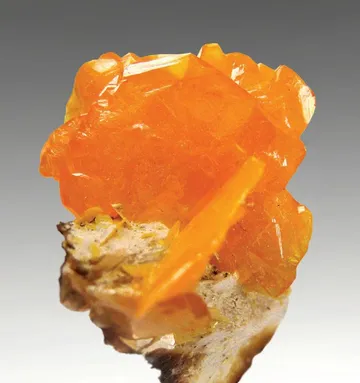
Wendwilsonite, Ca2Mg(AsO4)2 · 2H2O, is one of Bou Azzer’s great rare-mineral names and a co-type-locality species shared with Sterling Hill, New Jersey; in the district it is best known from Aghbar, where it forms pale pink to deep mauve or red-violet transparent to translucent crystals on calcite or dolomite, commonly associated with cobaltaustinite, cobaltlotharmeyerite, roselite-group minerals, and other secondary arsenates. Visually, the finest Aghbar specimens resemble excellent roselite: small, lustrous, curved or polycrystalline crystals, sometimes doubly terminated, standing on clean carbonate matrix; documented analysed pieces include crystals approaching the centimeter scale. Because wendwilsonite and roselite form a series and can be extremely difficult to separate by appearance, the best collector pieces are those with analysis, published reference, strong dealer provenance, or an old label that has survived scrutiny.
Beyond these five, Bou Azzer is a deep locality for both type minerals and rare arsenates. Mindat records hundreds of valid species from the district and identifies multiple type-locality minerals, including wendwilsonite, nickelaustinite, nickeltalmessite, irhtemite, arhbarite, halilsarpite, and the district-named bouazzerite. Aghbar is the type locality for arhbarite, reported as tiny blue spherulitic aggregates associated with dolomite, hematite, löllingite, pharmacolite, erythrite, talc, and mcguinnessite. Other collector-notable Bou Azzer minerals include gersdorffite from Aït Ahmane, native silver and silver minerals from Bouismas and related workings, native gold or electrum with skutterudite from Taghouni, lavendulan from vuggy quartz, picropharmacolite and pharmacolite as fragile pale secondary arsenates, and roselite-series relatives such as anorthoroselite, talmessite, zincroselite, and cobalt-bearing talmessite.
Bou Azzer is common enough as a locality name that inexpensive specimens are always around, but fine examples are not routine. The market separates sharply into colourful commercial pieces, respectable thumbnails and miniatures, and serious locality specimens with sharp crystals, good labels, and convincing mine-level provenance. Erythrite coatings, pink calcite crusts, and mixed arsenate matrix pieces are readily available; top skutterudite, intact large erythrite sprays, gemmy roselite, and analysed wendwilsonite are much more selective purchases.
The biggest authenticity issue is not a famous, systematic treatment but mislabelling and overconfident identification. “Bou Azzer” may be used broadly for anything cobalt-pink from Morocco, and the district contains several minerals that can fool the eye. Erythrite, roselite, wendwilsonite, roselite-beta, talmessite, cobaltaustinite, and cobalt-bearing calcite can all contribute red to pink colour. Roselite versus wendwilsonite is especially treacherous without analysis because the two are structurally and visually close members of a series. High-value wendwilsonite, Mg-rich roselite, cobaltaustinite, cobaltlotharmeyerite, and other rare arsenates deserve analytical support or a provenance chain strong enough to trust.
Photography is another practical concern. Bou Azzer cobalt minerals can be naturally intense, but digital saturation easily turns pink calcite into neon candy and erythrite into impossible purple. Ask for daylight and neutral-background images when buying expensive pieces. Likewise, be wary of vague “cobaltocalcite” labels: most such specimens are cobalt-bearing calcite, and locality, colour, crystal habit, and associated minerals should do more of the identification work than the marketing name.
Condition matters greatly. Erythrite is soft, hydrated, and commonly bladed or acicular; rubbed edges, missing terminations, broken sprays, flattened fans, and loose powder are common. Roselite and wendwilsonite crystals are small and exposed, so edge wear or bruising can erase much of a specimen’s value. Skutterudite is harder and metallic but brittle; isolated crystals often show contact scars from calcite-filled vugs or extraction. Calcite, whether white, pink, or cobalt-bearing, is easily cleaved, and acid cleaning can ruin associated arsenates or carbonate matrices.
Handling should reflect the arsenic-rich nature of the district. Stable display specimens are suitable for normal mineral collections, but avoid grinding, acid cleaning, ultrasonic cleaning, licking, food-area handling, or any activity that creates dust. Wash hands after handling arsenates or arsenides, keep specimens out of reach of children and pets, and store fragile hydrated arsenates in dry, stable conditions. For display, use a case or membrane box when possible; the best Bou Azzer erythrite and roselite pieces lose value from a single careless brush of a fingertip.
Fluorescence can be present in associated calcite, including some Bou Azzer and Aghbar pieces documented as fluorescent under longwave or shortwave UV, but fluorescence should be treated as a bonus rather than a primary identification test. The collector value of Bou Azzer specimens lies in colour, crystal definition, association, provenance, and condition, not in UV response.
The discovery story begins not in a mine but in Marrakech. In 1928, Jean Epinat encountered cobalt arsenates being sold in the traditional stalls of Jemaa el-Fna. The bright minerals were not collector curiosities in that setting; local people from the Bou Azzer region used cobalt arsenates as insecticides and rat poison. Epinat understood what the colour meant. At his request, inhabitants led him south to the Bou Azzer boutonnière, where mineralized veins cropped out at the surface and carried the mix that would define the district: oxides, arsenates, carbonates, and arsenides. It is a wonderfully mineralogical origin story—the eye of a prospector catching a cobalt clue in a market square, then following that clue across the Anti-Atlas to one of the great cobalt districts of the world.
A field account from a 2012 Natural History Museum of Los Angeles County visit captures the other face of Bou Azzer: the working mine as an industrial organism. The visiting group heard a geology lecture from Mr. Karfal, toured the plant, and watched ore move through grinders filled with steel ball bearings before passing across water-fed shake tables. The separation was physical rather than smelting: dense cobalt-rich grains travelled differently from less dense material, allowing the plant to sort cobalt-rich, silver-rich, and iron-rich fractions. The visitors noted that even “rejected material” was not simply waste; it moved on to more sensitive sorting. Afterward they searched nearby localities: Khder quarry yielded tiny red erythrite and roselite crystals, Aït Ahmane rewarded only the most experienced eyes, and Agoudal—called “Jackpot” in the account—produced pink cobalt-bearing calcite, purple sphaerocobaltite, löllingite, erythrite, roselite, and cobaltlotharmeyerite. The day ended not with a pocket of museum-grade crystals but with the earthy reality of Moroccan collecting: a stop at a local resident’s home, bright pink calcites laid out on a table, and then back to Tamnougalt for couscous and tagine.
Older collector travel reports describe Bou Azzer as a place where desire and difficulty met head-on. Erythrite, roselite, and cobalt-bearing calcite were in strong demand, yet access to specimen traffic around an active mining complex was delicate. One 2001 account emphasized that good specimens were not common and that the search could become “an unfruitful hunt,” even while miners’ hospitality made the human side memorable—mint tea and couscous inside homes, patient conversations, and many visits before anything worthwhile appeared. That same report noted the unevenness of the oxidation zones: one mine could produce erythrite down to surprising depths, while another nearby working might lack the oxidized environment needed for attractive erythrite altogether.
The Aghbar material has its own collector legend because of the way chemistry hides inside beauty. A fine magenta crystal on white carbonate may be sold as roselite, wendwilsonite, Mg-rich roselite, or simply roselite-wendwilsonite series unless analysis has been done. The distinction is not academic pedantry: wendwilsonite was not described until 1987, so older stock and old labels can predate the species name. Some specimens that circulated for years as roselite-like material later became candidates for a much rarer identity. Bou Azzer is full of these quiet reversals, where the specimen did not change, but mineralogy caught up with it.


_1.jpg)