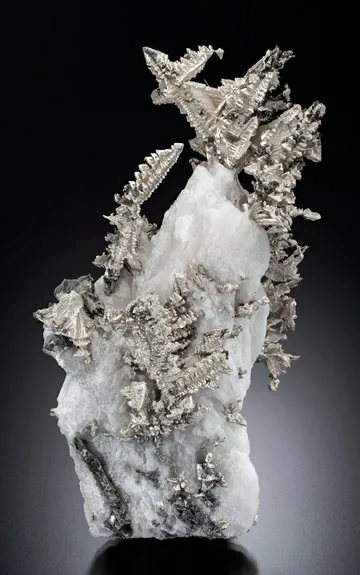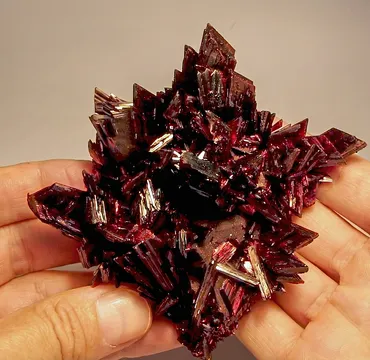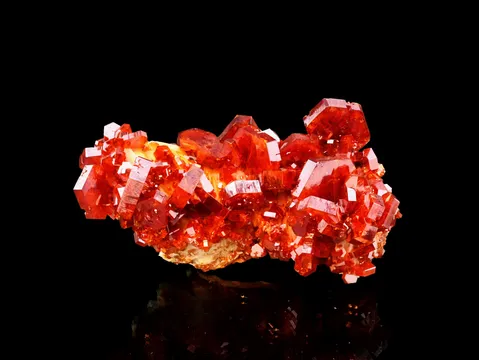
Bou Azzer skutterudite from Morocco’s cobalt district — metallic crystals in cubic, octahedral, and dodecahedral forms with mirror luster, prized by collectors.
Key facts
Bou Azzer skutterudite is the collector’s skutterudite: dense, metallic, hard-edged, and usually far more sculptural than the species has any right to be. The best pieces are not simply lumps of cobalt arsenide, but bright silver-gray to gunmetal clusters of modified cubic, octahedral, cuboctahedral, and dodecahedral crystals, often packed into blocky three-dimensional mounds or perched on pale calcite and quartz. The strongest examples have a mirrorlike flash across broad faces, crisp geometric terminations, and enough open space between crystals to avoid the “ore specimen” look that characterizes much skutterudite from less specimen-rich districts.

Photo: Rob Lavinsky, iRocks.com / Wikimedia Commons
The locality’s importance comes from an unusual marriage of world-class specimen aesthetics and world-class ore geology. Bou Azzer is a primary cobalt district in Morocco’s central Anti-Atlas, developed along the Bou Azzer–El Graara ophiolitic belt. Its cobalt-nickel arsenide mineralization is tied to serpentinite and fault-controlled hydrothermal carbonate veins, a setting that made skutterudite not an accessory curiosity but one of the principal ore minerals. For collectors, that means Bou Azzer produced skutterudite with real abundance by species standards, yet only a fraction of that abundance occurred as sharp, displayable crystals.

Photo: James St. John / Wikimedia Commons
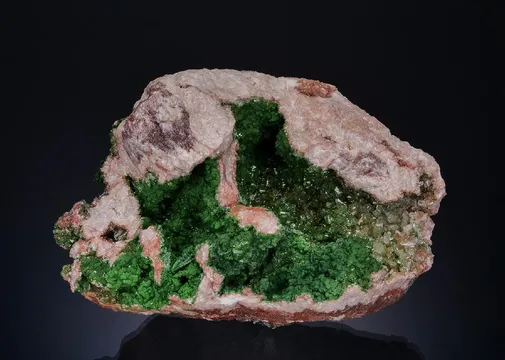
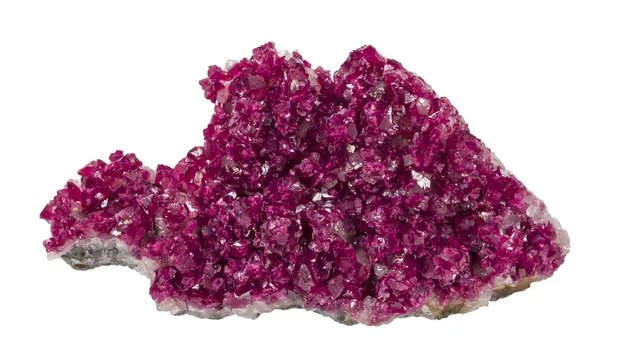
The district is also beloved because skutterudite is the dark parent rock behind several of Bou Azzer’s famous color minerals. Oxidation of primary cobalt arsenides gives rise to the vivid cobalt arsenates that made the district legendary: erythrite, roselite, wendwilsonite, and a long list of rare secondary arsenates. A Bou Azzer skutterudite specimen may therefore stand alone as a metallic crystal piece, or it may carry pink to purplish cobalt alteration, white calcite, quartz, or other supergene species that reveal the whole chemical personality of the district.
What serious collectors look for is specific: sharp, highly reflective crystals; individualized forms rather than massive ore; three-dimensional growth; minimal contacts; undamaged edges; natural calcite or quartz association; and reliable mine-level provenance when possible. Bouismas, Tamdrost, Bou Azzer Mine proper, Aghbar, Agoudal, Aït Ahmane, and other district labels can all matter, because the district is not a single hole in the ground but a long, structurally complex mining belt with multiple deposits and generations of collecting.
Search for specimens: View all skutterudite specimens from Bou Azzer Mining District, Morocco
Bou Azzer lies in the central Anti-Atlas, about 120 km south to southwest of Ouarzazate, in the Drâa-Tafilalet Region. The mining district follows the Bou Azzer–El Graara ophiolitic belt for roughly 30 km, with a broader modern exploration portfolio extending along the Anti-Atlas suture. This is one of the classic localities where a mineral specimen label can be geologically meaningful: the cobalt arsenides are not random vein curiosities, but part of a coherent hydrothermal system controlled by serpentinite contacts, carbonate-silica gangue, and crosscutting faults.
The host architecture begins with a dismembered Precambrian ophiolite: altered ultramafic rocks, especially serpentinite, emplaced during Pan-African tectonism and later exposed in the Bou Azzer inlier. The cobalt deposits occur in close spatial relation to serpentinite, commonly in silica-carbonate gangue at or near serpentinite contacts rather than simply disseminated through the serpentinite itself. The economically important ore assemblage is dominated by Co-Fe-Ni arsenides, with skutterudite, safflorite, rammelsbergite, löllingite, gersdorffite, and arsenopyrite among the characteristic primary minerals. Calcite and quartz are the most familiar gangue minerals to collectors, joined locally by dolomite, talc, chlorite, and serpentine minerals.
Modern geochemical work has sharpened the genetic picture. Bou Azzer’s cobalt arsenide mineralization is now understood as Late Devonian, much younger than the Neoproterozoic ophiolitic host rocks. The ore-forming system involved highly saline basinal brines interacting with serpentinite and other basement rocks, with methane-rich fluids and hydrocarbon source rocks playing a role in reduction and arsenide precipitation. For a specimen collector, this matters because the bright crystals in a vug are not just attractive objects; they are open-space hydrothermal products of a deep, reactive, metal-rich fluid system that exploited faulting and brecciation.
Mining history at Bou Azzer is unusually colorful. According to Managem’s corporate history, the modern cobalt story began in 1928, when a visiting geologist recognized cobalt-bearing erythrite being sold in Marrakech’s Jemaa el-Fna square. Prospecting followed quickly, artisanal work began in the early 1930s, and industrial-scale mining began in 1934. The operation was interrupted during World War II, resumed and mechanized in 1944, and later passed into the long-running work of CTT, now part of Managem. A major Technoexport exploration program from 1969 to 1971 led to discoveries including Taghouni, Bou Azzer East, and Tamdrost. Production stopped again in 1983 after reserve depletion, then restarted after CTT geologists discovered the Méchoui deposit in 1987.
Today Bou Azzer is still an operating cobalt mine, worked underground and described by Managem as a hydrothermal vein-type deposit mined by cut-and-fill stoping, with ore processed gravimetrically before supplying the Guemassa hydrometallurgical complex. Collecting access is therefore not comparable to an abandoned public dump. Specimens reach the market through mining activity, old collections, dealer stock, and occasional newer finds, not through casual recreational collecting. Provenance should be treated with care: “Bou Azzer” may mean the district, the Bou Azzer Mine proper, a specific named mine such as Bouismas or Tamdrost, or a historic label using older administrative geography.
Notable specimen periods include the classic 1970s material, pieces acquired by European collectors in the 1970s and 1980s, the 1980s–1990s Bou Azzer Mine proper skutterudites with calcite, and later Bouismas and Tamdrost pieces. Dealer records document skutterudite from the district purchased as early as the early 1970s, Bou Azzer Mine pieces from around 1985–1994, Bouismas examples from 2011, and Tamdrost specimens in more recent circulation. The best cabinet specimens remain uncommon: large, bright, open crystal clusters from Bou Azzer are dramatically less common than massive ore, contacted crystals, or compact intergrown masses.
Bou Azzer skutterudite is typically silver-gray, tin-white, bright metallic gray, or gunmetal, with a black streak and substantial heft. The formula is commonly given as CoAs3, though natural material may contain variable Ni and Fe substituting for Co. The most desirable crystals show cubic-system forms: cuboctahedra, modified cubes, modified octahedra, dodecahedral-looking crystals, complex interpenetrant clusters, and occasional twinned or roseate aggregates. Specimens from Bou Azzer can range from glittering massive arsenide with small faces to fully crystallized clusters with individual crystals exceeding 1 cm; documented collector examples include crystals to about 2 cm, 2.5 cm, 2.7 cm, 3.1 cm, and in one notable dealer-described example just over 3.5 cm across.
The finest Bou Azzer material has a particular visual tension: heavy metallic crystals that nevertheless look lively because the faces are sharply angled and reflective. On top pieces, the luster is not merely “metallic” but splendent, with broad flashes from bright silver-gray faces. The color can shift with viewing angle from pale tin-white to darker gunmetal; slight iridescence or dull gray tarnish may occur, but the prized pieces retain a clean, mirrorlike surface.
Matrix and association strongly affect desirability. White calcite is one of the most important associated minerals, not only for contrast but also as evidence of natural vug growth. Quartz, including milky crystals on some specimens, can add relief and textural contrast. Massive skutterudite matrix is common and accepted when it supports well-formed crystals. Pink to purple erythrite, salmon to pink cobalt arsenates, roselite, and other secondary cobalt minerals can make combination pieces particularly attractive, but on a serious skutterudite specimen the metallic crystals still need to be identifiable and not merely hidden under alteration.
The usual problem is growth habit. Many skutterudite crystals grew in small calcite-filled vugs or tight pockets, so they are often intergrown, contacted, partly incomplete, or crowded against matrix. This is why open, airy, three-dimensional pieces command such attention. A compact cabinet-size mass may be scientifically excellent, but a cluster with separated, bright crystals perched in relief is much more competitive aesthetically.
Mine-level styles overlap but are worth noting. Bouismas is well represented by very sharp, lustrous cubo-octahedral and octahedral skutterudite with calcite, sometimes in aerial or stalactitic-looking groups. Tamdrost has produced small but fine cubo-octahedral crystal groups and crystalline skutterudite in vein material. Bou Azzer Mine proper is strongly represented in classic specimens from the 1980s and early 1990s, including calcite-associated pieces that retain good luster after decades in collections. District labels without mine names are common, especially on older pieces, and should not be dismissed if the specimen itself is strong and provenance is plausible.
Quality factors, in practical order, are luster, form, completeness, three-dimensionality, crystal size, contrast, provenance, and condition. A small cluster of brilliant, isolated crystals can be more desirable than a larger, dull, contacted mass. Calcite is a plus when natural and intact. Brightness matters enormously: Bou Azzer’s reputation rests on skutterudites that look freshly metallic after years in collections, not on oxidized gray ore.
Bou Azzer skutterudite is common enough that specimens regularly appear, yet rare enough in high quality that the best pieces are still hotly contested. Massive ore chunks, crystallized fragments, and small cabinet examples are obtainable. Large, sharply crystallized, visually balanced cabinet specimens are not. Recent auction and dealer records show the market spread clearly: a large but contacted cabinet example can sell in the hundreds of dollars, while an exceptional 15 x 11 x 6.5 cm specimen from a named collection sold at Heritage in 2025 for $5,000 before premium considerations. Smaller, well-crystallized pieces with good luster remain the practical sweet spot for many collectors.
The principal authenticity concerns are not elaborate manufactured fakes, but label precision, cleaning, repair, stabilization, and condition disclosure. “Bou Azzer” is often used broadly, so a specimen sold as “Bou Azzer Mine” may actually be from the district unless older labels or dealer documentation support the exact mine. Likewise, Bouismas, Tamdrost, Agoudal, Aghbar, and other mine names should be preserved whenever known; upgrading a district label to a more famous sublocality without evidence is bad provenance practice.
Acid cleaning deserves special attention. Some skutterudite specimens were cleaned aggressively to expose metallic crystals from calcite-filled vugs. That can improve flash but may remove important natural context and may leave the piece looking unnaturally stripped. The presence of intact calcite on older Bou Azzer skutterudite is often a reassuring sign, especially when the calcite is nestled naturally between crystals rather than appearing as a later, unrelated patch. Conversely, absence of calcite is not proof of treatment; many specimens are naturally massive or were collected as exposed crystals. The point is to judge the whole surface: edges, protected recesses, matrix texture, and whether the piece looks chemically over-cleaned.
Repairs and stabilization are not unusual on dramatic specimens because skutterudite is dense and the matrix can be fractured or crumbly. Documented market examples include repaired pieces and specimens stabilized with glue on the back to prevent matrix deterioration. This is not automatically disqualifying if disclosed and visually unobtrusive, but it should affect price. Large Bou Azzer skutterudites also commonly show contact areas, incomplete growth, or surficial cracking; on very large pieces, some of this is expected.
Condition issues to inspect under strong light include chipped crystal edges, rubbed high points, dull or etched faces, fractures through the matrix, detached-and-reglued crystal groups, and hidden contacts masked by display angle. Because metallic faces reflect dramatically, photographs can flatter skutterudite; rotate the piece under a single light source to see whether the faces are truly brilliant or merely catching one staged reflection.
Safety is straightforward but worth stating. Skutterudite is a cobalt arsenide. It is stable as a specimen under normal handling, but it should not be cut, ground, acid-treated, heated, or stored where dust can be generated. Wash hands after handling, keep it away from children and pets, and avoid soaking arsenide-rich specimens in household chemicals. Specimens with powdery secondary arsenates such as erythrite deserve even more careful handling because friable surfaces can shed material.
For display, Bou Azzer skutterudite benefits from directional lighting that skims across the faces. White calcite or quartz associations brighten the composition, while erythrite adds color contrast. Avoid high humidity swings and harsh chemical environments. A good Bou Azzer skutterudite should look just as sharp decades from now as it does today.
The origin story of Bou Azzer’s modern cobalt industry begins far from a mine adit, in the noise and color of Marrakech’s Jemaa el-Fna square. In 1928, a geologist visiting as a tourist saw cobalt-bearing erythrite being sold in traditional stalls. Managem’s French account adds the domestic detail that local people used cobalt arsenate minerals as insecticides and rat poison. The geologist recognized the mineral, asked where it came from, and was led back toward the Bou Azzer inlier. There he found veins reaching the surface and carrying a range of cobalt minerals: oxides, arsenates, carbonates, and arsenides. The bright secondary minerals that collectors now admire in cabinets were, in that moment, the clue that exposed one of the world’s great primary cobalt districts.
The next chapters came quickly. Visual prospecting began in 1929, artisanal mining followed in 1932, and industrial mining began in 1934 on the central Bou Azzer deposits and Ightem. World War II interrupted operations, but production resumed and was upgraded in 1944 with a pneumatic industrial plant. The field story then shifts to the late 1960s, when Technoexport carried out a comprehensive research program from 1969 to 1971. That work led to discoveries at Taghouni, Bou Azzer East, and Tamdrost—names that now appear on mineral labels and in specimen catalogs, not merely in mine plans.
A USGS mission in early 1982 gives another grounded glimpse of the district as working geology rather than romance. From January 30 to February 5, the team worked in the Bou Azzer cobalt district, receiving briefings from CTT geologists, traversing the ophiolite at Aït Ahmane, examining Vein 58 and Vein 53E, and going underground and on surface at Vein 61, Ahmbed 3, and Tamdrost. Their report described around 60 known cobalt deposits in contact with serpentinite and stressed that the ore was usually not simply within serpentinite, but in the distinctive silica-carbonate gangue along or near serpentinite contacts. For collectors, that observation explains why the best specimens often look like metallic arsenide crystals locked into pale carbonate pockets instead of conventional sulfide-vein ore.
One collector-market story has become part of the Bou Azzer skutterudite mystique: the 1974 stream of major pieces into European and North American collections. Mindat’s gallery records a 4.8 x 4.5 x 2.9 cm specimen with lustrous metallic-gray crystals to 2.0 cm, described as from the famous finds at Bou Azzer and obtained by Giancarlo Fioravanti from the Gentile Collection in Geneva in 1974. Another documented specimen from the Ed Ruggiero Collection had been purchased in 1973 from Si and Ann Frazier and was crowned by an undamaged 2.7 cm crystal. These details matter because they show that Bou Azzer’s finest skutterudites were already recognized as exceptional nearly half a century ago, and many of the great pieces now appearing at auction are not new finds but old classics resurfacing.
Saintilan, N. J., Ikenne, M., Bernasconi, S. M., Toma, J., Creaser, R. A., Souhassou, M., Allaz, J. M., Karfal, A., Maacha, L., & Spangenberg, J. E. (2023). “The World’s Highest-Grade Cobalt Mineralization at Bou Azzer Associated With Gondwana Supercontinent Breakup, Serpentinite and Kellwasser Hydrocarbon Source Rocks.” American Journal of Science, 323. — Major modern geochronology and isotope study tying Bou Azzer Co-arsenide mineralization to Late Devonian fluid mixing, serpentinite, and hydrocarbon-related reduction.
Foose, M. P., & Rossman, D. L. (1982). USGS Open-File Report 82-618. — Field-based U.S. Geological Survey assessment of Morocco’s cobalt potential, with detailed observations on Bou Azzer geology, mineralogy, exploration history, and the role of serpentinite contacts and silica-carbonate gangue.
Hitzman, M. W., Bookstrom, A. A., Slack, J. F., & Zientek, M. L. (2017). “Cobalt—Styles of deposits and the search for primary deposits.” U.S. Geological Survey Open-File Report 2017–1155. — Places Bou Azzer within the broader family of hydrothermal cobalt deposits associated with ultramafic rocks.
Leblanc, M., & Billaud, P. (1982). “Cobalt arsenide orebodies related to an Upper Proterozoic ophiolite: Bou Azzer (Morocco).” Economic Geology, 77, 162–175. — Classic Economic Geology reference on Bou Azzer cobalt arsenide orebodies and their ophiolitic context.
Favreau, G., & Dietrich, J. E. (2006). “Die Mineralien von Bou Azzer.” Lapis, 31(7/8), 27–68. — Major collector-oriented mineralogical treatment of Bou Azzer’s extraordinarily diverse mineral suite, cited in Mindat’s locality references.
Weiß, S. (2006). “Komplette Mineralliste des Grubenreviers Bou Azzer.” Lapis, 31(7/8), 72–73. — Published mineral list for the Bou Azzer mining district, cited in Mindat’s references.
Mindat photo gallery for skutterudite. — Includes numerous documented Bou Azzer skutterudite specimens, including classic pieces from 1973–1974 collections, crystals to several centimeters, and examples from Bou Azzer Mine, Tamdrost, Aghbar, and the broader district.
Heritage Auctions, Lot #72087, Dan Kennedy Collection, sold October 8, 2025. — Documented large cabinet Bou Azzer skutterudite, 15 x 11 x 6.5 cm, formerly in the Marc Weill Collection and illustrated in the Mineralogical Record book on that collection.
Mindat — Bou Azzer mining district, Drâa-Tafilalet Region, Morocco — The essential locality database entry for the district’s mines, mineral list, references, and sublocalities.
Mindat — Skutterudite mineral data — Species-level mineralogical data and locality references for skutterudite.
Mindat — Skutterudite photo gallery — Useful visual archive of Bou Azzer skutterudite habits, sizes, and specimen provenance.
Managem — Bou-Azzer mine — Operator’s overview of the mine history, geology, mining method, and modern cobalt operation.
Managem — Cobalt — Current corporate context for Bou Azzer cobalt production and processing.
Wikimedia Commons — Skutterudite-80ab.jpg — Freely licensed photograph of a large Bou Azzer skutterudite cluster by Rob Lavinsky, iRocks.com.
Wikimedia Commons — Skutterudite from Tamdrost Mine — Freely licensed close-up photograph of crystalline Tamdrost skutterudite by James St. John.
Fabre Minerals — Skutterudite search results — Dealer archive documenting Bou Azzer, Bouismas, Tamdrost, and older collection specimens with sizes and descriptive notes.
McDougall Minerals — Skutterudite, Bouismas Mine — Dealer museum page discussing Bouismas crystal quality and common condition issues in calcite-filled vugs.
Mineral Auctions — Skutterudite, Bou Azzer Mine — Recent auction record for a large crystallized Bou Azzer skutterudite with calcite and possible annabergite.
EarthWonders specimen record — Skutterudite, Bou Azzer Mine — Example of a display-quality Bou Azzer skutterudite with notes on repair, stabilization, quartz association, and market presentation.