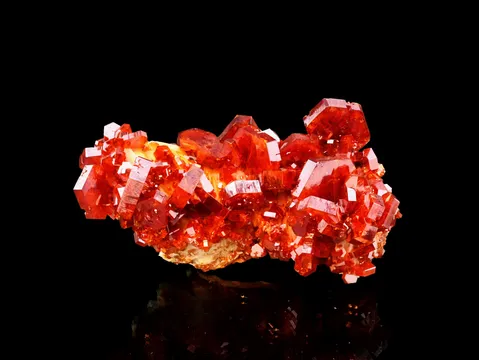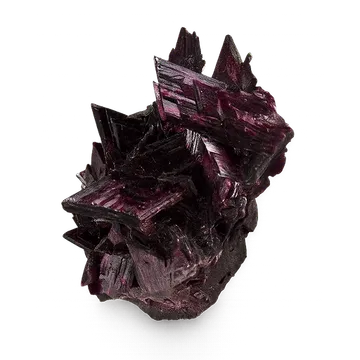
Bou Azzer Mining District, Morocco — renowned for erythrite and cobalt arsenides; vivid magenta blades, luster, and rarity prized by collectors.
Key facts
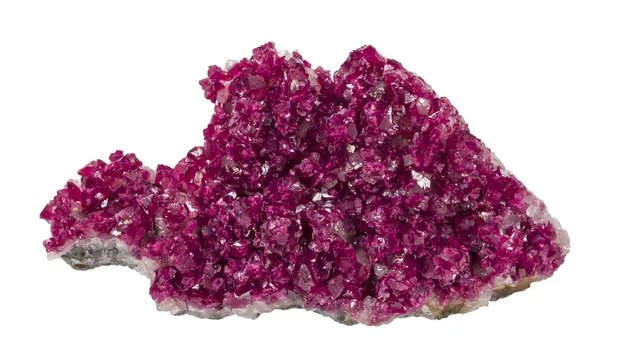
Bou Azzer is the modern standard for crystallized erythrite. The best pieces have the saturated magenta, wine-red to royal-purple color collectors hope for in the species, but with a sharpness and luster that lifts them far beyond ordinary “cobalt bloom.” Instead of merely powdery coatings, Bou Azzer has produced lustrous bladed crystals, radial fans, rosettes, jackstraw sprays, and vug-lining clusters on pale carbonate, quartz, gossanous matrix, or metallic cobalt arsenides. The visual drama comes from a simple but powerful contrast: hot cobalt-pink erythrite against gray ore, white calcite, quartz, dolomite, or dark skutterudite.
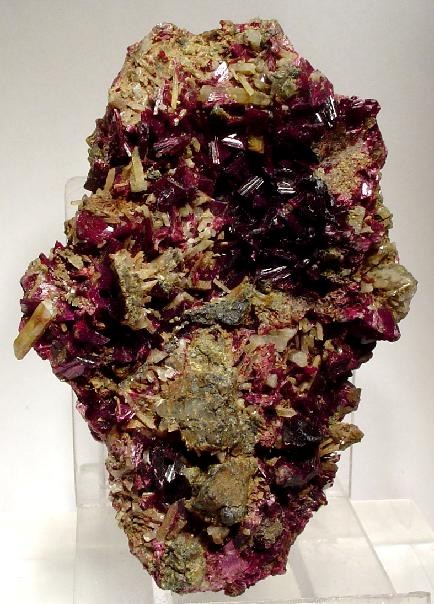
Photo: Wikimedia Commons
The locality’s importance is inseparable from its geology. Bou Azzer is a cobalt-nickel-arsenic mining district in the Central Anti-Atlas of Morocco, developed along contacts involving Neoproterozoic serpentinites of the Bou Azzer ophiolite, quartz diorites, gabbroic rocks, volcanic rocks, and quartz-carbonate veins. The primary ore assemblage is dominated by cobalt-nickel-iron arsenides and sulfarsenides such as skutterudite, safflorite, löllingite, nickeline, rammelsbergite, arsenopyrite, and gersdorffite. Erythrite is the supergene consequence of that arsenide foundation: cobalt and arsenate liberated in the oxidation zone recombine as Co3(AsO4)2·8H2O.

Photo: Wikimedia Commons
For collectors, Bou Azzer erythrite is distinctive because fine specimens can combine several qualities that are rarely present together in erythrite: rich color, real transparency at thin edges, bright glassy luster, sharp bladed form, and displayable three-dimensional groups. The classic pieces are not simply colorful; they are sculptural. Fans and radial clusters may sit in vugs like little magenta fireworks, while better isolated blades show flat, reflective faces and striated crystal surfaces. In the highest tier, the crystals retain intensity without becoming dull, broken, or powdery.
The historical significance is equally strong. Bou Azzer’s cobalt mineralization was recognized and developed in the late 1920s and early 1930s, and the mine became one of Morocco’s oldest major industrial mining operations. Erythrite was not a minor curiosity in that story: the conspicuous violet-red cobalt arsenate was known locally before industrial exploitation, and its visibility helped point prospectors toward cobalt ore. That same visibility now makes the species one of the district’s signature minerals.
Search for specimens: View all erythrite specimens from Bou Azzer Mining District, Morocco
The Bou Azzer Mining District lies in Morocco’s Drâa-Tafilalet Region, south of Ouarzazate, in the Central Anti-Atlas. Older specimen labels commonly give Bou Azzer, Bou Azer, Bouazzer, Tazenakht, Ouarzazate Province, Souss-Massa-Draâ, or simply “Morocco.” Modern locality practice separates the district from individual mines and sublocalities such as Bou Azzer Mine, Aghbar, Aït Ahmane, Tamdrost, and other workings spread along the cobalt belt.
The district is a rare primary cobalt province. Most of the world’s cobalt is recovered as a by-product of copper or nickel mining, but Bou Azzer has long been cited as a deposit where cobalt is mined as a principal commodity from cobalt-nickel-iron arsenide ores. The orebodies are structurally controlled and closely tied to serpentinite contacts. In simplified collecting terms, the important ingredients are the primary arsenides, the carbonate-quartz gangue, and later oxidation: where cobalt arsenides such as skutterudite broke down, erythrite could grow in open spaces, fractures, and altered zones.
The mining history begins with cobalt indices recognized in the Bou Azzer inlier around 1928–1929. Industrial exploitation followed in 1933 under Société Minière de Bou-Azzer El Graara, associated with Jean Epinat. In 1959, Compagnie de Tifnout Tiranimine, usually abbreviated CTT, took over exploration and mining activity, and the Bou Azzer mine remains part of Morocco’s modern cobalt industry. Managem describes Bou Azzer as one of the country’s oldest industrially operated mines and as a supplier of cobalt concentrate for hydrometallurgical processing at Guemassa, where high-purity cobalt cathode production began in 1996.
Specimen production has always been secondary to mining. The collector market has seen multiple generations of Bou Azzer erythrite, including older pieces from finds made decades ago and later material recovered through mining and sorting channels. Dealer and auction records repeatedly distinguish between “old find” specimens and more recent offerings. The strongest historic material tends to be richer, brighter, and more three-dimensional than the common small coatings and fragments that appear in bulk lots.
Collecting access should be understood in practical terms: Bou Azzer is an active industrial mining district, not a casual open collecting ground. Serious specimens generally reach collectors through Moroccan miners, mine-related channels, established dealers, older European collections, or auction dispersals. Labels matter. “Bou Azzer” may refer broadly to the district, while a more precise label—Bou Azzer Mine, Aghbar Mine, Aït Ahmane, or another sublocality—adds value only when credible and supported by old labels, dealer history, or analytical/contextual evidence.
Notable finds are not limited to erythrite. Bou Azzer is famous among mineralogists for a remarkable suite of cobalt, nickel, arsenate, carbonate, and arsenide species, including roselite, roselite-beta, talmessite, wendwilsonite, skutterudite, gersdorffite, cobaltoan calcite, picropharmacolite, lavendulan, and numerous rare arsenates. Erythrite remains the district’s most immediately recognizable calling card because it combines scientific relevance with spectacular color.
Bou Azzer erythrite ranges from thin pink coatings to major crystallized specimens, but the locality’s reputation rests on lustrous crystals rather than ordinary crusts. The most desirable habits are bladed to prismatic crystals in fan-shaped aggregates, radial sprays, rosettes, sheaves, and vug-lining clusters. Some crystals are narrow and acicular; others are broader, tabular, and visibly striated. In better examples, the blades stand up from the matrix rather than lying flat as a matted coating.
Color is one of the strongest locality markers. Bou Azzer material commonly shows intense magenta, raspberry, crimson, burgundy, violet-red, or deep purple tones. Thin crystal edges may glow pink-red and appear translucent, while thicker portions can look darker, wine-colored, or almost blackberry-purple. Luster varies from silky on fibrous coatings to bright vitreous on well-formed blades. The finest crystals can look almost enamel-like or glassy on the broad faces.
Size varies widely. Scientific descriptions of studied Bou Azzer material include elongated, prismatic, plate-like, or needle-shaped pink-red-violet crystals up to about 10 mm long and 2–3 mm wide. Wikimedia and dealer-documented specimens show individual crystals around the centimeter scale, including a 5.5 x 4.5 x 3 cm specimen with a reported 1.7 cm crystal and another 7.4 x 5.0 x 2.6 cm specimen with bladed crystal clusters to 1.0 cm from a 1986 find. Auction records also document larger display pieces with sizable vugs and sprays, including a cabinet specimen with erythrite clusters filling an 8.8 x 7.0 cm vug and a 3.0 cm crowning spray. These larger figures should be treated as exceptional display measurements, not ordinary single-crystal expectations.
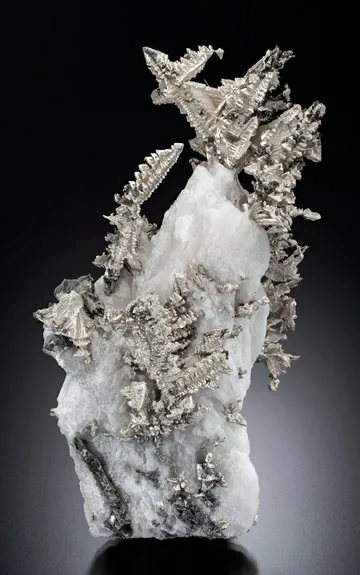
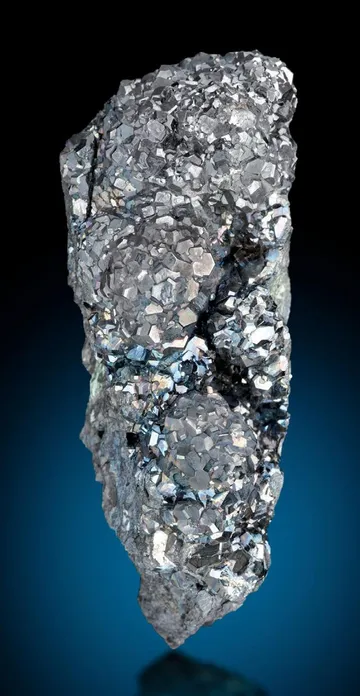
The most common associated minerals in collector specimens are quartz, skutterudite, calcite, roselite-group minerals, talmessite, heterogenite, and picropharmacolite. Dark metallic skutterudite is especially important: it is both a visual foil and a genetic clue, representing the primary cobalt arsenide source from which erythrite can form during oxidation. Pale calcite, dolomite, quartz, and altered gray matrix provide the classic contrast. Roselite and roselite-beta may occur in the same district and can produce their own red to rose hues, but their crystal habits and chemistry differ from erythrite.
One mineralogical peculiarity of Bou Azzer erythrite is its documented magnesium enrichment. Research on Mg-enriched erythrite from Bou Azzer showed that the mineral may fall within the erythrite-hörnesite-annabergite solid-solution field while remaining closest to erythrite. The studied crystals displayed fine oscillatory zoning, with magnesium increasing and cobalt decreasing across zones, and the highest magnesium content reported for erythrite at the time of that study. For collectors this is not usually visible without analysis, but it helps explain why Bou Azzer erythrite is more than just a pretty cobalt arsenate: it records changing chemistry in the oxidation zone, involving cobalt arsenides, dolomite, and local groundwater.
Quality is judged by five main factors: color saturation, crystal definition, luster, composition, and condition. A top Bou Azzer erythrite should have vivid magenta-to-purple color, individual blades or sprays rather than a shapeless crust, bright luster, attractive contrast with matrix, and minimal bruising. A lesser specimen may still be colorful but will show dull coatings, flattened aggregates, rubbed crystal tips, repaired matrix, or incomplete sprays. The most desirable pieces have a balanced architecture: well-separated crystal groups in a natural vug or on a stable matrix, with the color visible from normal display distance.
Bou Azzer erythrite is abundant enough that representative specimens remain available, but fine examples are not common. Small coatings and modest sprays appear regularly; sharp, lustrous, undamaged cabinet specimens with strong color and good three-dimensional form are much harder to replace. Older material from the classic finds is especially sought after, and high-quality pieces are often retained in collections.
The main condition issue is delicacy. Erythrite is soft, hydrated, and often formed as thin blades or acicular sprays. Crystals bruise easily during extraction, trimming, shipping, and cleaning. Rubbed tips, broken fans, compressed sprays, powdery surfaces, and detached crystals are common. A specimen that appears “busy” with color may still be heavily damaged under magnification, so serious collectors should inspect the crystal terminations and high points carefully.
Avoid aggressive cleaning. Do not soak Bou Azzer erythrite in acids, household cleaners, or ultrasonic baths. The matrix may include carbonates, arsenates, and arsenides, and the erythrite itself is not a robust mineral. Dust removal is best limited to gentle air, a very soft brush, or professional preparation. Water exposure should be minimized, especially on friable or earthy coatings.
Authenticity concerns center less on famous documented treatments and more on labeling, enhancement by photography, and confusion with other cobalt-bearing pink minerals. Bou Azzer is a name with market power, so vague “Morocco” specimens may be upgraded in speech or sales listings without evidence. Ask whether the label is district-level only or tied to a specific mine. Be especially cautious with oversaturated photographs: true Bou Azzer erythrite can be intensely colored, but digital magenta is easy to exaggerate.
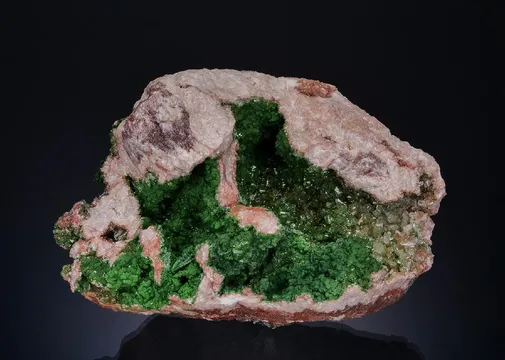
Distinguish erythrite from roselite, roselite-beta, cobaltoan calcite, and other pink cobalt minerals from the same district. Erythrite commonly forms bladed, acicular, radial, or fan-like aggregates; roselite-group minerals more often form small lustrous crystals in reddish to rose tones; cobaltoan calcite is carbonate, with rhombohedral to scalenohedral habits and a different luster and hardness. On high-value specimens, visual identification should be supported by provenance, expert review, or analysis.
Because erythrite contains arsenic as arsenate, handle specimens sensibly. The risk from a stable display specimen is low with normal mineral-collection hygiene, but avoid inhaling dust, do not lick or wet-test specimens, wash hands after handling, and keep pieces away from children and pets. Store them in a dry, stable environment, ideally boxed or under a case where the fragile sprays are protected from contact.
Market availability remains active. Modern listings include small cabinet and cabinet specimens, older collection pieces, and high-end examples with skutterudite or especially rich crystallization. Prices vary dramatically with condition and aesthetics: modest pieces can be accessible, while strong crystallized specimens from older finds can command serious collector prices. The best examples sell on the combination of unmistakable Bou Azzer color, intact form, and credible provenance.
Before Bou Azzer became a celebrated mineral locality and cobalt mine, the red-violet mineral itself was part of the story. Local inhabitants knew erythrite not as a cabinet specimen but as a useful and dangerous cobalt arsenate, reportedly using the conspicuous material as rat poison and insecticide. That small practical fact gives Bou Azzer’s discovery story its unusual flavor: the mineral that collectors now prize for beauty was once valued because its chemistry made it potent.
The most memorable version of the discovery tale begins far from the ore bodies, in Marrakech. Managem’s account tells of a geologist visiting the Jama Lfna area in 1928 and recognizing a cobalt mineral. At the time cobalt was a strategic metal, and that recognition helped direct attention toward the Bou Azzer deposit. The story has the compressed drama mineral collectors love: a vivid mineral seen in trade, a trained eye recognizing its significance, and a remote Anti-Atlas district becoming the focus of a targeted cobalt search.
Jean Epinat enters the story soon after. In the mining histories, Epinat appears as the French industrialist associated with development of the deposit in the early 1930s. Industrial mining began in 1933 with Société Minière de Bou-Azzer El Graara, and what had been a mineral clue became a lasting mining operation. The transition from violet-red arsenate on the surface to a full cobalt mining district is one of the reasons Bou Azzer carries more historical weight than many specimen localities.
There is also a collector’s story written in the specimens themselves. Older Bou Azzer erythrites often have a look that is difficult to fake by trimming or photography: vugs lined with magenta blades, dark cobalt arsenide matrix beneath, and fragile sprays preserved just well enough to make one wonder how they survived removal from an industrial ore environment. Dealers have repeatedly described the challenge of obtaining fine pieces because erythrite is so easily damaged. That fragility is part of the romance of the locality. A sharp fan of Bou Azzer erythrite is not just attractive; it is a survival.