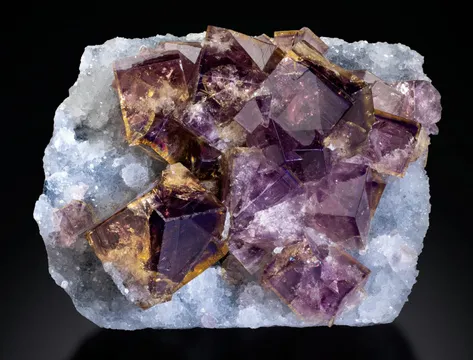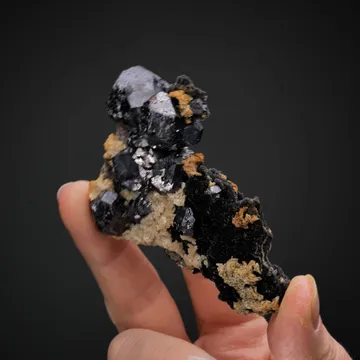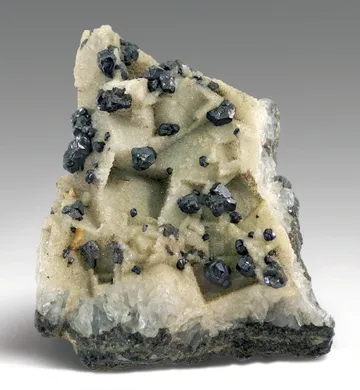
Nentsberry Haggs Mine, Cumbria: a notable locality for ruby-red sphalerite and honey-brown barytocalcite, witherite and galena—appealing to collectors.
Key facts
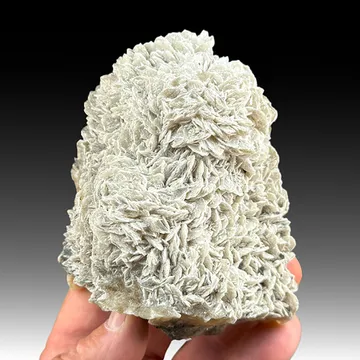
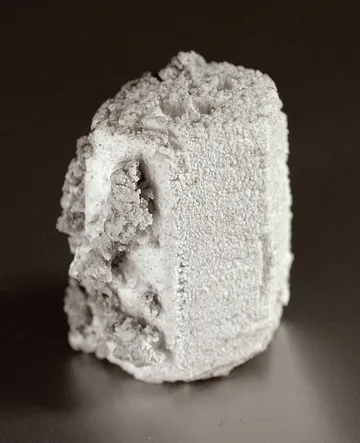
Barytocalcite from Nentsberry Haggs Mine is one of the great British locality signatures: not merely a rare barium-calcium carbonate, but a distinct Nenthead style of the species. The best pieces are rosettes and flower-like sprays of bladed to petal-shaped crystals, usually cream, tan, honey-brown, or internally amber, with many examples carrying the pale alteration crust that gives the specimens their characteristic old-Pennine, chalky-white skin. Where fresh crystal edges show through, the material can be surprisingly lustrous and translucent.

Photo: Wikimedia Commons
The locality matters because these specimens came from the Admiralty Concession Flat at the west end of the Second Sun Vein, in the Alston Moor sector of the Northern Pennine Orefield. It is a lead-zinc-barium-fluorine orefield, but the Nentsberry Haggs barytocalcite is not a simple vein accessory. It belongs to a complex late barium-carbonate episode in cavities within altered Great Limestone, where baryte, witherite, alstonite, barytocalcite, calcite, and sulphides record a remarkably intricate sequence of dissolution, replacement, and re-cementation.
Collectors value Nentsberry Haggs material for three reasons. First is form: the broad, curved, bladed sprays are unlike the classic prismatic barytocalcite of the nearby type area at Blagill. Second is provenance: many important pieces trace to the 1970s collecting of the Admiralty Flats and to old British collections, including Greenbank, Barstow, Senior, Ruggiero, and other familiar names in North Pennine mineral history. Third is locality specificity: a good Nentsberry Haggs specimen can often be recognized at arm’s length by its clustered cream blades, honey interiors, associated witherite or calcite, and the subtle baryte-calcite alteration crust that softens the crystal surfaces.

Photo: Wikimedia Commons
Nentsberry Haggs specimens are not usually about jewel-like single crystals; they are about architecture. The finest plates show repeated fans, spear-point clusters, rosettes, and overlapping blades over limestone, baryte, witherite, or calcite-rich matrix. The most desirable examples retain sharp terminations, strong relief, translucence or honey color beneath the surface, and a clear connection to the Second Sun Vein or Admiralty Concession Flat.
Search for specimens: View all barytocalcite specimens from Nentsberry Haggs Mine, UK
Nentsberry Haggs Mine lies near Nenthead, between Nenthead and Alston, on Alston Moor in Cumbria, England. The principal portal is on the north side of the Nenthead-to-Alston road, west of Nentsberry Bridge. The mine is also known in the literature and old plans as Nentsberry Mine, Nentsbury Mine, Haggs Mine, and Nentsberry Haggs Mine, a naming tangle made worse by the workings crossing the Cumbria-Northumberland boundary.
The deposit is part of the Northern Pennine Orefield, within the Alston Block. The mine worked lead and later zinc, with sphalerite and galena as the chief ore minerals in the relevant flat workings. The barytocalcite specimens came especially from the Admiralty Concession Flat, a strata-bound replacement body developed in the Great Limestone at the west end of the Second Sun Vein. The flat was reached by rises from the horse level where the Second Sun Vein is exposed as a shatter belt several metres wide. The workings were developed on two principal horizons: a smaller upper level at the High Flat Horizon below the Tumbler Beds, and a much longer lower level probably at the Middle Flat Horizon.
The geological setting is crucial to understanding the specimens. Dolomitisation and later iron-rich carbonate alteration produced porous, cavernous limestone adjacent to the vein. Brecciation and limestone dissolution enlarged cavities, many of which were lined with drusy quartz, “ankerite,” sphalerite, and galena before the barium minerals arrived. In the lower flat, baryte was deposited first, in some places as large blades. Later dissolution of baryte produced corroded crystals, voids, and epimorphic shapes, then barium carbonate minerals — chiefly barytocalcite, with witherite and some alstonite — formed in and around those spaces. A final hydrothermal alteration stage coated or partly replaced many barium carbonates with a white microcrystalline crust of baryte and calcite.

Photo: Wikimedia Commons
Mining in the Nentsberry Haggs area goes back at least to the eighteenth century. Records indicate that the Nentsberry Haggs Vein was being worked in 1737. The High Raise Vein was discovered in 1789 by the Brownley Hill Company, and by the nineteenth century the Haggs horse level had become one of the important access routes in the Nenthead system. The mine’s strongest production period was later, with lead and zinc activity continuing into the twentieth century; the peak of production is recorded in the 1930s, operations ceased in 1953, and the mine was formally abandoned in 1958.
The Cumbrian workings are no longer a casual collecting locality. The road portal is gated, the level has suffered major collapses, and the Nentsberry Haggs system is considered difficult and dangerous even by experienced mine explorers. Access to some of the Cumbrian workings has been possible via Brownley Hill Mine, and some workings over the county boundary in Northumberland have been reached via Wellhope Shaft, but this is specialist underground territory, not a field-collecting destination. Collectors should treat modern specimens as old material, recovered by knowledgeable underground collectors in earlier decades, or as pieces from established collections.
Notable finds cluster around the Admiralty Concession Flat and the Second Sun Vein. The 1970s discoveries produced the best-known barytocalcite specimens: honey to tan bladed crystals, commonly in fan-shaped sprays, with crystals reaching around 2 cm on strong pieces. Later work in the flat documented barytocalcite still observable in situ, including rare small colorless monoclinic prismatic crystals up to about 5 mm, but the classic collector material remains the larger curved-bladed lower-flat style.
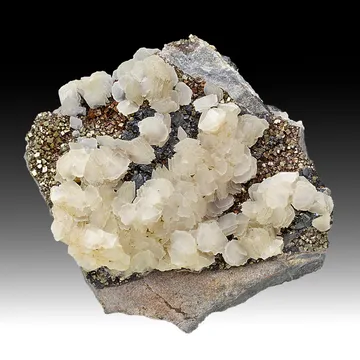
The classic habit is a spray or rosette of flattened, curved, petal-like blades. These aggregates may look floral, feathery, spear-pointed, or fan-like, depending on how tightly the blades overlap. Many specimens are mounded or crust-like, with parallel-growth clusters covering a small plate of matrix. The most recognizable pieces show cream to off-white blades over a darker limestone or sulphide-bearing base; fresher interiors may be tan, honey-brown, amber, or faintly glassy.
Crystal sizes vary by style. The most familiar display specimens carry bladed barytocalcite crystals around several millimetres to 2 cm long. Dealer and collection records describe crystals to about 2.2 cm on notable 1970s material, while research on the flat records rare small lustrous colorless monoclinic prisms up to 5 mm. A typical good miniature might be 4–6 cm across, but slabs and small cabinet pieces exist; documented examples include barytocalcite plates around 10–12 cm wide and a reported old specimen over 20 cm with lustrous honey-colored crystals on witherite.
The surface is often the key to identification. Many Nentsberry Haggs crystals are not bright throughout; they are naturally coated or partly replaced by a white to pale brown microcrystalline baryte-calcite crust. On collectible specimens this is not necessarily damage or artificial coating. It is part of the locality’s paragenesis and helps separate Nentsberry Haggs material from cleaner, more prismatic barytocalcite from other Alston Moor occurrences.
Associated minerals are highly diagnostic. Witherite is common on many collector specimens, especially in upper-flat material and in pieces from the Admiralty Flats. Baryte may occur as relic crystals, matrix, alteration crust, or pseudomorphic/epimorphic forms. Calcite is common as small scalenohedral or nailhead crystals and as part of the late crust. Sphalerite, galena, quartz, and iron-carbonate matrix are frequent in the broader flat assemblage, while alstonite is an important but much less common barium-calcium carbonate companion. Rare or minor species reported from the mine include harmotome, gypsum, melanterite, serpierite, schulenbergite, chalcopyrite, pyrite, and ankerite-like carbonate.
Quality in Nentsberry Haggs barytocalcite is judged differently than in gemmy single-crystal species. The best specimens have three-dimensional relief, complete fans, sharp blade tips, visible honey or tan translucence, minimal abrasion, and attractive contrast between the pale barytocalcite and darker matrix. Rich coverage matters, but not at the expense of form: a dense but flat crust is less compelling than a smaller specimen with upright, flower-like sprays. Strong provenance to Admiralty Flats, Second Sun Vein, or an old British collection adds real collector value.
Fluorescence is sometimes noted. Some specimens have been described with reddish-pink fluorescence in the barytocalcite and blue-white fluorescence in associated witherite. Fluorescence should be treated as a bonus, not as the primary basis for identification, because the altered surfaces and mixed barium-carbonate assemblages can make visual interpretation difficult.
Nentsberry Haggs barytocalcite is scarce, but not unobtainable. It appears episodically from old collections and dealer inventories, especially as miniatures and small cabinet specimens. Fresh production is not a realistic expectation; the locality is effectively an old-source mine for collectors. When good specimens surface, the combination of locality, species rarity, and attractive bladed habit can push prices well beyond ordinary carbonate specimens.
Authentication is important because Nentsberry Haggs material sits in a chemically and visually confusing group of barium minerals. Barytocalcite, alstonite, witherite, baryte, and calcite can occur together, and white altered surfaces can obscure the primary species. Old labels may be wrong. One documented dealer example from the John H. Marshall Jr. collection had earlier labels treating white crystals as witherite, while analysis showed them to be barytocalcite. For valuable pieces, especially white bladed specimens with old “witherite,” “alstonite,” or “baryte” labels, analytical confirmation by Raman, XRD, or other reliable methods is worth seeking.
Condition issues are predictable. The bladed aggregates chip at the tips and edges; rosettes can break where sprays project from matrix; and older collection pieces may have repairs. A well-known 1972 Second Sun Vein specimen acquired from Richard Barstow in 1976 was explicitly noted on its collection card as one of the best of the species but repaired in several places. Repairs are not automatically disqualifying in this material, but they should be disclosed and priced accordingly.
The pale crust on many specimens should not be casually removed. It is often a natural baryte-calcite alteration crust, not dirt. Acid cleaning is particularly risky: barytocalcite and calcite are carbonates, and associated witherite is also a carbonate. Aggressive cleaning can dull, etch, or destroy the very surfaces that make the locality recognizable. Dry dusting, careful air blowing, or professional conservation is safer than chemical cleaning.
There are no widely documented locality-specific fakes of Nentsberry Haggs barytocalcite in the specimen literature, but misidentification is a real and recurring issue. The most common “fake” is an honest old label error: witherite called barytocalcite, barytocalcite called witherite, or altered baryte-carbonate mixtures assigned to a single species without analysis. Provenance to Admiralty Flats or Second Sun Vein is valuable, but a convincing label should still be supported by mineralogical consistency.
Collectors should also handle associated witherite with ordinary caution. Witherite is barium carbonate and is more toxicologically significant than baryte; avoid dust, do not lick or acid-test display specimens casually, wash hands after handling friable material, and keep specimens away from children and pets.
The great collector story at Nentsberry Haggs is the 1970s return to a locality that still had surprises hidden in old workings. Richard Barstow, Lindsay Greenbank, and Patricia Greenbank were part of the rediscovery of the barytocalcite-bearing ground, and the best specimens from that work quickly took on classic status. One later-described Ruggiero specimen records the essential details in unusually vivid provenance: mined from the 2nd Sun Vein in 1972, acquired from Richard Barstow in 1976, and considered “one of the best pieces of the species,” though it required repair. The piece was only 4.5 x 4.0 x 3.5 cm, yet carried fan-shaped clusters of tan, glassy crystals to 2.2 cm — the sort of compact miniature that explains why Nentsberry Haggs barytocalcite became famous among serious British collectors.
The physical setting adds drama to the specimens. The Admiralty Concession Flat is not simply “a pocket” but a difficult underground flat in the Great Limestone, reached by rises from the mine level. Research visits described a two-level flat with barium mineralisation restricted to three areas. In the upper working, the roof below the Tumbler Beds included large suspended slabs in serious collapse; in the lower working, the cavities preserved the evidence collectors love to puzzle over — corroded baryte, epimorphic voids, fractured crystals, and barium carbonates sealing broken fragments back together. A specimen of Nentsberry Haggs barytocalcite is therefore not just a pretty carbonate; it is a hand-sized remnant of a cavern system where sulphide ore, dissolving baryte, carbonate brines, and late white crusts all overprinted one another.
Older Alston Moor collectors remember a different underground world. In the 1970s, parts of the Nenthead mines still held crystal-filled cavities, old tubs, mining tools, timber, explosive boxes, and water bottles. Over time, many cavities were raked clean, artefacts disappeared, and the soft shale drives deteriorated. Nentsberry Haggs was among the first of the big systems to become effectively lost to ordinary collectors, with massive collapses in the horse level making it all but inaccessible. That loss is part of the aura around good barytocalcite from the mine: the specimens come from a collecting window that has largely closed.