A collector's guide to Bairendaba Ag-polymetallic deposit, China: its geology, mining history and notable minerals, illustrated with the 30 specimens documented from this locality on EarthWonders.
Key facts
Bairendaba is one of the most important modern Chinese localities for fluorite and pyrrhotite specimens, yet it is not a traditional “specimen mine” in the collector’s sense. It is an active Ag-Pb-Zn polymetallic ore deposit in Hexigten Banner, Chifeng, Inner Mongolia, set on the western slope of the southern Great Xing’an Range, within the broader Weilasituo-Bairendaba metallogenic district. Geologically, it belongs to the family of fault-controlled, magmatic-hydrothermal vein systems developed in and around gneiss of the Xilinhot/Baoyintu metamorphic basement and quartz diorite. Economically it is a silver-lead-zinc mine; aesthetically it has become a source of some of the most recognizable fluorite and pyrrhotite combinations to emerge from China in the last decade.
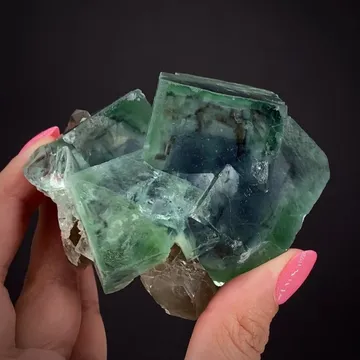
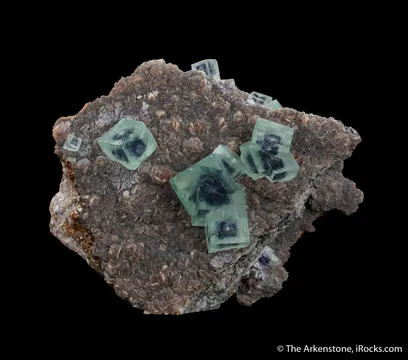
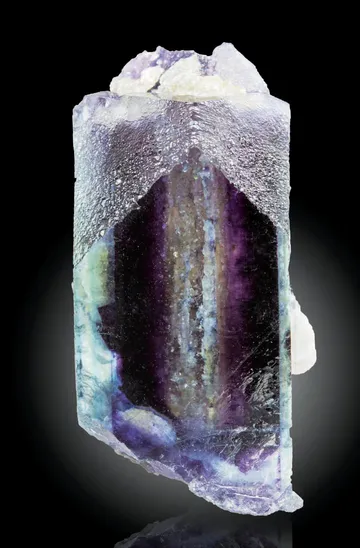
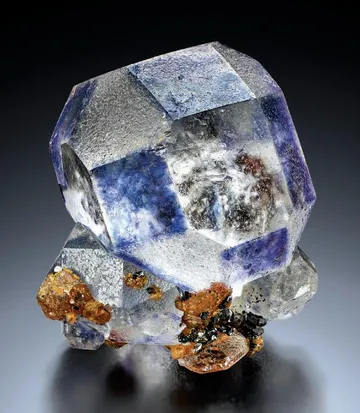
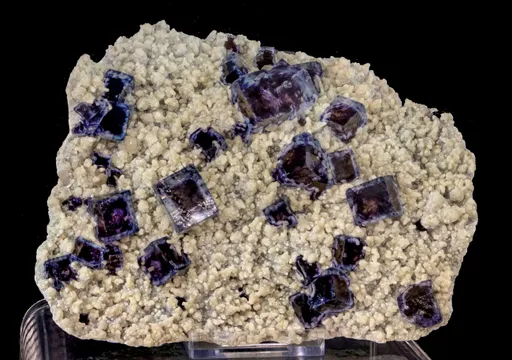
The deposit matters to collectors because its best specimens are not merely “another Chinese fluorite.” Bairendaba fluorites often show a particular internal architecture: transparent to translucent cubes and modified cubes with sharp purple, blue, green, teal, yellowish, or colorless growth zones, including octahedral and cubo-octahedral phantoms frozen inside later generations of fluorite. Some crystals look dark until backlit, then resolve into layered windows of purple core, pale blue shell, green rim, or complex stepped phantom geometry. Matrix pieces may carry muscovite, quartz, pyrite, galena, pyrrhotite, calcite, dolomite, or sphalerite; the best ones combine sharp form, saturated color, strong internal zoning, and enough transparency that the zoning can be read without laboratory-style lighting.
Bairendaba’s pyrrhotites are less abundant but highly distinctive. The locality has produced lustrous bronze to brassy, pseudo-hexagonal pyrrhotite plates and thick tabular crystals, some several centimeters across, in association with purple fluorite, galena, apatite-group microcrystals, and calcite. These specimens place Bairendaba in a small group of modern localities where collector-quality pyrrhotite, fluorite, and lead-zinc-silver sulfide mineralogy meet in a single pocket environment.
Regional View
Country View
In the commercial mineral trade the locality has often appeared under the name “Yindu mine,” a usage that has caused persistent confusion. Yindu is the operating company name, not a separate classic locality in the way many old labels imply. Specimens may also be confused with Weilasituo material because the deposits lie in the same district and have overlapping trade history. For serious collectors, the safest label is the full geological locality: Bairendaba Ag-polymetallic deposit, Hexigten Banner, Chifeng, Inner Mongolia, China, with “Yindu” retained only as a trade or operating-company reference when that is how the specimen entered the market.

Photo: Khyber Mineral Company
Search for specimens: View all specimens from Bairendaba Ag-polymetallic deposit, China
Bairendaba is located in Hexigten Banner, Chifeng City, Inner Mongolia Autonomous Region, China. In mineralogical literature it is usually treated as a large to superlarge Ag-Pb-Zn vein-type or magmatic-hydrothermal polymetallic deposit in the southern Great Xing’an Range. It lies within the Weilasituo-Bairendaba district, a zoned hydrothermal system in which tin-tungsten and lithium-rich mineralization at Weilasituo grades outward through Cu-Zn and into the Ag-Zn-Pb style represented by Bairendaba. That district-scale zoning is important for collectors because it explains why a silver-lead-zinc mine can yield abundant fluorite, pyrrhotite, chalcopyrite, galena, sphalerite, quartz, muscovite, and calcite in visually complex combinations.
The ore bodies are structurally controlled veins, lenses, and tabular bodies hosted mainly by biotite-plagioclase gneiss and quartz diorite. Regional and mine-scale faults provided the channels and open spaces for mineralizing fluids; the most important ore-controlling structures are described as EW-, NE-, and NW-trending faults depending on the part of the mine. Hydrothermal alteration includes silicification, sericitization, chloritization, carbonatization, fluorite-related alteration, and local kaolinization. The mineralization is Early Cretaceous/Yanshanian in age and is tied to Mesozoic magmatic-hydrothermal activity rather than to simple sediment-hosted replacement alone.
The paragenesis has been divided slightly differently by different authors, but the broad collector-relevant sequence is clear. Early quartz-rich veins contain arsenopyrite and pyrite. The principal ore stages produced Zn-rich sulfide veins and Pb-Ag-rich sulfide-sulfosalt veins, with sphalerite, galena, pyrite, marcasite, pyrrhotite, chalcopyrite, arsenopyrite, boulangerite, freibergite, pyrargyrite, diaphorite, stephanite, acanthite/argentite, and related silver-bearing phases. Later low-temperature gangue stages brought abundant calcite, muscovite, and fluorite. Fluorite appears both as an important gangue mineral in the deposit’s hydrothermal evolution and as the dominant collector species in modern specimen recovery.
Economically, Bairendaba is operated by Inner Mongolia Yindu Mining Co., Ltd. The mine is a large underground silver-lead-zinc operation. Public company and local-government disclosures describe a design mining and processing capacity of 900,000 tonnes per year, underground extraction, flotation processing, and a mining license originally issued on December 27, 2010, with validity to December 28, 2031. Recent disclosures also state that the licensed mining area has been enlarged through integration of adjoining northern exploration ground, with the certificate area increasing from 5.1481 km2 to 5.5395 km2 after a new permit was obtained in January 2026. The operator’s parent company, Shengda Resources, has described Yindu Mining as a controlled subsidiary and Bairendaba as one of its important producing mines.
Mining history is fairly recent by the standards of classic mineral localities. Company environmental filings state that construction began in May 2004 and that production was completed and commissioned in September 2005; other official basic-information tables list the mine-building date as 2006. Production data published in a 2014 mining-right evaluation report show substantial operation during 2008-2013, with annual mined ore ranging roughly from 670,984 tonnes in 2009 to 900,200 tonnes in 2013. A later government mine-status table describes the operation as in production, with underground workings extending from approximately the 1433 m elevation down to the 782 m elevation.
Collecting access today should be understood in the context of an active industrial mine, not an open collecting site. The underground workings, shafts, declines, stopes, processing areas, and waste facilities are controlled mine property. Legitimate specimens reach collectors through the mine-to-dealer chain, not through casual field collecting. Because the mine remains active and deepening, specimen production is tied to the unpredictable intersection of ore mining with open vugs, fluorite-rich veins, and sulfide-bearing cavities. As a result, the market sees bursts of very distinctive material rather than a steady, fully documented series of named pockets.
The most important collector finds appear to have entered the Western market in stages. Early material seen around 2013 included blue to purple fluorite on siderite-rich matrix, but much of it was frosted or only modest in quality. Around 2018, better blue fluorite with purple phantoms and the so-called “ghost eye” style began to appear, along with the pyrrhotite-fluorite associations that made the locality more than a fluorite footnote. During and after the pandemic years, collectors began seeing much more varied material: vivid green fluorite, purple cores in pale blue or teal shells, colorless windows, pyrite-dusted fluorites, fluorite on quartz, fluorite on muscovite, and internally complex miniature and thumbnail crystals that often reward strong transmitted light.
Bairendaba fluorite is prized for complex growth zoning rather than sheer crystal size: good individual crystals are commonly thumbnail to small-miniature scale, often under about 2 cm on an edge, although matrix groups reach several centimeters and occasional cabinet pieces occur. Habits include sharp cubes, modified cubes, cubo-octahedral forms, octahedral-looking crystals, and unusual elongated or twinned forms; colors range from pale blue and sky blue through deep purple, inky blue, teal, green, yellowish, and colorless zones. The defining feature is internal structure—purple octahedral or cubo-octahedral phantoms inside clearer blue or green outer growth, “windowed” colorless centers, dark crystals that ignite when backlit, and multiple generations of fluorite over quartz, muscovite, pyrite, galena, pyrrhotite, or calcite. The best pieces show sharp undamaged edges, strong luster, transparent outer growth, saturated phantom color, and enough thickness control that the zoning can be enjoyed in normal display light; ordinary pieces are darker, frosted, badly bruised from blasting, or attractive only under intense backlighting.
Bairendaba pyrrhotite is a serious collector mineral from the locality, not merely an accessory sulfide. Specimen material includes lustrous bronze to brassy pseudo-hexagonal plates, books, and thick tabular crystals, with documented examples carrying pyrrhotite crystals from about 2 cm across to nearly 8 cm on major museum-quality specimens. Associations are especially attractive: purple fluorite, cubic galena, calcite, and drusy apatite-group coatings on pyrrhotite faces are all recorded from notable pieces. The finest pyrrhotites have bright metallic luster, crisp hexagonal outline, aesthetic three-dimensional exposure, and contrasting attached fluorite or galena; lesser examples are massive, oxidized, scratched, or visually heavy without the sharp plated habit that gives the best Bairendaba pieces their character.
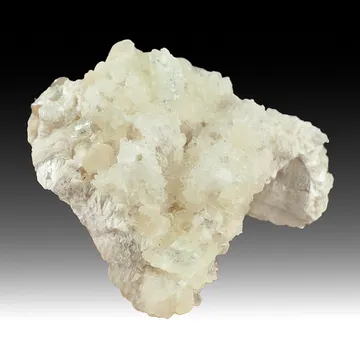
Calcite at Bairendaba is best understood as a late gangue and pocket companion rather than the locality’s headline species. In the deposit’s paragenesis, calcite is tied to late hydrothermal stages and to Ag-rich sulfide-sulfosalt mineralization, where it occurs with quartz, fluorite, galena, sphalerite, pyrrhotite, chalcopyrite, and silver sulfosalts. On specimens it may appear as pale, white, gray-white, or colorless drusy to tabular coatings, including compressed tabular crystals selectively covering pyrrhotite, or as contrasting carbonate gangue around fluorite and sulfide groups. Good calcite-bearing Bairendaba pieces are valued when calcite sharpens the composition—white carbonate on metallic pyrrhotite, for example, or calcite providing contrast to blue-purple fluorite—whereas calcite alone from the mine is generally less competitive unless unusually lustrous, architectural, or intimately associated with the classic Bairendaba fluorite-sulfide assemblage.
Other documented Bairendaba minerals include acanthite, apatite-group minerals, arsenopyrite, baryte, berlinite, biotite, boulangerite, chalcopyrite, chlorite-group minerals, diaphorite, dolomite, freibergite-group minerals, galena, marcasite, muscovite, native bismuth, pyrite, pyrargyrite, quartz, semseyite, siderite, sphalerite, stannite, and zircon, along with the host rocks and alteration minerals expected in a gneiss-quartz diorite vein system. No valid type-locality mineral has been verified from the Bairendaba deposit itself; collectors sometimes encounter confusion with nearby Hexigten/Chifeng rarities such as shijiangshanite and shinichengite from the Shijiangshan mine, which belong to a different locality. For Bairendaba proper, the rarities of greatest locality significance are not showy type minerals but the silver sulfosalts—pyrargyrite, freibergite, diaphorite, stephanite, acanthite/argentite, boulangerite, semseyite—and trace-element-bearing sulfides that record the deposit’s Ag-Pb-Zn-Sn-Cu hydrothermal evolution.
The chief authenticity problem with Bairendaba specimens is not known widespread fabrication; it is locality accuracy. Labels reading “Yindu mine,” “Yindu,” “Weilasituo,” “Bairendaba,” and occasionally vague “Inner Mongolia fluorite” may refer to overlapping or confused trade usage. The safest approach is to preserve all original labels but modernize the main locality line to Bairendaba Ag-polymetallic deposit when the specimen matches documented Yindu/Bairendaba material and came through that trade channel. Conversely, do not automatically relabel every Inner Mongolia blue fluorite as Bairendaba: Huanggang, Yaogangxian, Xianghualing, Huangshaping, and other Chinese fluorite sources can overlap superficially in color, but they differ in matrix, crystal style, associations, and pocket history.
No well-documented, locality-specific treatment problem has been established for Bairendaba fluorite. That said, blue and purple fluorites from China are sometimes viewed skeptically in the market because irradiation and color enhancement have been discussed for other fluorite sources. For Bairendaba, rely on provenance, matrix consistency, and association minerals rather than rumor. Natural Bairendaba pieces commonly show complex zoning, color changes through the crystal, and growth phantoms rather than a flat, uniform color. If a specimen is unusually intense, uniformly colored, matrix-free, and without credible provenance, it deserves the same caution one would apply to any modern Chinese fluorite of uncertain origin.
Condition is a major grading issue. The mine is worked for ore, and blasting has damaged many specimens. Chipped cube corners, bruised fluorite edges, contacted backs, cleaved faces, broken matrix, and detached-and-repaired crystals are all common enough that top-condition pieces command a premium. Fluorite has perfect cleavage and should be handled accordingly; pyrrhotite is softer, can tarnish, and should be kept dry and away from prolonged humid storage. Pyrrhotite specimens with delicate apatite or calcite coatings should not be scrubbed or ultrasonically cleaned.
Lighting matters more here than at many fluorite localities. Some Bairendaba fluorites look nearly black or muddy in reflected light but become spectacular under transmitted light. That is not necessarily a defect, but collectors should distinguish display quality from photographic quality: a specimen that only “works” with a flashlight behind it may be less satisfying in a cabinet than one whose phantoms and colors read under ordinary illumination. The strongest pieces balance both worlds—rich phantom architecture in backlight and attractive color, luster, and form in normal viewing.
Market availability is active but uneven. Miniatures and thumbnails are the most commonly seen high-quality sizes; larger clean matrix specimens are harder to find. Fine fluorites with vivid green, teal, or sharply resolved purple phantoms, especially on attractive muscovite or quartz matrix, are increasingly competitive. Fine pyrrhotite-fluorite combinations are much scarcer and should be bought selectively when the pyrrhotite is lustrous, three-dimensional, and well associated.
Bairendaba’s rise in the collector world was oddly quiet at first. Around 2013, a dealer at Tucson who was focused on nearby Huanggang had a single flat of blue-purple fluorite on sideritic matrix. The crystals hinted at something interesting, but the surfaces were frosted and the overall quality was modest. Many collectors who saw them would not have guessed that the same ore field would soon become one of China’s most talked-about fluorite sources.
By about 2018, the locality had found its visual identity. Blue crystals with purple phantoms began circulating, followed by dark-purple pieces with pale internal centers that dealers nicknamed “ghost eye.” The resemblance to Erongo’s famous “alien eye” fluorites was obvious enough that the name stuck in sales conversation, even if it never became a rigorous geological pocket name. At roughly the same time, pyrrhotite specimens began appearing: bronze pseudo-hexagonal plates and books with purple fluorite and galena, the kind of material that made collectors stop treating Bairendaba as just another fluorite occurrence.
The pandemic years brought the strangest and most coveted material. Dealers described bright green fluorites with purple cores, crystals that looked nearly black until backlit, purple cubes with colorless “windows,” and pieces in which colorless cores were overgrown first by purple fluorite and then by vivid teal or green. Some crystals seemed almost to change direction mid-growth, with one part dark and phantom-rich and another part water-clear. The result was a locality whose best pieces looked less like a repeated pocket style and more like a whole catalog of experiments in fluorite growth.
One of the more useful pieces of collector lore concerns the name “Yindu.” For several years, Western labels often treated Yindu as though it were the mine locality itself. Later clarification in the collector literature emphasized that Yindu Mining Company operated the workings, and that “Yindu mine” had become a convenient but imprecise trade name for Bairendaba material. That matters because serious locality labels age better than trade shorthand. A specimen labeled only “Yindu mine, Inner Mongolia” is not necessarily wrong in historical trade context, but it is incomplete.
Dealers have also pushed back against the modern habit of inventing pocket names for every visually distinct fluorite find. Bairendaba has produced enough dramatically different styles that the temptation is obvious: ghost-eye, blueberry, green phantom, teal window, and so on. But the more disciplined view is that most fluorite crystals come from pockets by definition, and a pocket name is useful only when it marks a genuinely documented discovery rather than a marketing wrapper. For Bairendaba, color, habit, matrix, and provenance currently matter more than a catchy pocket nickname.
C. J. Stefano, “The Bairendaba Deposit, Keshiketen District, Inner Mongolia, China,” The Mineralogical Record, 54(3), 2023 — The key collector-oriented article for Bairendaba, noted in issue listings and later dealer discussions as the modern reference that brought the locality to broad specimen-market attention.
Tianci Huang, Chao Chen, Xinbiao Lv, Shouguo Wang, and Hongyu Liu, “Evolution and origin of the Bairendaba Ag–Pb–Zn deposit in Inner Mongolia, China: Constraints from infrared micro-thermometry, mineral composition, thermodynamic calculations, and in situ Pb isotope,” Ore Geology Reviews, 154, 105316, 2023 — A detailed genetic study interpreting Bairendaba as a magma-related hydrothermal vein-type Ag-Pb-Zn deposit, with data on temperatures, pH, oxygen fugacity, sulfide chemistry, and Pb isotopes.
Yang ShaSha, Cao MingYu, Su HuiMin, Mi WenTian, Hu ZiFu, Li Geng, and Li HaiDong, “Mineral characteristics, silver occurrence state and enrichment mechanisms of Bairendaba Ag-Pb-Zn polymetallic deposit in southern Great Xing’an Range,” Mineral Deposits, 44(3), 537-558, 2025 — A focused ore-mineralogy paper on the silver-bearing phases and precipitation sequence, including freibergite, diaphorite, pyrargyrite, stephanite, argentite/acanthite, boulangerite, galena, stannite, and chalcopyrite.
Guo Li-Jun, Xie Yu-ling, Hou Zeng-qian, Wang Shuo, Chen Wei, Li Zheng, Li Yingxu, Xue Huaimin, Tong Ying, Pan Xiaofei, and Zhou Xiwen, “Geology and ore fluid characteristics of the Bairendaba silver polymetallic deposit in Inner Mongolia,” Acta Petrologica et Mineralogica, 28(1), 26-36, 2009 — A foundational geology and fluid-inclusion study recognizing the Yanshanian, structure-controlled, moderate- to low-temperature hydrothermal nature of the deposit.
Yan Liu, Sihong Jiang, Zhigang Zhang, Yifei Liu, and Fengjun Nie, “Mineragraphy of Bairendaba and Weilasituo silver-polymetallic deposits in Inner Mongolia,” Mineral Deposits, 30(5), 837-854, 2011 — A mineralographic treatment of Bairendaba and Weilasituo, useful for understanding the ore stages and the position of silver mineralization in the paragenesis.
Yifei Liu, Sihong Jiang, and Leon Bagas, “The genesis of metal zonation in the Weilasituo and Bairendaba Ag-Zn-Pb-Cu-(Sn-W) deposits in the shallow part of a porphyry Sn-W-Rb system, Inner Mongolia, China,” Ore Geology Reviews, 75, 150-173, 2016 — The important regional-zonation paper connecting Bairendaba with Weilasituo in a larger porphyry-related hydrothermal system.
Frontiers in Earth Science, “3D mineral exploration Cu-Zn targeting with multi-source geoscience datasets in the Weilasituo-Bairendaba district, Inner Mongolia, China,” 2023 — A modern exploration-modeling paper with regional maps, orebody models, structural discussion, and resource context for the Weilasituo-Bairendaba district.
mim Museum display note for pyrrhotite with apatite, galena, and fluorite from Bairendaba — Records a notable museum specimen measuring 9 x 7 x 10.5 cm, with a 7.9 cm pyrrhotite crystal, probable 2019 extraction, photographed by The Arkenstone / Robert Mosley and published in Mineralogical Record “Ikons: The Beauty of Fine Minerals.”
Mindat locality page for Bairendaba Ag-polymetallic deposit — The most useful mineral-species checklist and reference hub for the locality, including ore minerals, gangue minerals, and modern literature.
Khyber Mineral Company: “Bairendaba! (Yindu)” — A valuable dealer archive showing the diversity of Bairendaba fluorite styles, including green, teal, blue, purple-phantom, pyrite-dusted, and backlit “window” specimens.
The Mineralogical Record: What’s New in the Mineral World, Online Report 68 — Includes discussion of Yindu/Bairendaba fluorites, the correction of “Yindu mine” as an operating-company-derived name, and notes on 2022-2023 market appearances.
Government notice: Bairendaba green-mine status and 2025 plan — Official local-government information on operator, permit, capacity, underground mining status, mine scale, and resource figures.
Shengda Resources 2026 announcement on Yindu Mining’s 900,000 t/year technical upgrade approval — Current public-company disclosure on the expanded mining area, operator, resource inventory, and continued production plans.
2014 mining-right evaluation report for Inner Mongolia Yindu Mining Co., Ltd. Bairendaba silver polymetallic mine — Historical mining and processing data for 2008-2013, useful for understanding early production scale.
Shengda Resources 2025 annual report — Recent reserve and resource disclosure for Bairendaba and the adjoining northern exploration area.