






Chifeng City, China — a premier locality for Huanggang skarn, magnetite-cassiterite ores, and a diverse mix of fluorite, ilvaite, arsenopyrite, and calcite pri…
Key facts
Chifeng City, in southeastern Inner Mongolia, has become one of the most consequential modern Chinese names on mineral labels, not because of a single mine but because a cluster of large Mesozoic polymetallic systems within the southern Great Xing’an Range has produced both serious ore deposits and first-rank collector specimens. For collectors, the name most often means the Huanggang Fe-Sn deposit in Hexigten Banner: a vast skarn system where granitoid intrusions reacted with carbonate and volcanic-sedimentary rocks to form magnetite-cassiterite ore bodies and a remarkably varied suite of silicates, fluorides, carbonates, arsenides, sulfides, borates, and phosphates. Since its appearance on the international specimen market around 2010, Huanggang has supplied glossy black ilvaite, prase quartz colored by fine amphibole or pyroxene inclusions, wine-purple to pink fluorite, lustrous arsenopyrite and löllingite, manganoan calcite, green garnet, scheelite, sphalerite, helvine-group minerals, borcarite, cahnite, and many other species.
Regional View
Country View
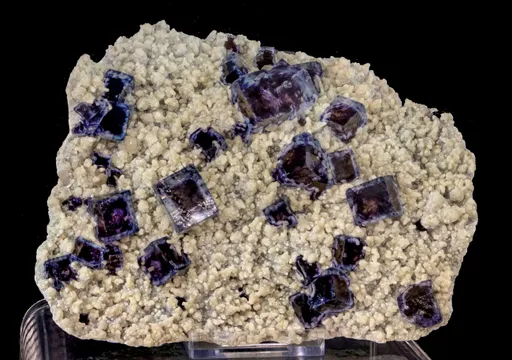
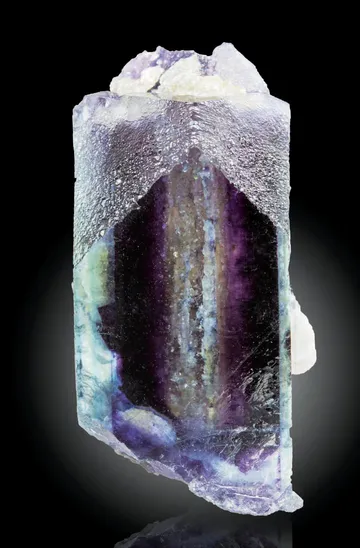
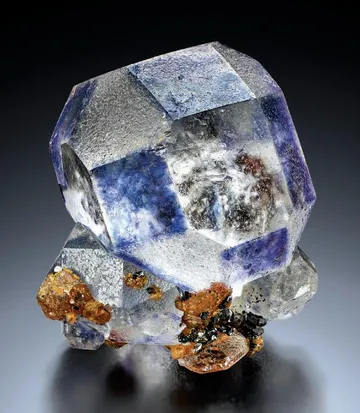
The best Chifeng specimens have a highly recognizable skarn aesthetic: hard mineral contrasts, sharp geometry, and unusual color pairings. Huanggang fluorite ranges from deep violet and bluish-purple modified cubes to pink octahedra and paler gemmy masses, often set on quartz, calcite, byssolite-like amphibole, or sulfide-rich matrix. The quartz is equally distinctive: slender, transparent to translucent crystals, many green from dark fibrous inclusions, with ilvaite, hedenbergite, arsenopyrite, fluorite, calcite, and magnetite creating some of the most dramatic modern Chinese combination specimens. Outside Huanggang, Chifeng also includes the Yindu Ag-Pb-Zn deposit, well known to fluorite collectors for multicolored crystals with muscovite, siderite, sphalerite, pyrrhotite, quartz, and other base-metal associations, and the Shuangjianzishan Ag-polymetallic deposit, a major silver system of scientific importance.

Photo: Wikimedia Commons
Historically, Chifeng matters because it entered the collector world very late yet immediately behaved like an old classic locality: multiple mine areas, repeated pocket discoveries, strong species diversity, and specimens good enough to define new standards for several mineral associations. Its scientific importance has grown in parallel. Huanggang has become a reference example for Early Cretaceous Fe-Sn skarn mineralization in northern China, while the broader Chifeng area now includes several type localities for newly approved or recently described minerals.
Search for specimens: View all specimens from Chifeng City, China
Chifeng City is a prefecture-level administrative region of Inner Mongolia, so a label reading simply “Chifeng” should be treated as a regional label rather than a mine-level locality. For serious collecting records, the sub-locality matters. The most important specimen source is the Huanggang Fe-Sn deposit, also seen as Huanggangliang, in Hexigten Banner. Modern precise labels usually read “Huanggang Fe-Sn deposit, Hexigten Banner, Chifeng City, Inner Mongolia, China,” often with a numbered mine or shaft when known. The deposit is not a small collector dig: it is a large industrial iron-tin polymetallic skarn complex with several mine areas and a long list of ore and gangue minerals.
The Huanggang ore system formed where Early Cretaceous K-feldspar granite and related intrusions interacted with carbonate-rich units including marble of the Huanggangliang and Dashizhai formations. The resulting skarn assemblages were built in stages. Early high-temperature anhydrous skarn produced minerals such as garnet and pyroxene; later hydrous skarn and oxide stages introduced amphibole, chlorite, quartz, magnetite, and cassiterite; later sulfide and carbonate stages added pyrite, arsenopyrite, fluorite, calcite, sphalerite, chalcopyrite, and related vein minerals. This paragenetic succession is exactly what collectors see in the specimens: green included quartz sitting with black ilvaite, fluorite growing with quartz and calcite, arsenopyrite or löllingite flashing from skarn matrix, and late carbonates partially covering earlier silicates or fluorides.
The ore bodies at Huanggang are complex rather than uniform. Published geological descriptions record skarns and iron orebodies as lenses and replacement bodies along intrusive contacts, with magnetite and cassiterite as the principal economic minerals and with Pb, Zn, Cu, W, Mo, and other metals present in varying degrees. Earlier summaries describe a very large mineralized belt with numerous individual ore bodies, while more recent work refines the timing and fluid evolution of the system. For collectors, the practical lesson is that Huanggang specimens are not all from one pocket style: different mine numbers and ore blocks produced recognizably different associations.
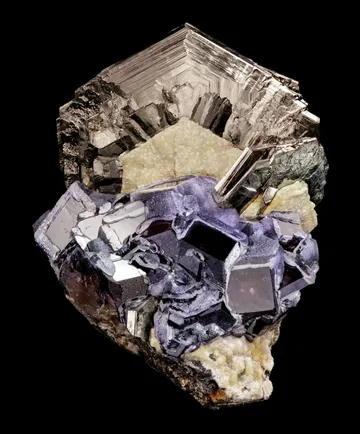
The numbered Huanggang mines are useful on labels. The No. 1 area is associated with fluorite, quartz, hedenbergite, garnet, ilvaite, magnetite, helvine, and arsenopyrite. No. 2 is especially important for ilvaite, quartz or prase, arsenopyrite, pyrite, sphalerite, calcite, and associated skarn minerals. No. 3 is noted for borate-rich material including borcarite and cahnite with quartz and baryte. No. 4 produced striking fluorite-on-quartz specimens, including the dark blue to violet “bug-eye” or bulbous fluorite style that became familiar in the trade. No. 5 is a key source for fluorite, calcite, quartz, scheelite, magnetite, helvine, sphalerite, löllingite, and garnet; it is also tied to important pink fluorite production. No. 6 and No. 7 are less often specified on commercial labels but belong to the same broader mine complex.
Mining history at Huanggang is modern. The ore deposit itself was discovered in the mid-twentieth century, while construction of the modern mine complex took place in the early 2000s and limited production began before the major collector-specimen boom. Specimens began reaching international attention around 2010. At first, accurate locality information was not always supplied, partly because new Chinese finds were often deliberately obscured in the market until dealers and miners understood the commercial consequences of disclosure. As the locality became better known, the Huanggang name stabilized and the mine-number system became more important for well-documented specimens.
Collecting access today should be understood as industrial, restricted, and variable. Huanggang, Yindu, Shuangjianzishan, Baiyinnuo’er, Dajing, and other Chifeng deposits are operating or historically worked mining districts, not public collecting grounds. Underground workings, open industrial sites, waste dumps, and ore stockpiles require permission from mine operators or mineral-rights holders, and access conditions can change without warning. Most fine specimens enter the market through miners, mine contacts, Chinese dealers, and international mineral dealers rather than through casual field collecting.
Beyond Huanggang, Chifeng includes other important mineralized districts. The Yindu Ag-Pb-Zn deposit in Hexigten Banner is a smaller but highly visible collector source for fluorite, especially multicolored crystals associated with muscovite, siderite, sphalerite, quartz, pyrrhotite, pyrite, chalcopyrite, galena, boulangerite, calcite, and fluorapatite. The Shuangjianzishan Ag-polymetallic deposit in Bairin Left Banner is one of the region’s most important modern ore discoveries and is scientifically notable for silver-bearing sulfides, sulfosalts, and the type mineral luoxianchangite. The broader Chifeng region also includes the Danailingou As-Co deposit, the Shijiangshan mine, the Dajing Sn-Cu-polymetallic deposit, and other Pb-Zn-Ag-Cu-Sn systems that make the prefecture far more mineralogically diverse than its common “Huanggang” shorthand suggests.
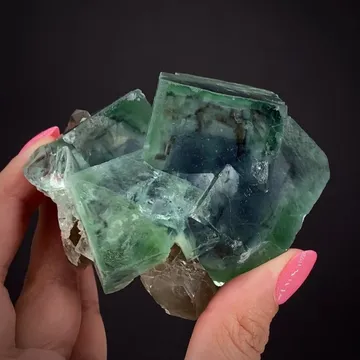
Fluorite from Chifeng is best known from Huanggang and Yindu, and the two can look very different. Huanggang specimens include deep violet to bluish-purple modified cubes, pink to orangey-pink octahedra, and fluorite crusts or clusters on quartz, calcite, byssolite-like amphibole, magnetite, scheelite, sphalerite, löllingite, and garnet-bearing skarn; documented Huanggang pink fluorite crystals reached large cabinet scale, with octahedra in the low-teen centimeter range from early production and a later No. 5 Mine pocket yielding loose crystals, clusters, matrix pieces, and gem rough. The most desirable Huanggang fluorites have sharp faces, strong transparency or attractive translucency, visible color zoning or phantoms, undamaged edges, and balanced placement on contrasting quartz or skarn matrix; ordinary examples are massive, contacted, cleaved, or visually crowded. Yindu fluorite is more often judged for color zoning, multicolored phantoms, and sulfide or muscovite associations, with collectors especially preferring pieces whose locality can be separated confidently from the many loosely labeled “Inner Mongolia fluorite” specimens on the market.
Quartz from Chifeng is most famous in the Huanggang skarn assemblage, where slender crystals can be water-clear, milky, smoky, or green from dense fibrous inclusions commonly sold as hedenbergite-included quartz or prase. The classic aesthetic is a spray or group of green quartz crystals with lustrous black ilvaite, arsenopyrite, fluorite, calcite, magnetite, or garnet, and the best pieces show sharp terminations, undamaged tips, open architecture, and a strong contrast between the translucent green quartz and the darker skarn minerals. Some Huanggang quartz forms casts, epimorphs, or quartz-after-calcite styles, and some specimens carry later fluorite, calcite, or sulfides; lesser pieces tend to be broken mine-run crystals, heavily contacted aggregates, or examples where the green included character is weak and the association is not visually decisive.
Other Chifeng minerals add real depth to the locality name. Huanggang has produced highly regarded ilvaite, andradite, hedenbergite, arsenopyrite, löllingite, scheelite, magnetite, manganoan calcite, sphalerite, helvine and genthelvite, borcarite, cahnite, datolite, fluorapophyllite-(K), wollastonite, vesuvianite, aquamarine, euclase, and rare borate or skarn species. The wider Chifeng region is also important for type-locality minerals: potassic-hastingsite from the Danailingou As-Co deposit, shijiangshanite and shinichengite from the Shijiangshan mine, and luoxianchangite from the Shuangjianzishan Ag-polymetallic deposit. Those species are not common cabinet minerals in the way fluorite and quartz are, but they make Chifeng a region of current mineralogical research as well as specimen commerce.
Labels are the first thing to scrutinize. Many older Huanggang pieces were sold simply as “Inner Mongolia,” “Mongolia,” or “Huanggang Mine,” and some early material circulated while the true locality was still being obscured. “Mongolia” on a commercial label usually means Inner Mongolia, China, not the independent country of Mongolia; it is worth correcting that on collection records. For better specimens, try to preserve the mine number if it is credible, especially for Huanggang No. 1, No. 2, No. 4, No. 5, or No. 6 material, because those sub-localities often correspond to different associations and pocket histories.
Mislabeling within Inner Mongolia is common enough to matter. Huanggang and Yindu fluorites are both widely traded, and some generalized “Chifeng” or “Inner Mongolia fluorite” specimens can be difficult to place without old labels, dealer history, or a distinctive association. Yindu fluorite commonly appears with muscovite, siderite, sphalerite, pyrrhotite, and other Ag-Pb-Zn vein minerals, whereas Huanggang fluorite more often belongs to skarn combinations with quartz, calcite, magnetite, scheelite, ilvaite, arsenopyrite, löllingite, garnet, and amphibole. These are tendencies, not absolute rules, so avoid upgrading vague labels without evidence.
Condition is critical. Huanggang fluorite has perfect cleavage and many pieces show edge rubs, internal cleaves, rehealed-looking fractures, or bruised corners. The early pink fluorite production is specifically known for damage caused when crystals were broken from matrix before their specimen value was fully understood, and for thermal-shock damage when cold mine specimens encountered warmer conditions or bare-hand handling. Large fluorite octahedra and modified cubes should be examined under side light for cleaves, contacted back faces, repaired contacts, and stabilized cracks.
Quartz from Huanggang is tougher than fluorite but often has fragile aesthetics: thin green crystals chip at the tips, and sprays with ilvaite or arsenopyrite can lose balance from small breaks. Prase-style quartz also attracts confusion with synthetic or dyed green quartz in the general mineral trade. Genuine Huanggang included quartz should show natural growth, credible matrix relationships, and associations consistent with the skarn; glassy, unnaturally saturated green single crystals without believable matrix deserve caution.
No major, well-documented program of routine treatment is tied to Chifeng fluorite or quartz, but individual cleaning, trimming, stabilization, and repairs occur in the normal specimen trade. Ask about repairs on large fluorite crystals, detached-and-reset octahedra, and composite-looking clusters. Avoid aggressive washing of arsenopyrite- or löllingite-rich specimens, and handle arsenide-bearing pieces sensibly: do not create dust, do not acid-clean casually, and wash hands after handling friable material.
Fluorescence is variable. Some Huanggang pink fluorite has been reported as inert to both longwave and shortwave ultraviolet light, while other Huanggang fluorite examples show a white longwave response. Scheelite from Huanggang is far more predictably useful under UV and can fluoresce strongly, making mixed scheelite-calcite-fluorite specimens especially interesting to fluorescent-mineral collectors. As always with fluorite, display away from heat and direct sunlight, and avoid rapid temperature changes.
Market availability remains good but uneven. Small Huanggang fluorite-on-quartz and included-quartz pieces are still obtainable, while early, large, undamaged, mine-numbered, publication-quality fluorite, ilvaite, and quartz combinations are increasingly cabinet pieces with stronger premiums. Yindu fluorite remains available in a broad quality range, from inexpensive miniatures to highly desirable multicolored phantom specimens. For Chifeng specimens, documentation and association matter: a clean “Huanggang No. 5 Mine, 2019 pocket” pink fluorite or a sharp No. 1/No. 2 green quartz-ilvaite combination is a different collecting object from an attractive but generic “Inner Mongolia” fluorite.
The modern collecting story of Chifeng begins with the suddenness collectors love: a major locality appearing almost fully formed on the market. Around June 2010, Huanggang began to be recognized as a serious specimen source. Ilvaite was the first mineral to draw wide attention, but the list widened quickly: transparent octahedral fluorite, arsenopyrite with pink or red fluorite, quartz, hedenbergite, pyrite, aquamarine, and pink calcite. John Chen visited during a China minerals trip from June 6 to June 17, 2011, when the locality was still new enough that every mine area felt like a fresh clue. His field note reads with the excitement of a dealer who knows he is watching a Chinese classic in formation: the species seemed “so many,” the quantity of specimens looked “a lot,” and Huanggang was “another good locality for China Minerals career.”
Chen’s early mine-area breakdown is now part of the locality’s lore because it shows how quickly collectors were trying to make order out of a complicated industrial district. He described about eight mining areas. No. 1 was associated with hedenbergite, garnet, quartz, ilvaite, and fluorite. No. 2 was producing arsenopyrite, hedenbergite, and ilvaite. No. 5 was linked with calcite and fluorite. That rough taxonomy was not a final geological map, but it was a practical collector’s map, made while specimens were still coming out and while the international trade was trying to learn which combinations belonged to which part of the deposit.
The road to the mine supplied details that no specimen label can hold. Chen’s party rented a local taxi and noted that the route from the ReShui line saved time. The approach passed the landscape of Keshiketeng Qi: open country, horses near the road, fresh air, and silver birch forest. Near the mine there was a hunter club. On the mountain roads the taxi’s brake pad began burning, and the group stopped to cool it with water. That small roadside interruption says as much about early Huanggang collecting as any pocket description: new classic specimens were not coming from a polished tourist locality, but from a remote, active mining landscape where a mineral trip could turn into mechanical improvisation.
At the mine, the human traces were as memorable as the minerals. In the No. 1 mining area, Chen noted small broken ilvaite crystals scattered in a miner’s sleeping room. At No. 2, the top of the area was producing good arsenopyrite specimens. These details help explain why so many early Huanggang specimens show damage or incomplete context: the miners were working ore, not curating museum pieces, and the collector value of the crystals was still being learned in real time.
The most cinematic moment came at night. On a return visit, a red deer appeared in the vehicle headlights and stood there for a while before moving away. Chen regretted not getting a photograph. For collectors who know Huanggang only as a label under a green quartz or purple fluorite, the scene gives the locality its real setting: Inner Mongolia, a working mine road, a car halted in the dark, and a wild animal caught briefly in the light while one of the great modern Chinese specimen localities was still revealing itself.
A second chapter came with the fluorite pockets. The first major pink fluorite production in late 2010 yielded translucent octahedra of impressive size, but many were broken from matrix before miners understood their specimen value. Some were also damaged by thermal shock as they came out of cold mine conditions. Years later, on August 26–29, 2019, a large pocket on the edge of skarn at Huanggang No. 5 was mined more carefully. It yielded thousands of loose single octahedra, pale grey-green byssolite aggregates, quartz included with byssolite-like fibers, crystal clusters, a few dozen large fluorite crystals, about 100 good-quality matrix specimens, and roughly 5 kg of gem rough from broken crystals. The 2019 material also entered the gem world: approximately 100–150 stones were faceted in China, most in the 25–50 ct range, with the best large stones reaching about 270 ct.
.jpg)