






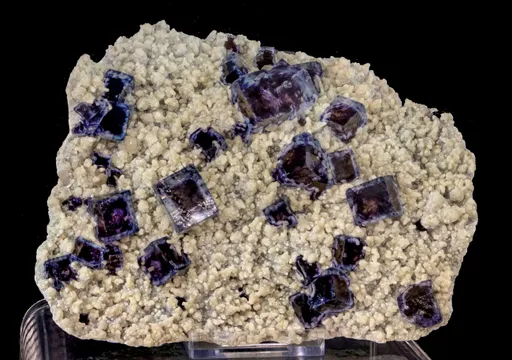
Inner Mongolia, China - key locality for mineral specimens, notably Huanggang skarn with blue-purple fluorite on quartz, magnetite, and cassiterite; prized for…
Key facts
Inner Mongolia has two very different meanings to mineral collectors. On a global economic-geology map it immediately evokes Bayan Obo, the enormous iron–rare-earth–niobium deposit north of Baotou, a locality of historic importance for rare-earth mineralogy and the type locality for several uncommon species. In the specimen market, however, a label reading simply “Inner Mongolia, China” most often points to the Huanggang or Huanggangliang mining complex near Chifeng: a Cretaceous granite-related Fe-Sn polymetallic skarn system that suddenly became one of China’s great modern specimen sources in the early 2010s.
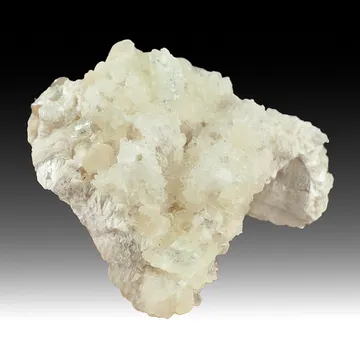
At Huanggang, granitic intrusions met Permian carbonate rocks and produced a long, compartmentalized skarn field with magnetite, cassiterite, sulfides, calc-silicates, fluorite, quartz, carbonates, and late hydrothermal vein minerals. That geological complexity is exactly what collectors see in the specimens. The best Inner Mongolia pieces are not monotonous ore samples; they are architectural combinations—blue to purple fluorite beads and octahedra on white “candle” quartz, pink fluorite octahedra against byssolite-rich matrix, lustrous arsenopyrite and löllingite on magnetite, green hedenbergite or amphibole with quartz, fluorescent scheelite, and pale pink manganoan calcite plates folded around glassy quartz.
Regional View
Country View
The collector fame of the region rests on freshness. Huanggang did not spend a century feeding the Western specimen trade; it arrived in force in the Internet era, when pockets could be photographed, circulated, and sold almost as quickly as miners and dealers learned which material would survive extraction. Early finds brought ilvaite, arsenopyrite, hedenbergite, and transparent octahedral fluorite; later, large pockets of pink fluorite and distinctive blue botryoidal fluorite-on-quartz combinations gave the locality a visual identity that is now instantly recognizable.

Photo: James St. John / Wikimedia Commons
Bayan Obo adds a deeper scientific dimension. It is not mainly a source of showy cabinet specimens in the way Huanggang is, but it is one of the most important mineral deposits on Earth: a supergiant REE-Nb-Fe system with monazite, bastnäsite-group minerals, fluorite, magnetite, hematite, niobium minerals, and a long list of rare species. For collectors, the region’s appeal lies in this unusual dual identity: world-class ore geology on one side, and one of the most distinctive modern Chinese specimen assemblages on the other.

Search for specimens: View all specimens from Inner Mongolia, China
For collector purposes, the dominant specimen-producing locality behind most modern Inner Mongolia fluorite and quartz labels is the Huanggang Fe-Sn deposit in Hexigten Banner, Chifeng City. The older market names Huanggang, Huanggangliang, Huanggang Mine, Huanggang Mines, and sometimes simplified “Chifeng, Inner Mongolia” all refer to this same broad mining complex or to parts of it. A serious locality label should preserve the mine number when known, because No. 1, No. 2, No. 4, No. 5, No. 6, and No. 7 material can differ sharply in habit and association.
Geologically, Huanggang is a skarn-type iron-tin-polymetallic deposit in the southern Great Xing’an Range metallogenic belt of northeastern China. The mineralization developed where Cretaceous orthoclase granite intrusions interacted with carbonate rocks of the Early Permian Dashizai and Huanggangliang formations. Garnet-diopside skarn and garnet-amphibole-biotite skarn formed along the intrusive contacts, and later hydrothermal activity introduced cassiterite, magnetite, arsenopyrite, pyrite, fluorite, quartz, carbonates, amphibole, epidote, and polymetallic sulfides. The skarn system is not a single pocket zone but a long mineralized belt with western iron-rich orebodies and eastern tin-rich skarn lenses.
The district is worked as a commercial mining complex rather than a recreational collecting field. Published locality summaries describe seven mines distributed through a deposit area roughly 19.5 km long. Mines 1–4 are associated with the more isolated iron-rich western skarn orebodies, while mines 5–7 work the eastern tin-rich skarn lenses developed in marble along the southern contact of the eastern intrusion. Collectors should therefore treat “Huanggang” as a district name, not as a single shaft-locality in the old European sense.
Mining history and collector history do not start at the same moment. The ore deposit was known well before the specimen boom and was described in technical literature as an active iron-tin skarn system by the late twentieth century, with mining by Inner Mongolia Huanggang Mining Co., Ltd. beginning in 1993 in parts of the deposit. The collector breakthrough came much later, around 2010, when ilvaite and then a widening range of specimen-quality minerals began reaching Chinese and international dealers. By 2011 and 2012, Huanggang had become one of the most watched new Chinese localities, and The Mineralogical Record devoted major coverage to the mine and to field visits there.
Huanggang specimens enter the market through miners, local handlers, Chinese dealers, and international dealers. Direct collecting by visitors should not be assumed; this is an operating mining district with commercial access, safety controls, and local permissions. The best provenance comes from pieces that retain their mine number, year or find period, and association: “No. 5 Mine, Huanggang Fe-Sn deposit” means much more than “Inner Mongolia fluorite,” especially for pink fluorite and some quartz-fluorite combinations.
Notable pocket records include the first wave of transparent octahedral fluorite in the latter part of 2010, with crystals reportedly reaching 13 cm; many were separated from matrix before miners recognized their specimen value, and some were damaged by thermal shock as they came from cold mine conditions. A later pink fluorite pocket at No. 5, mined over 26–29 August 2019, yielded thousands of loose octahedral crystals, clusters, a few dozen large crystals reaching 16 cm, about 100 good matrix specimens, and approximately 5 kg of gem rough, mostly from broken crystals. This pocket also produced cut stones, including large pink fluorites in the tens to hundreds of carats.
Bayan Obo, near Baotou, is the second essential Inner Mongolia name for advanced collectors. It was discovered as an iron deposit in 1927, with rare-earth minerals recognized in 1936 and niobium-bearing ores recognized in the late 1950s. Its specimen appeal is mostly scientific and systematic: rare-earth carbonates and fluorocarbonates, niobium minerals, fluorite-rich ores, type-locality species, and research material. Unlike Huanggang, it is not chiefly prized for abundant aesthetic fluorite-on-quartz cabinet pieces, but its place in mineralogy is enormous.
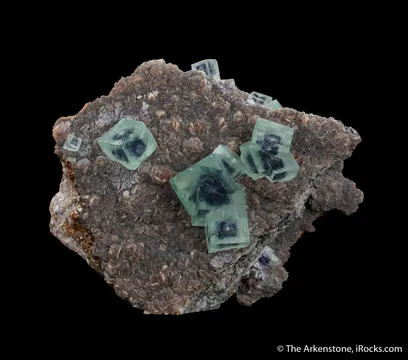
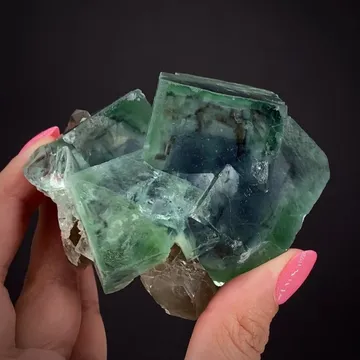
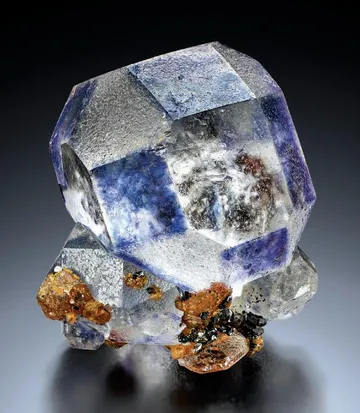
Inner Mongolia fluorite in the modern specimen trade is dominated by Huanggang, where fluorite appears in several strongly collectable styles: colorless to pale green, blue, purple, pink, and bluish botryoidal to microcrystalline coatings on quartz. Fine pieces show sharp octahedra, complex forms balancing cube, octahedron, and dodecahedron, or the now-familiar “blueberry” habit—rounded blue fluorite aggregates draped over white to translucent quartz. No. 5 is especially important for pink fluorite, including octahedra and clusters from the 2010 and 2019 finds; good crystals can be large, but matrix specimens with undamaged octahedra, clean contrast, and associated byssolite, quartz, calcite-dolomite, or magnetite are much scarcer than loose singles. Ordinary pieces tend to be crowded, bruised, or indistinctly coated; the best have saturated color, crisp geometry, intact terminations, and an unmistakable skarn association rather than a generic “China fluorite” look.
Huanggang quartz is valuable to collectors less for classic rock-crystal perfection than for habit, inclusions, and association. It occurs as white to translucent “candle” quartz, parallel-growth and sceptered groups, dipyramidal crystals with little or no prism development, and green included quartz colored by amphibole, especially ferro-actinolite or related calcic amphiboles. Some pieces have been misleadingly marketed as beta-quartz because of their dipyramidal habit, but they are quartz growth forms from the skarn-hydrothermal system rather than preserved high-temperature beta-quartz paramorphs. The locality is also known for trapiche-like slabs and polished sections showing six-rayed dark, green, or red inclusion patterns; studies have tied these patterns to fibrous amphibole, clay minerals, hematite, or iron-rich inclusions incorporated during complex growth. The best collector specimens keep their three-dimensional quartz architecture intact and add fluorite, magnetite, calcite-dolomite, hedenbergite, or byssolite for contrast.
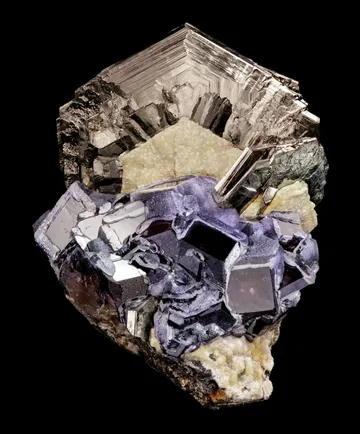
Other documented Inner Mongolia minerals make the region far broader than fluorite and quartz. Huanggang has produced important collector specimens of ilvaite, hedenbergite, andradite-grossular garnet, arsenopyrite, löllingite, magnetite, scheelite, sphalerite, calcite, dolomite, byssolite-type amphibole, pyrite, cassiterite, and rarer beryllium minerals such as bavenite and genthelvite-group material reported from the district. Bayan Obo is a systematic collector’s landmark, with type-locality or historically important rare species including zhangpeishanite, yangzhumingite, huanghoite-(Ce), huanghoite-(Nd), bayanoboite-(Y), cebaite-(Ce), and zhonghuacerite-(Ce). Harhada, in the Wenduermiao iron deposit near Erenhot, adds erlianite, a vanadium- and iron-bearing silicate described from Inner Mongolia in the 1980s.
The main collecting issue with Inner Mongolia specimens is not artificial manufacture but precision of identity. Labels are often compressed to “Inner Mongolia,” “Huanggang,” “Huanggangliang,” or “Chifeng,” and mine-number detail is frequently lost. For common fluorite-on-quartz this may be tolerable, but for serious cabinet or reference pieces the best label should record Huanggang Fe-Sn deposit, Hexigten Banner, Chifeng City, Inner Mongolia, China, and the mine number when known.
Be alert to misused habit names. Dipyramidal Huanggang quartz is sometimes described as beta-quartz; reputable dealer descriptions have specifically warned that some crystals lack prism faces and have been erroneously called beta-quartz. Treat “beta quartz” claims from this locality as a red flag unless the seller explains the morphology carefully and does not imply that a high-temperature polymorph is present at room temperature.
Condition is a major factor in value. Fluorite from Huanggang commonly shows bruised edges, contacted faces, pocket abrasion, cleaved crystals, and separated octahedra. Pink octahedral fluorite is especially condition-sensitive; early material suffered from rough extraction and thermal shock when pieces were removed from cold mine conditions. Blue botryoidal fluorite on quartz should be checked for rubbed high points, detached quartz tips, and healed or glued breaks along the quartz matrix. Quartz points often show contacts or broken terminations hidden under fluorite coatings; always inspect from the side, not only from the display face.
Fluorescence varies by species and specimen. The pink fluorite studied as gem material from Huanggang was reported inert to both long-wave and short-wave ultraviolet radiation, so strong fluorescence should not be assumed for every fluorite from the district. Calcite and some carbonate-bearing pieces may fluoresce, and scheelite from Huanggang can be highly responsive under short-wave UV. Store fluorite away from hard minerals, protect sharp octahedral corners, and avoid rapid temperature changes for large, included, or internally strained crystals.
Market availability remains relatively good compared with classic localities that are long exhausted, but quality is stratified. Small fluorite-on-quartz pieces and included quartz specimens appear regularly; fine pink fluorite matrix specimens, large undamaged octahedra, sharp löllingite or arsenopyrite associations, and top scheelites are far scarcer. The name “Inner Mongolia” on an inexpensive specimen should be treated as a starting point, not a complete provenance.
In June 2011, John Chen visited the Huanggang mine during a China minerals trip that ran from June 6 to June 17. His field note catches the district at the moment it was becoming visible to collectors. The locality, he wrote, had been recognized as a good specimen source around June 2010, first for interesting ilvaite and then for transparent octahedral fluorite, arsenopyrite with pink or red fluorite, quartz, hedenbergite, pyrite, aquamarine, and pink calcite. The tone of the report is full of the excitement of a locality still being sorted out: “Minerals species looks so many,” and the quantity of specimens looked substantial.
That early trip also shows how quickly collectors were trying to impose order on a complicated mining field. Chen described about eight mining areas and offered a preliminary breakdown: No. 1 for hedenbergite, garnet, quartz, ilvaite, and fluorite; No. 2 for arsenopyrite, hedenbergite, and ilvaite; No. 5 for calcite and fluorite. The notes are rough, but that roughness is part of their value. They come from the mine’s first wave of collector attention, before the international market had settled into the polished labels and shorthand names that are common today.
The report includes small, vivid moments that make Huanggang feel less like a locality name and more like a place. The party rented a local taxi and took the ReShui route to save time. There were horses near the road, silver birch forest, fresh air, and a hunter club near the mine. At night they met a red deer that stood in the car headlights for a while before disappearing. On the mountain road, the taxi’s brake pad began burning; they stopped and cooled it with water. In a miner’s sleeping room, Chen Xiao Jun was photographed among many small broken ilvaite crystals—a telling image from the period when specimen value and extraction technique were still catching up with one another.
The pink fluorite story has its own drama. The first major find in late 2010 produced translucent octahedral crystals to 13 cm, but many were broken from their matrix before the miners appreciated them as specimens. Some pieces were also damaged by thermal shock as they came out of cold mine workings or were handled bare-handed. Nearly a decade later, the August 26–29, 2019 No. 5 pocket showed how much had changed. This time the pocket was worked more carefully from the edge of a skarn, yielding thousands of loose octahedra, clusters, a few dozen crystals to 16 cm, about 100 good matrix specimens, and roughly 5 kg of gem rough. The same locality that had once destroyed too many large pieces had learned, pocket by pocket, how to save them.
Berthold Ottens and Günther Neumeier, “The Huanggang mine, Inner Mongolia, China,” The Mineralogical Record, 43(5), 529–563, 2012 — The major collector-oriented reference on Huanggang mineralogy and specimen production.
Robert Lavinsky and Xiaojun Chen, “Visiting the Huanggang mines,” The Mineralogical Record, 43(5), 571–581, 2012 — Cited in later gemological literature for observations on mine visits, early fluorite recovery, and the specimen boom.
Mei Wei, Lü Xiangkun, Cao Xiaofeng, Liu Zhongfa, Zhao Yiming, Ai Zuowen, Tang Rui, and Abfaua M. M., “Ore genesis and hydrothermal evolution of the Huanggang skarn iron–tin polymetallic deposit, southern Great Xing’an Range: Evidence from fluid inclusions and isotope analyses,” Ore Geology Reviews, 64, 239–252, 2014 — A key ore-geology study of Huanggang’s skarn-hydrothermal evolution.
Xue Hanwen, Wang Keyong, Sun Qingfei, Chen Junchi, Wang Xue, and Li Haoming, “Ore Genesis of the Huanggang Iron-Tin-Polymetallic Deposit, Inner Mongolia: Constraints from Fluid Inclusions, H–O–C Isotopes, and U-Pb Dating of Garnet and Zircon,” Minerals, 15(5), 518, 2025 — Recent open-access synthesis defining mineralization stages from anhydrous skarn through carbonate stages.
Wang Li Juan, Shimazaki Hidehiko, and Shiga Yoshihide, “Skarns and Genesis of the Huanggang Fe-Sn Deposit, Inner Mongolia, China,” Resource Geology, 51, 2001 — Earlier technical description of Huanggang skarn mineralogy and genesis.
Brendan M. Laurs, “Pink Fluorite from Inner Mongolia,” Journal of Gemmology, 37(3), 2020 — Documents the 2019 No. 5 pink fluorite pocket, large crystals, gem cutting, and UV response.
Brendan M. Laurs, “Gem Notes: Quartz slabs from Inner Mongolia,” Journal of Gemmology, 35(1), 15–16, 2016 — Early gemological note on polished Huanggang quartz slices with six-fold internal patterns.
Emmanuel Fritsch, “Hematite Inclusions in Red Trapiche Quartz from Inner Mongolia,” Journal of Gemmology, 37(6), 569–571, 2021 — Describes red-included trapiche quartz material from Inner Mongolia and its hematite-related features.
Gabriela A. Farfan, John Rakovan, Michael R. Ackerson, Benjamin J. Andrews, and Jeffrey E. Post, “The origin of trapiche-like inclusion patterns in quartz from Inner Mongolia, China,” American Mineralogist, 106(11), 1797–1808, 2021 — Scientific treatment of the fibrous amphibole and clay inclusion patterns in Inner Mongolia quartz.
ShuXin Zhao, Tao Li, Qingfeng Guo, LiangYu Liu, Yinghua Rao, and Libing Liao, “Gemological characteristics and inclusions of green rutilated quartz from Huanggangliang, Inner Mongolia,” RSC Advances, 14, 2896–2904, 2024 — Identifies green hairlike inclusions in Huanggangliang quartz as calcic amphiboles close to ferro-actinolite.
Hidehiko Shimazaki, Ritsuro Miyawaki, Kazumi Yokoyama, Satoshi Matsubara, and Zhuming Yang, “Zhangpeishanite, BaFCl, a new mineral in fluorite from Bayan Obo, Inner Mongolia, China,” European Journal of Mineralogy, 20(6), 1141–1144, 2008 — New-mineral description of zhangpeishanite from Bayan Obo fluorite.
Ritsuro Miyawaki, Hidehiko Shimazaki, Masako Shigeoka, Kazumi Yokoyama, Satoshi Matsubara, and Hisayoshi Yurimoto, “Yangzhumingite, KMg2.5Si4O10F2, a new mineral in the mica group from Bayan Obo, Inner Mongolia, China,” European Journal of Mineralogy, 23(3), 467–473, 2011 — Type-mineral publication for yangzhumingite from Bayan Obo.
Yuan Xue, Ningyue Sun, Guowu Li, Jinhua Hao, Peng Liu, Wenlei Song, Xianhua Li, Junfeng Shen, Li Yang, Zhaojing Wang, Wenxiang Meng, Guoying Yan, Yonggang Zhao, and Yun Liu, “Bayanoboite-(Y), IMA 2023-084,” CNMNC Newsletter 77, European Journal of Mineralogy, 36, 2024 — IMA announcement for bayanoboite-(Y), a new barium-HREE fluorocarbonate from the Bayan Obo main pit.
Shuiyuan Yang, Zhengxi Gao, Qing Zhang, Laishi Zhao, Fengqin Bao, Xiangping Gu, Guang Fan, and Qifeng Li, “Huanghoite-(Nd), IMA 2025-014,” CNMNC Newsletter 85, European Journal of Mineralogy, 37, 337–342, 2025 — IMA announcement for the Nd-dominant analogue of huanghoite-(Ce) from Bayan Obo.
Xiancan Feng and Ruiying Yang, “Erlianite, a new vanadium- and iron-bearing silicate mineral,” Mineralogical Magazine, 50(356), 285–289, 1986 — Description of erlianite from the Harhada iron deposit along the Jining–Erlian railway in Inner Mongolia.
“Fluorite on Quartz,” Heritage 1971 — Dealer video linked from a Huanggang fluorite-on-quartz specimen page, useful for seeing luster, relief, and three-dimensional arrangement.
“Fluorite (octahedral) with Calcite from Huanggang Mines, Inner Mongolia Autonomous Region, China,” Vimeo — Rotating specimen video of octahedral fluorite with calcite from Huanggang.
“Fluorite (octahedral) with Mica (Group) from Huanggang Mines, Hexigten Banner, China,” Vimeo — Specimen video showing the octahedral fluorite habit from the Huanggang mining complex.
“dmb1345 FLUORITE, Huanggang Fe-Sn Deposit (No. 5 Mine), CHINA,” Vimeo — Video record of a No. 5 Mine Huanggang fluorite specimen.
Mindat: Huanggang Fe-Sn deposit, Hexigten Banner, Chifeng City, Inner Mongolia, China — Core locality page for the Huanggang mining complex, including mineral list, mine subdivisions, coordinates, and references.
Mindat article: John Chen, “China Minerals trip: HuangGang mine, Keshiketeng Qi, ChiFeng, Inner Mongolia, 2011” — Early field note from the moment Huanggang was entering the international specimen market.
Mindat: Bayan Obo deposit, Bayan Obo mining district, Baotou City, Inner Mongolia, China — Essential reference for Bayan Obo’s rare-earth, niobium, fluorite, and type-mineral assemblage.
USGS: “Sedimentary carbonate-hosted giant Bayan Obo REE-Fe-Nb ore deposit of Inner Mongolia, China” — Authoritative overview of Bayan Obo as a giant hydrothermal rare-earth–iron–niobium system.
USGS: “The Bayan Obo iron-rare-earth-niobium deposits, Inner Mongolia, China” — Earlier USGS publication on the regional geology and economic geology of Bayan Obo.
Mindat: Harhada Mine, Wenduermiao Fe deposit, Inner Mongolia, China — Locality page for the type locality of erlianite and associated iron-formation minerals.
Fabre Minerals reference page for China specimens — Useful dealer archive illustrating Huanggang habits, associations, mine dates, and recurring mislabel issues such as “beta-quartz” descriptions.
Journal of Gemmology, Volume 37 No. 3, 2020 PDF — Contains Brendan Laurs’s gem note on pink fluorite from Inner Mongolia and the detailed 2019 pocket information.
RSC Advances: “Gemological characteristics and inclusions of green rutilated quartz from Huanggangliang, Inner Mongolia” — Open-access research on green included quartz from Huanggangliang.
American Mineralogist abstract: “The origin of trapiche-like inclusion patterns in quartz from Inner Mongolia, China” — Scientific explanation of trapiche-like quartz inclusion patterns from the region.
Wikimedia Commons: Manganoan calcite and quartz from Huanggang Mine — Freely licensed photograph illustrating the pink calcite–quartz style of Huanggang specimens.
Wikimedia Commons: Cebaite-(Ce) from Bayan Obo — Freely licensed image of a rare Bayan Obo type-locality mineral.
_(43556234741).jpg)
.jpg)