A collector's guide to Azul Bien Grande Pocket, Pederneira Mine, São José da Safira, Brazil: its geology, mining history and notable minerals, illustrated with the 34 specimens documented from this locality on EarthWonders.
Key facts
The Azul Bien Grande Pocket is one of the named pocket discoveries that gave the Pederneira Mine its almost mythic status among modern tourmaline collectors. Pederneira lies in the São José da Safira pegmatite district of eastern Minas Gerais, within the Eastern Brazilian Pegmatite Province, a region whose great lithium-rich granitic pegmatites also include such names as Cruzeiro, Aricanga, Golconda, and Jonas. The mine’s collector fame rests on highly evolved miarolitic cavities in complexly zoned pegmatite, where elbaite tourmaline, cleavelandite, lepidolite, quartz, feldspar, and a small cast of phosphate and beryllium minerals grew together in pockets rather than merely occurring as gem rough in massive pegmatite.
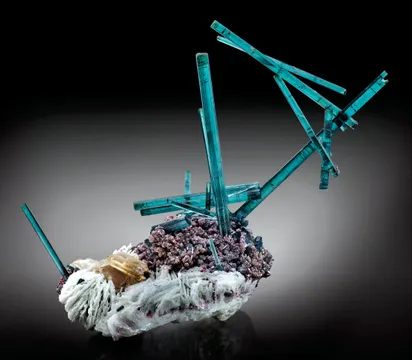
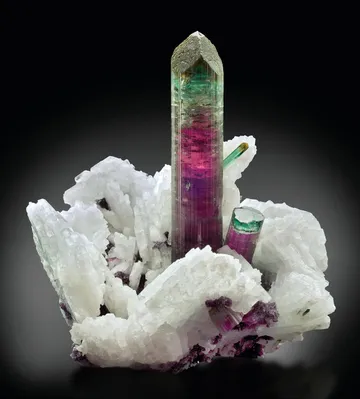
Azul Bien Grande matters because it combined scale, color, and matrix in a way that is unmistakably Pederneira but also pocket-specific. Discovered in the last days of May 2004 in Dada’s Tunnel, it was reported at nearly 5 cubic meters—enormous for a specimen-producing pegmatite pocket. Its name is usually rendered in English as “Blue, Good ’n’ Big,” and the best specimens justify every word: deep blue to steel-blue indicolite crystals, some with violet or lilac internal color architecture, rising from snowy cleavelandite, lavender to purple lepidolite, pale citrine quartz, and feldspar. The finest pieces are not simply blue tourmalines; they are architectural pocket specimens, with long glassy prisms standing upright or radiating from a light-colored matrix that seems to have been designed to set off the blue.
Regional View
Country View
In the Pederneira sequence, Azul Bien Grande followed close on the heels of the Grandon Pocket and immediately preceded the Bi-Color Steel Pocket, placing it in one of the mine’s most important production years. Its distinction is not just that it was large, but that it produced elegant blue tourmaline specimens of major size with comparatively favorable condition for such long, delicate crystals. Published accounts describe crystal groups averaging 20 to 25 cm, the largest crystals around 40 cm, a 59 cm tourmaline-lepidolite-cleavelandite specimen, a 62 cm tourmaline-quartz-cleavelandite-lepidolite specimen, and the 30 cm “Smokestacks,” a matrix piece with massive deep-blue tourmalines grown on cleavelandite, quartz, and lepidolite.
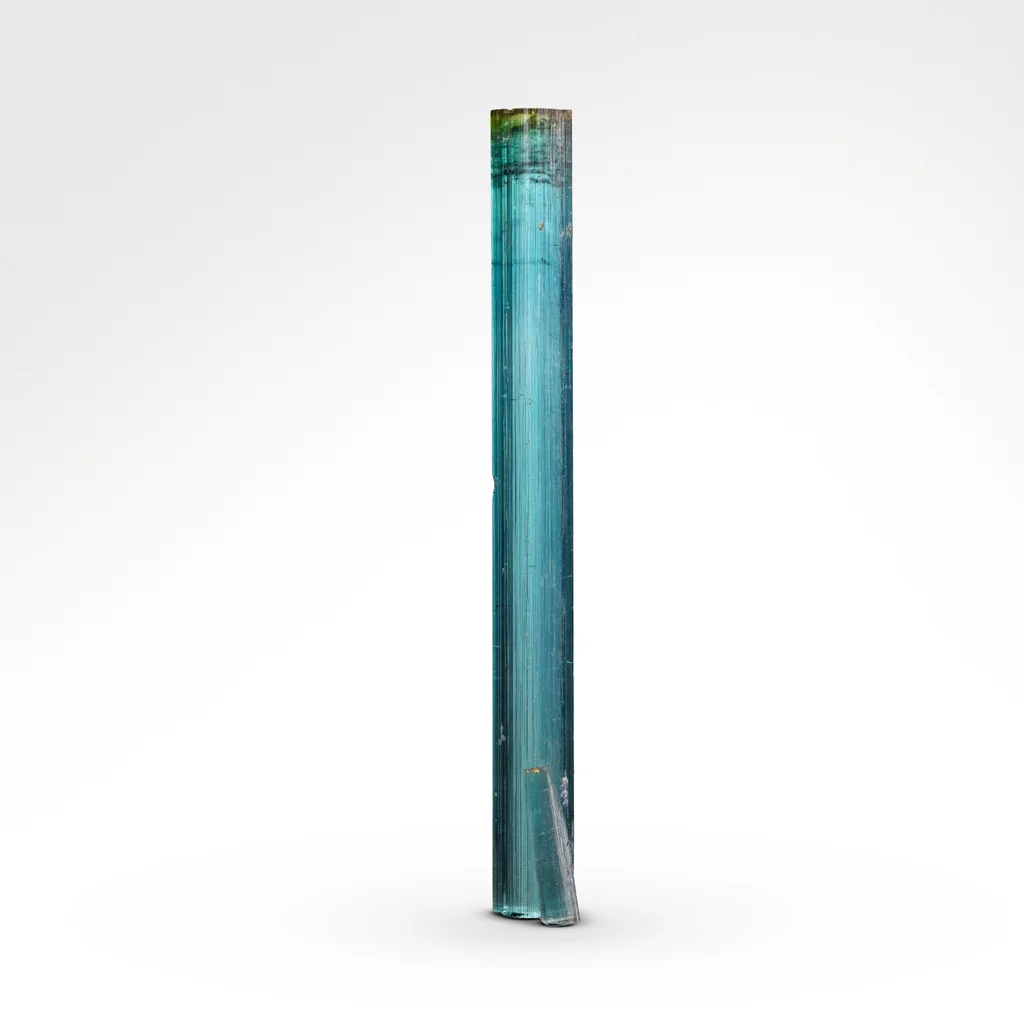
Photo: EarthWonders specimen record
The pocket is also important as a case study in how modern high-end pegmatite specimens reach the market. Azul Bien Grande did not appear as a neat box of perfect crystals ready for a show table. Its contents had to be laid out, studied, matched, cleaned, repaired where appropriate, and reconstructed over a period long enough that the pocket entered the market in portions rather than all at once. For collectors, that history is part of the label: an Azul Bien Grande specimen is judged by color and transparency, certainly, but also by credible pocket attribution, matrix integrity, documented repair status, and whether the piece still reads as a natural pocket object rather than an assembled curiosity.
Search for specimens: View all specimens from Azul Bien Grande Pocket, Pederneira Mine, São José da Safira, Brazil
Pederneira is a lithium-rich granitic pegmatite locality in the municipality of São José da Safira, Minas Gerais, Brazil. The mine is also known historically as the Pederneira claim or Lavra da Pederneira. It is situated in the São José da Safira district of the Eastern Brazilian Pegmatite Province, a province dominated by highly differentiated pegmatites related to late to post-collisional granitic magmatism in the Araçuaí orogenic belt. At the mine scale, the important pegmatites crop out in a small valley of the Córrego da Pederneira at roughly 700 to 750 meters elevation.
The two principal pegmatite bodies exploited in the modern mine are known through the workings as Dilo and Dada. Geological mapping described them as two subparallel tabular pegmatite bodies, nearly concordant with the schistosity of their host rocks and separated by a mica-schist septum. The country rock is biotite-quartz-garnet mica schist with an east-west-trending foliation dipping gently south. In simple tabular portions, the pegmatite may be only about half a meter to a few meters thick and relatively poor in collectible pocket mineralization. The most important specimen production came where the bodies changed attitude and swelled into steep, prismatic or columnar sectors, locally reaching 15 meters or more in thickness.
The Pederneira deposit is not an “ore body” in the conventional metallic-mining sense, although muscovite was the first economically exploited material and gemstones remain an economic commodity. For collectors, the ore body is effectively the pocket plane: a highly evolved zone near the pegmatite core where open cavities formed between upper and lower core zones. These cavities are the source of the mine’s elbaite tourmaline specimens. The common pocket assemblage is quartz, albite of the cleavelandite variety, lepidolite-group mica, K-feldspar, muscovite, and tourmaline, with accessory beryl, fluorapatite, hydroxylherderite, helvine, cassiterite, niobium-tantalum oxides, and related late-stage minerals recorded from the mine.
The cavity structure explains much about Pederneira specimens. Many large pockets were partly collapsed before miners reached them, leaving broken crystals, fresh roof rock, and a pile of pocket rubble that could conceal intact groups. Extraction therefore required slow hand work, pneumatic splitters, diamond chain saws, careful wrapping, and later preparation. Matrix specimens were commonly cut from pocket walls, floors, or sides, while broken but matching crystals were later reattached to original fit points when those contacts were preserved. This is why repairs are not incidental in Pederneira collecting; they are inseparable from the geology, mining, and preparation history of the great pockets.
The mining history began with mica. During World War II, muscovite from the area was valuable, and the earliest workings were tied to mica-rich outcrops rather than collector tourmaline. A first significant tourmaline-specimen era developed in Dilo’s Tunnel in the 1980s and early 1990s under local miners including Dilermando Rodrigues de Melo, from whom the tunnel name “Dilo” derives. That period produced important tourmaline material but not with the same systematic pocket-by-pocket documentation that later made Pederneira labels so meaningful.
The modern specimen era began in 1999 with Dada’s Tunnel, about 100 meters above the older workings. Dada, who had worked in the earlier lower adit, found a new pegmatite outcrop and began tunneling into it with his sons. The initial working group included Dada, Eustacio Neves, and landowner José Oliveira Rocha, known as Deca. The pocket that became known as Keké’s Pocket brought extraordinary green tourmaline and vivid lepidolite into the market and helped create the M. Pederneira Limited partnership. From that point onward, Pederneira became one of the rare mining projects in which preserving display specimens—not just producing gem rough—was a central purpose.
Dada’s Tunnel supplied the named-pocket sequence that collectors still recite: Keké’s Pocket, Giant Quartz Pocket, Sharon Stone Pocket, Proud Pocket, Rocket Pocket, Afghan Pocket, Porcupine Pocket, 18% Pocket, Morganite Pocket, Big Blue Pocket, Grandon Pocket, Azul Bien Grande Pocket, Bi-Color Steel Pocket, and others. The upper tunnel was considered largely exhausted by about 2007 and was closed in early 2008. A third era centered on the reopening and rehabilitation of Dilo’s Tunnel, a process that began in 2005 but required years of cleaning, infrastructure work, mapping, and renewed exploration.
The Azul Bien Grande Pocket belongs to the Dada’s Tunnel era and was discovered in late May 2004. It was one of the most voluminous pockets in the documented Pederneira history, nearly 5 cubic meters, and so productive that more than three rooms in the Pederneira house in Governador Valadares were reportedly needed simply to lay out the recovered contents. Reconstruction and preparation took more than a year just to understand the scale of what had been collected, and parts of the pocket were marketed over a period of years because the quantity and preparation demands were too great for a single release.
Collecting access today should be understood as private, commercial, and controlled. Pederneira is an underground mine, not a public dig site. Published accounts describe a working mine with tunnels, generators, compressors, ventilation, drills, water handling, diamond chain saws, hydraulic splitters, security measures, a camp, and a preparation chain that extended from the mine to Governador Valadares and then to specialized laboratories. Fine Azul Bien Grande specimens on the market should be regarded as mine-produced, dealer-handled, or collection-circulated objects, not field-collected pieces.
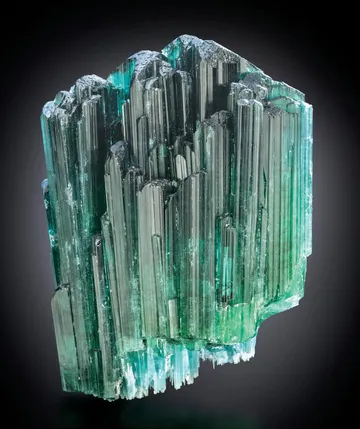
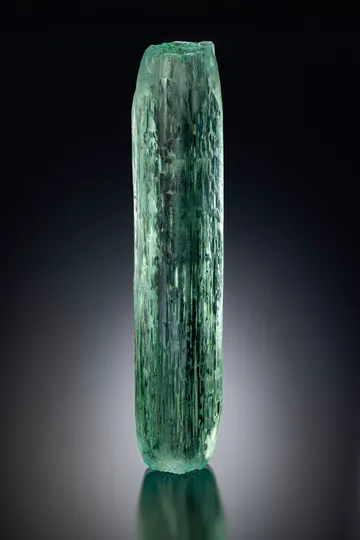
Tourmaline from the Azul Bien Grande Pocket is chiefly prized as blue elbaite—indicolite in collector language—with long, strongly striated, glassy prisms that may show a light violet to lilac core surrounded by a steel-blue exterior, sometimes with narrow red or darker terminal zoning. The best crystals are elegant “pencils,” either isolated or rising from cleavelandite-lepidolite-quartz matrix, and the pocket produced both major cabinet matrix specimens and smaller single crystals; published examples include groups with crystals averaging 20 to 25 cm, crystals to about 40 cm, and matrix pieces as large as 59 to 62 cm. A strong Azul Bien Grande tourmaline has saturated blue color, transparency, crisp terminations, undistorted prism faces, and believable matrix context; ordinary pieces tend to be merely blue rods with edge wear, missing bases, weak zoning, or unsupported pocket attribution.
Cleavelandite from Azul Bien Grande is the bright structural counterpoint to the pocket’s blue tourmaline: white to slightly bluish albite in bladed, platy, fanlike, or “bloom” aggregates that provided natural pedestals for the tourmalines. In the great matrix specimens, cleavelandite occurs with lepidolite and pale citrine quartz, framing the blue indicolite and giving the pieces the high-contrast Pederneira look that collectors recognize immediately. The best cleavelandite here is sharp, fresh, lustrous, and visibly crystallized rather than sugary or massive; pieces where the blades form a coherent base, cradle the tourmaline, and retain clean surfaces are far more desirable than those with crushed albite, iron-stained cleavages, or a matrix that appears merely as pale rubble under the crystals.
Lepidolite in the Azul Bien Grande Pocket is an essential aesthetic mineral rather than a background accessory, occurring as lavender, lilac, purple, or reddish-purple mica aggregates with tourmaline, cleavelandite, and quartz. Its best role is chromatic: it warms the cool blue of the indicolite and the icy white of cleavelandite, especially on specimens where small lepidolite clusters sit like colored accents around the tourmaline bases. The most attractive examples show fresh micaceous sparkle, distinct rosettes or granular clusters, and strong placement within the composition; less successful pieces have dull, friable, muddy, or rubbed lepidolite that sheds easily and contributes little more than a purple stain on the matrix.
Quartz from Azul Bien Grande is most important as matrix and accent, commonly pale citrine to smoky or colorless and associated with blue tourmaline, cleavelandite, and lepidolite. Published Azul Bien Grande examples include pale citrine quartz crystals with minor tourmaline and cleavelandite, as well as large tourmaline-bearing matrix pieces in which quartz adds mass, sparkle, and a pale golden contrast to the blue indicolite. The strongest quartz-bearing specimens are those where the quartz is well terminated, lustrous, and compositionally integrated rather than a bulky support; bruised terminations, cloudy broken quartz, or quartz that overwhelms the tourmaline tends to lower the visual balance, even when the associated tourmaline is good.
Other minerals documented specifically with Azul Bien Grande material include hydroxylherderite, recorded on small tourmaline-lepidolite and tourmaline specimens from the pocket. More broadly at Pederneira, the species list includes albite, beryl including uncommon morganite, elbaite and other tourmaline-group members, fluorapatite, orthoclase or microcline-type feldspar, helvine, hydroxylherderite, mica-group minerals including lepidolite, quartz, and spodumene, with cassiterite and niobium-tantalum oxides noted in evolved pegmatite zones. The locality is not known primarily as a type locality; its rarity value lies instead in world-class pocket aesthetics, pocket-specific tourmaline habits, and uncommon accessory associations preserved with top tourmaline specimens.
Azul Bien Grande specimens should be assessed with the same seriousness one would bring to any elite Pederneira label: color, transparency, termination, matrix, repair, and documentation all matter. The pocket’s best-known visual signature is blue to steel-blue elbaite, commonly with violet or lilac internal color and, in some examples, subtle red or darker terminal zoning. A specimen labeled Azul Bien Grande but lacking strong blue color, appropriate Pederneira matrix, credible provenance, or pocket-style consistency deserves scrutiny.
Repairs are the central authenticity and value issue. Many Pederneira pockets were naturally collapsed or partly broken before mining, and long tourmaline crystals are especially prone to breakage. Repaired Pederneira specimens are therefore not automatically suspect; they may be entirely legitimate if the repairs are original lock-fit joins and are disclosed. Azul Bien Grande has an advantage over some other Pederneira pockets because several of its longer crystals were reported with only one or two repairs, often near the base where crystals meet the matrix. That makes unrepaired or minimally repaired Azul Bien Grande pieces particularly desirable, but also means claims of “no repairs” should be checked carefully.
Use magnification on attachment points, crystal bases, and matrix contacts. On matrix pieces, examine whether cleavelandite, lepidolite, quartz, and tourmaline meet naturally or whether adhesive has been used to disguise an artificial placement. UV light can be useful for detecting some glues, though not all adhesives fluoresce. Study growth striations, continuity of color zoning, matching break surfaces, and whether a crystal’s weight and orientation make sense on the matrix. A clean, disclosed repair on a major pocket specimen is a different matter from a hidden join, a mismatched crystal, or an artificially improved composition.
Condition problems are predictable: bruised terminations, chipped prism edges, broken or missing bases, rubbed lepidolite, cleaved or crushed albite, and small losses on quartz points. Cleavelandite blades can be deceptively fragile, and lepidolite may shed fine mica flakes if handled roughly. Avoid ultrasonic cleaning, aggressive brushing, acids, or repeated wetting. Dust with air, a very soft brush, or professional preparation advice. Tourmaline itself is relatively durable for cabinet display, but the matrix minerals and repairs are not.
Mislabelling is common enough to matter. Labels may say “Azul Bien,” “Azul Bien Grande,” “Azul Being Grande,” “Pederneira,” “Pederniera,” “indicolite,” or simply “blue tourmaline from Brazil.” Some loose blue Pederneira crystals are plausibly from Azul Bien Grande, but a plausible color match is not equivalent to documented pocket provenance. Older dealer labels, publication history, photographs from the original release, collection provenance, or association with known Pederneira dealers and preparers all strengthen an attribution.
No locality-specific treatment issue dominates Azul Bien Grande specimen collecting in the way heat treatment or irradiation concerns may affect some gem materials. The practical concern is reconstruction and disclosure, not dyed or cooked crystals. For faceted stones or rough said to come from the pocket, ordinary gemological caution still applies, but for specimen collectors the questions are simpler and harder: is the crystal natural, is the matrix natural to it, is the repair history honest, and is the pocket attribution more than a sales phrase?
Market availability is limited but not nonexistent. Azul Bien Grande was large enough that material entered the market in multiple releases, and small to small-cabinet blue crystals still circulate from collections and dealer stock. Fine matrix examples, large blue crystals, unrepaired pieces, and documented major specimens are scarce and priced accordingly. Top pieces belong in the upper tier of modern tourmaline collecting, where a named Pederneira pocket label with strong documentation can be as important as locality, species, and size.
The name sounds almost too convenient until one imagines the pocket opening in late May 2004: blue tourmalines appearing in quantity, the cavity larger than expected, and the crystals seeming to multiply as they were removed. “Azul Bien Grande” is not polished mineral-show branding; it has the directness of a miner’s description. Blue. Good. Big. Nearly 5 cubic meters big. In a mine where pocket names already carried personality—Rocket, Afghan, Grandon, Porcupine—this one announced itself by scale.
The aftermath was almost domestic in its absurdity. The pocket contents were taken to the Pederneira house in Governador Valadares, the off-mine headquarters where specimens could be sorted, matched, and reconstructed in safety. More than three rooms were needed just to lay everything out. For a collector used to seeing a finished specimen isolated on a black base, that image is essential: tables and rooms filled with fragments, loose crystals, matrix pieces, labels, fits, possibilities, and the slow realization that the pocket was too large to comprehend in a single glance.
The work did not resolve quickly. It took more than a year of reconstruction just to understand the magnitude of the find. When the first crystal groups came together, they revealed why Azul Bien Grande entered Pederneira history. One remarkable group carried crystals averaging 20 to 25 cm that appeared to shoot in different directions from cleavelandite and lepidolite, while a central three-crystal group rose perpendicular to the matrix to more than 40 cm. Another specimen, “the Smokestacks,” stood 30 cm tall and displayed deep-blue tourmalines on white cleavelandite blooms with citrine quartz and lepidolite; each of the massive blue “stacks” was about 10 cm tall and 9 cm across.
The pocket also produced smaller wonders. Published photographs document 6.4 cm tourmaline crystals with hydroxylherderite and lepidolite, an 8 cm tourmaline with hydroxylherderite, pale citrine quartz to 25 cm with minor tourmaline and cleavelandite, a 28.1 cm tourmaline-on-lepidolite specimen, and multiple large blue tourmaline matrix pieces. In collector terms, the pocket was unusually complete: it supplied both the museum-scale centerpieces and the more intimate cabinet specimens that preserve the same blue-violet character at a manageable scale.
The most striking aspect of the find may be how long it remained alive after mining. Azul Bien Grande material was divided into portions and marketed over several years because there was too much material for the collector market to absorb in one release and because many specimens demanded prolonged preparation. More than a decade after the crystals first came from the mine, a final group was still described as being in a laboratory in Italy. For most mineral localities, discovery is a date. For Azul Bien Grande, discovery was only the beginning of a long second life in rooms, labs, show cases, and collections.
The broader Pederneira story gives the pocket its human frame. Dada’s Tunnel began with Dada and his sons cutting into a new outcrop above the old workings; the partnership that followed brought together Brazilian miners, landholders, gem dealers, specimen dealers, and eventually international preparers. The mine became one of the few places where the goal was not merely to remove valuable gem rough but to save specimens as specimens. That sounds obvious to collectors now, but in a pegmatite rich in gem tourmaline it is a radical choice: every crystal left on matrix is a piece of rough not cut, every pocket slowed down is immediate money delayed in favor of preservation.
Even the logistics carried drama. The road from Governador Valadares to the mine involved hours of driving, much of it unpaved, with cattle crossings, rough terrain, and the risk of landslides. Valuable pocket contents could be flown out by helicopter to reduce risk. The camp itself had the rhythms of a working mine rather than a romantic expedition: miners, drillers, assistants, compressors, generators, pumps, fans, diamond chain saws, hydraulic splitters, and a cook named Neuza whose kitchen appears repeatedly in the mine’s published story. Above ground were gardens and chickens; underground were cool, generally dry tunnels, strategy meetings, and the constant problem of deciding where the next pocket might be.
Security became part of the narrative after a 2008 attempted intrusion. Following a robbery at another mine, intruders dug under the gate near Dada’s Tunnel and entered at night, apparently hoping to mine tourmaline. Around 1 a.m., guards saw people emerge, shouts were exchanged, and bullets were fired up and down the mountain. No one was injured and nothing was taken, but the event led to a major security overhaul: watchtowers, armed guards, a halt in mining during the upgrade, and more than $100,000 in security improvements. In a mine that produced specimens like Azul Bien Grande, beauty carried risk.