A collector's guide to Aosta Valley, Italy: its geology, mining history and notable minerals, illustrated with the 59 specimens documented from this locality on EarthWonders.
Key facts
Aosta Valley is one of the compact marvels of Alpine mineral collecting: a small, mountainous region whose specimen record is far larger than its map area suggests. For collectors, its name most often means the Bellecombe–Châtillon rodingites, where altered mafic dykes enclosed in serpentinite produced gemmy vesuvianite, hessonite-rich grossular, diopside, clinochlore, and subordinate epidote in a distinctively Alpine Ca-silicate assemblage. These are not skarn specimens in the simple contact-metamorphic sense; the classic Bellecombe material grew in rodingitic boudins and veinlets tied to serpentinization and Alpine metamorphic overprint. The result is a suite of small but dazzling specimens: glassy olive to dark green vesuvianite prisms, reddish orange hessonite garnets, pale to yellow-green diopside blades, and green chloritic matrix that gives the pieces their unmistakable contrast.
Regional View
Country View
The region is broader than Bellecombe alone. On the Italian side of the Mont Blanc massif, alpine-type fissures in granite and orthogneiss around Courmayeur, Val Ferret, Triolet, Miage, Pré de Bar, and neighbouring glaciers have produced quartz and smoky quartz, often with chlorite, adularia, fluorite, anatase, rutile, titanite, and other fissure minerals. Farther east and south, the Saint-Marcel mining district gives Aosta Valley a second, more systematic-mineralogical identity: manganese, copper, iron, and rare-element assemblages at Praborna, Servette-Chuc, and Varenche include piemontite, braunite, violane, alurgite, strontiomelane, ardennite-series minerals, scandium-bearing arsenates, and other rarities that belong as much to the literature as to the display case.

Photo: Wikimedia Commons
The best Aosta specimens are characteristically Alpine in scale: thumbnails and miniatures are far commoner than large cabinet pieces, but the visual intensity is high. Fine Bellecombe vesuvianite can show brilliant flat-topped prismatic crystals with edge transparency; hessonite pieces can be carpets of red-orange garnet flashes on green clinochlore; and diopside specimens from the same paragenesis may carry pale, glassy, sharply terminated crystals against reddish garnet. Mont Blanc quartz, by contrast, has the architecture of alpine cleft growth: lustrous, well-terminated crystals, sometimes smoky, sometimes chlorite-dusted, occasionally accompanied by adularia or rare accessory species. Together, these two worlds—rodingite and alpine fissure—make Aosta Valley a locality name that serious Alpine collectors read with particular care.

Photo: Wikimedia Commons
Search for specimens: View all specimens from Aosta Valley, Italy
Aosta Valley sits in the Italian Western Alps, where several major geological units meet in a narrow mountain region: Mont Blanc granite and gneiss to the northwest; high-pressure Piemonte ophiolitic rocks, calcschists, serpentinites, metagabbros, and metabasites through much of the central and southern valley system; and additional Austroalpine and Penninic units toward the Matterhorn and Monte Rosa sectors. This structural variety explains the diversity of collectible minerals. The most recognizable display specimens are products of two different environments: open-space alpine fissures in granitic and gneissic rocks, and rodingites formed where calcium-rich, silica-undersaturated fluids altered mafic rocks within serpentinite bodies.
Bellecombe, above Châtillon and Saint-Vincent, is the critical locality for the classic vesuvianite-garnet-diopside suite. The rodingites occur near Mont-Avi as fine- and coarse-grained boudins in sheared antigorite serpentinite assigned to the Zermatt-Saas zone. The boudins may be only tens of centimetres thick, but they are cut by millimetre- to centimetre-scale rodingitic veins, and it was these veins and adjacent reaction zones that yielded the prized crystals. Published work on the Bellecombe rodingites distinguished several vein generations: early chlorite-diopside-grossular veins, andradite-grossular and diopside veins, andradite-rich garnet plus chlorite veins, grossular-rich veins, vesuvianite-rich veins, and later chlorite veins. For the collector, that sequence translates into the familiar visual combinations: hessonite or grossular with clinochlore, vesuvianite with diopside, isolated prismatic vesuvianite crystals, and small but exceptionally lustrous mixed Ca-silicate miniatures.
The genetic story at Bellecombe is unusually well documented. The rodingites began as mafic bodies—basaltic dykes and probably gabbroic material—later enclosed in serpentinite and profoundly modified during Alpine metamorphism. Their Ca-silicate minerals grew during rodingitization, a metasomatic process linked to serpentinization. Fluid-inclusion work on vesuvianite and garnet recorded saline Ca-Na brines with hydrogen and traces of methane, trapped under late Alpine greenschist-facies conditions. This matters to collectors because it explains both the mineral assemblage and the specimen style: these were not large open ore cavities, but narrow, chemically reactive Alpine veins in already deformed ultramafic rocks. The finest crystals are therefore usually modest in size, but sharply crystallized, lustrous, and compositionally distinctive.
A second collecting world occupies the Mont Blanc side of the region. Around Courmayeur, Val Ferret, the Triolet Glacier, Miage Glacier, Pré de Bar Glacier, and related sectors of the Italian Mont Blanc massif, alpine fissures cut granitic to orthogneissic rocks. These pockets have yielded clear and smoky quartz, adularia, chlorite-coated quartz, fluorite, anatase, rutile, titanite, scheelite, and rare-earth or rare-element species in classic alpine-cleft style. The best quartz specimens show the slow open-space growth expected from fissures: lustrous faces, clean terminations, chlorite phantoms or dusting, and occasional feldspar association rather than massive vein quartz. Access is alpine in the serious sense: glacier margins, steep debris, protected areas, and rapidly changing mountain conditions make old labels and collected specimens much safer territory than casual field ambition.
The Saint-Marcel valley adds the mining and type-locality dimension. At Praborna, a high-elevation manganese deposit near 1900 m was known by at least 1415 and worked intermittently into the early twentieth century. The ore is a braunite-rich manganiferous quartzite associated with the calcschist and greenstone assemblage of the Piemonte complex, formed as submarine hydrothermal-exhalative manganese mineralization related to ophiolitic volcanism and later deformed and recrystallized during Alpine orogeny. The deposit became famous not for large display crystals, but for its chemistry: piemontite, braunite, strontiomelane, violane, alurgite, and related manganese minerals gave the locality lasting scientific importance. The ore was historically valued as a manganese material for glassmaking, especially for its ability to counteract iron colour in glass.
Nearby Servette-Chuc was a Fe-Cu sulphide mining complex rather than a rodingite specimen source. It exploited pyrite and chalcopyrite in chloritic-talcose schists with garnet and chloritoid, garnet quartzites, and locally garnet-bearing glaucophanites within the calcschist-with-greenstones unit. Servette has evidence of ancient activity, including radiocarbon-dated metallurgical remains from the late first millennium CE; the mine was rediscovered in the eighteenth century and remained active, in varying forms, until 1957. Copper was the early target, and pyrite became increasingly important later for sulphuric acid production. The mining landscape includes galleries, foundry remains, slag heaps, mine buildings, millstone workings, and cableway infrastructure; parts of the Servette site are interpreted for visitors today, while underground access is controlled through guided arrangements rather than informal collecting.
Varenche, in Saint-Barthélemy near Nus, is another manganese locality with outsized mineralogical importance. It was worked from 1415 to the early twentieth century for quartz-rich manganese ore used by the glass industry. The mine has an upper tunnel roughly 2 km long, a shorter lower tunnel, and dumps along the path toward Lignan; the tunnels are now gated. The deposit consists of jasper and manganese ore layers and lenses, with braunite, spessartine, piemontite, rhodochrosite, manganese-bearing siderite, ardennite-type minerals, and alurgite in a quartzitic setting. It is the type locality for bonacinaite, Sc(AsO4) · 2H2O, the first natural scandium arsenate, found as submillimetre colourless to faint violet tabular crystals in the dumps.
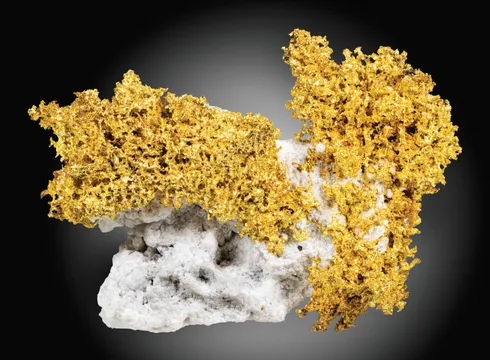
Gold gives Aosta Valley another historical thread. The Brusson area in Val d’Ayas, especially the Chamousira-Fénilliaz mine, was the most important gold-mining district in the region. It was discovered at the end of the nineteenth century and worked by companies including the Société des Mines d’or de l’Evançon and The Evançon Gold Mining Company Limited during its early industrial phase; the site is now part of the region’s mining heritage network. Native gold specimens from Brusson do occur in collections, but the locality’s main public identity today is industrial archaeology rather than open collecting.
Collecting access must be treated conservatively. Bellecombe material is classic, but the productive area is within or affected by protected-land restrictions, and modern field collecting there has long been reported as forbidden or tightly restricted. Aosta Valley also has regional legislation governing mines, quarries, fossils, and collectible minerals, and several historic mining sites are now preserved or interpreted as heritage areas rather than specimen sources. At Saint-Marcel, the public experience is a managed mining route; at Varenche, the mine workings are gated; in alpine-fissure districts, mountain hazards and protected-area boundaries matter as much as permission. For collectors, the practical locality today is usually the secondary market: old Italian collections, older Piedmont-labelled material, museum deaccession-era pieces, and carefully attributed Alpine specimens.
Aosta Valley vesuvianite is most coveted from Bellecombe, where it occurs in rodingitic veins in serpentinite as lustrous prismatic crystals, commonly olive green, dark green-brown, brown, or locally lighter gemmy material, associated with hessonite-rich grossular, diopside, clinochlore, chlorite, and occasional epidote; documented specimens include miniature clusters with individual crystals around 1–2 cm and older loose or matrix crystals approaching several centimetres, while gemological studies and collector literature emphasize Bellecombe and nearby Montjovet as sources of gem-quality vesuvianite from Cretaceous to Alpine-overprinted rodingite veins. The best pieces here are not merely “green vesuvianite”: they show brilliant glassy faces, sharp tetragonal prism form, flat or well-developed terminations, some edge transparency, and attractive contrast against red-orange garnet or green chloritic matrix, whereas ordinary pieces tend to be dark, massive, contacted, or lost in granular rodingite.
Aosta Valley quartz is chiefly an alpine-fissure mineral from the Mont Blanc side of the region and a gangue mineral in the manganese districts; the most collectible quartz comes from clefts around Courmayeur, Val Ferret, Triolet, Miage, Pré de Bar, and related Mont Blanc localities, where clear to smoky crystals may be lustrous, chlorite-dusted, or associated with adularia, fluorite, anatase, rutile, titanite, and other classic cleft minerals. Good Aosta quartz is judged by fissure aesthetics—undamaged terminations, transparency or rich smoky colour, sharp lustrous faces, balanced cluster form, and meaningful association—while ordinary pieces are more often massive vein quartz, iron-stained quartzite, or broken alpine float; in the Saint-Marcel and Varenche manganese deposits, quartz is mineralogically important but usually serves as matrix or host for rarities rather than as the main display species.
Grossular from Aosta Valley is inseparable from the rodingite suite, especially at Bellecombe, where garnet occurs as grossular to andradite-grossular compositions and as the reddish hessonite variety in open-space veinlets with vesuvianite, diopside, and clinochlore; studies of the rodingites record grossular-rich cores, andradite-grossular rims, grossular-rich veins, and garnet generations wrapped by Alpine deformation fabrics. Collector pieces range from small sparkling crusts to rich miniatures with red-orange to brownish, lustrous dodecahedral or trapezohedral garnets on green clinochlore or pale diopside, with the finest examples showing abundant, bright, gemmy crystals cleanly separated on matrix; less desirable pieces are granular garnet-rich rodingite with little crystal definition or heavily contacted garnet surfaces.
Epidote is a supporting but significant Aosta Valley mineral, appearing in rodingitic reaction zones and alpine fissures rather than dominating the region’s specimen output; in the Bellecombe–Mont Avic style of rodingite, epidote belongs with garnet, chlorite, diopside, vesuvianite, and titanite in calcium-rich metasomatic assemblages, while in the Mont Blanc alpine-cleft environment it may occur with quartz, adularia, fluorite, muscovite, and calcite. The best Aosta epidote specimens are expected to be sharp, lustrous green crystals with clear context—either on a rodingite matrix with garnet/diopside or in an alpine fissure association with quartz and feldspar—whereas dull massive epidote, dark altered aggregates, or pieces lacking precise sublocality data are far less compelling to advanced collectors.
Diopside from Aosta Valley is a hallmark of the Bellecombe rodingites, where it occurs as pale green, yellow-green, grey-green, or darker prismatic crystals and aggregates associated with hessonite grossular, vesuvianite, clinochlore, chlorite, titanite, and magnetite; in the studied Bellecombe rocks, clinopyroxene is diopside, commonly linked to both the rodingitic boudins and the vein generations that cut them. Fine specimens show bright, well-terminated prismatic diopside crystals, sometimes over or among red-orange hessonite and green clinochlore, and the strongest pieces gain much of their value from that three-colour rodingite association; ordinary pieces tend to be pale massive pyroxene, broken acicular material, or specimens where diopside is present only as a non-descript matrix mineral.
Hessonite, the cinnamon to orange-red variety of grossular, is one of the defining Bellecombe collector minerals, occurring as lustrous red, orange-brown, honey, or cherry-toned garnet crystals on clinochlore-rich rodingite matrix, frequently with diopside and vesuvianite; photo records and dealer archives show the locality’s typical miniature scale, but also its exceptional sparkle, with individual garnets commonly in the millimetre range and some crystals around a centimetre on better pieces. Superior Aosta hessonite has gemmy colour, high luster, sharp dodecahedral or trapezohedral form, dense but not muddy coverage, and attractive contrast with green clinochlore or pale diopside; lower-grade pieces are dark, crowded, granular, acid-etched, or poorly attributed, and are easily confused at a glance with similar Italian Alpine rodingite garnets from Piedmont localities.
Beyond the main collector species, Aosta Valley is important for type-locality and rare-species mineralogy. Praborna, Saint-Marcel is tied to piemontite and historically important manganese minerals including braunite and strontiomelane, and it is famous among collectors for violane, the violet-blue manganese-bearing clinopyroxene variety associated with the Saint-Marcel manganese assemblage. Varenche is the type locality for bonacinaite, Sc(AsO4) · 2H2O, a submillimetre scandium arsenate found with quartz, braunite, arseniopleite, manganberzeliite, and thortveitite. The regional type-locality list also includes ferro-glaucophane, magnesiochloritoid, magnesiobeltrandoite-2N3S, and manganiandrosite-(Ce), underscoring how much of Aosta’s importance lies in microscopic, chemically complex minerals rather than showy cabinet specimens alone.
The first authenticity issue with Aosta Valley specimens is locality precision. “Aosta Valley” on a label can refer to very different mineral environments: Bellecombe rodingite vesuvianite/hessonite/diopside, Mont Blanc alpine-fissure quartz, Saint-Marcel manganese minerals, Brusson gold, or other old mining districts. A fine vesuvianite merely labelled “Italy” or “Piedmont” may still be Aosta material because Aosta Valley was historically tied administratively to Piedmont before becoming a separate autonomous region after World War II; older labels reading “Val d’Aosta, Piemonte” or simply “Piedmont” should not be dismissed automatically. Conversely, Bellecombe-style hessonite and vesuvianite can be confused with rodingite specimens from Val d’Ala, Val di Viù, Val di Susa, and other Western Alpine localities, so matrix, crystal habit, association, and old provenance matter.
For Bellecombe pieces, scrutinize condition under magnification. The crystals are commonly small and brilliant, but edge chips, contacted terminations, and bruising on exposed hessonite faces are frequent. Vesuvianite is often dark, and sellers may overstate transparency; the best crystals transmit light at the edges or in thinner zones but many appear nearly black without strong illumination. Hessonite may be naturally lustrous, but acid-cleaned or overcleaned pieces can show rounded garnet surfaces or unnaturally exposed crystals on a pitted matrix. Diopside is vulnerable as slender prisms and may be partly hidden among garnet and clinochlore; broken pale green crystals can be hard to notice until the specimen is tilted.
Mislabelling between grossular and hessonite is common but usually not malicious. Hessonite is a variety name, not a separate species, and many labels legitimately read “grossular var. hessonite.” More problematic are unanalysed colour claims, especially “chrome vesuvianite” or “cyprine” style descriptions. Some Bellecombe vesuvianite is visually chrome-like or bright green, but colour alone is not a chemical analysis. Treat varietal and trace-element claims as descriptive unless backed by analytical data.
Quartz from Aosta Valley should be evaluated like other Mont Blanc alpine-cleft quartz: look for natural contacts, re-healed bases, chlorite dusting, and pocket clay traces rather than expecting a pristine pegmatite aesthetic. Many fissure specimens are partly contacted because crystals grew on narrow cleft walls or were recovered from glacier/scree contexts. Detached single crystals can be entirely legitimate, but a precise sublocality—Triolet, Miage, Val Ferret, Pré de Bar, Courmayeur, or another named sector—adds real value.
For rare manganese and type-locality material, assume microscopy and analysis are essential. Bonacinaite, ardennite-related minerals, strontiomelane, manganiandrosite-(Ce), and many Varenche or Praborna rarities occur as tiny grains or crystals in complex quartzitic matrices. Attractive hand specimens labelled with these species but lacking analytical history should be treated cautiously. Piemontite, alurgite, braunite, spessartine, rhodonite, and quartz can make visually appealing manganese-suite specimens, but the rarest names on an Aosta label often require documentation.
Market availability is uneven. Bellecombe vesuvianite and hessonite appear regularly enough that a patient collector can find thumbnails and miniatures, but truly sharp, undamaged, glassy crystals from old finds are much scarcer and increasingly held in established Alpine collections. Diopside from Bellecombe is less often offered as the primary species. Good Aosta quartz is available, but the best Mont Blanc fissure pieces are usually marketed by exact sublocality and compete with French and Swiss Mont Blanc material. Type-locality micros from Varenche and Saint-Marcel are specialized, sporadic, and often circulate through micromount networks rather than mainstream mineral auctions.
The Bellecombe story is not a tale of deep mine galleries or ore wagons; it is a story of small boudins and narrow veins producing specimens that outshone their scale. East of Bellecombe, near the top of Mont-Avi, the rodingite bodies sit in sheared antigorite serpentinite, some only 20–50 cm thick. Within those compact bodies, later veinlets only millimetres to centimetres thick carried the crystals that would make Bellecombe a name known in Alpine collections. The science reads like a sequence of pocket generations: first chlorite, diopside, and grossular; then andradite-grossular with diopside; then andradite-rich garnet and chlorite; then grossular-rich veins; then vesuvianite; then chlorite again. A collector holding a red hessonite-green clinochlore piece from Bellecombe is looking at the polished consequence of that repeated cracking, reaction, sealing, and recracking.
One of the most memorable details from the modern study of Bellecombe is hidden inside the vesuvianite itself. Researchers cut double-polished sections only about 100 μm thick and found tiny fluid inclusions in vesuvianite from the type V veins—some up to 50 μm across, elongated parallel to the vesuvianite crystal axis. Under the microscope the vapour bubbles looked unusually brownish to blackish. Raman spectroscopy then revealed the signal of molecular hydrogen, with methane also present. From those microscopic bubbles came an interpretation of late Alpine serpentinization-derived brines: salty Ca-Na fluids carrying H2 and traces of CH4, trapped as vesuvianite grew at roughly 400 °C and 0.22 GPa. It is a striking thought: the lustre on a Bellecombe vesuvianite miniature is the display-case face of a reducing, hydrogen-bearing Alpine fluid system.
Saint-Marcel offers a different kind of mineral story, one with smoke, forests, ore, and public complaint. The valley’s Praborna manganese mine was already known in 1415, while Servette-Chuc carried evidence of much older metallurgical activity. At Servette, charcoal fragments in furnace slags gave radiocarbon dates around 890–980 CE, pulling the mine’s early working history back into the early medieval period. After a long quiet interval, the mine was rediscovered around 1732, and copper smelting returned to the valley. Eighteenth-century metallurgy was laborious: contemporary accounts describe the need for thirteen fusion processes to obtain copper. Around Servette, at least six smelting or foundry places were established, and slag heaps accumulated, especially near Fontillon.
The same mining revival that produced metal also produced conflict. The furnaces consumed timber for charcoal, stripping forest resources, and sulphurous fumes damaged the valley’s agriculture. Farmers complained of grass, fruit, and trees drying out, and the public administration investigated; an inspection report by the vice-bailiff Joseph Lambert in 1749 records the concern. Later, when pyrite became the main product for sulphuric acid and chemical fertilizers, the industrial pattern changed from scattered smelting to more extractive mine work. At Chuc, pyrite lenses were exploited through several levels, and in the twentieth century the mine could produce hundreds of tonnes per month. The workforce usually numbered a few dozen, but in 1919 it reached a reported maximum of 80 miners.
Varenche’s modern claim to fame began not with a large crystal, but with a nearly invisible one. In 2005, Giorgio Maria Bortolozzi and Marco E. Ciriotti found tiny, almost colourless tabular crystals with faint violet tints on the dumps of the abandoned manganese mine in Saint-Barthélemy. Initial work through the Associazione Micromineralogica Italiana’s unknown-identification service suggested something unusual: a scandium arsenate analogue of metavariscite. The material was so scarce that nearly all the crystals found were consumed or used in the complete characterization. Later, Roberto Bracco found a few more specimens in the dumps, and Francesco Vanini found stockier purple-blue crystals. Even after those additions, the total known bonacinaite material amounted to only about a dozen small samples, each with a very small number of crystals.
The new mineral was named for Enrico Bonacina, known among Italian micromineral collectors as “Maestro Bonacina.” His story belongs in an Aosta guide because it says something about how modern mineralogy actually works. In the early 1970s, dissatisfied with the available microscope-photography results, Bonacina built his own optical equipment and went on to provide tens of thousands of micromineral photographs to collectors, magazines, and researchers. Naming bonacinaite for him recognized not a mine owner or a patron, but the indispensable craft of seeing: the patient, technically demanding photography that makes submillimetre minerals available to science and collectors alike.