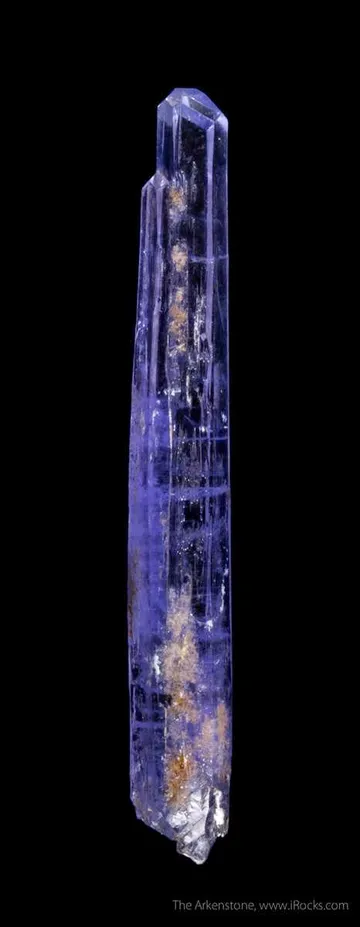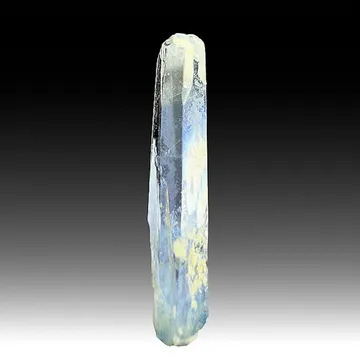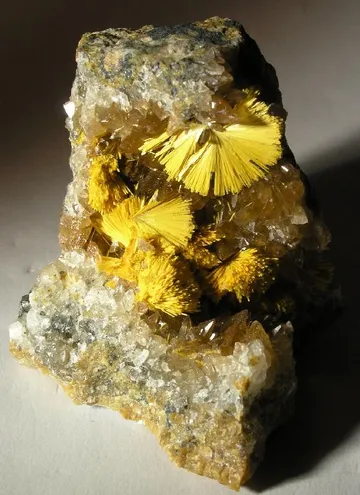
Jeremejevite from Ameib Farm 60, Namibia: blue-to-colorless, slender hexagonal prisms with glassy luster from a key Erongo locality that fascinates collectors.
Key facts
Ameib Farm 60 is one of the decisive modern localities for collectible jeremejevite: a place where a mineral once known to most collectors only as a near-mythical rarity suddenly appeared as lustrous, transparent to translucent, prismatic crystals with blue, violet-blue, lavender-blue, and colorless zoning. The best Ameib crystals have the look collectors want immediately—slender hexagonal prisms, glassy luster, sharp or complex pyramidal terminations, and that unmistakable Namibian color: cool blue at the base or along part of the prism, fading toward colorless or pale yellowish tips.

Photo: Wikimedia Commons
The locality sits in the Erongo Mountains of Namibia, a mineral province famous for miarolitic cavities in granitic rocks and for specimen species that reward close inspection: aquamarine, smoky quartz, schorl, cassiterite, fluorite, topaz, and rare borates among them. Ameib’s jeremejevite came from small cavities and weathered material associated with the Erongo granite system, close to the boundary area between Ameib Farm 60, Davib Ost 61, and Brabant 68. In collector terms, these are pocket minerals—crystals grown freely enough to preserve natural faces, then often etched, corroded, rehealed, or detached by later fluids and weathering.
Before the Erongo discovery, Namibia’s classic jeremejevite reputation rested largely on Mile 72, the coastal occurrence north of Swakopmund that produced celebrated blue crystals in the 1970s. Ameib changed the scale of availability. The 2001 Erongo finds produced not merely a few isolated rarities but enough crystals to circulate through the collector market, from small loose needles under a centimeter to exceptional crystals several centimeters long. That production window did not make jeremejevite common; it made Ameib the locality many collectors now picture when they think of natural, displayable blue jeremejevite.

Photo: Wikimedia Commons
For advanced collectors, the appeal is not just rarity. Ameib specimens carry recognizable locality character. The better crystals are elongated and hexagonal, sometimes tapered toward the termination, sometimes etched into sculptural floaters, and often pleochroic enough that the blue changes with viewing direction. A fine example should show natural color, intact prism geometry, attractive termination, and enough transparency to separate it from the more opaque or heavily corroded material that also came from the Erongo pockets.
Search for specimens: View all jeremejevite specimens from Ameib Farm 60, Namibia
Ameib Farm 60 lies near Usakos in the Karibib Constituency of Namibia’s Erongo Region, on the southern to southeastern side of the Erongo Mountains. The broader Erongo complex is an eroded Cretaceous volcanic-plutonic center: granitic intrusions, volcanic rocks, ring structures, and older Damara basement rocks together form one of Namibia’s most productive specimen provinces. The setting that matters for jeremejevite collectors is the pocketed, mineralized granite and related pegmatitic to miarolitic systems, where late boron- and fluorine-bearing fluids produced uncommon species in small cavities.
The jeremejevite discovery on Ameib Farm 60 was made in March 2001. Early in the find, the blue prismatic crystals were reportedly mistaken for aquamarine, a reasonable first guess in a district where beryl is familiar and the color overlap can be deceptive. Analysis proved the crystals were jeremejevite, and the news spread quickly through the mineral trade. The pockets were not large industrial workings; they were small miarolitic cavities and weathered alluvial occurrences on granite slopes. Some crystals were taken directly from cavities, while others were recovered loose from weathered material.
Production appears to have been intense and short-lived. During the main exploitation of the 2001 pockets, a few thousand specimens were reportedly recovered. Many were small, pale yellowish to colorless, or needle-like loose crystals, most under 1 cm long and only a few millimeters thick. Larger crystals to about 5 cm are known, and a 6 cm maximum was later cited in the Erongo literature. The best matrix pieces are much scarcer than loose crystals; where matrix exists, the jeremejevite is typically associated with smoky quartz or, more rarely, feldspar.
The locality was also part of a larger history of tin-bearing pegmatites around the Erongo fringe. Cassiterite had been commercially exploited on farms including Ameib 60, Davib Ost 61, Sandamap, Onguati 52, and Brabant 68. That older mining history matters because it frames Ameib as more than a single-species occurrence: the jeremejevite find belongs to a district where granitic and pegmatitic mineralization had already drawn attention for decades.
Collecting access should be treated as private-property access, not open rockhounding. Ameib Farm 60 is also associated with Ameib Ranch Guestfarm, and the Erongo mineral diggings have a documented history of unauthorized excavation. Collectors should not attempt to visit or collect at the site without explicit permission from the land and mineral-rights holders. The published accounts describe the 2001 jeremejevite workings as having been heavily dug and later largely worked out; a later visit in 2005 found the specific Ameib cavities deserted.
A later Erongo jeremejevite occurrence was reported in April–May 2006 away from the original Ameib 60 site, with fewer crystals and a more opaque, distorted character. A separate Ameib-related pulse of attractive material reached the market around 2010 and was visible as a Tucson 2011 novelty, including transparent sky-blue to violet-blue etched floaters. More recently, collector-market listings have described a small 2015–2016 pocket that produced gemmy etched floater crystals, showing that Ameib-style jeremejevite has continued to appear in small, episodic parcels rather than steady production.
Ameib jeremejevite is best known as loose, elongated hexagonal prisms. The classic crystals are slender, often several times longer than wide, with a vitreous to glassy luster and pyramidal or complex terminations. Some taper toward the tip; others show etched, rehealed, or partly corroded terminations. The finest examples preserve enough straight prism face to read clearly as hexagonal jeremejevite, while also showing the natural surface history that gives Ameib pieces their locality personality.
Color is the collector’s first filter. The desirable range runs from pale blue through lavender-blue and violet-blue to rich sky blue. Many crystals are zoned, with the base distinctly bluer than the termination or with lengthwise blue-white striping. Some examples fade to colorless or pale yellowish zones. Pleochroism is important: blue Namibian jeremejevite can shift from colorless to cornflower or blue-violet depending on orientation. This is why a crystal that looks subdued in one position may flash better color when rotated, and why lighting angle matters so much in evaluating a specimen.
Size ranges are sharply tiered. The commonest Ameib material is small: loose needles and thin prisms under 1 cm are far more available than major display crystals. Crystals in the 1–2 cm range are collectible when complete and lustrous. A clean, well-colored 2–3 cm crystal is already a serious specimen. Crystals over 3 cm with good color, transparency, and undamaged form become notably scarce, and anything approaching 5 cm from Ameib belongs in the upper tier for the locality. Published and dealer-recorded examples include 2.7–3.5 cm crystals, and the literature records rare crystals to 5–6 cm.
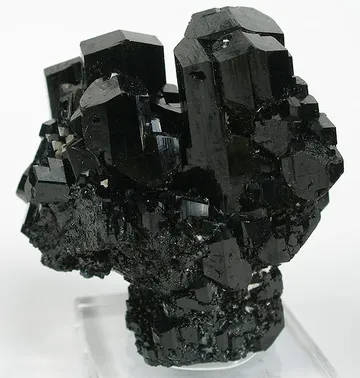
The associated mineral suite is simple but diagnostic. Mindat’s locality data and the Erongo literature record associations including schorl, foitite, cassiterite, microcline, quartz, smoky quartz, topaz, and clay minerals. Matrix specimens with smoky quartz are especially desirable because most jeremejevite crystals were recovered loose. Pieces on feldspar are rarer. Cassiterite inclusions or adjacent grains appear on some specimens and fit the tin-bearing character of the Erongo pegmatites. Tourmaline associations require care: schorl and foitite-like long dark prisms can occur, but not every black acicular companion has been analytically nailed down.
Quality depends on a balance of four factors: color, form, transparency, and integrity. The best Ameib crystals are blue to violet-blue, transparent to gemmy, well-terminated, and naturally complete. A moderate etch texture is acceptable and often attractive when it produces sculptural form without destroying the prism. Heavily ragged or splintery floaters, contacted terminations, iron-stained fissures, and broken bases reduce value unless the piece is large or exceptionally colored. Because many crystals detached easily from matrix, a loose crystal is not automatically inferior; for Ameib jeremejevite, loose complete crystals are the norm, while matrix pieces are the exception.
Ameib jeremejevite is rare enough that provenance matters. A fine loose blue crystal labeled simply “Namibia” may be from Ameib, Mile 72, another Erongo pocket, or a later market parcel whose exact source has been blurred. Whenever possible, preserve old labels, dealer invoices, auction descriptions, and collection history. The strongest labels specify Ameib Farm 60, Usakos, Karibib Constituency or Karibib District, Erongo Region, Namibia; older labels may say Ameib Farm, Ameib 60 Farm, or Erongo Mountains.
The most common authenticity issue is misidentification with aquamarine. This is not just a beginner’s mistake: the original Ameib blue crystals were reportedly first thought to be aquamarine. Slender pale-blue beryl fragments can resemble jeremejevite in color and outline, especially when broken or poorly terminated. Refractive index, specific gravity, pleochroism, and crystal morphology resolve the question. In crystals, jeremejevite’s hexagonal prisms, tapered or pyramidal terminations, vitreous luster, and strong blue-to-colorless pleochroism are useful clues, but expensive pieces deserve laboratory confirmation.
Assembled specimens are another concern. Jeremejevite crystals detach easily from matrix, and matrix pieces are much rarer than loose crystals, so any dramatic “jeremejevite on matrix” should be examined carefully for glue, cement, suspicious contact points, mismatched dirt, or unnatural seating. Some assembled jeremejevite specimens have been reported in the trade, including joins made with resistant dental cement. Acetone alone is not a sufficient test. A microscope, UV light, and close inspection of the contact are better tools.
Documented treatments are not a major feature of the jeremejevite specimen market, and commercially available synthetic jeremejevite crystals are not a routine problem for collectors. The realistic hazards are simpler: wrong mineral, wrong locality, repaired or mounted-as-matrix pieces, and hidden damage. For faceted stones, standard gem testing is essential because small pale-blue gems can be visually ambiguous; for crystals, good provenance and morphology carry more weight, but they do not replace testing on high-value pieces.
Condition issues are locality-typical. Many Ameib crystals show etched prism faces, rehealed breaks, contacted bases, surface-reaching fissures, iron staining, or included dark grains. These are not automatically defects; they are part of the pocket history. The collector’s job is to distinguish natural etching from damage, and attractive rehealing from unattractive breakage. A broken base on a loose crystal may be acceptable if the termination, color, and prism are excellent, but a snapped termination is a serious loss. Because the crystals are brittle and often slender, storage in a fitted perky box or custom mount is preferable to loose handling.
Market availability is sporadic. Small loose crystals appear periodically, but fine blue, gemmy, complete Ameib examples are not abundant. Auction and dealer records show both modest thumbnail lots and high-priced gem crystals; price rises sharply with size, saturation, transparency, and completeness. A 1 cm pale or etched crystal may be accessible, while a 3 cm transparent blue crystal with an intact termination is a competitive advanced-collector specimen. Matrix pieces, large floaters, and crystals with strong violet-blue color remain the most difficult to replace.
The first chapter of Ameib jeremejevite reads almost like a field joke: in March 2001, in a granite landscape already famous for aquamarine, blue prismatic crystals came out of small cavities and were initially taken for aquamarine. Only after analysis did the find reveal itself as jeremejevite, one of the collector world’s great rarities. The surprise was not merely that jeremejevite occurred in the Erongo Mountains; it was that the pockets yielded enough crystals to create a market event. For a short time, a species that had been counted in handfuls could be seen in dealer parcels.
The Erongo account describes several miarolitic cavities excavated in granite on Ameib Farm 60, close to the neighboring farms Davib Ost 61 and Brabant 68. The material came out in two modes: loose crystals from weathered alluvium and crystals from in situ pockets. Dealers reportedly had small plastic bags filled with pale yellow to colorless, needle-like crystals without matrix. Most of those were tiny—less than 1 cm long and about 2 mm thick—but among them were the much rarer larger crystals, the ones that made collectors stop and recalibrate what a “large” jeremejevite could be.
By August 2005, the rush was over. A visit to the discovery area found several small, worked-out cavities clustered on a southeast-facing granite face. Most were less than a meter across, and drilling marks were still visible. The scene had changed dramatically from 2001, when several hundred diggers were reportedly excavating jeremejevite illegally. Four years later, the slope was deserted; the pockets had given up their best material, and the tailings held almost nothing.
The approach to the diggings was not casual. The published field party climbed from Davib Ost 61, then moved southeast toward the boundary fence with Ameib 60. The granite slope was steep enough that the ascent had to be made in zigzags, and the route crossed older excavations for schorl, quartz, and aquamarine before reaching the jeremejevite area. Some cavities seen along the way were several meters across and a couple of meters deep. Boulder overhangs showed evidence that diggers had used them as shelters while working the mountain.
At the top, the reward was not a pocket of blue crystals but a single remnant: one tiny chip of blue jeremejevite in feldspar scratched from the tailings. The diggers had left little behind. The view, however, fixed the locality in a way no label can: Gross Spitzkoppe visible to the northwest, the wide plain stretching away from the Erongo foothills, the dry Khan River snaking into the distance, and an old cassiterite pegmatite on the Ameib 60 plains below. The best mineral localities are often like that—geology, exhaustion, disappointment, and beauty all visible at once.
A later market episode added another distinctive texture to the Ameib story. Around Tucson 2011, transparent blue to slightly violet jeremejevite floaters from a 2010 find were presented as novelties. Some had acute, pyramidal, polycrystalline terminations and irregular surfaces interpreted as having formed in dissolution channels within larger crystals that were no longer present. These were not the neat, textbook prismatic needles of the early find; they were sculptural, corroded, and very Namibian in character—proof that Ameib’s best crystals could be both gemmy and geologically expressive.
A still later pocket, described in collector-market records as a small 2015–2016 discovery, produced gemmy etched floaters, many of which reportedly passed through Marshall Sussman’s Crystal Cellar before broader Tucson distribution. One thumbnail from that pocket weighed 22.3 carats as gem rough, and the description notes that some worthwhile gemstones were cut from the material. The same account is blunt about the run of the pocket: many crystals in that size range looked “raggedy” or jagged, but the best retained balance, form, luster, and color. That is the essential truth of Ameib jeremejevite collecting—most pieces tell the story of etching and dissolution; the great ones turn that damage history into sculpture.