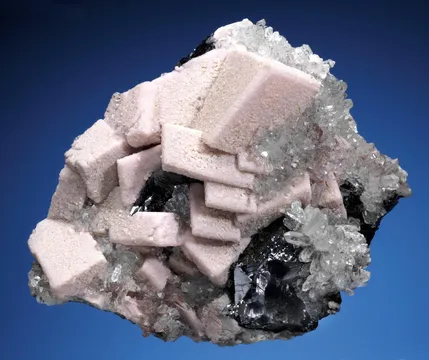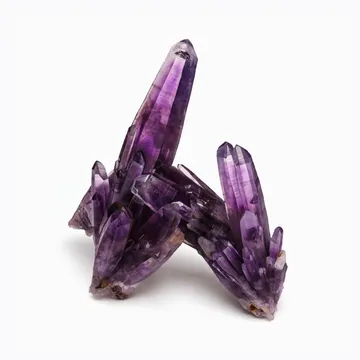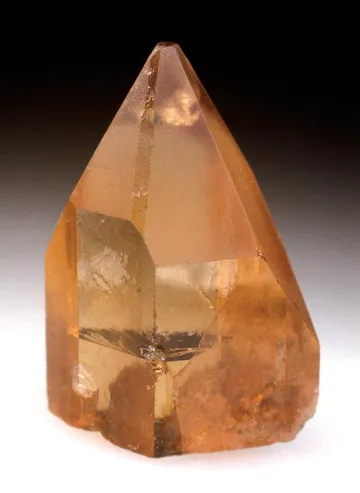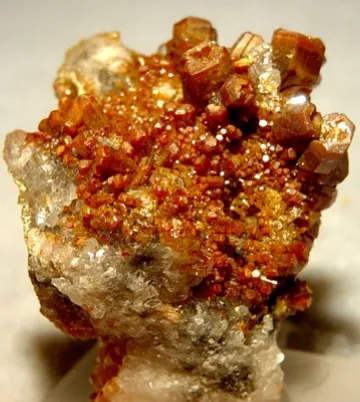
Amatitlán, Mexico — Guerrero amethyst with stout, tapered quartz crystals, vivid wine-purple cores, phantoms, and clusters prized by collectors.
Key facts
Amatitlán is the classic heartland of Guerrero amethyst: a scattered field of small veins, cuts, shallow adits, and pocket diggings in Eduardo Neri Municipality, north-central Guerrero, south of the Balsas River. For mineral collectors the name does not stand for an orderly single mine so much as a distinctive specimen style—stout, tapered quartz crystals with vivid wine-purple to reddish-purple amethyst cores, pale or colorless outer zones, strong phantoms, and the sculptural, divergent clusters that made Mexican amethyst a world classic.
Geologically, the Amatitlán amethyst veins belong to the broader mineralized environment of the Guerrero Gold Belt. The region’s important ore systems formed where Cretaceous carbonate and calcareous sedimentary rocks were intruded by early Tertiary granitoid bodies, producing gold-iron skarn mineralization nearby. The amethyst was not mined from great basaltic geodes like Brazil or Uruguay; it came from localized open spaces in veins and pods cut into rugged, altered country. That matters to collectors because the locality produced individual crystals and groups with architecture, not merely purple-lined cavities.
The best Amatitlán specimens have an unmistakable visual grammar. Their crystals are broad-shouldered through the middle, tapering upward to normal quartz terminations, with the richest color often held inside the crystal as a sharply bounded phantom. The outermost quartz may be milky, smoky, frosty, or water-clear, so the purple appears to glow from within rather than coat the surface. Groups can form loose fans, floral sprays, and balanced cabinet pieces; lesser examples are crowded, bruised, or weakly colored, but fine ones rank among the most desirable amethysts of the twentieth-century specimen trade.
Regional View
Country View
Labels for this material have long varied. Older specimens may be marked simply “Guerrero,” “Amatitlán,” “Iguala,” or “Rio Balsas district,” while more precise labels name individual workings such as Margarita, Palo Verde, Valenciana, Rayas, Santa Rita, La Sorpresa, Altimirano, or the Amatitlán Mine. Unless the mine name is backed by old labels, invoices, collection history, or first-hand documentation, “Amatitlán, Eduardo Neri Municipality, Guerrero, Mexico” is often the most defensible collector label.
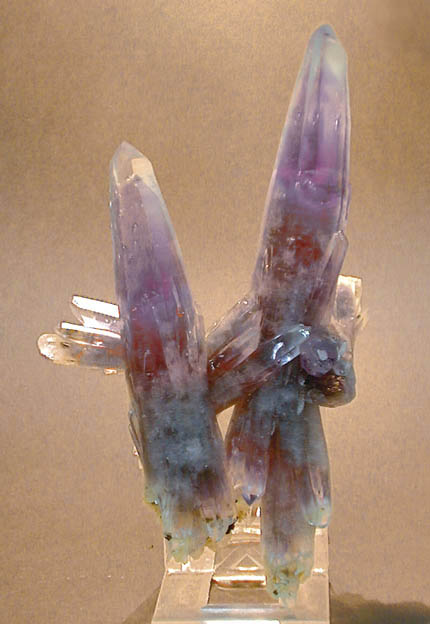
Photo: Fabre Minerals
Search for specimens: View all specimens from Amatitlán, Mexico
Amatitlán is a diggings locality in Eduardo Neri Municipality, Guerrero, at about 17° 51' 54" N, 99° 45' 41" W. The productive amethyst ground lies around the small village of Amatitlán and is best understood as a district of many discontinuous vein occurrences over a broad area north of the village and south of the Balsas River. The collector locality is therefore regional in the practical sense: pockets were opened, exhausted, abandoned, rediscovered, renamed, or sold under imperfect labels across decades of small-scale work.
The deposit type is a quartz-amethyst vein and pocket system developed in a region dominated by intrusion-related gold-iron skarn geology. Nearby Guerrero Gold Belt deposits are associated with early Tertiary granodioritic intrusions into the Morelos–Guerrero sedimentary basin, a thick Mesozoic sequence that includes carbonate rocks of the Morelos Formation and overlying clastic and calcareous units including the Cuautla and Mezcala formations. Skarn assemblages in the belt include garnet-pyroxene rocks, magnetite, specular hematite, and related calc-silicate alteration. The amethyst veins are collector offshoots of this mineralized terrain: narrow, locally open-space veins and pockets rather than large, continuous ore bodies.
The ore-body language used by specimen collectors here can be misleading. Most Amatitlán amethyst “mines” were not large mines in the industrial sense. They were shallow workings—trenches, cuts, pits, adits, and vein-following excavations—opened where amethyst showed at or near the surface. Miners followed a productive vein until it pinched, hardened, or stopped giving pockets, then moved along the structure or to another exposure. Some productive zones reportedly bottomed or became unworkable after only several meters of hand digging; others were reworked after earlier miners had backfilled or disguised the ground.
The published discovery story begins around 1930, when Donato Retana, a farmer in the mountains near Amatitlán and Tenantla, found white and purple quartz while preparing cornfields. At first the crystals were valued principally as gem rough. Querétaro’s lapidary trade provided a ready market, and large crystals that collectors would now prize intact were broken for clean amethyst suitable for cutting. As collector demand matured, the value shifted from faceting rough to complete crystals and sculptural groups.
The Ontiveros family became central to the district’s mining history. Joaquín Ontiveros staked La Cuna, an early claim that produced excellent deep-colored crystals, and later staked the Margarita claim, named for his daughter Margarita. Margarita became one of the great names attached to Amatitlán specimen groups, especially balanced clusters with the classic pale-and-purple phantom character. Palo Verde was another important early producer, described as unusual because a major pocket occurred as a pod in decomposed granite-like material at depth rather than as a typical vein pocket. Other names recorded in the district include Rayas, Valenciana, Santa Rita, Altimirano, Amatitlán Mine, and La Sorpresa.
La Sorpresa belongs to the later collector history of the district. In 1997–1998, work associated with Mike New, Wayne Thompson, and Ruben Avila recovered important material from a half-mile-long exposure of veins on a hillside overlooking a tributary of the Rio Balsas. Much of the ground appeared to have been worked before and then backfilled, suggesting that the same productive structure may have circulated earlier under another name. Even so, the operation produced fine specimens, and La Sorpresa became one of the modern names collectors recognize.
Field access today should not be treated as casual rockhounding. The Amatitlán occurrences are on private, claimed, or concessioned ground in a region where land rights, security, and local permission are serious matters. Most collectors should consider the locality effectively a market locality: specimens are obtained responsibly through established dealers, documented old collections, museum deaccession channels where applicable, or auctions rather than by independent field collecting.
Quartz from Amatitlán is valued less as ordinary colorless SiO2 and more as the structural host that gives the district’s amethyst its character: stout prismatic crystals, commonly 5–10 cm on collectible pieces, with broader lower or middle sections, tapering upper portions, strong horizontal striations, and glassy to frosted luster. Colorless, milky, smoky, or pale gray outer quartz commonly encloses the deeper purple amethyst core, so even “quartz” specimens from the district may show ghostly purple phantoms, pale caps, and contrasting zones. The finest quartz groups are divergent and architectural, with separated crystals rising cleanly from minimal matrix or from quartz/calcite-coated bases; ordinary pieces are crowded, bruised, blocky, or lacking the internal zoning that makes Amatitlán immediately recognizable.
Amethyst is the defining mineral of Amatitlán and occurs as deep reddish-purple to grape-purple zones within tapered quartz crystals, commonly fading outward to milky, smoky, frosted, or water-clear quartz and often ending in pale tips. The classic crystals are thicker and more muscular than Veracruz amethyst, with purple concentrated in the lower or central interior rather than intensifying toward the termination; sharp chevron phantoms, concentric zoning, and backlit inner color are major premiums. Fine specimens from Margarita, Palo Verde, La Sorpresa, Valenciana, and neighboring Amatitlán diggings range from elegant miniatures to cabinet clusters, while exceptional single crystals have been reported far larger than normal collector sizes. The best examples combine rich internal color, strong phantom definition, complete pale terminations, glassy luster, and an open, balanced arrangement of crystals rather than a dense mass.
The documented Amatitlán mineral list is deliberately austere: quartz, its amethyst variety, and calcite are the dependable collector minerals for the locality. Calcite appears as an associated carbonate mineral and as coatings or matrix on some amethyst pieces, while dark manganese-oxide coatings or stains are common enough on the crystals to be part of the locality’s field character, though not usually treated as a prized species in themselves. Amatitlán is not a type-locality suite and is not notable for a long list of rare species; its greatness rests on one superb collector mineral, produced in a highly diagnostic style.
The first question with an Amatitlán amethyst is locality precision. “Guerrero” may be entirely honest but vague; “Amatitlán” is usually the safest refinement for classic material unless a named mine is documented. Be cautious of pieces assigned too confidently to Margarita, Palo Verde, Valenciana, La Sorpresa, or another named working without old labels or credible provenance. The mines are real, but the district’s small, temporary workings and long dealer history mean that over-specific labels are easy to inherit and hard to prove.
Condition is critical. Pale caps and colorless outer quartz make damage easy to see, especially bruised terminations, cleaved-off tips, edge nicks along prism faces, and missing companion crystals. Many specimens were removed from tight pockets or handled first as gem rough, so damage is common. A small chip hidden on a back crystal is tolerable on a strong piece; bruising on the principal termination, broken central crystals, or sawed and glued bases should affect price substantially.
Repairs and assembly deserve close inspection. Check the base of clusters for glue lines, modern fills, mismatched contact surfaces, and crystals reattached at unnatural angles. A repaired classic may still be collectible if the restoration is disclosed and the price reflects it, but undisclosed reattachments are a serious issue. Backlighting is useful because it reveals whether purple zoning continues naturally through the crystal or is interrupted at a suspicious join.
One unusually instructive treatment concern for Guerrero-style amethyst is hydrothermal re-healing. A documented experimental specimen attributed uncertainly to Guerrero had broken terminations regrown as clear quartz in an autoclave over several months at high temperature and pressure. That example was not presented as a commercial fake, but it proves the technical possibility of adding convincing clear caps to damaged amethyst. On suspect pieces, look for abrupt changes in surface texture, striations that do not continue naturally, oddly perfect clear tips on otherwise worn crystals, and secondary faces that seem inconsistent with the original growth.
Routine dyeing is not the main danger with high-grade Amatitlán specimens; the locality’s signature is internal purple zoning, not a surface color. Heating can alter amethyst in general, and synthetic amethyst is abundant in the gem world, but the more realistic risks for this collector market are mislocality, undisclosed repair, assembled groups, re-polished or regrown terminations, and ordinary pocket damage.
Rarity is quality-dependent. Small or imperfect Amatitlán pieces still appear with some regularity, but fine, undamaged, well-balanced clusters with strong phantoms and saturated reddish-purple cores are genuinely scarce. Recent public market records show the spread: modest miniatures can sell in the low hundreds of dollars, attractive cabinet specimens may sit in the mid hundreds to low thousands, and exceptional named-mine or top-tier pieces can rise dramatically when composition, color, scale, and provenance converge. Buy the specimen, not merely the locality name.
Fluorescence is not a central value feature for Amatitlán amethyst. Handling priorities are mechanical rather than optical: protect terminations, keep clusters from knocking against one another, avoid aggressive cleaning of manganese-oxide coatings unless you know what you are doing, and store specimens where pale caps and phantom zoning can be examined under both reflected and transmitted light.
The Amatitlán story begins not in a formal mine office but in cornfields. Around 1930, Donato Retana, a farmer in the mountain country near Amatitlán and Tenantla, turned up white and purple quartz crystals while working the soil. He recognized that the material might have value and carried it toward the towns where dealers and lapidaries could judge it. The early destination was Iguala, and then Querétaro, whose lapidary trade could turn purple quartz into saleable gems.
The discovery quickly became a family and claim story. Donato could not write, so he needed help filing a claim. Manuel Ontiveros later recalled that Donato’s nephew, Margarito Retana, filed the claim in his own name. The resulting dispute was not a polite legal disagreement. It developed into a violent feud between branches of the family, involving men, women, and children, with many deaths before the matter settled. The refined cabinet specimens collectors now handle under clean lights came out of a rough human landscape of illiteracy, opportunism, pride, and violence.
The Ontiveros family entered the mountains because the material had lapidary value. Querétaro cutters wanted amethyst, and Joaquín Ontiveros staked a claim near Amatitlán called La Cuna. The occurrence was simple but hidden: a vein or lode under dense vegetation in difficult country. Manuel Ontiveros, still a young man, was sent to work it with trusted men. The claim produced excellent crystals, some remembered as being as large as a Coke bottle and some larger, nearly all with strong amethyst color. At that time, however, specimen collecting had not yet caught up with the locality. Large crystals were often broken apart for clean faceting rough—the very act that would horrify later collectors hunting intact Guerrero groups.
Travel to the diggings was its own ordeal. One route involved reaching the Balsas Train Station and then continuing by mule and on foot toward Aguacatillo, a climb of about five hours. Another began at the Iztla Bridge over the Balsas River and required roughly six hours to reach Amatitlán. Along the way the Ontiveros party passed an old copper occurrence where azurite crystals lay as float in the soil. They noticed them, admired them, and left them because their business was amethyst rough, not blue copper minerals. Later writers suggested that the old copper locality may have been near the present Nukay mine area.
Margarita, the name now attached to some of the most desirable Amatitlán pieces, came from another Ontiveros claim. Joaquín Ontiveros staked it high in the mountains, and Manuel named it after his older sister Margarita. During the claim survey, an engineer noticed a chalky zone containing crystals. Manuel dug down about 3 meters and broke into a sand-filled pocket packed with amethyst. The claim proved to lie near one end of a long fault system that produced much of the Amatitlán material.
La Cuna vanished almost as dramatically as it appeared. After only a short period of work, the Ontiveros group heard that dangerous rivals planned to attack them on a Sunday. A friend’s warning convinced them the threat was real. They worked day and night to hide all evidence of mining, scattering rubble and vegetation and letting heavy rain wash away the remaining signs. Then they left over the mountains by a pathless route rather than risk the known trails. The claim was never found again. Manuel Ontiveros later said, “I am the last man who still knows where it is.”
That escape became a long prospecting march through the Guerrero mountains toward the Pacific side. The party found amethyst float near Chilpancingo but did not like the crystals enough to remain. At Campo Morado they obtained food, and villagers taught them about edible roots and forest plants. At Corral de Piedra they found a chalky formation with good-colored crystals and dug about 15 kg of amethyst, dividing it into three loads because more would have been impossible to carry through the mountains.
The most memorable survival episode came at a stream. The men were hungry, and a small dam had formed a pool full of fish. Manuel joked that it was a shame they had no hooks. Their guide disappeared into the woods, returned with branches from an unfamiliar plant, crushed them with a rock, and let the sap run into the water. Fish soon floated to the surface, stunned for about 15 minutes—long enough for the men to gather and cook them. Afterward they pushed through forest so dense that machetes were needed to cut through fern leaves and branches, while the guides navigated by the sun and stars. Manuel was only 17 when the party finally emerged at Atoyac on the coast.
The last Guerrero amethyst expedition in the Ontiveros account had a darker modern edge. Manuel and his brother Alfonso followed reports of crystals on Pico de Oro near Caballos and spent about a month searching the Filo Mayor range. They used burros to carry tools and food, bringing supplies in on weekends. One Sunday, two armed men appeared and accused them of being spies. The brothers were taken deep into the countryside, where they saw people working among fields of poppy flowers, though Manuel said they did not understand what they were seeing at the time. A foreign leader considered killing them, but someone recognized them as miners. They were allowed to collect their crystals, load the burros, and leave under guard. At the road, the guards warned them not to return. Ontiveros never again prospected for amethyst in Guerrero.