






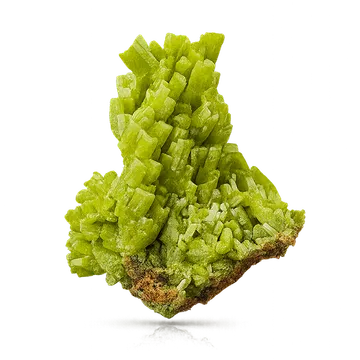
Minas del Horcajo, Spain — Pyromorphite from a mining locality, famed for green hexagonal prisms, color zoning, and historic collector provenance.
Key facts
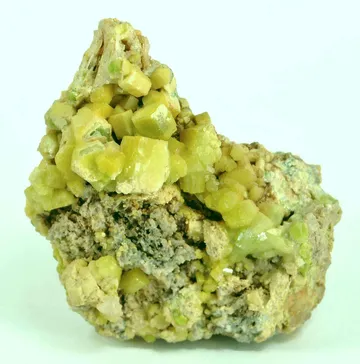
Minas del Horcajo is one of the grand European names for pyromorphite: a 19th- and early-20th-century Spanish lead-silver camp whose best specimens became famous for dense groups of green hexagonal prisms, richly varied color zoning, and the old-collection romance that collectors still recognize at a glance. The classic pieces are not merely “green pyromorphite.” They are El Horcajo pyromorphites: compact sprays and clusters of long prismatic crystals, often bright apple green to olive green, sometimes with brown, yellow, colorless, whitish, gray, pinkish, or blackish tones, and very often with internal color zoning that gives the crystals a lively, architectural look.

Photo: Wikimedia Commons
Mineralogically, the appeal is twofold. First, El Horcajo produced handsome cabinet and miniature specimens during the productive mining era, with the best historic material showing lustrous, elongated prisms in vivid green groups. Second, the locality is a serious mineralogical study site. Spanish crystallographers and later mineralogists paid close attention to the pyromorphite because of its unusually rich crystal morphology, its twinning, its zoning, and its relationship to phosphohedyphane, plumbogummite, kintoreite, and the broader phosphate suite of the deposit.
The deposit lies in the Valle de Alcudia district of Ciudad Real, within the southern Central Iberian Zone, where post-Hercynian hydrothermal veins carrying Pb-Zn-Ag-Sb-Cu mineralization cut older siliciclastic rocks. Primary galena, ankerite, sphalerite, chalcopyrite, tetrahedrite-group minerals, and related sulfides supplied the lead and metals; later supergene alteration generated the pyromorphite and the remarkable secondary phosphate-sulfate assemblage. In collector terms, the best specimens are judged by intact, sharply developed hexagonal prisms, attractive green color, luster, freedom from bruising, visible zoning, and convincing old provenance.
Search for specimens: View all pyromorphite specimens from Minas del Horcajo, Spain
Minas del Horcajo is a mining hamlet and historic lead-silver district in the municipality of Almodóvar del Campo, Ciudad Real, Castilla-La Mancha. The workings sit in the Sierra Madrona–Quintana natural unit, near the boundary with Brazatortas and not far from the province of Córdoba. The landscape is mountainous rather than open meseta country, and the mining settlement developed around a group of veins and shafts rather than a single isolated pit.
The ore deposit belongs to the Pb-Zn-Ag-Sb-Cu vein systems of the Valle de Alcudia. The district is set within the southern part of the Central Iberian Zone and is structurally tied to Hercynian deformation, later brittle faulting, and late-Hercynian intrusive activity associated with the Los Pedroches batholith. In the El Horcajo area, the mineralization is linked to post-Hercynian extensional fractures, especially structures described as La Basilisa and La Rivera. The main hydrothermal stage produced vein deposits dominated by galena and ankerite, with sphalerite, chalcopyrite, silver-bearing sulfosalts, and other accessory sulfides and sulfosalts. Subsequent weathering and groundwater circulation altered these primary minerals and produced the pyromorphite, phosphohedyphane, anglesite, cerussite, linarite, plumbogummite, kintoreite, and other secondary minerals that make the locality important to collectors.
The principal modern mining story begins in the 19th century. Juan Inza made the first mining registrations in 1858, and small production began the following year at the María del Pilar mine. In 1865 the operations passed to Ceferino Avecilla, who gave the camp a major impulse; by 1870 the mines were in the hands of Sociedad La Minería Española, with Avecilla still involved as manager. By 1873 the principal veins were being worked: San Alberto, also known as Nuevo Perú, with more than 2 km of strike length and later workings down to 555 m; Ana María, with about 800 m of strike; Paralelo; and San Germán, a somewhat separate working to the northwest.
The two main vein systems were developed by a line of shafts including Malacate, Argentino, San Miguel, San Juan, and San Ceferino. Malacate was the deepest, ultimately reaching 603 m. The mining camp became a substantial company town, with schools, a hospital, a church, and housing for miners’ families. In 1903, during the period when the mines belonged to the Banco de París, production reached 13,000 tonnes of ore and more than 1,200 workers were employed. Ore moved to the Veredas station with the help of about 290 pack animals. A mining railway to Conquista was opened in 1907, but the main productive story was nearly over: the mines closed definitively in 1911 after reaching the 603 m depth level.
There were later attempts to revive or investigate the district. From 1951 to 1955 the SMMP restarted work, mainly as prospecting; in 1959 exploitation was leased to Sociedad Minera Beticomanchega; all work stopped in 1963. A later, non-mining event became important for mineral collectors and mineralogists: the construction of the Madrid–Seville high-speed rail tunnel and viaduct near the old settlement moved old dumps and produced new spoil, exposing phosphate-bearing material and adding to the modern micromineral record of El Horcajo.
The San Germán mine deserves separate mention because its mineralogy differs from the main El Horcajo workings. It contains a notable secondary copper enrichment zone with chalcocite and native copper, and its pyromorphite-like phosphate material has proved especially important in the pyromorphite–phosphohedyphane identification problem. Modern analytical work indicates that San Germán specimens in this series may be phosphohedyphane rather than pyromorphite, so labels from this sublocality require special caution.
Today the site is a historic mining landscape, not a producing specimen mine. Old underground workings, dumps, rail-related cuts, and remaining structures such as the Argentino and San Juan shaft remains are part of the locality’s heritage. Serious field interest is therefore best approached with respect for private property, safety, conservation, and the fact that many of the finest pyromorphites entered collections during the old mining period rather than through modern collecting.
The most characteristic El Horcajo pyromorphite is prismatic. The common habit is an elongated hexagonal prism, usually horizontally striated, terminated by the basal pinacoid and frequently modified by bipyramidal faces. Classic crystals may be slender to acicular, gathered into centimetic groups, with parallel and subparallel growth that gives good specimens a bundled, almost fibrous architecture without losing the identity of individual crystals.
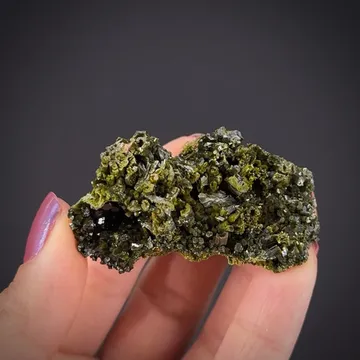
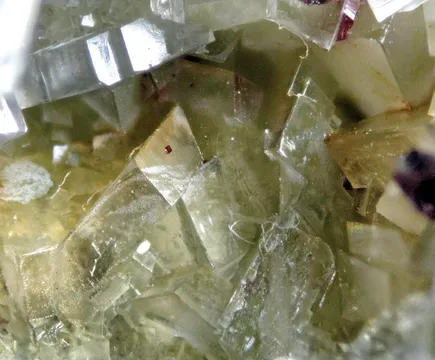
The old green specimens are the locality’s signature. Fine examples show apple-green, grass-green, olive-green, or yellow-green tones, often with a resinous to vitreous luster and a translucency that rewards close lighting. Some crystals are strongly zoned, with internal yellow or opaque cores and greener, more transparent outer zones. “Hourglass” zoning is especially characteristic, created by repeated symmetrical laminae within the crystal. Color bands may be parallel or perpendicular to the c-axis, and in many examples the zoning appears to reflect crystal-growth defects rather than major compositional changes.
El Horcajo also produced a broader palette than the market shorthand suggests. Documented colors include colorless transparent crystals, white, grayish, blackish crystals probably darkened by microscopic galena inclusions, honey-yellow, brown, pinkish brown, and a wide range of greens. Tabular crystals occur but are much less common than the elongated prismatic habit; they are usually smaller, more isolated, and less varied in color.
Crystal size varies by generation and by collecting period. Modern micromount material may involve crystals of 1–4 mm, including highly zoned and beautifully formed individuals on goethite, plumbogummite, coronadite, or other secondary minerals. Historic cabinet material can carry much larger visual impact through dense groups of elongated crystals, and individual crystals over 1 cm are known in classic pieces. The best museum and old-collection specimens show groups large enough for display rather than simply microscopic interest.
Associated minerals are central to understanding the locality. The lead oxidation suite includes galena, cerussite, anglesite, pyromorphite, phosphohedyphane, plumbogummite, kintoreite, linarite, and caledonite. The iron phosphate suite includes cacoxenite, beraunite, dufrénite, kidwellite, strengite, chalcosiderite, turquoise, and related species in the phosphate-rich weathering environment. Goethite and quartz are common matrix or cavity minerals; ankerite is a major gangue mineral in the primary veins. San Germán adds copper-rich associations such as chalcocite, native copper, cuprite, malachite, brochantite, langite, and related secondary copper minerals.
A notable modern complication is the pyromorphite–phosphohedyphane series. Classic green El Horcajo specimens generally correspond to pyromorphite with relatively little Pb-for-Ca substitution, but many smaller whitish to pinkish dump specimens contain higher calcium and may grade toward phosphohedyphane. Because the series is continuous and the visual distinction can be impossible, analytical confirmation is the only secure way to assign some specimens to one species or the other.
Quality is judged by the usual pyromorphite criteria, but with El Horcajo-specific priorities. Strong green color is desirable, yet not the only virtue: crisp prism faces, horizontal striation, hoppered or cavernous growth, luster, transparency, clear zoning, intact terminations, and credible old provenance all matter. Fine old labels from Spanish, French, German, or major private collections can add substantial collector interest because the locality’s peak production is long past.
The first authenticity concern is locality identity. El Horcajo is a famous name, and “Horcajo” labels appear on older European specimens, dealer labels, museum labels, and collection duplicates. A convincing specimen should look consistent with the locality: prismatic to acicular hexagonal crystals, commonly green to yellow-green or olive, often in parallel-growth aggregates, and frequently showing zoning or hoppered growth. Specimens with an old handwritten label, a known collection history, or a dealer chain back to a recognized European collection deserve extra confidence.
The second concern is species identity. Some specimens historically labeled pyromorphite from El Horcajo, especially pale, small, or San Germán-related material, may in fact be phosphohedyphane or lie very close to the pyromorphite–phosphohedyphane boundary. For display collecting, this distinction may not change the visual appeal; for systematic collections, it matters. If a specimen is from San Germán or is a white to pinkish dump specimen in the pyromorphite-like habit, an analytical note is valuable.
Plumbogummite and kintoreite can also complicate labels. At El Horcajo, plumbogummite may coat, replace, or form epimorphs after pyromorphite, preserving hexagonal shapes even after the original pyromorphite has been partly or completely removed. Kintoreite has also been documented pseudomorphing or replacing pyromorphite–phosphohedyphane crystals in the María del Pilar vein material. A collector should look carefully at surface texture: true pyromorphite crystals tend to show prismatic faces, striation, luster, and termination details, whereas replacement crusts may be more granular, botryoidal, or matte under magnification.
Condition issues are typical for old pyromorphite but worth inspecting closely. Elongated crystals chip at terminations and edges; dense clusters can hide bruising inside hollows; older specimens may have contact points from extraction or old trimming. Some classic groups have naturally hoppered or cavernous interiors, which should not automatically be mistaken for damage, but actual broken terminations and rubbed high points are common. Because the mineral is lead-rich and relatively dense, specimens should be handled sensibly and kept away from children; normal display is not a problem, but wash hands after handling and avoid generating dust.
Availability is limited but real. Small and miniature specimens from old collections still appear, often with labels dating to the early 20th century or with provenance through Spanish and European collections. Cabinet-size, richly green, highly aesthetic examples are much scarcer and increasingly museum-grade. Modern dump or micromount material can be mineralogically fascinating, but it rarely replaces the appeal of the classic mining-era green specimens. The best purchases balance beauty with documentation: a good Horcajo pyromorphite should be attractive in the hand, but it should also make sense historically, morphologically, and—where needed—analytically.
The old mines had the scale and atmosphere of a fully formed industrial village. By the 1870s, El Horcajo was not a few shallow holes in the hills but a complex mining camp with named veins, named shafts, company buildings, schools, a hospital, a church, and houses for miners’ families. The main shafts lined up from east to west—Malacate, Argentino, San Miguel, San Juan, and San Ceferino—over the workings of the San Alberto/Nuevo Perú and Ana María veins. Malacate eventually went down 603 m; Nuevo Perú alone ran for more than 2 km and was worked to 555 m.
A surviving photographic memory of the camp is the 1895 album “Recuerdo del Horcajo,” which recorded shafts, machinery, and buildings when the district was still alive. The San Juan shaft was remembered as the first, begun by Juan Inza; Malacate appears with a curious steam machine; Argentino had its machinery and boiler buildings. Those photographs matter to collectors because the finest green pyromorphites were not abstract “locality pieces.” They came from a real mining town at the height of the Spanish lead-silver boom, when steam engines, deep shafts, and ore transport shaped the valley.
The numbers from 1903 convey the scale better than any romantic language. That year, the mines produced 13,000 tonnes of ore and employed more than 1,200 workers. Before the dedicated railway connection, ore had to be hauled to Veredas station, and the transport work occupied about 290 pack animals. Four years later, in 1907, a rail line was inaugurated southward to Conquista, in Córdoba. Yet the railway arrived almost at the end of the story. By 1911 the great mining enterprise had closed definitively, even after the workings had reached their deepest level.
There is also a vivid silver story tied to the same district. Native silver was a significant historical find at El Horcajo, particularly from the Nuevo Perú and Ana María veins. In 1877 the natural history museums in Madrid and the School of Mines received specimens of filamentary native silver on crystallized galena from Nuevo Perú, donated by Avecilla y Cía. Ceferino Avecilla’s 1878 report selected 26 specimens from the Ana María vein; 18 of them were native silver, along with one pyromorphite, five galenas, and two samples of wall rock. In the Alberto vein, old miners reportedly recovered silver filaments from clay along the gallery walls—the “calichón”—by plastering the walls with clay before blasting so that the silver would be caught after the shot.
The modern mineralogical afterlife of the mine is quieter but no less interesting. The AVE Madrid–Seville works near the old village moved dumps and tunnel spoil, exposing material that later collectors and mineralogists examined under microscopes, with Raman spectroscopy, SEM-EDS, and X-ray diffraction. The old world of shafts and pack animals gave way to high-speed rail cuttings and micromount study, and El Horcajo became not only a source of classic green pyromorphites but also a laboratory for understanding Spanish supergene phosphate assemblages.
One modern museum description captures the visual shock that made the mineral famous. In darkness and humidity, a light on a rock covered in bright green “moss” would suggest life where no moss could grow. The answer is pyromorphite: not a plant, but a lead chlorophosphate crystallizing in brilliant green forms. That image—green mineral “moss” in a lead mine—is one reason El Horcajo still has a hold on collectors more than a century after the main mine closed.
.jpg)