






Aragonite from Minglanilla, Spain: robust cyclic twin prisms in smoky beige to purple, architectural pina clusters, prized by museums and serious collectors.
Key facts
Aragonite from Minglanilla is one of Spain’s great classic mineral occurrences: robust, pseudohexagonal cyclic twins of CaCO3, most famously in smoky beige, honey-brown, gray-lilac, violet, and reddish-purple tones. The best pieces have the peculiar authority of a “simple” crystal habit made extraordinary by scale, luster, and geometry: barrel-like prisms, double terminations, stacked groups, and radiating clusters whose six-sided look is not true hexagonal symmetry but the repeated intergrowth of orthorhombic aragonite twins.
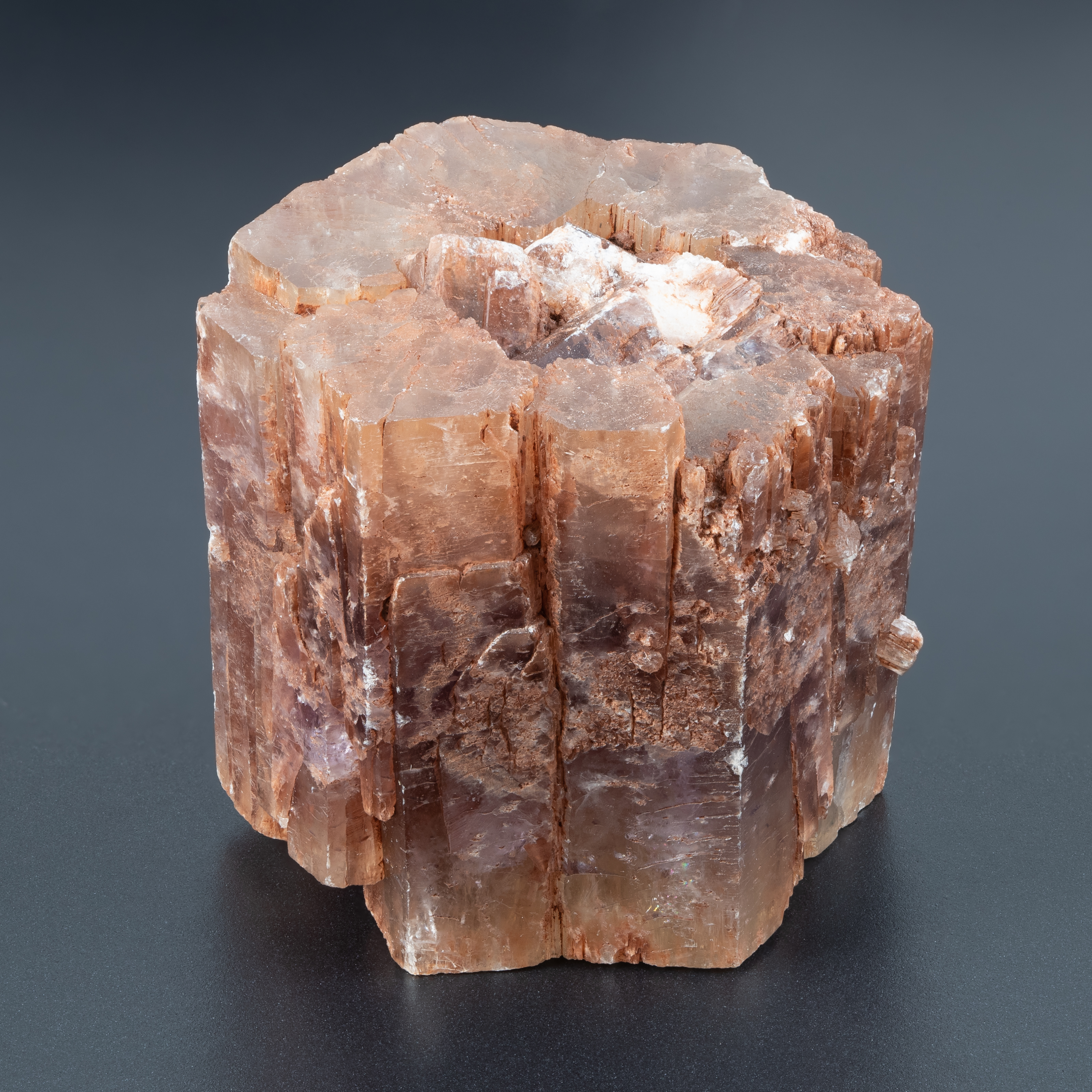
Photo: JJ Harrison / Wikimedia Commons
The locality belongs to the broad Keuper facies mineral belt of eastern and central Spain, where Upper Triassic evaporitic sediments — colored clays, marls, gypsum, halite, dolomitic and calcareous levels, and associated detrital beds — have yielded aragonite, gypsum, halite, and quartz varieties including jacinto de Compostela. In the Minglanilla area the most celebrated specimen ground is around Los Molinillos and La Vacariza, with adjacent and historically confused occurrences extending toward La Pesquera, Enguídanos, Camporrobles, and Villargordo del Cabriel near the Contreras reservoir.
Collectors prize Minglanilla because its crystals can be both architectural and colorful. A fine specimen is not merely a “brown Spanish aragonite”: it may show a translucent gray-green termination, a purple core, a salmon-to-lilac internal glow, basal striations, and a crisp pseudohexagonal outline. Cabinet pieces with several complete cyclic twins in open, three-dimensional arrangement are the locality’s signature; compact groups of “piña” habit — pineapple-like clusters of repeated prisms — are equally characteristic.

Photo: Miguel Calvo / Wikimedia Commons
The site’s importance is not just commercial. Minglanilla material appears in major museum and private collections, has been used in scientific studies of luminescence and Spanish Triassic aragonite deposits, and has become a touchstone for recognizing the best development of cyclic-twin aragonite in the Iberian Keuper. It stands close in spirit to the aragonite type-locality tradition of Molina de Aragón, but Minglanilla’s fame rests on abundance, size, and the quality of its pseudohexagonal twins.
Search for specimens: View all aragonite specimens from Minglanilla, Spain
Minglanilla lies in Cuenca Province, Castile-La Mancha, in the Manchuela region near the Cabriel river country and the Contreras reservoir. The aragonite localities most relevant to collectors are Keuper outcrops at Los Molinillos–La Vacariza and Pino de la Vacariza, with a broader collecting district that spills across municipal names and is often loosely labeled “Minglanilla” on older specimens.
The geological setting is Upper Triassic evaporitic terrain of the Keuper facies. These deposits record arid continental to marginal evaporitic environments in which clays, marls, gypsum, halite, dolomites, limestones, and sandstones accumulated during the late Triassic. Later deformation and erosion exposed the colored clay-and-gypsum sequence as steep badland slopes and gullies. That landscape matters to collectors: Minglanilla aragonites are not products of a hard-rock vein mine but of sedimentary-evaporitic units, released from soft, variegated Keuper marls and clays where erosion continually opens and destroys pockets.
The Spanish Geological Survey’s inventory recognizes the Minglanilla–La Pesquera–Enguídanos area as a geological-interest site for both its old salt deposits and its mineralogical value. The protected geological-interest area includes salt workings, gypsum, jacinto de Compostela quartz, and notable aragonite occurrences in badland terrain. It also records a high anthropogenic degradation risk and gives mineral collecting as acceptable for research purposes, a useful caution for modern collectors: historic specimens are legitimate classics, but field recovery today should be approached conservatively, legally, and with respect for protected-status boundaries, land ownership, erosion control, and local restrictions.
Minglanilla’s mining history is bound up with salt. The old “Mina de Minglanilla” name is somewhat misleading because the salt mine itself is in the municipality of La Pesquera, although access and local usage have long associated it with Minglanilla. The workings exploited halite and left ruined shafts, galleries, and evaporation or drying installations. Local accounts describe a deep mine with a 68-meter vertical access and numerous tunnels; the mine later shifted to solution methods after the wooden spiral stair was burned during the Carlist wars in 1837. The salt operation continued into the nineteenth century and was finally abandoned completely in the twentieth.
For aragonite collectors, the production history is less a single mine chronology than a long period of repeated field collecting. Los Molinillos and La Vacariza have supplied specimens for decades, with older pieces from the 1970s and 1980s especially desirable when they show strong violet color, sharp form, and reliable old collection provenance. Recent dealer listings and collection records show continuing market circulation, but the best older pieces — clean floaters, complete doubly terminated crystals, and large lustrous groups — are much scarcer than ordinary small brown twins.
Locality labels require care. Many specimens sold as Minglanilla may actually come from nearby municipal areas, especially Enguídanos or La Pesquera, including well-known ravine localities such as Retamal and Tormagal. In a broad collecting sense this is one mineralogical district; in a serious cabinet, however, “Los Molinillos–La Vacariza, Minglanilla” is a much sharper label than simply “Minglanilla, Spain.”
The defining habit is the cyclic twin. Aragonite is orthorhombic, but repeated twinning on 110 produces pseudohexagonal prisms that look, at first glance, like hexagonal barrels. Minglanilla examples commonly show flat to slightly irregular basal faces, longitudinal striations, stepped prism faces, and a six-sided outline that may be sharp in fine pieces and rougher or blockier in more common material.
Colors range from transparent to translucent beige, honey, caramel, brown, gray, smoky, salmon, lilac, violet, reddish-brown, and purple-gray. The violet material is particularly associated with the locality’s appeal; many of the most memorable specimens show a purplish interior with paler glassy terminations or a subtle gray-green cast near the ends. More opaque brown groups are common, but even these can be attractive when the crystal form is crisp and the luster is strong.
Crystal sizes vary widely. Thumbnail and miniature single twins around 1–3 cm are common in trade. Better small-cabinet specimens often show crystals in the 3–6 cm range, and published or cataloged examples include groups around 6.5 cm across, 7–8 cm specimens, 11 cm crystal groups, and larger cabinet clusters. Exceptional pieces combine size with completeness: a large aragonite from Minglanilla is not automatically fine if it is contacted, dull, or heavily cleaved; a smaller floater with glassy faces and undamaged terminations can be far more desirable.
The locality produces single crystals, double-terminated floaters, clusters of several intergrown cyclic twins, and “piña” aggregates. Some specimens sit on gypsum-rich or marly matrix, including salmon-colored gypsum; others are loose floaters with no point of attachment. Associated minerals in the Minglanilla district include gypsum, halite, quartz, milky doubly terminated quartz, and quartz var. jacinto de Compostela. These associations are part of the Keuper setting and help distinguish the locality from cave aragonites, oxidized-zone sprays, and modern carbonate deposits.
Quality is judged by five main factors: form, luster, color, completeness, and arrangement. The best Minglanilla aragonites have a crisp pseudohexagonal silhouette, bright vitreous luster, attractive internal color zoning, visible translucency, and a displayable composition that does not rely on hiding broken backs or contacted terminations. Purple-gray to lilac color can raise desirability, but not if the piece is dull or damaged. Conversely, a tan or honey specimen with sculptural form and glassy faces can be more collectible than a purple but battered cluster.
The main authenticity issue for Minglanilla aragonite is not whether the mineral is aragonite, but whether the locality is exact. The broader Contreras–Keuper district includes multiple productive outcrops across Minglanilla, La Pesquera, Enguídanos, Camporrobles, and nearby areas, and older labels often compress that geography into “Minglanilla.” For a serious Spanish suite, preserve the original label, but record any refined locality with caution. A specimen documented as Los Molinillos–La Vacariza is more precise than one labeled only “Minglanilla,” while pieces labeled “Minglanilla Mine” may deserve scrutiny because the famous salt mine is commonly associated with La Pesquera.
Condition problems are common. Aragonite has perfect to good cleavage tendencies and moderate hardness, and Minglanilla’s cyclic twins often show contacted basal faces, bruised prism edges, internal fractures, rehealed-looking zones, clay-filled cracks, or granular coatings from the host marl. Loose clusters can be deceptively heavy and vulnerable to shock at junctions between crystals. Examine terminations under side light; chips on the broad basal faces can be much less obvious in dealer photographs than in hand.
Color should be evaluated carefully. The violet component of Minglanilla aragonite has been studied in luminescence work, and heating experiments caused decoloration in samples. This does not mean that pale or tan Minglanilla specimens are treated; natural color variation is broad. It does mean that strongly colored pieces should be kept away from heat and harsh light, and that any specimen with suspiciously uneven bleaching, fresh break surfaces, or a washed-out look should be assessed in the context of its provenance and overall condition.
Market availability is steady at the lower and middle levels. Small brown or lilac twinned crystals and modest clusters appear regularly from Spanish and international dealers. Fine examples are a different market: lustrous purple-gray floaters, doubly terminated crystals with clean faces, large three-dimensional clusters, and old-collection pieces with documented provenance can command substantially higher prices. The best Minglanilla specimens are no longer merely “field classics”; they are benchmark examples of the species.
Minglanilla has the unusual distinction of being a mineral locality that entered village identity. Local writing from Minglanilla describes foreign collectors — Dutch, Belgian, French, American, German, and Spanish — returning year after year, walking the surrounding ground “palmo a palmo,” and buying supplies in town while hunting the aragonite that had made the place known in mineral circles. The tone is affectionate rather than promotional: the village recognizes that a quiet landscape of gullies, salt, gypsum, and red Keuper clay had become, for collectors, a destination.
One of the most vivid accounts comes through Jacques Lafite, whose photographs were used in a local feature on “Minglanilla, tierra de aragonitos.” Lafite wrote that he first came to Minglanilla in 1974 and, by January 2008, had been coming to the area for 34 years. He camped for many seasons at the Contreras gorge campground, remembered Fidel and his son as hosts, and singled out María’s paellas as part of the ritual of returning. What brought him back was not tourism in the ordinary sense, but “la búsqueda de los cristales de aragonito” — the search for aragonite crystals.
That same local account places Antonio Martínez Palomares at the center of Minglanilla’s collector lore. Martínez is described as a Minglanilla collector known in Europe and the United States for his knowledge of the area’s aragonite, a local specialist whose collection and exchanges connected the village to the broader mineral world. In the best mineral localities, there is usually someone like this: a person who knows which ravines produce ordinary brown twins, which slope once gave violet floaters, and which labels are too vague to be trusted.
More recent field accounts keep the romance but add the practical difficulty. Collectors describe Minglanilla not as a tidy quarry face but as monte bajo, pines in places, red ground, steep or brushy slopes, and laderas where the right patch of Keuper can reward patient searching. One writer recalled beginning in the wrong place, retreating to town for coffee, and receiving better directions there — a very Minglanilla kind of field correction. Another association trip grouped Minglanilla, La Pesquera, Enguídanos, and Camporrobles into a collector’s “Triángulo del oro” for aragonite, centered on the Keuper around the Contreras reservoir.
The salt mine adds a deeper historical undertone to the collecting ground. The Geolodía 2023 field guide describes a mine with a 68-meter vertical access, a wooden spiral stair, and more than 50 tunnels roughly 3 meters wide by 4 meters high. Three pack animals raised the salt to the surface. In 1837, during the Carlist wars, the stair was burned; afterward, the mine was worked by dissolving the salt with water and pumping the concentrated brine. That mining story is adjacent to, rather than the origin of, the aragonite specimens, but it explains why the Minglanilla–La Pesquera landscape feels so layered: one slope may speak to collectors of cyclic twins, while the ruins nearby speak of halite, brine, and the trade routes that carried salted fish inland.

.jpg)