Adun-Cholon Range, Russia - historic Siberian gem locality producing pale-blue aquamarine, heliodor, and topaz; famed for old-world crystals and provenance.
Key facts
Adun-Cholon is one of the great old Siberian gem localities: a lonely, granite-built range in southeastern Transbaikalia where miarolitic pegmatites, rare-metal greisens, and tin–tungsten mineralization produced aquamarine, heliodor, topaz, smoky quartz, cassiterite, wolframite, and a surprisingly deep list of secondary minerals. For collectors, its importance rests on two intertwined reputations. The first is historical: Adun-Cholon specimens entered European and Russian collections from the 18th and 19th centuries onward, commonly under spellings such as Adun Chilon, Adun Chelon, Adun-Tschilon, Adontschelon, “Nertschinsk,” or simply “Sibirien.” The second is visual: the best crystals are elegant, old-world pieces—striated beryl prisms in pale blue, greenish blue, yellow, or wine-yellow tones, sometimes with smoky quartz or topaz, and with a distinctive horizontal banding that gives many crystals a soft, watery Siberian character rather than the saturated modern-blue look of heated gem rough.
Regional View
Country View
The name has always carried some geographic ambiguity. Older labels often treated Adun-Cholon and Sherlova Gora as one gem district, whereas modern mineralogical usage separates the Adun-Cholon pegmatite field from Sherlova Gora’s greisen and ore system. That distinction matters to a field geologist, but to a collector reading an 1800s label it can be nearly impossible to know which side of the massif produced a given beryl or topaz. This is not a weakness of the locality; it is part of its provenance story. The range is a classic precisely because specimens were circulated for generations before modern locality precision became normal.

Photo: Wikimedia Commons
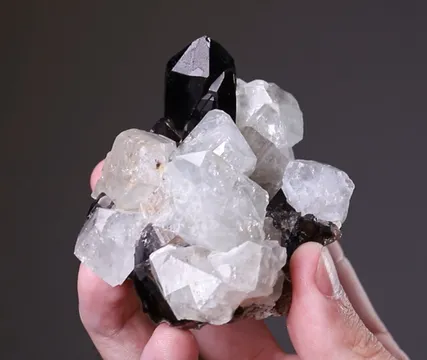
The Adun-Cholon look is usually subtle rather than theatrical. Fine aquamarines are prismatic and sharp, with longitudinal striations and pale steel-blue to greenish-blue color; heliodor and ordinary beryl add yellow, wine-yellow, green, colorless, and white tones. Topaz is generally colorless, white, or very pale blue, but on matrix with smoky quartz it can be far more compelling than its individual color suggests. Smoky quartz is the dark stage on which many of the classic combinations perform, often iron-stained at the base, with black wolframite, cassiterite, siderophyllite, schorl-like tourmaline, fluorite, and clay or limonite marking the old pocket environment.

Photo: Wikimedia Commons

Photo: Wikimedia Commons
Search for specimens: View all specimens from Adun-Cholon Range, Russia
Adun-Cholon lies in the southeastern part of Zabaykalsky Krai, historically tied to the Nerchinsk gem mines and to the broader Sherlova Gora–Adun-Cholon mineral district. The rock mass is principally a late-Jurassic granitic massif with strong enrichment in volatile and ore-forming elements, especially tin, tungsten, beryllium, fluorine, and boron. The range is also a landscape of weathered granite tors: the same resistant rocks that produced mineral pockets also weathered into the “stone herd” forms that gave the massif its name.
From a deposit-classification standpoint, collectors should think in two related systems rather than one simple pegmatite quarry. The Adun-Cholon field includes chambered granitic pegmatites that produced beryl, aquamarine, heliodor, topaz, smoky quartz, rock crystal, morion, muscovite, fluorite, adularia, tourmaline, garnet, apatite, cassiterite, wolframite, magnetite, hematite, and allanite. Sherlova Gora, historically folded into the Adun-Cholon label, is best treated as a rare-metal greisen and tin-polymetallic system developed in and around the Sherlova Gora granite massif, an apical cupola of the Kukulbeisky Complex. The productive greisens are lenticular, swelling and pinching along strike, and occur in roughly parallel swarms; the central parts can consist of granular quartz with embedded prismatic beryl, while wider portions produced open vugs large enough to furnish significant crystal specimens.
The ore-mineral side of the district explains many of the specimen associations. Cassiterite and wolframite occur with quartz-rich greisens and veins, and later mining for tin, tungsten, bismuth, lead, and zinc intersected gem pockets as by-products. The visual combinations that collectors prize—beryl with smoky quartz, topaz with smoky quartz, beryl on wolframite-rich matrix, fluorite with topaz and smoky quartz—make sense in this environment. These are not simple clean feldspar–quartz pegmatite pockets of the sort familiar from many granite pegmatite districts; they are rare-metal, volatile-rich systems where gem minerals and ore minerals overlap.
The recorded discovery story begins in 1723, when the Nerchinsk Cossack Ivan Gurkov, also rendered Gerkov in older Western accounts, reported aquamarines and topazes from the area. Systematic gemstone work is documented from the 1770s in the western part of the Sherlova Gora massif under the administration of the Nerchinsk works. Eighteenth-century extraction was shallow and opportunistic: pits, short shafts, surface diggings, and trenches followed pockets and weathered ground rather than a sustained hard-rock mine plan. Yet the yields could be remarkable. In 1787 nearly a metric ton of aquamarine crystals was reportedly extracted and sent to St. Petersburg; from 1810 to 1819 mining engineers recovered about 180 kg of aquamarine; in 1849–1850 a Nerchinsk party obtained more than 57 kg of gem crystals, including crystallographically notable aquamarines up to about a pound in weight.
By the middle of the 19th century, the easy weathered zone had largely been exhausted down to fresher granite. That did not mean the district was barren; it meant that the old mining technology was poorly suited to systematic deeper work for pockets. Official gem mining diminished after the 1850s, though later contract miners and local diggers continued to recover material. Around the turn of the 20th century, attention increasingly shifted toward bismuth, tin, and tungsten, and some aquamarines were found as by-products of ore work. During World War II, construction of underground headquarters for the Transbaikal Front encountered productive beryl and topaz pockets; material discarded or placed on dumps later became a target for local collectors after the 1990s.
Modern collecting access is highly restricted and should not be treated as a casual field-collecting opportunity. The Adon-Chelon cluster is part of the Daursky State Nature Biosphere Reserve system and has formal visitor rules for ecological routes, including advance application and accompaniment by reserve staff. The reserve literature also emphasizes the protected status of the massif and its wildlife and cultural values. Mineral collecting, digging, or removal from protected ground without explicit legal permission is not appropriate. Since 1996, published mineralogical summaries note that no authorized gem mining has taken place at Adun-Cholon, though local inhabitants have continued to find crystals on surface, in subsoil, in placers, and around shallow old workings.
Named and historically important sublocalities include Sherlova Gora, Gopeevskaya Mt, Soktuj Gora, Sopka Bolshaya, Vostochnaya Anomaly, the Novaya Vein, and the Millionnaya and Podnebesny workings associated with the Novaya Vein system. Collector labels may also mention Zolotoy or “Golden” spur, a name connected with 18th-century yellow beryl finds. For old specimens, label language must be interpreted cautiously: a crystal labeled “Adun Chilon” may represent the pegmatite field proper, Sherlova Gora in the older broad sense, or simply the Nerchinsk gem district as understood by a 19th-century dealer.
Adun-Cholon aquamarine is best known as slender to stout hexagonal prisms, typically striated parallel to the c axis and commonly showing watery greenish-blue, steel-blue, sky-blue, or pale blue color with fine basal color zoning; older examples may be labeled as aquamarine, beryl, or even “emerald” in the loose historical sense used for greenish beryl. Crystals range from small cabinet singles of a few centimeters to museum-grade prisms over 20 cm, with the finest pieces prized for sharp termination, transparency, subtle horizontal banding, and association with smoky quartz, topaz, or greisen matrix rather than for modern heat-treatment-like saturation. The most desirable Adun-Cholon aquamarines look unmistakably old: lightly included, often a little smoky or iron-stained toward the base, and far more mineralogical than jewelry-commercial.
Beryl from Adun-Cholon and Sherlova Gora occurs in a broader palette than aquamarine alone, including colorless, white, green, sky-blue, pale yellow, wine-yellow, and heliodor tones, generally as striated prisms from small crystals to many centimeters. The most distinctive specimens are not merely loose gem rough but matrix or combination pieces: beryl intergrown with smoky quartz or pale blue topaz, beryl seated on quartz-rich greisen, and rare yellow beryl crystals on wolframite-rich matrix. Good Adun-Cholon beryl should show some combination of clean prism form, readable termination, old locality character, and provenance; ordinary pieces are usually small, abraded, cloudy, or lacking the horizontal zoning and crisp crystal architecture that make the classic material sing.
Topaz from Adun-Cholon is typically colorless, white, pale blue, or occasionally yellowish, forming prismatic crystals that are commonly terminated by brachydomes and often lack a strong basal plane; individual crystals may reach several centimeters, while historical reports mention much larger masses and crystals by weight. Much of the material is fractured, cloudy, included, or only partly gemmy, so the finest collector pieces are matrix combinations: pale blue topaz crystals set against dark smoky quartz, topaz with aquamarine, or topaz emerging from limonite-stained quartz-greisen material. A good Adun-Cholon topaz is judged less by isolated gem clarity than by contrast, locality age, association, and preservation of glassy faces on a matrix that still tells the greisen-pocket story.
Quartz is the essential matrix and pocket mineral of Adun-Cholon: rock crystal, smoky quartz, morion, iron-stained quartz, and rarer amethyst and citrine are all recorded from the district. The collectible quartz is usually dark smoky to morion, in lustrous prismatic clusters or as matrix for aquamarine, topaz, fluorite, beryl, cassiterite, or wolframite; older literature even records smoky quartz exported to China, where it was worked into lenses for protective spectacles. Stand-alone quartz specimens can be attractive when they show deep color, sharp terminations, and little bruising, but the strongest Adun-Cholon quartz pieces are association specimens, where black-brown smoky crystals provide the visual counterweight to pale blue beryl or topaz.
Beyond the four display staples, Adun-Cholon and Sherlova Gora have a remarkable supporting cast. Jeremejevite is the great type-locality rarity from Soktuj Gora, originally described from only a few isolated prismatic crystals in the 1880s; zavaritskite, BiOF, is another type-locality mineral tied to Sherlova Gora. The district also records cassiterite, wolframite, fluorite, siderophyllite, schorl and other tourmaline-group material, muscovite, gilbertite, adularia, apatite, allanite-(Ce), magnetite, hematite, bismuthinite, bismuth, arsenates, sulfates, oxides, and many supergene species generated by the oxidation of complex tin-polymetallic ores. For systematic collectors, the locality is therefore not merely an aquamarine source but a long-lived mineralogical laboratory where gem pockets, rare-metal greisens, ore veins, and oxidation-zone chemistry overlap.
The chief authenticity issue is locality, not species. Many old beryls and aquamarines labeled “Ural Mountains,” “Catherineberg,” “Nertschinsk,” “Sibirien,” or similar broad Russian terms have physical characters and historical context pointing instead to Adun-Cholon or the Nerchinsk gem district. Conversely, many specimens labeled Adun-Cholon may actually be from Sherlova Gora in the modern, narrower sense. A strict modern locality claim should be treated cautiously unless supported by reliable old labels, museum history, or recent field provenance. For a collector, “Adun-Cholon Range” is often best understood as a historically correct district attribution rather than proof of a precise pit or vein.
Beryl color also deserves care. Old Adun-Cholon aquamarines are commonly pale, greenish, banded, or watery blue; they should not be expected to resemble saturated modern heated aquamarine. Colorless to greenish beryl and yellow heliodor from the same district are legitimate, and old labels may use terminology inconsistently. Strong, uniform blue in a crystal with no historical support should be examined skeptically, though the locality did produce attractive natural blue material. Look closely for natural color zoning parallel to the basal plane, longitudinal striation, and the surface wear expected of old collection pieces.
Condition is a major value factor. Adun-Cholon crystals often show bruised prism edges, chipped terminations, internal veils, iron staining, clay residues, and contact or breakage at the base. Topaz is especially prone to cleavage damage, edge nicks, and internal fractures; many historical topazes are cloudy or cracked. Smoky quartz clusters may show broken points or rehealed contacts. These flaws are common and not necessarily disqualifying, but they matter sharply in pricing because truly sharp, glassy, well-terminated Adun-Cholon crystals are much less available than small damaged loose crystals.
No locality-specific modern treatment pattern is well documented for collector specimens, but general gem-market caution still applies: blue topaz is widely irradiated in commerce, and aquamarine is commonly heated to improve color. A loose, intensely colored, gemmy stone sold as “Adun-Cholon” should therefore be evaluated as a gem first and a mineral specimen second. Matrix specimens, old labels, and documented provenance are far harder to replace than a cut stone or loose crystal with a romantic Siberian attribution.
Market availability is limited and uneven. True old Adun-Cholon beryl and aquamarine appear episodically from estate collections, museum deaccessions, and long-held European collections, while more recent small material from Sherlova Gora and related workings appears occasionally through Russian and international dealers. Fine matrix pieces with aquamarine, topaz, and smoky quartz remain scarce. The most compelling specimens combine locality age, crystal aesthetics, and provenance; a modest but well-labeled 19th-century crystal may be more desirable to a serious collector than a larger but anonymous pale prism.
The opening scene of Adun-Cholon’s gem history has the texture of Siberian legend. In 1723, Ivan Gurkov of Nerchinsk reported aquamarines and topazes from the mountains south of the town and received a reward of five rubles from the Mining College in St. Petersburg. Later accounts add a wonderfully human detail: local Buryat people had apparently collected crystals in quantity long before official notice, treating them not as state treasure or mineralogical rarities but as children’s toys. The gem field did not suddenly become mineralized in 1723; rather, it entered the written economy of empire.
By the late 18th century, Adun-Cholon was no longer a curiosity. European naturalists were hearing of aquamarine scattered so freely that early writers described it as occurring almost everywhere. In 1776, systematic gemstone mining began, and within a decade the district produced enough yellow beryl to name a spur. In 1785–1786, large numbers of heliodor crystals came from a spur off the main ridge; the place became known as Zoltai, the “Golden” spur. Then came 1787, the astonishing year in which nearly a ton of aquamarine crystals was reportedly shipped to St. Petersburg. For any modern collector accustomed to seeing a single old Adun-Cholon crystal in a thumbnail box, that figure is almost impossible to imagine: sacks and crates of pale blue beryl leaving a remote Transbaikal ridge by imperial route.
In 1788, Egor Barbot-de-Marni, head of the Nerchinsk silver smelter, decided that these crystals deserved a formal mineral museum in Nerchinsk. The instruction was not merely administrative; it recognized that the mine was producing specimens, not just raw material. Pyotr Kirgizov was commissioned to recover pieces for the museum, and by September he had reported matrix specimens with aquamarine and other minerals. Barbot-de-Marni also built his own collection: aquamarine crystals on matrix, smoky topaz pierced by aquamarine, quartz crystals, schorl, twelve particularly fine aquamarines, and a white topaz cluster with black smoky quartz and black schorl. That list reads like an early collector’s dream cabinet, and it preserves the very associations that still define the locality.
The mining itself was improvised and shallow. In 1796, a member of the Nerchinsk Mining Expedition named Tomilov ordered trenches cut across the Adun-Cholon ridge and down into plow-land. In only three days, more than 4 kg of aquamarine crystals came out; during the rest of the season, the recovery rose to more than 80 kg. Shafts seldom went deeper than about 6 m, and workings were often abandoned when rubble and collapsed weathered granite made them inconvenient. Yet this crude work fed some of the finest Russian and European collections of the period.
One of the most evocative 19th-century observations came from Germain Henri Hess, who visited in 1826. Hess saw aquamarine and topaz crystals with smoky quartz lining clay-filled fissures at the margins of granite bodies. For a collector, that is a key image: not isolated gems in a sterile pocket, but crystals projecting from the walls of damp, clay-packed fissures, with dark quartz and ore minerals around them. Hess also noted cassiterite and wolframite, clarifying the rare-metal character that later mining would exploit.
Another story belongs to a single heliodor crystal. A 4.3 cm yellow beryl from Adun-Chilon passed through a tangle of historic collections and labels before its provenance was reconstructed like a detective case. It appeared in the Alfred von Janson collection, whose 1892 catalog included a lot of 130 Adun-Chilon beryls of “rare beauty and size.” The von Janson collection entered the Humboldt University Museum in Berlin in 1899; World War II later destroyed catalog records, and the heliodor’s paper trail was broken. In 1992 it was traded out of the Humboldt Museum to Eric Asselborn, then passed to Wayne Thompson, Sandor Fuss, and finally to Jon Sigerman. The crystal itself is not large by modern pegmatite standards, but its importance lies in its chain of survival: from a Siberian pocket, to aristocratic European collecting, to a university museum, through wartime archival loss, and back into the collector world with its identity rebuilt.
The district’s 20th-century history produced one of its strangest collecting episodes. During World War II, the Transbaikal Front established underground headquarters in the area as part of defenses against possible Japanese incursions. Construction cut through productive beryl and topaz pockets, but the material was not mined as cabinet specimens. It went onto dumps. Decades later, after the 1990s, local collectors rediscovered and searched those dumps. The image is almost absurdly mineralogical: military excavation for an underground command post accidentally intercepting Siberian gem pockets, only for collectors a half-century later to recognize what had been discarded.
Even in the late 20th century the field was not finished. In 1993, exploration in the Podnebesnykh area encountered a productive vein while working loose sediments. The find yielded high-quality faceting aquamarine and crystals up to 10 cm long. The episode is a reminder that “classic” does not mean “dead.” The old shallow weathered zone was heavily worked, and authorized gem mining ceased after 1996, but the geologic system still contains pockets; the difficulty is legal, economic, and practical rather than simply mineralogical.