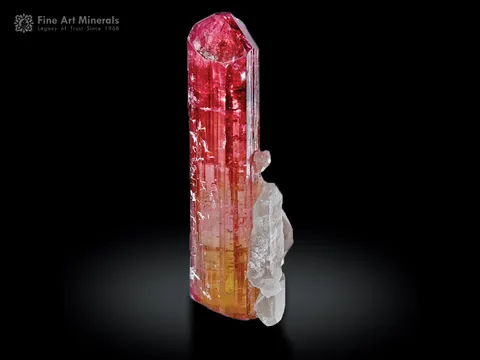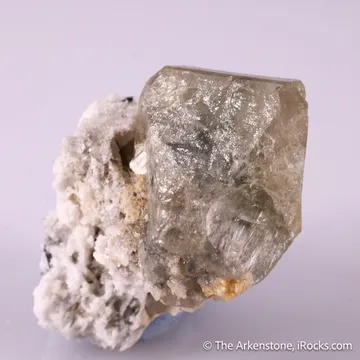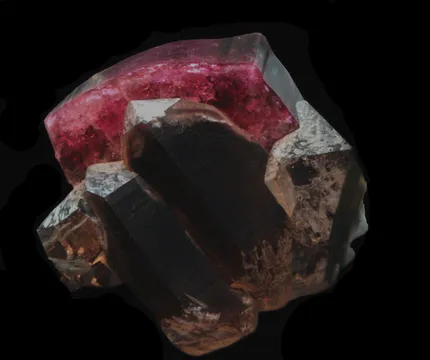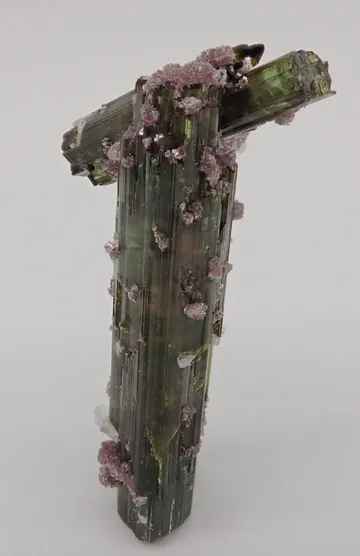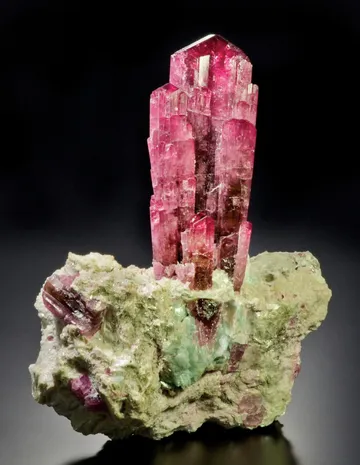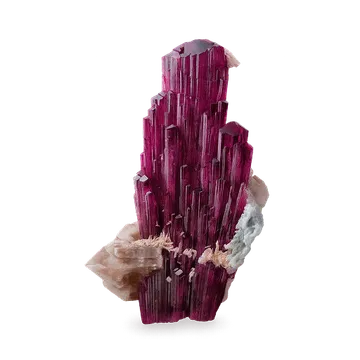
Albite from the Malkhan Pegmatite Field, Russia: pale, bladed cleavelandite with tourmaline matrix; a prized pegmatite mineral from a famed district.
Key facts
Albite from the Malkhan Pegmatite Field is best understood as the pale, bladed architecture that makes many of Malkhan’s famous tourmaline specimens work visually. The collector name most often attached to it is cleavelandite: thin, platy to bladed albite, commonly white to bluish white, forming sprays, sheaves, and snowy matrix around rubellite, smoky quartz, lepidolite, and late zeolites. Malkhan is not a locality where albite is prized mainly as isolated feldspar crystals; its strength is as a sculptural matrix mineral in one of Russia’s premier gem-pegmatite districts.

Photo: Wikimedia Commons
The setting is a complex, miarolitic, LCT-type granite-pegmatite field in Transbaikalia, south-east of Lake Baikal and near Krasnyi Chikoy. The pegmatites are famous for wine-red to purple-red tourmalines, but those tourmalines are rarely seen without their supporting cast: pale cleavelandite blades, smoky quartz, violet lepidolite, feldspar, and pocket clays. In the best specimens, albite provides the contrast that turns a dark cranberry tourmaline into a display piece—white feldspar against saturated red, platy texture against glassy prismatic tourmaline, and a sense of pegmatite pocket context rather than a trimmed single crystal.
The district’s significance goes beyond specimen beauty. Malkhan has produced more than fifty recorded mineral species and several type-locality minerals, and it has been the subject of unusually detailed Russian and international work on boron-rich pegmatite fluids, miarolitic pocket formation, rare-metal mineralization, and tourmaline chemistry. For albite collectors, the key point is that the cleavelandite is not incidental gangue: it is part of the late, rare-metal, boron- and lithium-rich pocket environment that made the gem pockets possible.
Collectors look for Malkhan albite in two related ways. The first is as aesthetic cleavelandite matrix—clean, bright, bladed, preferably with tourmaline, smoky quartz, lepidolite, or zeolite accents. The second is as locality evidence: a Malkhan tourmaline on pale blue-white cleavelandite, especially with smoky quartz or lepidolite, carries a very different visual signature from tourmalines on quartz from Brazil, on feldspar from Pakistan, or on lepidolite-rich matrix from Madagascar. Fine Malkhan albite is therefore valued less by the square centimeter of feldspar and more by the quality of the entire pocket association.
Search for specimens: View all albite specimens from Malkhan Pegmatite Field, Russia
The Malkhan Pegmatite Field lies in the Krasnyi Chikoy area of Zabaykalsky Krai, in central Transbaikalia. It is a mountainous taiga district of pine forest, rare bedrock exposures, deep weathering and colluvium, and permafrost-affected ground. Published descriptions place the productive pegmatites on the Malkhan Ridge, at elevations around 1,700–1,800 meters, reached historically by long overland travel from railway and regional centers rather than by any easy collecting route.
Geologically, Malkhan belongs to a Lower Cretaceous granite-pegmatite system associated with the Malkhan Granite and related granitic massifs. The pegmatites intrude metamorphic rocks of the Malkhan complex and related schists, with the gem-bearing bodies concentrated near the northern exocontact of the Oreshny Massif. Radiometric work on the granite-pegmatite system gives ages in the range of about 123.8–127.6 million years, and later summaries of the field commonly cite an age interval of roughly 128–124 million years.
The productive bodies are complex, zoned granitic pegmatites. Border zones may be aplitic or granitic; graphic and blocky zones dominate much of the interior; and the most interesting specimen-producing portions are late metasomatic and miarolitic zones associated with cavities. In the collector’s eye, these zones translate into a classic Malkhan assemblage: quartz, feldspar, cleavelandite albite, lepidolite, colored tourmaline, and locally danburite, axinite, fluorite, zeolites, beryl, hambergite, pollucite, petalite, and rare Nb-Ta-Bi minerals.
Malkhan’s mining history began not as a romantic gem rush but through Soviet geological exploration. Black tourmaline-bearing pegmatites had been known in the region long before colored gem tourmalines were recognized. Gemmy colored tourmaline of the elbaite-liddicoatite series was discovered in 1980, and exploration through the early and mid-1980s opened a series of now-famous dikes, including Skakunya, Krutaya, Mokhovaya, Oreshnaya, Oktyabrskaya, and Sosedka. A uranium-prospecting effort found no uranium deposit, but it helped expose the gem pegmatites that made Malkhan famous.
The central productive cluster includes the Mokhovaya, Oreshnaya, and Sosedka veins, with nearby dikes such as Oktyabrskaya, Karkadilovaya, and Yubileinaya. Sosedka became especially important in the modern specimen trade. It is described as a large, subhorizontal pegmatite, about 400 × 200 × 40 meters, originally recognized in drill core rather than as an obvious outcrop. After smaller bodies were exhausted, Sosedka was opened in quarries around 2000 and continued to produce important pockets through the 2010s.
Collecting access is not comparable to public rockhounding at an old pegmatite dump. The important pockets were worked by mining companies, Russian geological teams, local miners, and invited foreign specialists. Published field accounts describe licensed mining by TourMalkhan, periods of unauthorized mining, careful but rushed pocket extraction, and the constant pressure to recover tourmaline before pockets were damaged, stolen from, or mined for gem rough. For collectors today, Malkhan material is best approached through reputable dealers, older collections, and documented specimens rather than any expectation of casual field access.
Production has been irregular and pocket-driven. Some seasons produced little; others produced extraordinary cavities. One of the largest recorded cavities in the Sosedka pegmatite reached about 12 × 6 × 1.5 meters and reportedly contained more than 1,000 kilograms of purple liddicoatite with quartz, feldspar, lepidolite, and axinite, though much of that material went to lapidary use. Later pockets yielded more specimen-oriented material: tourmaline with cleavelandite, smoky quartz, lepidolite, and zeolites, often in fragile pocket plates rather than durable massive matrix.
Albite’s importance at Malkhan is tied to this pocket history. The best albite pieces are not merely “feldspar from Russia”; they are records of late-stage pocket growth—pale cleavelandite blades and albite-rich matrices that held, framed, and sometimes partly embedded gem tourmalines during the final, volatile-rich stages of crystallization.
Malkhan albite is most characteristic as cleavelandite, the platy to bladed variety of albite, NaAlSi3O8. In specimens, it may appear as thin, white to pale bluish-white blades, fanlike sprays, sheaves, crusts, and open platy aggregates. It can also appear as more ordinary white feldspar matrix or tabular albite crystals associated with cleavelandite blades. In the finest tourmaline combinations, the albite gives a cool, snow-bright or blue-white field behind red, cranberry, pink, purple, or polychrome tourmaline.
Published descriptions of the Malkhan pocket mineralogy specifically note albite as cleavelandite commonly associated with tabular purple lepidolite. In the field’s most productive gem pockets, cleavelandite appears with quartz, smoky quartz to morion, K-feldspar, lepidolite, tourmaline, laumontite and other zeolites, axinite, danburite, fluorite, beryl, hambergite, petalite, pollucite, and boron-bearing micas or chlorites. The association is not random: the late albite-lepidolite-cleavelandite complex belongs to the rare-metal, volatile-rich stage of the pegmatite system.
Color is usually pale and understated. The collector appeal lies in texture and contrast rather than strong albite color. White cleavelandite can be clean and snowy; some specimens show a blue-white cast; others are creamier, clay-stained, or partly obscured by lepidolite, zeolite, or pocket debris. Where laumontite or other zeolites are present, the albite matrix may look more matte, crusted, or sugary. Where pocket plates were carefully prepared, the albite can be bright, bladed, and crisp enough to serve as a major display element.
Typical specimen sizes range widely because albite is a matrix mineral here. Small cabinet pieces may show a single tourmaline emerging from a few centimeters of cleavelandite; large cabinet specimens can carry multiple tourmalines, smoky quartz crystals, and broad albite plates. Individual cleavelandite blades are usually small to moderate in size, but aggregate albite matrices can be substantial. The largest Malkhan display specimens are valued for their entire architecture: tourmaline crystals reaching many centimeters, quartz crystals, lepidolite roses or plates, and albite as the structural base.
Quality in Malkhan albite depends on several factors:
The strongest Malkhan “look” is a wine-red to cranberry tourmaline rising from a pale cleavelandite-albite matrix, often with smoky quartz and lepidolite. That combination is the locality’s visual signature, and it is why even modest albite can be important when it is in the right association.
The main authenticity issue for Malkhan albite is not artificial coloring of albite; it is provenance and preparation. Many specimens reach the market as tourmaline-on-albite or tourmaline-on-cleavelandite combinations, and the value may reside overwhelmingly in the tourmaline. Labels should therefore be read carefully. “Malkhan,” “Malchan,” “Malkhansk,” and older administrative names such as Chitinskaya Oblast or Transbaikalia may all appear on labels, but “Malechansk” is a known misnomer rather than a separate locality.
Professional repair and restoration are especially important in this district. Published accounts from the modern Malkhan specimen trade describe major specimens being transported to preparation laboratories in Europe or the United States for cleaning, repair, reattachment, and restoration. That is not surprising: pocket rupture, freeze-thaw damage, rushed extraction, blasting, theft of fragments, and the inherently brittle nature of tourmaline-cleavelandite plates all contributed to breakage. For high-end Malkhan pieces, especially tourmalines on albite matrix, a frank restoration report is not a luxury—it is part of responsible ownership.
Condition issues in albite itself are predictable. Cleavelandite blades chip along edges, detach from matrix, and can be crushed where tourmaline or quartz plates broke loose. Albite may be partly coated by clay, lepidolite, laumontite, or later zeolites; such coatings can be natural and desirable if they show pocket history, but they can also obscure the feldspar. Laumontite-bearing specimens should be treated cautiously because laumontite can dehydrate and become powdery in dry indoor conditions. Avoid soaking complex Malkhan pieces unless you know the full assemblage.
Loose or reattached tourmalines on albite should be examined under magnification. Look for glue lines, filled fractures, mismatched luster across a break, restored terminations, and unnatural seating of a crystal into cleavelandite. Repaired specimens can still be excellent and collectible, but the market should price them according to the extent and quality of the work. A repaired world-class Malkhan rubellite on albite may be entirely acceptable; an undisclosed composite is not.
Pure albite or cleavelandite from Malkhan is less common in the trade than tourmaline specimens with albite matrix. Most dealers list the primary species as elbaite, rubellite, liddicoatite, tourmaline, quartz, or lepidolite, with albite noted as an associated mineral. As a result, collectors seeking the locality’s albite should search under both “albite” and “cleavelandite,” and should inspect tourmaline listings where the feldspar matrix is visually significant.
Rarity is best described in layers. Albite as a mineral is not rare at Malkhan. Attractive, undamaged cleavelandite sprays are less common. Fine cabinet plates where albite, tourmaline, smoky quartz, and lepidolite are balanced naturally are genuinely scarce. Large, dramatic Malkhan matrix specimens with important tourmalines on clean albite are now elite pieces, often from older finds or carefully prepared pocket material rather than abundant new production.
Malkhan’s modern story began with a geological anticlimax that turned into a gem discovery. A state-sponsored expedition was prospecting for uranium in the early 1980s. The uranium did not materialize, but the pegmatites did. The first opened bodies—Skakunya 1 and related early dikes—proved rich in gemmy bicolored tourmalines, and the district’s purpose changed almost overnight. In 1983, the joint Baikal Quartz Expedition brought new attention to the area. Victor E. Kusnaryov, later closely associated with TourMalkhan, came with about twenty geologists and students. In the Oreshnaya pegmatite they found the first large miarolitic gem pocket and recovered nearly 100 kilograms of top-quality wine-red tourmalines edged with pale green. The old Russian scarcity of tourmaline, after the exhaustion of earlier Siberian and Ural sources, suddenly had a new answer in the taiga.
The Sosedka pegmatite produced the sort of numbers that collectors remember. One cavity reached 12 × 6 × 1.5 meters and held more than 1,000 kilograms of purple liddicoatite with quartz, feldspar, lepidolite, and axinite. The largest crystals in that pocket were about 25 × 8 cm. Yet the story is bittersweet: almost all of those tourmalines were used as cabochon and lapidary material rather than preserved as specimens. For albite collectors, that detail explains why matrix pieces from Malkhan can feel surprisingly scarce compared with the tonnage of gem material removed. Many pocket contents became rough, and the delicate cleavelandite matrices were simply in the way.
In September 2011, after two days of nearly fruitless work, the field team had found only a single 23 × 22 × 16 mm liddicoatite crystal. Then Saša Sotnik, the main geologist, came with better news: a pocket had been opened in the floor of the Sosedka quarry. The entrance was lined with gray quartz blocks, abundant pale blue cleavelandite, purple elbaite, and lepidolite. The cavity was about one meter across and vertical. Its free space held rock fragments, loose crystals, small matrix specimens, and druses of K-feldspar, cleavelandite, lepidolite, quartz, and tourmaline. The tourmalines reached 12 × 3.5 cm as single dark-purple gem crystals, and clusters reached 20 × 15 × 15 cm. The next day, the pocket was worked out. That speed—one pocket, one day—says much about why Malkhan specimens so often show damage, repairs, or lost parts.
The physical act of collecting at Malkhan could be absurdly difficult. The pockets were often vertical or subvertical, amoeboid, narrow, and interconnected, with sharp crystal-lined walls. Field accounts describe collectors working without gloves because they needed fingertip control, even though the crystal edges cut hands under gloves and without them. Sometimes the only way to reach matrix plates was to go upside down into a pocket, hands extended as much as three meters below, while one or two strong companions held the collector by the ankles so he would not drop face-first into icy water.
One 2011 episode captures the clash between careful specimen extraction and mining reality. The team told the miners they could not continue collecting from a very long, narrow pocket in the awkward upside-down manner. It was evening, so they went back to camp for dinner. About an hour later came the familiar horn signal for blasting, followed by a low rumble. When they ran back to the quarry, they found that two miners had drilled six holes, each 1.8 meters deep, around the pocket and blasted it open. The maneuver created working room, but destroyed almost all of the remaining matrix specimens. In a district where albite plates and tourmaline attachments are everything, that single blast translated directly into lost specimen history.
Preparation became a second chapter of collecting. Malkhan pockets yielded crystals, plates, terminations, fragments, and matrix pieces that did not always stay together from pocket to market. Published accounts describe specimen work as a “mine to market” process: material transported to Europe, cleaned and sorted, then sent to professional laboratories such as Collector’s Edge Minerals in Colorado, Federico Pezzotta’s MCP in Milan, and Peter Kolesar’s lab in the Czech Republic. For Malkhan tourmaline-on-albite specimens, the preparation bench could be as decisive as the quarry wall.
One of the most memorable stories unfolded at the Sainte-Marie-aux-Mines show in France in June 2016. While browsing another dealer’s stock, the Malkhan team noticed, among duller older Malkhan crystals, a beautiful wine-red, extra-lustrous tourmaline with a flawless gem termination. It was not just a good crystal—it was the missing part of an incomplete specimen they owned. They bought it, trying not to reveal too much excitement, took it back to the Czech Republic, and reunited it with its proper matrix and crystal base. It fit perfectly.
Another specimen, nicknamed “X,” became a two-year chase. In 2012, one of the best Malkhan pockets of the year yielded a matrix specimen with two very lustrous 20 cm red tourmalines crossing in an aesthetic X configuration. One crystal lacked its termination. The team bought the specimen from the TourMalkhan director anyway, then searched through boxes of pocket material, visited miners and dealers in Russia, and asked repeatedly whether any forgotten material remained from the cavity. After two years and five or six targeted trips to Russia, the missing termination finally appeared. The key was a $5,000 reward. The completed specimen was sent to MCP in Italy for reassembly.
Then there was “Ares,” named for the god of war. It had lustrous smoky quartz on the bottom of a super-lustrous red tourmaline crystal, all on a matrix of blue-white albite, lepidolite, and zeolites. The flaw was obvious: the long upper termination of the main tourmaline was missing. Two years later, while looking through Malkhan material offered as faceting and cabbing rough, the team recognized the missing termination, partly covered with recrystallized fine-grained quartz and lepidolite. They bought it, took it to Milan, and found that it matched. After the microcrystalline quartz was removed, the risk paid off in the form of a spectacular restored specimen.
The most telling of these stories may be the one that began with more than 1,000 kilograms of tourmaline from a major Sosedka pocket. The team sat on the floor of their Malkhan residence sorting and matching crystal pieces. Just sorting the individual crystals by size took a full day. Some pieces had been stolen shortly after the pocket was found, and terminations and matrix fragments were missing. Eventually they located a vibrant red 20 cm rubellite on a large piece of cleavelandite and pegmatite matrix, with recrystallized faces and a perfect detached termination. It was found at the end of the day. The next morning, the specimen was gone. After a frantic hour, they found the termination attached to the wrong specimen; the bottom part had been moved to another room. Several hours later the pieces were reunited. The story ends not with drama but with the quiet truth of Malkhan: in a chaotic room full of pocket fragments, a great specimen can be lost, found, mismatched, and saved before it ever reaches a collector’s cabinet.