Sosedka, Russia — premier Malkhan pegmatite locality; wine-red to purplish tourmaline on albite, famed miarolitic pockets, and rare boron-rich minerals for col…
Key facts
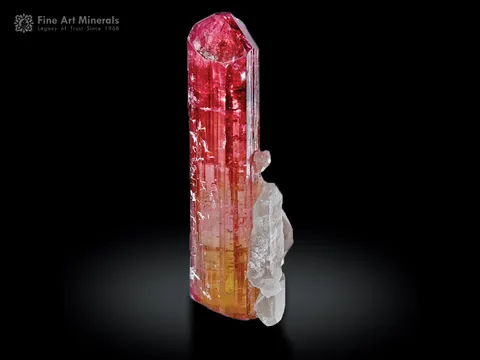
Sosedka is the specimen collector’s name to know in the Malkhan pegmatite field of Transbaikalia: a steep, gem-tourmaline-bearing LCT pegmatite vein on the Malkhan Ridge near Krasnyi Chikoy, in Zabaykalsky Krai. Within the Malkhan field it belongs to the tight central cluster of highly productive veins that includes Mokhovaya and Oreshnaya, but Sosedka distinguished itself by the sheer number of miarolitic pockets opened during modern mining and by the size, color, and matrix aesthetics of its finest tourmalines. The best pieces are unmistakably Siberian in personality: wine-red to purplish-red elbaite-liddicoatite crystals, sometimes strongly polychrome, standing on white to pale-blue albite or cleavelandite, smoky quartz, violet lepidolite, muscovite, and late zeolite coatings. At the highest level, Sosedka tourmaline specimens are not merely “Russian rubellites”; they are among the major modern matrix-tourmaline productions anywhere.
Regional View
Country View
The vein is important scientifically as well as aesthetically. It is a large, concentrically zoned pegmatite body whose pocket mineralogy changes abruptly over very short distances; published work on Sosedka feldspars and miaroles has been used to challenge simplified models of orderly inward crystallization in zoned pegmatites. Sosedka also supplied type material for borocookeite and nioboixiolite-(Mn2+), tying a celebrated gem locality to the rare-mineral literature. For collectors, that combination matters: the locality is both a source of spectacular cabinet specimens and a genuine reference locality for the mineralogy of boron-rich, rare-element pegmatites.

Photo: Wikimedia Commons
Search for specimens: View all specimens from Sosedka pegmatite vein, Russia
Sosedka lies in the Malkhan pegmatite field near Krasnyi Chikoy, in Krasnochikoysky District, Zabaykalsky Krai. The pegmatites sit high on the Malkhan Ridge in a taiga and permafrost setting, with productive workings reached by rough field roads rather than by ordinary collecting tracks. The broader district is part of the Malkhan granite-pegmatite system and is known for miarolitic, gem-bearing rare-element pegmatites of LCT affinity: lithium, cesium, tantalum, boron, beryllium, and volatile-rich late-stage fluids all left their imprint in the pockets and accessory mineral suite.
The Sosedka body was exposed by broad surface stripping and then mined in open cuts on its southwestern and northeastern parts. In plan it is roughly oval at the surface, with published Russian work giving approximate surface dimensions around 80 × 50 m; other descriptions of the productive body emphasize its lens-like scale and steep contacts in metamorphosed diorite host rock. Its internal zoning is not the tidy textbook sequence many collectors imagine. The outer annular zone is dominated by quartz-oligoclase pegmatite with schorl, coarse graphic to subgraphic textures, and local orange to dark-red garnet. Toward the center, quartz-K-feldspar pegmatite and blocky K-feldspar become prominent, with blocky quartz subordinate. A petalite-rubellite-albite-lepidolite lens, roughly 8 × 5 × 4 m in the published Russian description, was found in the outer zone near the boundary with the central zone; it contained petalite-rich portions associated with rubellite individuals to about 15–20 cm, pale pink beryl in places, violet lepidolite, and white to pale-bluish albite, but it was not a miarolitic pocket body.
The specimen-producing heart of Sosedka is its system of miaroles. Surface stripping initially showed only a few small colored-tourmaline cavities, but quarrying in the southwest part of the vein later exposed hundreds of pockets ranging from decimeter-scale cavities to volumes of many cubic meters. Their forms include spherical, tubular, slit-like, branched, and amoeboid cavities, and some of the large open voids were interconnected. The walls and near-pocket zones may be lined with quartz, colored tourmaline, cleavelandite, lepidolite, K-feldspar, and later zeolites, but Sosedka is notorious for variability: pockets only a meter or two apart can have strikingly different mineral assemblages and collecting value.
Three pocket types are especially important. The tourmaline-rich type consists of quartz-lepidolite-Mn-Li-Al tourmaline assemblages, locally with pollucite, hambergite, borocookeite, boromuscovite, danburite, and light-pink beryl. A second type is quartz-adularia-axinite, commonly with laumontite. A third is dominated by quartz and laumontite, with boron-bearing cookeite in some cases. Tourmaline-bearing cavities are concentrated irregularly in the outer zone and in a southwestern belt that extends northeastward and broadens downward; the more quartz-zeolite and axinite-adularia pocket types become increasingly important toward the center and with depth.
Modern specimen production is closely tied to the Tourmalkhan mining enterprise and to specimen dealers and preparators who worked with the mine. Malkhan gem tourmalines were recognized in the late Soviet period, but Sosedka’s strongest international specimen reputation was built through the 2000s and especially the 2012–2018 pocket discoveries. Named pockets and finds that matter to collectors include the PR Pocket, Breccia Pocket, Teflon Pocket, Bloody Pocket, Forgotten Pocket, Frozen Pocket, Rocket Pocket, Electric Pink Pocket, and Peach-Lemon Pocket. The names are not marketing trivia: they help track matrix style, color, associated minerals, repairs, and provenance among Sosedka’s important pieces.
Collecting access should be regarded as closed to casual field collecting. Sosedka is a remote, mined pegmatite quarry in a licensed district, and the best material was recovered under mine control, not by recreational collecting. Export of Russian gem and mineral specimens has historically required formal documentation, and older accounts make clear that access, security, and paperwork were significant barriers even for established foreign dealers. Today, collectors encounter Sosedka almost entirely through established dealer inventories, auction archives, museum displays, and specimens with older Malkhan provenance.
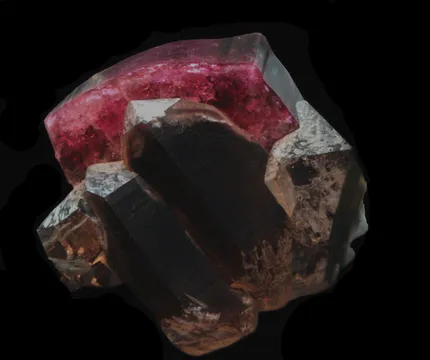
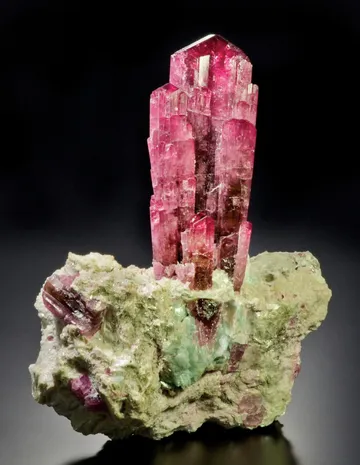
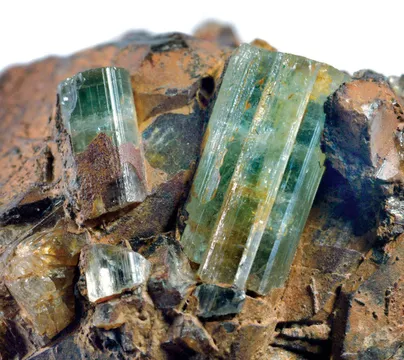
Sosedka tourmaline is the locality’s defining mineral, occurring chiefly as elbaite-liddicoatite and rubellite-bearing tourmaline in miarolitic pockets and near-pocket assemblages with albite, cleavelandite, smoky quartz, lepidolite, muscovite, laumontite, and other late minerals. Crystal habit ranges from individual prismatic crystals and flattened prisms to groups and matrix sprays; colors include deep cranberry, wine-red, purplish red, pink, peachy or yellowish zones, brownish-green to dark etched remnants, and black schorl in the outer pegmatite. Published specimen records include Sosedka tourmalines from small thumbnail-to-miniature pieces up to major cabinet crystals: 20–30 cm red crystals occur in named pockets, exceptional matrix pieces exceed 30 cm, and the celebrated “Rocket of Russia” crystal is recorded at 40 cm. The best pieces combine strong color, translucency or gemminess, sharp terminations, high luster, natural association on pale albite or smoky quartz, and convincing pocket provenance; ordinary pieces are more often etched, incomplete, dull, detached, or poorly documented as merely “Malkhan.”
Albite at Sosedka is far more than pale matrix. It occurs as white to faintly blue albite and platy cleavelandite in tourmaline-bearing miaroles, as fracture and replacement material near pockets, and as a key matrix mineral for the most aesthetic red tourmaline specimens. In the productive pocket assemblages, cleavelandite plates can form bright, bladed nests around rubellite and quartz; published pocket descriptions mention albite plates directly entering cavities as cleavelandite brushes, pale-blue albite associated with violet lepidolite, and blue albite matrix in reconstructed Breccia Pocket specimens. Good Sosedka albite pieces are judged less as stand-alone feldspar specimens than as architecture: crisp, clean, contrasting blades that set off red tourmaline, survive without heavy zeolite crusting, and retain the natural pocket relationship between crystal and matrix.
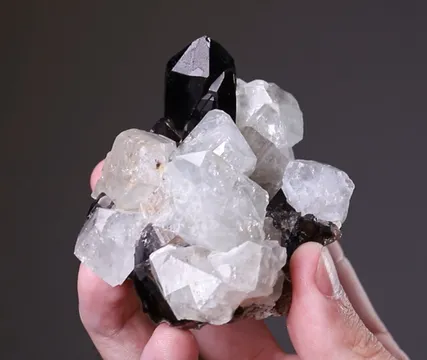
Quartz is abundant throughout Sosedka but becomes collectible when it preserves the pocket history: smoky crystals, pale-smoky roots with colorless outer growth, doubly terminated crystals from loose pocket fill, smoky quartz clusters with tourmaline, and blocky or milky quartz forming the walls of non-tourmaline miaroles. Some quartz-dominant cavities lacked colored tourmaline altogether, while the tourmaline pockets produced classic combinations of red tourmaline on smoky quartz and albite; published Sosedka captions record smoky quartz clusters around 24 cm and major tourmaline-on-quartz combinations from the PR and related pockets. The most desirable quartz-associated pieces have lustrous smoky crystals that frame, rather than compete with, the tourmaline; quartz-only material from Sosedka is usually much less important unless the crystals are unusually sharp, large, or associated with rarities such as fluorite, axinite, hambergite, or late zeolites.
Rubellite from Sosedka is the collector-facing expression of the locality’s best tourmaline: deep red, wine-red, cranberry, pink, and purplish-red crystals, commonly in albite-cleavelandite-lepidolite-quartz pocket assemblages. The 2012–2018 production made Sosedka especially important for high-quality rubellite crystals, including matrix examples to several tens of centimeters and gem-quality crystals in the 10–15 cm range; Russian geological descriptions also record rubellite individuals to 15–20 cm in the petalite-rubellite-albite-lepidolite lens outside the open miaroles. Top rubellite specimens from Sosedka are vivid, lustrous, terminated, and preferably on pale albite or smoky quartz, with minimal zeolite masking and well-disclosed repair history; lesser examples may be dark, etched, internally fractured, heavily coated, or detached from their original pocket matrix.
Muscovite is a subordinate but significant matrix and association mineral at Sosedka, particularly in tourmaline specimens where mica provides silvery to pale plates beneath red crystals or occurs with quartz, albite, schorl, spessartine, and late laumontite. Published Sosedka specimen captions record tourmaline on muscovite, laumontite on muscovite with tourmaline from the Rocket Pocket, and older tourmaline-muscovite combinations, showing that mica was part of both pocket and near-pocket specimen aesthetics even if it was not the main target of mining. The best muscovite-bearing specimens are those in which the mica is clean, bright, and structurally useful—supporting or contrasting the tourmaline—rather than loose, bruised, clay-coated, or overgrown by friable zeolite crusts.
Other documented Sosedka minerals give the locality unusual depth beyond its headline tourmalines. The Mindat mineral list and primary literature record beryl, danburite, hambergite, petalite, pollucite, boromuscovite, cookeite, laumontite, adularia, almandine-spessartine garnet, schorl, bismuthinite, bismutite, native bismuth, euxenite-(Y), monazite-(Ce), xenotime-(Y), zircon, ilmenorutile-strüverite-series minerals, and scandium-bearing ixiolite. Borocookeite is a type-locality mineral from Sosedka, later also known from Mokhovaya and a few other occurrences, while nioboixiolite-(Mn2+) was described from Sosedka as brown-black lath-like crystals and radiating aggregates embedded in albite with quartz, microcline, elbaite, beryl, bismuthinite, euxenite-(Y), zircon, rutile, cassiterite, and cannonite. Fluorite also deserves mention: 2018 Sosedka pockets produced octahedral crystals, including notable material associated with dark smoky to morion quartz in tourmaline-free miaroles.
The main authenticity issue for Sosedka is not a flood of outright fake crystals; it is repair, restoration, and uncertain specificity of locality. Published accounts by people involved in the modern Malkhan trade state plainly that many major and minor Malkhan specimens required professional cleaning, repair, restoration, or reassembly because of pocket decompression, freeze-thaw damage, rushed extraction, and loss of matrix or terminations during mining. That means a fine Sosedka tourmaline should be evaluated like a major Pederneira or Himalaya mine tourmaline: expect the possibility of reattached crystals, repaired terminations, restored matrix contacts, filled fractures, or cleaned zeolite and clay coatings, and ask for disclosure from the seller.
Condition issues are locality-specific. Sosedka pockets were commonly wet, icy, clay-filled, and mechanically awkward, so crystals may show contact damage, dinged terminations, bruised edge faces, missing basal sections, repaired pocket breaks, or late laumontite and zeolite crusts in fractures. Etched tourmalines occur naturally, especially in non-classic tourmaline pocket types where tourmaline was leached or replaced by zeolite material; such etching should not automatically be read as damage, but it lowers aesthetic value unless the form, color zoning, or association is exceptional. Laumontite and some zeolite coatings can be delicate and may powder or dehydrate, so avoid soaking or aggressive ultrasonic cleaning on mixed specimens unless a conservator has assessed the matrix.
Mislabelling is common in a softer sense: many older labels say only “Malkhan,” “Malkhan district,” or “Transbaikalia,” and only later were some pieces assigned to Sosedka, Mokhovaya, Oktyabrskaya, or another named vein. For high-value specimens, a named Sosedka pocket provenance—PR, Breccia, Rocket, Teflon, Electric Pink, Bloody, Frozen, Forgotten, or Peach-Lemon—adds context but should be supported by an old dealer label, mine-period documentation, publication history, or a reliable chain of custody.
Rarity depends sharply on quality tier. Small, detached, etched, or dark Sosedka tourmalines appear with some regularity. Good cabinet matrix specimens with red tourmaline on clean albite or smoky quartz are much scarcer. Large, gemmy, lustrous, well-terminated red crystals over 10 cm on natural matrix are genuinely important modern classics, and the best 20–40 cm examples are museum-grade. Access limitations, mined-out zones in the upper Sosedka quarry, political/export complications, and the finite nature of the 2012–2018 pocket production all support strong long-term collector demand for well-documented specimens.
In the modern Sosedka story, the romance begins well before the pocket opens. Jindřich and Jan Kynický described their first serious 2003 expedition as an 8,500 km plunge from the Czech Republic toward a Siberian district where ordinary outsiders did not simply arrive and start collecting. After months of preparation, including buying and modifying a special Russian car, they drove through Poland, Lithuania, Latvia, and roughly 6,000 km of Russia. They remembered geological hammers, generators, pneumatic drills, other mining tools, and food, but somehow the vehicle also acquired far less useful cargo: packs of tissues, shaving gear, and miscellaneous comforts that had no obvious value in a frozen pegmatite quarry. At the Russian border the trip became more theatrical—customs agents, requests for Czech beer, a small bribe, X-ray inspection of their overloaded belongings, and a shoeless walk through the metal detector under the eye of a formidable woman they compared to a boxer. After a broken-down car episode on the shore of Lake Baikal and more confusion over who they were, they finally reached Malkhan and met Alexander D. Sotnikov, the chief geologist who had helped discover many of the district’s pockets.
The pocket mining itself could be absurdly physical. Sosedka miaroles were often vertical or subvertical, amoeboid, branched, and narrow; the only way to reach crystals on the wall could be to go head-first into the cavity, sometimes as much as 3 m down, while another miner held your ankles to keep you from tumbling face-first into icy water. The pockets filled with water at roughly 0–3 °C, with slush and ice mixed in, and collectors rotated like a tag team because hands numbed and reddened after about ten minutes. Sharp quartz shards and broken crystal edges could cut through gloves—or bare fingers—before the collector even felt the wound. One evening in 2011, after the collectors told miners they could not continue working a long, narrow pocket that way, they went back to camp for dinner. About an hour later they heard the horn signals for blasting, then the rumble. Two miners had drilled six holes, each 1.8 m deep, around the pocket and blasted it open. The workspace improved; most of the remaining matrix specimens were destroyed.
The afterlife of a Sosedka specimen could be as dramatic as extraction. At Sainte-Marie-aux-Mines in June 2016, the Kynický team found, mixed among older duller Malkhan tourmalines in another dealer’s stock, the missing top of a specimen they owned. It was a wine-red, highly lustrous, gemmy termination, and they recognized it immediately even though it was separated from its original matrix. They had to buy it without revealing too much excitement, brought it back to the Czech Republic, and reunited it with the base; it fit perfectly. A second specimen, nicknamed “X,” had two lustrous 20 cm red tourmalines crossing on matrix, but one crystal lacked its termination. The missing piece took two years, five or six targeted trips to Russia, repeated visits to miners and dealers, and eventually a $5,000 reward before it reappeared and the specimen could be sent to Italy for reassembly.
Another celebrated Sosedka piece acquired the name “Ares.” It combined a super-lustrous red tourmaline, doubly terminated smoky quartz crystals, blue-white albite, lepidolite, and zeolites, but the main tourmaline was missing its long upper termination. Victor Emiljanovic of TourMalkhan assured the buyers that the missing section would be found. Two years later, while looking over material being sold as faceting and cabbing rough, they recognized the lost termination under fine recrystallized quartz and lepidolite. The main piece was already in Federico Pezzotta’s Milan laboratory, so they traveled there to test the fit. It matched; the quartz was removed; the risk became one of the great Sosedka reconstructions.