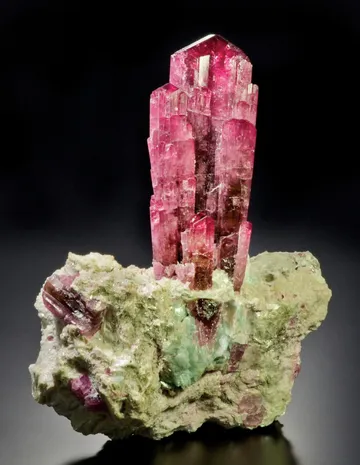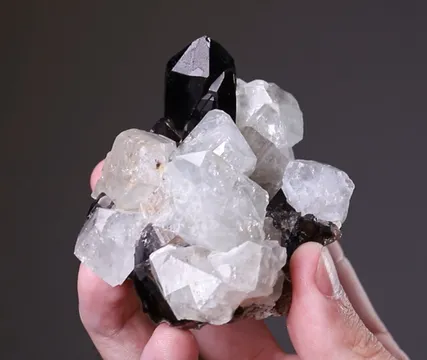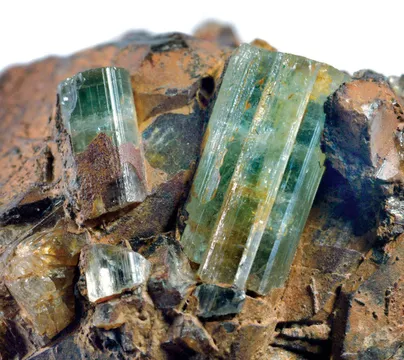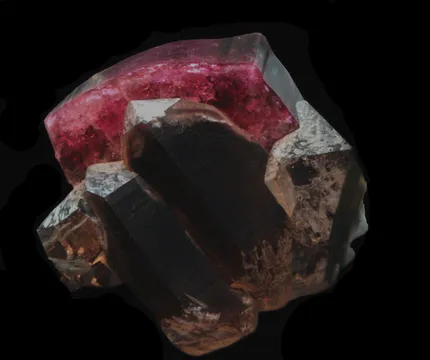
Malkhan pegmatite field, Russia - Transbaikalia locality yielding gem tourmaline pockets, wine-red rubellite, and crystals on smoky quartz and feldspar.
Key facts
Malkhan is the great modern Russian tourmaline locality: a remote, high-country pegmatite field in central Transbaikalia whose best pockets have produced wine-red, cranberry-red, violet-red, green-rimmed, and strongly polychrome tourmalines on the classic Siberian matrix of smoky quartz, white to pale-blue cleavelandite, feldspar, lepidolite, and local muscovite. For collectors, the locality matters because it is not merely a source of cuttable rubellite; it is a specimen district. The best pieces are pocket-grown compositions: lustrous prismatic tourmalines standing upright on bladed albite, seated against smoky quartz, or grouped on feldspar with enough contrast and architecture to hold their own beside the famous tourmaline classics of Brazil, California, the Himalaya mines, and Madagascar.
Geologically, Malkhan belongs to the family of complex, miarolitic, rare-element granitic pegmatites. The field lies on the Malkhan Ridge near Krasnyi Chikoy in Zabaykalsky Krai, in the Chikoy Highland of central Transbaikalia. Its gem pegmatites are related to Mesozoic granites of the Bolsherechensky and Oreshny massifs and are hosted in older metamorphic and metaigneous rocks of the Malkhan complex. The productive bodies are mostly steep to slab-like pegmatite veins, many zoned internally and many containing open miarolitic cavities where late boron-, lithium-, cesium-, rubidium-, sodium-, and tantalum-enriched fluids and melts made the locality’s collector minerals.
Historically, Malkhan arrived late. Black tourmaline and smoky quartz-bearing pegmatites were known in the region long before collectors saw fine gem pockets, and Russian mineralogists had noted miarolitic smoky quartz in the early twentieth century. The gem-tourmaline story began in earnest in the early 1980s, when state geological work and the Baikal Quartz-Gemstone Expedition revealed that some of these apparently utilitarian pegmatites carried superb colored tourmaline. From that point onward, Malkhan became the principal Russian source of gem-grade and specimen-grade tourmaline, with the Oreshnaya, Mokhovaya, Sosedka, Oktyabrskaya, Svetlaya, Zapadnaya-1, Solnechnaya, and related veins entering the collector vocabulary.
Regional View
Country View
A strong Malkhan specimen has a particular look: saturated red or pink-red tourmaline, often somewhat darker and more “Siberian” in tone than many Brazilian pieces, with crisp terminations and some degree of translucency or gemminess. The finest matrix specimens add contrast—the cold blue-white of cleavelandite, the glassy brown of smoky quartz, the lilac scales of lepidolite, or the pale feldspar base that makes the tourmaline color flare. The field is also scientifically important. Malkhan is a type locality for several rare minerals, and its tourmalines can be chemically complex enough that a single zoned crystal may cross several tourmaline-supergroup species.
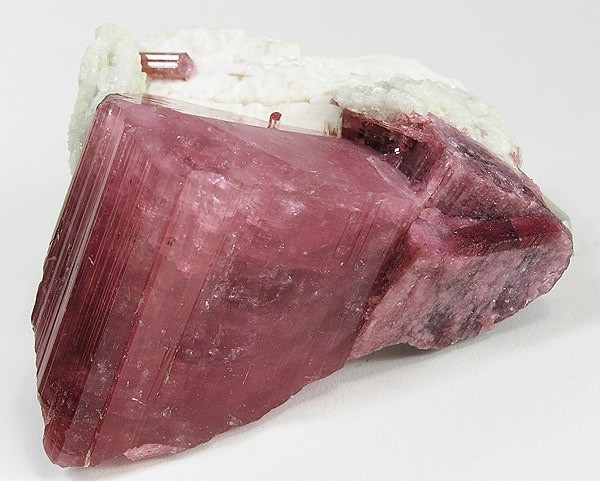
Photo: Wikimedia Commons
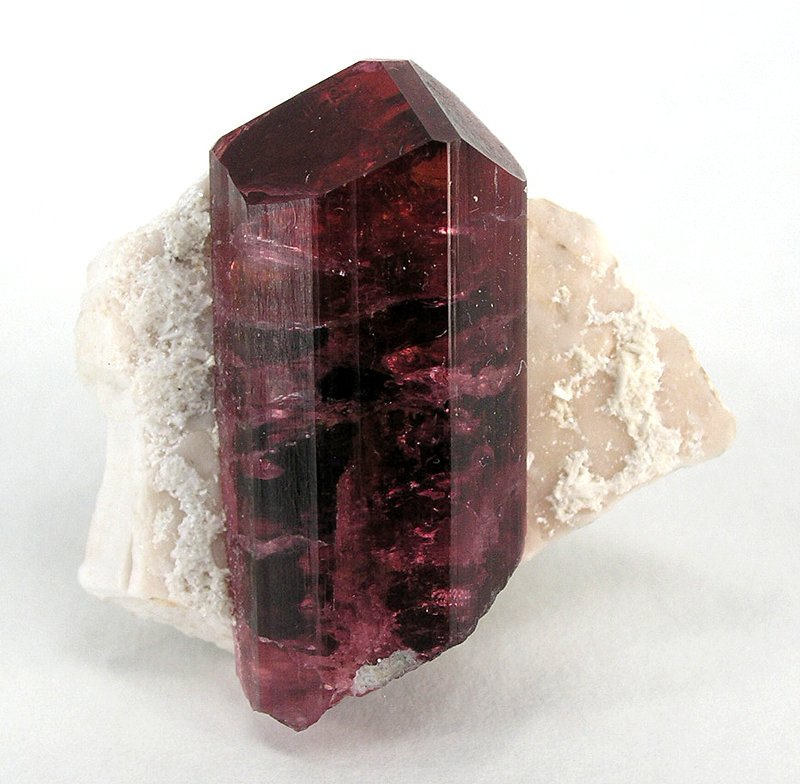
Photo: Wikimedia Commons
Search for specimens: View all specimens from Malkhan pegmatite field, Russia
The Malkhan pegmatite field lies on the southern slopes of the Malkhan Ridge, near the village of Krasnyi Chikoy, in Krasnochikoysky District, Zabaykalsky Krai. The field occupies roughly 60 square kilometers in the interfluve of the Mogzon, Skakunia, and Bolshaya Rechka river systems, all tied to the Chikoy drainage. It is a Siberian mountain-taiga locality: pine forest, subdued ridges, limited natural outcrop, deep weathering and colluvium, winter freezing, and a level of remoteness that has always shaped mining logistics. Access from major transport routes requires long overland travel; the better-known workings are not roadside collecting localities.
The deposit type is complex granitic pegmatite, specifically miarolitic, rare-element, gem-bearing pegmatite of the lithium-cesium-tantalum family. The pegmatites are genetically related to Cretaceous granites of the Bolsherechensky and Oreshny massifs, including biotite granite and two-mica leucogranite, and are emplaced in older metamorphosed rocks of the Malkhan complex such as metadiorite, metagabbro, gneiss-diorite, amphibolite, and schist. Published work gives Cretaceous ages around 128–124 Ma for the granite-pegmatite system, a useful anchor for collectors who wonder how these delicate-looking pocket crystals survived later uplift, faulting, frost action, and weathering.
The ore bodies are pegmatite veins and dikes, locally steep, slab-like, and internally zoned. Individual veins may reach hundreds of meters in length and several meters in thickness; the largest productive bodies have quartz-feldspar wall zones, graphic and blocky feldspar-quartz zones, quartz cores, replacement zones, and cavity systems. Miarolitic pockets concentrate near the inner zones and along structural or chemical traps. Some pockets are small, some are meter-scale, and the best have yielded matrix specimens rather than only loose crystals.
Mineralization varies sharply from one vein to another and even between neighboring pockets. The tourmaline-rich bodies are enriched in Li, B, Rb, Cs, Na, and Ta, while other pegmatites nearby are comparatively barren and may carry only schorl, smoky quartz, and feldspar. A collector-grade pocket may contain colored tourmaline with quartz, cleavelandite albite, microcline or orthoclase, lepidolite, muscovite or boron-rich mica coatings, danburite, hambergite, pink beryl, fluorapatite, pollucite, axinite-(Mn), zeolites, and late clay or chlorite. The district’s rare-metal signature is equally important: columbite-tantalite minerals, ixiolite, microlite-group minerals, bismuth oxides and sulfides, bismutocolumbite, oxybismutomicrolite, nioboixiolite-(Mn2+), monazite-(Ce), xenotime-(Y), and other accessory phases document a highly evolved pegmatitic system.
The productive names matter. Oreshnaya produced early yellow-red to red tourmalines with green rims and some very large miaroles. Mokhovaya is known for red rubellite, including short, deep-pink crystals and groups with clear quartz. Svetlaya produced attractive yellow-red-green polychrome crystals. Oktyabrskaya is noted for especially lustrous multicolored tourmaline and was the subject of detailed work on pocket formation. Zapadnaya-1 became famous for strongly defined watermelon tourmalines with red cores, pale or lettuce-green intermediate zones, and dark green to nearly black rims. Sosedka, above all, became the modern specimen engine of the district, producing many of the great cranberry-red, electric-pink, bicolored, tricolored, and matrix pieces that reached the international market from the 2010s onward.
Mining history begins before the celebrated tourmaline finds. Schorl-bearing pegmatites were known in the wider Malkhan region for more than a century, and smoky quartz-bearing miarolitic pegmatites were recognized in the early twentieth century. Niobium-tantalum mineralization attracted attention by the 1930s, but the early work did not anticipate gem pockets. The decisive turn came in the early 1980s. A state-sponsored expedition prospecting for uranium found no uranium deposit but did open gemmy tourmaline-bearing pegmatites. In 1983, the Baikal Quartz-Gemstone Expedition began systematic exploration, mapping, and mining for gem tourmaline and optical quartz; Victor E. Kusnaryov and a group of geologists and students are associated with the first major Oreshnaya pocket, which reportedly yielded nearly 100 kg of top-quality wine-red tourmaline edged with pale green.
The 1980s and 1990s saw wide exploitation by Soviet and post-Soviet geological organizations, including the Baikal Quartz-Gemstone Expedition, and later by a mixture of licensed and unauthorized groups. Published field accounts describe hundreds of pegmatites tested or mined during that period, with many productive or partly productive bodies exhausted. The later specimen era, especially from 2011 through 2018 at Sosedka and related workings, is associated in collector literature with careful pocket recovery by teams linked with TourMalkhan, Top Minerals, Collector’s Edge, and local Russian mine operators. More recent scientific work records renewed work by LLC Technologiya on the Krutaya pegmatite beginning in 2020, though that particular vein proved poor as an industrial gem source and unexpectedly important as a source of unusual tourmaline chemistry.
Collectors should treat Malkhan as a mined commercial locality, not as an open collecting ground. The best pieces have come from private or controlled quarrying, trenching, pocket extraction, and subsequent preparation. There is no established public fee-dig tradition for international collectors, and the locality is remote, logistically difficult, and subject to mining rights, local permissions, and Russian legal controls. Specimens on the market should be bought for their mineral quality and provenance: “Malkhan” is useful, but a more complete label naming Sosedka, Mokhovaya, Oreshnaya, Oktyabrskaya, Zapadnaya-1, Solnechnaya, Danburitovaya, Krutaya, or another vein adds real scientific and collector value.
The important pocket names read like a compressed history of the modern district. The Great Watermelon Pocket at Sosedka produced a 50 kg lot of watermelon tourmalines, the kind of material that is now far scarcer as fresh production. The V Pocket, opened in August 2015 in an unexpectedly productive lower part of Sosedka, yielded intact large crystals, medium crystals, and small bonus crystals on quartz and blue-white cleavelandite. One month later, the Electric Pink Pocket produced the famous large Russian pink tourmaline specimens, including the “Rocket of Russia” and the “Trident.” The Mad Max Pocket, first opened in 2017 and extended in 2018, produced bicolored, tricolored, and even more complex zoned tourmalines with quartz, albite, microcline, lepidolite, danburite, and hambergite. The PR Pocket became notable not for tonnage alone but for preservation and reconstruction: an unusually dry, well-preserved columnar cavity whose walls, crystals, and fallen fragments were removed with unusual care.
Tourmaline is the signature collector mineral of Malkhan, and it occurs here in a spectrum that reflects the field’s unusually evolved, boron-rich pegmatite fluids: black schorl in less evolved zones; honey-brown, tobacco-brown, yellow-green, lettuce-green, and pale green Mn-rich zones; cranberry-red to cherry-red rubellite; pale to colorless intervals; and dark green to blue-green rims or late pencils. Crystals are typically prismatic, with flat pedions or rhombohedral terminations, and many show zoning perpendicular to the c-axis; three to four color zones are common in better polychrome material, while exceptional crystals may show more. Most collector crystals are a few centimeters to about 15 cm long, but major pockets at Oreshnaya, Mokhovaya, Oktyabrskaya, Zapadnaya-1, and Sosedka produced much larger crystals and groups, with Sosedka responsible for many of the elongated cranberry-red matrix specimens of recent fame. The strongest Malkhan tourmalines combine saturated color, transparency in transmitted light, sharp undamaged terminations, and natural placement on smoky quartz, cleavelandite, lepidolite, or feldspar; ordinary pieces are more opaque, bruised, contacted, clay-coated, or loose from gem-rough production.
Elbaite is the dominant collector name historically applied to Malkhan’s colored lithium tourmaline, especially red, pink, green, and polychrome crystals from the gem pockets, although modern analytical work shows that individual zones may pass into fluor-elbaite, fluor-liddicoatite, rossmanite, fluor-rossmanite, or other tourmaline-supergroup compositions. In hand specimen, Malkhan elbaite is admired for deep cranberry to wine-red rubellite, pale green to dark green caps and rims, yellow-red-green polychrome sequences, and watermelon sections from pockets such as Zapadnaya-1 and Sosedka. Habits range from short, stout, flat-terminated crystals at Mokhovaya and Oktyabrskaya to more elongated groups at Sosedka, commonly with quartz, albite cleavelandite, lepidolite, K-feldspar, danburite, hambergite, and rare pink beryl. The best elbaites are lustrous, sharply terminated, internally gemmy, and compositionally interesting, but collectors should be careful with unanalysed labels: “elbaite” is often a practical market name here, not proof that every colored zone in the crystal is elbaite sensu stricto.
Malkhan rubellite is the locality’s great visual brand: saturated pink-red, cranberry-red, cherry-red, wine-red, and violet-red tourmaline, most famously from Mokhovaya, Oktyabrskaya, and especially Sosedka. The top crystals may be short and broad with flat pedion terminations, elongated and grouped on matrix, or part of bicolored and tricolored crystals with pale green, dark green, or blue-green caps and rims; the best pieces show a dark but vivid body color that glows in transmitted light rather than dying to black. Sosedka’s V, Electric Pink, Mad Max, PR, Breccia, Frozen, and related pockets produced many of the benchmark matrix specimens, with rubellite on smoky quartz, blue-white cleavelandite, albite, lepidolite, and occasional muscovite. A fine Malkhan rubellite should have color that remains alive in normal display light, a complete and preferably glassy termination, minimal rehealed or extraction damage, and a convincing natural matrix composition; lesser specimens are contacted, reconstructed without disclosure, overly dark, or simply loose fragments from pockets that were mined primarily for gem rough.
Quartz is not a background mineral at Malkhan; it is one of the defining matrix and pocket minerals. The pegmatites contain pale gray, smoky, morion-like, citrine-toned, and locally amethystine or pale purple-zoned quartz, with large crystals especially known from Sosedka, Zapadnaya-1, Svetlaya, Mokhovaya, and Irkutianka. Pocket quartz may occur as individual lustrous crystals, broken loose crystals in miaroles, or dramatic smoky groups carrying red tourmaline and cleavelandite; some larger embedded crystals reach far beyond specimen scale. Collectors value quartz here chiefly when it composes the architecture of a tourmaline specimen—brown smoky points framing red crystals, quartz plates carrying albite and rubellite, or transparent crystals adding depth to otherwise feldspar-rich matrix. Condition matters greatly: Malkhan pockets commonly suffered collapse, freeze-thaw breakage, clay coating, blasting damage, and rehealing, so clean smoky quartz with intact tips and undisturbed tourmaline attachment is much more desirable than loose or heavily damaged quartz from pocket fill.
Albite at Malkhan is most prized as cleavelandite, the bladed to platy, blue-white, white, pale electric-blue, or rarely bluish green albite that forms the crisp stage on which the red and polychrome tourmalines stand. In massive quartz-feldspar pegmatite, plagioclase may appear as less showy white oligoclase, but in near-pocket zones with colored tourmaline and lepidolite, cleavelandite becomes a key collector feature. Individual cleavelandite blades are generally small, commonly around a few centimeters, yet their visual importance is large: they provide color contrast, indicate a desirable pocket assemblage, and help preserve natural compositions rather than loose gem crystals. Early mining discarded or destroyed many delicate matrix pieces, so fine tourmaline-on-cleavelandite specimens from recent Sosedka pockets are more important than their species abundance would suggest; the best albite pieces show clean, undamaged blades with rubellite, smoky quartz, lepidolite, or muscovite in a balanced, not overly trimmed, matrix.
Muscovite is a subordinate but telling Malkhan mineral, rarer in the field than many collectors expect from a pegmatite locality. It occurs in quartz-feldspar matrix as white to pale green wedge-shaped or bladed crystals, commonly a few centimeters across and only rarely larger, and also as boron-rich muscovite or boromuscovite precipitated from late hydrothermal fluids. In pockets of Mokhovaya and Sosedka, boron-rich muscovite may form snow-drift-like coatings on smoky quartz, grade locally toward boron-rich cookeite, or appear with albite and tourmaline in matrix specimens. For collectors, muscovite is usually a supporting player rather than the object of the piece, but it can add locality character when it occurs as fresh pale blades or silky coatings with red tourmaline, smoky quartz, and cleavelandite; damaged, powdery, or clay-confused mica coatings are much less desirable unless the specimen also has strong tourmaline aesthetics.
Beyond the major collector minerals, Malkhan is a serious rare-mineral locality. It is the type locality for bismutocolumbite from the Danburitovaya pegmatite vein, borocookeite from Sosedka and Mokhovaya, oxybismutomicrolite from the Solnechnaya vein, nioboixiolite-(Mn2+) from Sosedka, and fluor-rossmanite from the Krutaya vein. The field is also notable for bismuth enrichment, with native bismuth, bismuthinite, bismutite, bismite, bismutotantalite, cannonite, oxybismutomicrolite, and wittichenite reported among Bi-bearing assemblages. Other documented species of collector or scientific interest include lepidolite, danburite, hambergite, fluorapatite, fluorite, topaz, pink beryl, pollucite, axinite-(Mn), spessartine, microlite-group minerals, columbite-(Mn), tantalite-(Mn), ixiolite, monazite-(Ce), xenotime-(Y), nanpingite, laumontite, stilbite, and late boron-rich cookeite-group material.
Malkhan specimens deserve close attention to identity, condition, and preparation. The first point is tourmaline nomenclature. Many older and market labels use “elbaite,” “rubellite,” “liddicoatite,” or “tourmaline” in a visual rather than analytical sense. That is understandable—most collectors do not microprobe every zone—but Malkhan tourmalines can be chemically intricate. A single crystal may include zones corresponding to different tourmaline-supergroup species, so “rubellite” is safest as a color-variety term, while precise species names such as elbaite, fluor-elbaite, fluor-liddicoatite, rossmanite, fluor-rossmanite, fluor-tsilaisite, or darrellhenryite require analysis.
The second issue is restoration. Published accounts of the great Sosedka pockets openly describe broken, fallen, rehealed, reconstructed, and reattached pocket material. That does not make a specimen bad; it makes disclosure essential. Many Malkhan pockets were naturally disturbed by tectonic movement, freeze-thaw cycles, pocket collapse, and later mining blasts, and some of the finest specimens exist because careful preparators reassembled crystals or returned detached crystals to matching matrix positions. In this district, an old-fashioned prejudice against all repair misses the reality of the material, but undisclosed reconstruction should affect value.
Condition problems are common and locality-specific. Pocket crystals may have contacted backs, damaged bases, bruised terminations, missing rehealed sections, matte prism faces on larger crystals, late drusy overgrowths, clay coatings, and quartz-shard abrasion from collapsed cavities. Some pockets were wet or frost-damaged; others were affected by late hydrothermal fluids that corroded earlier crystals, in extreme cases leaving strange fibrous or “woolly” remnants of tourmaline surfaces. Quartz tips and cleavelandite blades are easily damaged, and lepidolite or mica-rich matrices may be friable. Handle specimens by the matrix, not by the tourmaline, and avoid ultrasonic cleaning unless the piece has been professionally assessed.
Fluorescence is not a major selling point for typical Malkhan tourmaline, but associated feldspar, apatite, fluorite, or some secondary minerals may respond variably under ultraviolet light. The more important optical behavior is pleochroism and transmitted-light color: crystals that look dark in reflected light may show strong red, pink, champagne, or green when backlit. For buying, examine both display light and transmitted light, and do not confuse backlit beauty with normal cabinet presence.
Rarity is uneven. Loose red and pink tourmaline crystals from Malkhan appear regularly enough in the fine-mineral market, but excellent matrix specimens with sharp, saturated, transparent crystals on intact cleavelandite or smoky quartz are much scarcer. Older production often went to gem cutting; published accounts suggest that very large proportions of some early pocket output were treated as rough rather than preserved as specimens. Well-labeled pieces from named pockets or veins—especially Sosedka, Mokhovaya, Oreshnaya, Oktyabrskaya, Zapadnaya-1, Solnechnaya, Danburitovaya, and Krutaya—carry a premium over generic “Malkhan” labels, particularly when the specimen has known preparation history and no hidden repairs.
The most memorable Malkhan story begins with a false target. In the early 1980s, a state geological expedition went into the Malkhan Mountains prospecting for uranium. Uranium did not materialize, but the expedition opened the first gemmy tourmaline-bearing pegmatites. In 1983, the Baikal Quartz-Gemstone Expedition turned that chance into a mining program. Victor E. Kusnaryov, later inseparable from the modern Malkhan story, traveled into the area with about twenty geologists and students. At Oreshnaya they found the first large gem pocket and recovered nearly 100 kg of top-quality wine-red tourmaline crystals with thin pale-green rims. For a district that had been known mostly for black tourmaline, smoky quartz, niobium, and tantalum, that find changed everything.
Oreshnaya was only the first shock. The largest miaroles there produced more than 300 kg of tourmalines, with crystals reaching 40 cm. Mokhovaya produced even larger cavities—up to 10 m in maximum diameter—and as much as 500 kg of tourmaline in a single large miarole. Zapadnaya-1 became legendary for “watermelon” tourmaline: red cores, pale or lettuce-green zones, and dark green to almost black rinds. Its largest miarole reportedly yielded over 1,000 kg of top-quality watermelon material. The bittersweet part for specimen collectors is that much of the early production was regarded as gem rough. Matrix was heavy, fragile, and inconvenient; crystals were valuable. Many pieces that would now be coveted as matrix specimens were likely cut, broken down, or sold by weight.
The V Pocket at Sosedka was discovered on August 3, 2015, in a lower part of the pegmatite that had not been expected to produce tourmaline pockets at all. That was the first surprise. The second came when the first crystals emerged with an apparent vivid violet color, later seen as more pink once the excitement settled. The pocket had the shape that gave it its name: one arm nearly a meter long and 30–50 cm wide, the other about 1.2 m long and 20–40 cm wide. From the better-preserved upper part came tourmalines perched on quartz and blue-white cleavelandite. The lower part was crueler: many crystals had been damaged by natural freezing and thawing of water in the pocket and by blasting in a nearby cavity. Even so, the intact count was remarkable—ten large crystals over 15 cm, seven medium crystals from 4 to 12 cm, and about 50 small crystals to 3 cm. The V Pocket is remembered as one of the great Russian gem-tourmaline discoveries.
Only a month later, on September 23, 2015, weather gave the miners a longer season and Sosedka gave up the Electric Pink Pocket. The find began modestly with a columnar mass of lepidolite and small tourmaline on cleavelandite. It led into a cleavelandite-rich roof zone where a large 10 cm diameter tourmaline appeared in an unusual electric-pink color. Within minutes, more large crystals were removed. Then a huge termination section more than 10 cm across appeared among fragments of quartz, feldspar, and cleavelandite. After careful searching and matching, the miners realized they had parts of a much larger crystal. Reassembled, the great pink tourmaline became the “Rocket of Russia,” around 40 cm long in one published caption and described in the pocket narrative as nearly 50 cm when the major section was reunited, with the top portion alone measuring 28 cm. The Electric Pink Pocket also produced a dramatic matrix specimen with three intensely red tourmaline crystals, named the “Trident,” because the crystals stood like a natural three-pronged sculpture.
The Mad Max Pocket earned its name from a person rather than a movie. In 2017, while opening a new upper part of the Sosedka quarry where no tourmaline had been known, miners found a large pocket and blocked the entrance with a pegmatite slab to protect it until the outside team arrived. Mine manager Maxim Kusnarjov, son of the TourMalkhan director, had been convinced they were about to enter an important miarole. He worked so intensely that he strained his back before the upper part of the pocket was fully opened and then, in pain and frustration, could not continue that day. The pocket was named in his honor. It proved irregular, amoeba-like, with many offshoots and small chambers. It produced lustrous bicolored, tricolored, and even four- or five-zone tourmalines with quartz, orthoclase, microcline, lepidolite, danburite, and hambergite. The largest crystal from the first stage stood 23 cm tall and 5 by 5 cm across. In 2018, a continuation was found after another 2.5 m of material was removed. Then, after one more blast two weeks later, the mine owner reportedly called with an ultimatum: be there in 48 hours or the crew would mine it out. The rush by air, car, and train led to the largest pocket of the previous four years, yielding 115 single crystals, four large matrix specimens up to 50 kg, about 15 smaller matrix pieces of 1–2 kg, and many quartz crystals.
The PR Pocket tells a different kind of story: not of sudden abundance, but of restraint. Found in the upper Sosedka quarry about 24 m below the original surface, it was an unusually dry, well-preserved columnar miarole about a meter tall and 50 by 50 cm across. Similar pockets had often been mined in a couple of hours; this one took about two weeks. Mechanical splitters, chisels, careful drilling, and hammering were used to remove the pocket contents. The team recovered 80 rich violet, gemmy tourmaline crystals, each about 3–5 cm, and saved 17 slabs of pocket wall so detached crystals could later be returned to their positions. One reconstructed “hedgehog-like” matrix carried 16 tourmalines. The published account notes that probably 99% of the large crystals had detached and fallen into the lower part of the miarole, but many were recovered undamaged. Preparation and reconstruction then moved to Federico Pezzotta’s laboratory in Italy, where thousands of hours were invested in turning a broken natural cavity back into display specimens.
Krutaya is the quiet counterpoint to the great Sosedka pockets. The name means “steep,” fitting a pegmatite dipping 60–70° to the north-northeast. It was known before the formal 1983 Malkhan breakthrough, having been discovered by the Sosnovgeologiya expedition in 1981, but mid-1980s prospecting showed poor tourmaline mineralization and low crystal quality. LLC Technologiya resumed work there in 2020 and again found very little gem-quality tourmaline. Yet one small, chemically extraordinary crystal changed Krutaya’s scientific standing. Obtained from miners by Mikhail Yu. Anosov during an October 2022 trip to Zabaykalsky Krai, the crystal measured only about 3.2 by 2 cm, but its internal zoning contained a newly described light-pink fluor-rossmanite zone and a suite of other tourmaline-supergroup compositions. A vein that failed as a gem producer became, unexpectedly, one of Malkhan’s most important mineralogical localities.
Jindřich Kynický, Jan Kynický, Bryan Lees, Wenlei Song, Michaela Krejčí Kotlanová, Gerhard Wagner, and Philip Persson, “The Malkhan Pegmatite District,” The Mineralogical Record, 50(3), 245–324, 2019 — The essential collector-locality monograph, with geology, mining history, mineral descriptions, pocket narratives, and specimen photographs.
R. Thomas, P. Davidson, and E. V. Badanina, “Water- and Boron-Rich Melt Inclusions in Quartz from the Malkhan Pegmatite, Transbaikalia, Russia,” Minerals, 2(4), 435–458, 2012 — Detailed fluid- and melt-inclusion work explaining the water- and boron-rich conditions behind Malkhan pocket formation.
I. S. Peretyazhko, V. Ye. Zagorsky, R. Thomas, and others, “Conditions of pocket formation in the Oktyabrskaya tourmaline-rich gem pegmatite, the Malkhan field, Central Transbaikalia, Russia,” Chemical Geology, 210, 91–111, 2004 — A major study of mineral-forming media and pocket genesis in one of the district’s important gem pegmatites.
V. Ye. Zagorsky, I. S. Peretyazhko, A. N. Sapozhnikov, A. P. Zhukhlistov, and B. B. Zvyagin, “Borocookeite, a new member of the chlorite group from the Malkhan gem tourmaline deposit, Central Transbaikalia, Russia,” The Canadian Mineralogist, 42, 215–246, 2004 — Type description of borocookeite from the Malkhan gem-tourmaline system.
Borocookeite, Handbook of Mineralogy — Concise mineral data and occurrence summary for one of Malkhan’s type-locality species.
Bismutocolumbite mineral page, Mindat — Mineral entry documenting bismutocolumbite and its type occurrence at the Danburitovaya pegmatite vein, Malkhan field.
A. V. Kasatkin, S. N. Britvin, I. S. Peretyazhko, N. V. Chukanov, R. Škoda, and A. A. Agakhanov, “Oxybismutomicrolite, a new pyrochlore-supergroup mineral from the Malkhan pegmatite field, Central Transbaikalia, Russia,” Mineralogical Magazine, 84, 444–454, 2020 — Type description of oxybismutomicrolite from the Solnechnaya vein.
A. V. Kasatkin, O. S. Vereshchagin, L. A. Gorelova, D. I. Belakovskiy, F. Bosi, M. Yu. Anosov, and coauthors, “Fluor-rossmanite, □(Al2Li)Al6(Si6O18)(BO3)3(OH)3F, a new tourmaline supergroup mineral from Malkhan pegmatite field, Western Siberia, Russia,” Mineralogical Magazine, 88, 668–676, 2024 — Type description of fluor-rossmanite from the Krutaya pegmatite, including the locality setting and holotype information.
A. V. Kasatkin, O. S. Vereshchagin, L. A. Gorelova, and D. I. Belakovskiy, “Eight mineral species in one crystal: unique zonation of polychrome tourmaline from the Krutaya vein, Malkhan pegmatite field, Transbaikalia, Russia,” Mineralogy, 10(2), 5–25, 2024 — Study of an exceptionally zoned Malkhan tourmaline crystal containing six valid and two potentially new tourmaline-supergroup species.
N. V. Chukanov, I. V. Pekov, N. V. Zubkova, V. O. Yapaskurt, Yu. S. Shelukhina, S. N. Britvin, and D. Yu. Pushcharovsky, “Nioboixiolite-(Mn2+), (Nb2/3Mn2+1/3)O2, a new ixiolite-group mineral from the Malkhan Pegmatite Field, Transbaikal Region, Russia,” Zapiski RMO, 152(1), 8–17, 2023 — Type description of nioboixiolite-(Mn2+) from the Sosedka pegmatite.
V. Ye. Zagorsky, “Sosedka pegmatite body at the Malkhan deposit of gem tourmaline, Transbaikalia: Composition, inner structure, and petrogenesis,” Petrology, 23(1), 68–92, 2015 — Detailed petrogenetic study of the Sosedka pegmatite body.
“Mineralogy of pockets of the Malkhan tourmaline deposit, Transbaikalia: feldspars of the Sosedka vein,” Russian Geology and Geophysics, 53(6), 522–534, 2012 — Study recognizing distinct feldspar-bearing pocket types within the Sosedka vein.
Alexander Shtukenberg, Ira Rozhdestvenskaya, Olga Frank-Kamenetskaya, Julia Bronzova, Harald Euler, Armin Kirfel, Irina Bannova, and Anatoly Zolotarev, “Symmetry and crystal structure of biaxial elbaite-liddicoatite tourmaline from the Transbaikalia region, Russia,” American Mineralogist, 92, 675–686, 2007 — Crystallographic study of zoned Malkhan tourmaline and its anomalous biaxiality.
Minerals of the Malkhan deposit, Mineralogical Museum of Irkutsk National Research Technical University — Museum collection page for Malkhan specimens, useful for Russian institutional context.
“Elbaite variety Rubellite (Tourmaline group). Malkhan pegmatite field…” — MChMinerals, fine minerals — Short specimen video of Malkhan rubellite, useful for seeing color and luster in motion.
“ECM1178 Rubellite, Malkhan pegmatite field, Russia” — EarthWonders / dealer specimen media — Modern specimen video showing cabinet-scale Malkhan rubellite presentation.
Malkhan pegmatite field, Mindat — Core locality page with species list, sublocalities, references, photos, and type-locality entries.
Rubellite from Malkhan pegmatite field, Mindat photo/locality entry — Useful entry point for browsing Malkhan rubellite photographs and sublocality attributions.
Sosedka pegmatite vein, Mindat — Important sublocality page for the vein that produced many of the best recent Malkhan matrix tourmalines.
Solnechnaya pegmatite, Mindat — Sublocality page for the Solnechnaya vein, important for oxybismutomicrolite and Bi-rich rare-mineral assemblages.
Krutaya pegmatite vein tourmaline entry, Mindat — Useful reference for the Krutaya vein, the source of fluor-rossmanite and the extraordinary multi-species tourmaline crystal.
Tourmaline-206328.jpg, Wikimedia Commons — Freely licensed Rob Lavinsky photograph of a Malkhan rubellite specimen on matrix.
Elbaite-gem7-04a.jpg, Wikimedia Commons — Freely licensed Rob Lavinsky photograph of gemmy rubellite elbaite on feldspar from Malkhan.
Russian-language Malkhan locality page, Geo.web.ru Druza — Russian mineral-locality page with type-locality notes and historical mineral context.
Oxybismutomicrolite, Mineral Index — Concise modern entry for oxybismutomicrolite and its Malkhan type locality.
Bismutocolumbite, Webmineral — Independent mineral data page for a Malkhan type-locality oxide.
Borocookeite, Webmineral — Mineral data page for borocookeite, with Malkhan occurrence information.
Fluor-rossmanite summary, Mingen.hk — Short accessible summary of the newest Malkhan tourmaline-supergroup type mineral.