







Most fake crystals are one of three things: a real mineral that has been treated, an imitation made of glass, resin or a cheaper stone, or a lab-grown synthetic. None is a problem when it's disclosed. Here's how each group looks, a few quick checks, and which guides go deeper.
Most fake "crystals" fall into one of three groups, and it helps to know which one you're looking at. Treated stones are real minerals whose color or surface has been changed by dye, heat, coating or radiation. Imitations are a different material, usually glass, resin or a cheaper dyed stone, made to look like something else. Synthetics are the real mineral, grown in a lab or a factory instead of the ground. None of these is a problem when the label says so. They become one when they're sold as natural, untreated specimens at natural prices.
This guide is the hub of our series on fakes and treatments. It walks through each group, gives you a few quick checks and points you to the in-depth guides, starting with Quartz or Glass? Five Tests You Can Do at Home and Is Your Citrine Heat-Treated Amethyst?.
Treated, imitation or synthetic: why the difference matters
A dyed agate is still agate, and a heated amethyst is still quartz. Treated material is a real mineral, but the treatment should be disclosed. An imitation is not the mineral named at all: opalite contains no opal. A lab-grown crystal is chemically and structurally the real thing, which is why it can pass tests that catch glass, but it is not a natural specimen.
Disclosure matters for three reasons:
- Price. Natural, untreated material with a documented locality is what collectors pay a premium for. GIA notes that sellers are expected to disclose treatments, and that an undisclosed treatment can make a stone seem more valuable than it is.
- Care. Some treatments are not stable. Dyes can fade in strong light or lift with solvents, coatings scratch, and stabilized pieces can be damaged by cleaning that the untreated mineral would survive.
- Your records. What you're told becomes part of the specimen's history. Write it in your catalog, including "treatment unknown" when that's the honest answer.
Dyed stone
Dye works on porous material, and chalcedony, the family that includes agate, is the classic case. Agate's bands differ in porosity, so dye takes unevenly, which is why dyed agate often shows neon bands next to pale ones. Bright pink, purple, electric blue and vivid green agate slices are very often dyed. So are many red, blue and purple geodes and druzy clusters whose color looks painted into the crystal lining.
Howlite and magnesite sold as turquoise are the other big group. Both are white, porous and take a blue dye well, and GIA's turquoise buying guide lists dyed howlite among the common turquoise imitations. Look for a too-even blue with gray or black veins that look painted on.
Crackle quartz, sometimes sold as "fire and ice", is real quartz that has been heated and plunged into water to fracture it, usually with dye in the water. Under a loupe you see a web of colored cracks with clear quartz between them.
The tell: dye collects where the stone is weakest. Under a 10x loupe it concentrates in cracks, pits, porous bands and along fracture edges, while natural color is spread through the body of the stone.
Coated: aura quartz
"Aura" quartz gets its metallic iridescence from an extremely thin film of metal bonded to the surface in a vacuum chamber. The classic blue "aqua aura" uses gold, and other metals give other colors. Underneath is ordinary quartz. The coating can scratch and wear, especially on edges, and it should never be described as natural color. The same kind of coating is applied to other gems too.
Heat-treated: citrine and carnelian
Heat changes color in several minerals, and it's often accepted when disclosed. Most citrine on the market is heated amethyst, and our guide to heat-treated citrine explains how to read a cluster from its tips to its base and what a natural-citrine claim needs to back it up. Carnelian is also routinely heated to deepen its red, one of the oldest gem treatments on record.
Irradiated: smoky quartz and blue topaz
Radiation can create color centers in some minerals. Colorless quartz is routinely irradiated to turn it smoky, and the result is hard to separate from natural smoky quartz without a reliable locality and history. Nearly all blue topaz is irradiated and heated, so the trade assumes it is treated unless stated otherwise. Topaz treated in a nuclear reactor is held until its residual radioactivity has decayed before it can be sold.
Glass and resin imitations
Glass is the most common imitation by far. Many of these names are simply trade names for glass:
- Opalite is a milky glass with a blue and orange glow. It is neither opal nor quartz.
- Goldstone is glass full of tiny copper crystals that sparkle. Blue goldstone uses cobalt for the color.
- Cherry quartz and similar candy-colored "quartz" with pink or red swirls is glass.
- Crackle glass marbles and spheres imitate crackle quartz. Under a loupe, look for round bubbles.
- Transparent blue, green or red "obsidian" is almost always man-made glass or factory slag. Natural obsidian is usually dark, and EPI, a German gem lab, states that it does not occur in clear, bright colors.
- Fiber-optic glass, often sold as "cat's eye" in bright colors, is a bundle of fused glass fibers. It shows the same silky stripe as satin spar selenite and the same image-carrying effect as ulexite, so it can be mistaken for either. GIA has seen it submitted as cat's-eye chrysoberyl. Selenite is soft enough to scratch with a fingernail and glass isn't.
Resin and plastic turn up too, as imitation amber and in some imitation turquoise and opal. They feel warm and light in the hand. For telling glass from quartz properly, use the five tests in Quartz or Glass?.
Lab-grown and synthetic crystals
Lab-grown material has the same chemistry and structure as the mineral, and its value depends entirely on being labeled as what it is.
- Bismuth. Most rainbow "hopper" crystals are grown from melted bismuth; our bismuth guide covers how natural material differs.
- Synthetic quartz. Quartz is grown hydrothermally in industrial quantities, including amethyst and citrine colors. Specimen-style pieces are often too perfect, sold without matrix, and sometimes show a flat seed plate at the base. Faceted, it can be nearly impossible to separate from natural quartz without lab testing.
- Alum. Clear or dyed octahedral alum crystals are easy to grow from solution and appear in kits and shops. Natural alum usually forms crusts and powdery efflorescences, and good natural crystals are rare.
- Chalcanthite. Most of the large, vivid blue copper sulfate crystals on the market are lab-grown. Natural crystals are uncommon.
- Gem synthetics. Synthetic ruby, sapphire and spinel have been made by flame fusion for over a century and are cheap and common.
Some "minerals" grew in a factory by accident. Bright orange and yellow zincite crystals labeled "Poland" formed in the flues of zinc works, and GIA has described gem-quality synthetic zincite produced as a by-product at a foundry in Lower Silesia. They are attractive and collectible as what they are.
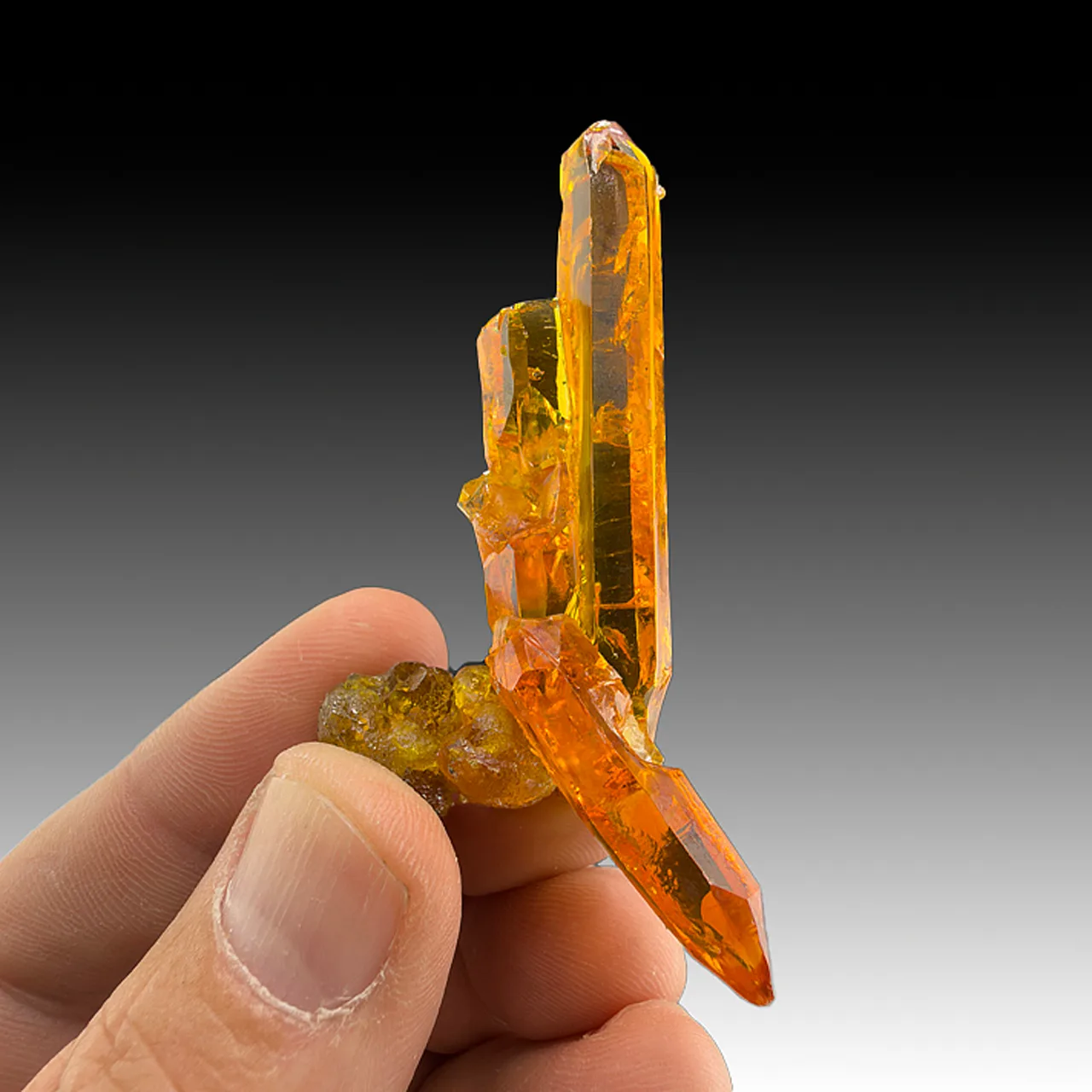
A 7 cm group of zincite crystals, labeled Poland, recorded on EarthWonders with Weinrich Minerals in their provenance. The description states plainly that the crystals are a smelter by-product and not natural. That is what good disclosure looks like. View the specimen.
Stabilized, reconstituted and assembled
Stabilized material has been impregnated with resin or polymer to harden a porous or crumbly stone. Turquoise is the main example, and reconstituted turquoise goes further: powdered material bound with resin and pressed into blocks. Collectors also stabilize fragile specimens, such as uranium micas coated to slow dehydration, which is fine when the label says so. Assembled specimens are crystals glued onto matrix they never grew on. In its Winter 2025 issue, Gems & Gemology reported such pieces in Pakistan's mining areas, including aquamarine mounted on unrelated rock, along with repairs sold without disclosure. Inspect every crystal-to-matrix contact for glossy seams or tiny bubbles.
Quick checks before you pay
None of these proves anything on its own, but each tells you where to look harder.
- Bubbles. Round, frozen bubbles or swirls under a loupe point to glass.
- Color pooling. Color that collects in cracks, pits and porous bands points to dye.
- Suspicious perfection. Identical points by the tray, flawless crystals with no matrix, even rainbow colors and sizes far too big for the price point to glass, molds or a lab.
- Names. Opalite, goldstone, cherry quartz, aura and bright "obsidian" tell you the answer before you test anything.
The full home tests are in Quartz or Glass?. For questions to ask the seller, photos to request and what to check on arrival, see How to Buy Minerals Online (Without Getting Burned).
Quick reference
| Group | Common examples | Typical tell |
|---|---|---|
| Dyed | Bright agate, howlite "turquoise", colored geodes, crackle quartz | Color pooled in cracks and porous bands |
| Coated | Aura quartz | Metallic iridescence, wear on edges |
| Heat-treated | Citrine from amethyst, carnelian | See the citrine guide |
| Irradiated | Smoky quartz, blue topaz | Usually needs a lab |
| Glass and resin | Opalite, goldstone, cherry quartz, bright "obsidian", fiber-optic "cat's eye" | Bubbles, swirls, mold marks, trade names |
| Synthetic | Bismuth, quartz, alum, chalcanthite, zincite | Too perfect, no matrix, seed plates |
| Stabilized, assembled |
Common questions
Is lab-grown quartz fake?
No. It is real quartz, but it is not a natural specimen, so it should be sold and labeled as synthetic and priced accordingly.
Is aura quartz natural?
The quartz is, but the color is a thin metal coating applied in a factory. It should always be sold as coated.
Is goldstone a real stone?
No. Goldstone is man-made glass with copper crystals in it. It's a fine decorative piece, but not a mineral.
Do sellers have to disclose treatments?
Disclosure is the expected standard in the gem and mineral trade. Ask in writing before you pay, and keep the answer with your invoice and photos.
This is general guidance for collectors, not a laboratory identification. For a costly purchase, ask a gemological laboratory whether it can answer your specific question before you pay.