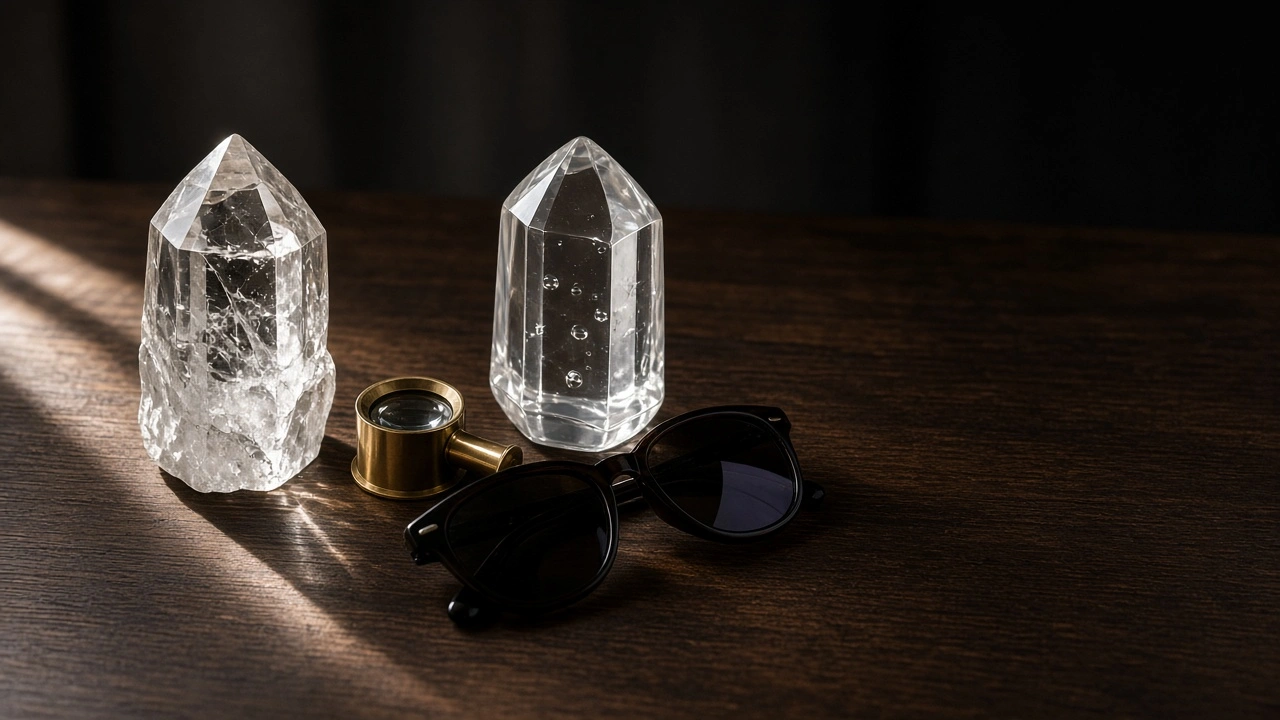
You found a gorgeous clear crystal at a market, or a listing online that looked too good to pass up. Now it's sitting on your desk, and a small voice keeps asking: is this actually quartz, or is it just a nice piece of glass?
You're not being paranoid. Quartz and glass are made of almost the same stuff, and a polished piece of either can look exactly the same. The difference is on the inside. Quartz is a real crystal, with its atoms lined up in a neat, repeating pattern. Glass is the same material cooled so fast that the atoms never got organized. That one difference shows up in how the stone feels, how it handles light and how hard it is, and you can check all three at home.
A quick word on names, because they trip a lot of people up. "Crystal glass", the kind used for chandeliers and wine glasses, is glass, not quartz. "Fused quartz" sounds like the real thing, but it's quartz that has been melted down, so technically it's glass too. And the "quartz" in kitchen countertops is crushed stone held together with resin.
These tests work best on loose, clear stones. They're much less reliable on jewelry in a setting, coated stones, opaque pieces or anything glued together.
Below are five tests, starting with the gentlest. Go in order, and stop as soon as you're sure. One test on its own can fool you, but when three or four point the same way, you can trust the answer.
Most "fake quartz" isn't a clever forgery. It's ordinary decorative glass sold under a name that sounds like a mineral. If you see one of these on a label, you already have your answer:
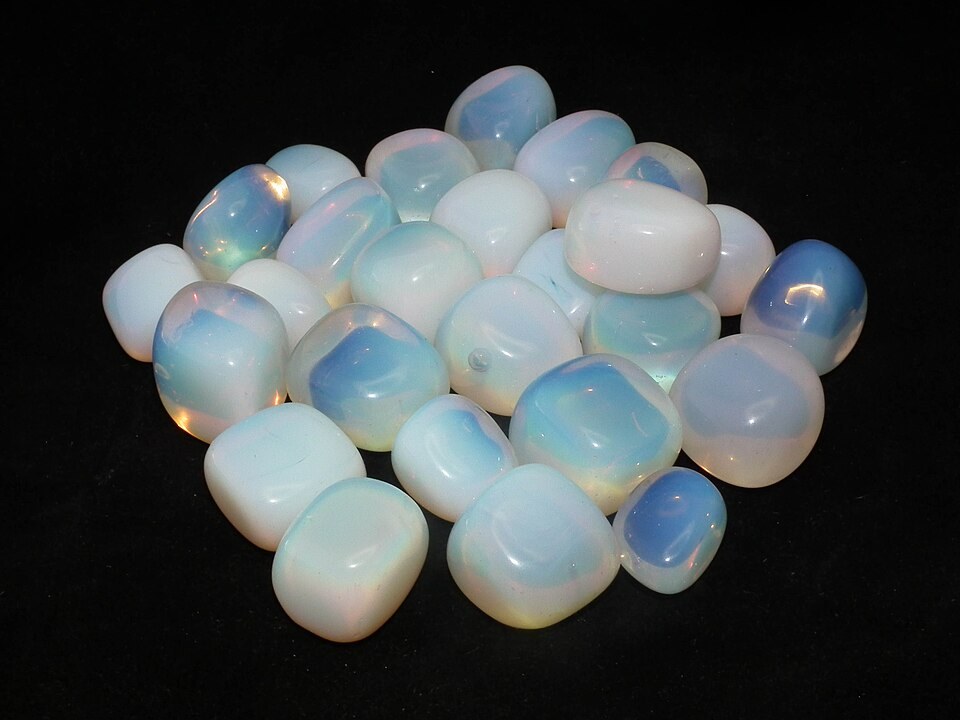
Just so there's no confusion: lab-grown quartz is still real quartz and will pass every test here. Most citrine on the market is heated amethyst, and "aura" quartz is quartz with a thin metallic coating. Sellers should tell you about those treatments, but they aren't glass.
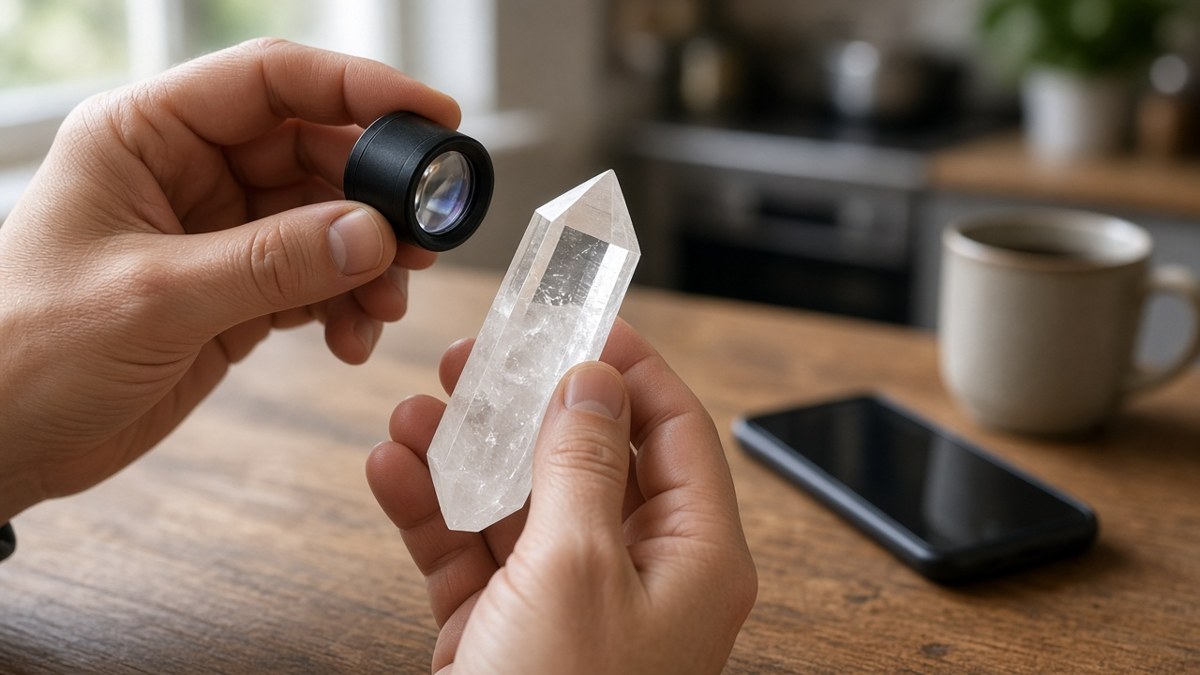
A 10x jeweler's loupe costs a few euros and is the best tool a collector can own. Hold it close to your eye, bring the stone up until it's in focus, and look inside.
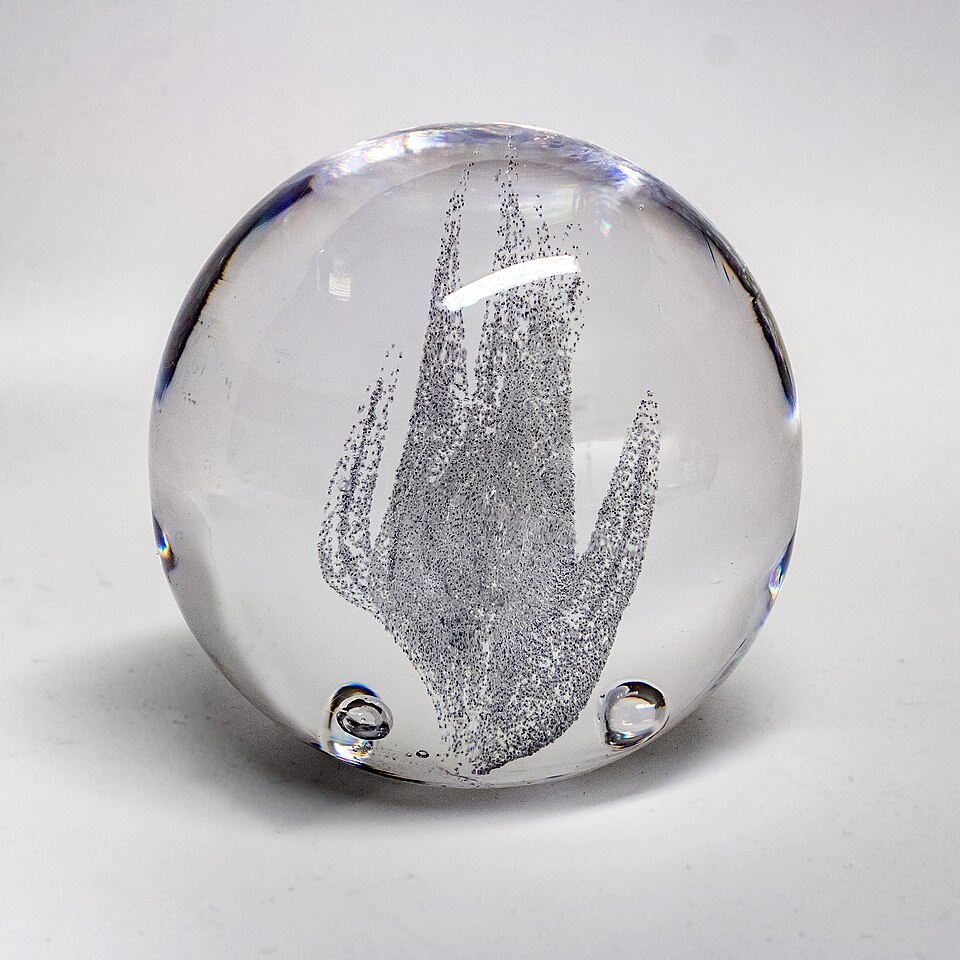
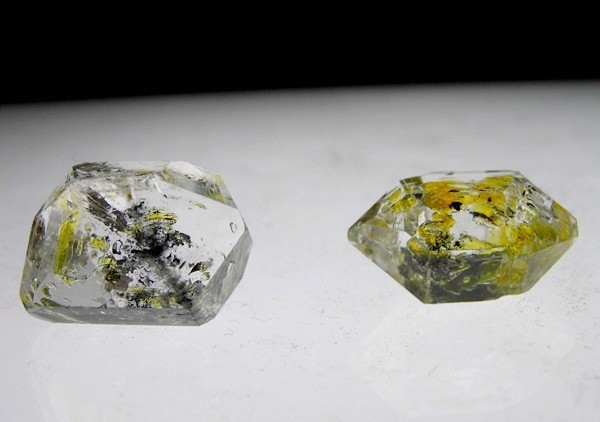
Glass usually shows perfectly round bubbles, like tiny pearls, that sit frozen in place. You might also see swirly lines, a bit like honey stirred into tea. Colored glass often looks either swirled or suspiciously even.
Quartz usually shows something messier and more interesting. You might see little pockets of trapped liquid with sharp, angular edges, wispy veils that look like fingerprints, fine needles of other minerals, or a faint "ghost" of an earlier crystal inside. Sometimes a trapped droplet holds a tiny bubble that moves when you tilt the stone. If you see that, you're almost certainly holding real quartz.
Don't fall for these two traps. The first is "bubbles mean glass." Plenty of real quartz gets written off because of one round-looking spot that turns out to be a pocket of trapped liquid. The second is "no bubbles means it's real." Look around your kitchen and see how many bubbles your drinking glasses have. Modern glass is made bubble-free, so a perfectly clean stone tells you nothing. The same goes for rainbows inside the stone. They come from tiny cracks, and glass cracks too.
What your result means:
This one sounds too simple to work, but it's real physics. Quartz carries heat away from your skin several times faster than glass, so it feels colder and stays cold longer.
The trick is not to hold the stone in your hand first, because that warms it up and ruins the test. Leave your stone next to something you know is glass, like a marble or a small drinking glass, for about an hour. Then touch each one to your lip or the inside of your wrist. Quartz feels properly cold and stays that way. Glass feels cool for a second and then warms up.
There's an even easier version: breathe on both at the same time. The fog disappears faster from quartz.
This test works best on pieces about the size of a walnut or bigger. A tiny chip or a thin bead warms up too fast to tell. Treat it as a helpful hint, not a final verdict.
What your result means:
If your piece still has its natural crystal faces, and wasn't polished into a tower or sphere, the outside can tell you a lot.
Natural quartz grows as a six-sided column with a pointed tip. The long sides often have fine lines running across them, like the rungs of a ladder. These are called striations, and they're one of the best signs of a natural crystal. Real crystals are rarely perfect. Expect small steps, dents, frosted patches, or a rough, broken base where the crystal came away from the rock.
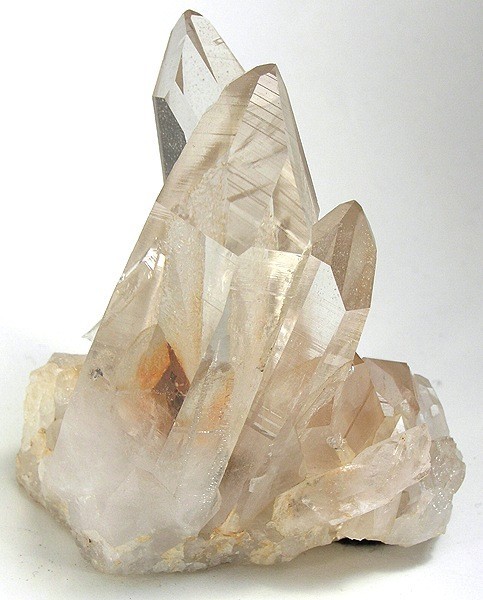
Molded glass tends to look too smooth and too perfect. Look for a thin line where the two halves of the mold met, edges that are soft and rounded instead of crisp, sides that are slightly wavy, or a dimpled texture like orange peel.
One caveat: this only works on natural faces. A polished point has no striations, whatever it's made of, and lots of polished points are genuine quartz. The way a stone chips doesn't help either, because quartz and glass both break with the same curved, shell-like edges.
What your result means:
This is our favorite, because it looks like a magic trick and it's based on exactly the same idea a gemologist uses in the lab.
Quartz is a crystal, so it does something special to light that glass can't do. You can see it with two things you probably already own: polarized sunglasses and a laptop or computer screen.
Quartz will flash: it lights up and goes dark again four times in one full turn, sometimes with a bit of color. Glass stays dark the whole time.
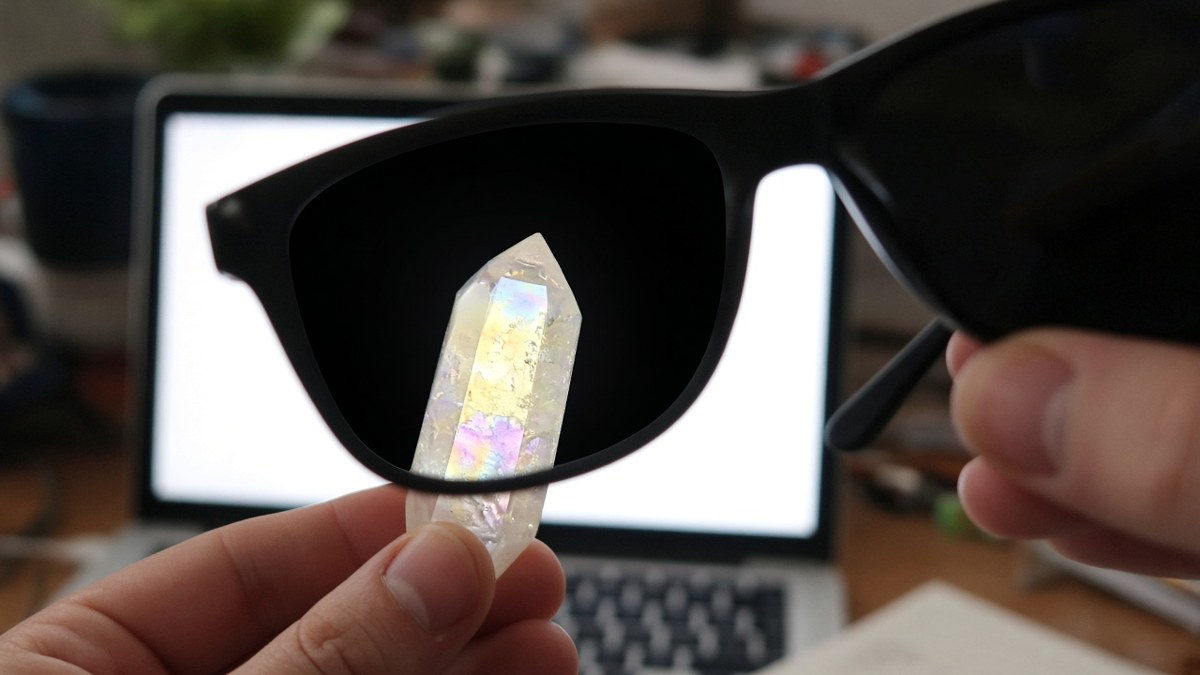
A few things can throw you off. If you happen to look straight down the length of a quartz point, it can stay dark, so turn it sideways and try again. Glass that cooled unevenly can show some patchy, blotchy light, but it won't flash on and off cleanly as you turn it. And milky or heavily cracked quartz, or stones like agate, glow in every position because they're made of lots of tiny crystals. The trick works best on clear pieces.
What your result means:
Keep in mind that lab-grown quartz flashes exactly like natural quartz, because it's the same crystal.
An extra check for faceted stones. The same property that makes quartz flash also splits light into two slightly different paths. In a large faceted stone, you can sometimes see this as doubling. Look down through the top of the stone with your loupe at the facet edges on the far side, and turn the stone slowly. In quartz, some of those edges may look doubled, as if each line had a faint twin right next to it. Ordinary glass won't do this.
Don't lean on it too hard, though. The effect is weak in quartz, so small, thin or rounded stones usually show nothing, and from some directions even a big quartz gem shows no doubling at all. Reflections from other facets can also look like extra lines. Real doubling shows the same edge twice, side by side, and it changes as you turn the stone. If you see it, that's a good sign of quartz. If you don't, it proves nothing.
Quartz is harder than ordinary glass. That means quartz can scratch a glass bottle, but glass can't scratch quartz. It's the most famous test, but we put it last on purpose, because it can damage your stone.
If you do it, do it the gentle way. Use your stone to scratch a piece of glass, not the other way round. Grab an old glass bottle or a spare piece of window glass. Don't use your phone screen or a toughened oven dish, because those are made harder on purpose. Choose a rough spot or the base of your stone, press firmly, and drag it across the glass.
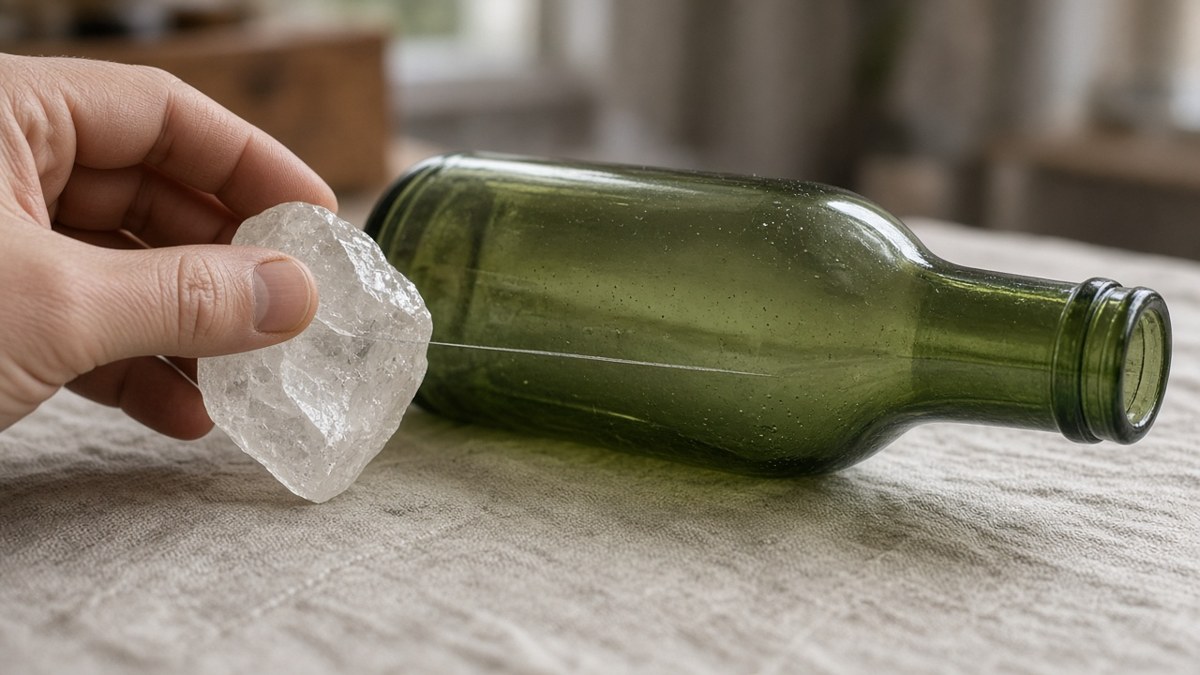
Then wipe the mark with a wet finger. Loose powder can look like a scratch, so check whether you can feel a real groove with your fingernail. Quartz bites in and leaves a clear line. A glass copy tends to skid or leave only a faint mark.
A couple of honest warnings. Some special glasses are harder than normal, so this test isn't bulletproof. Many other minerals can also scratch glass, so a scratch tells you it isn't ordinary glass, not that it's definitely quartz. And never try this on a polished face, a cut gemstone or anything you care about.
Never tap or strike the stone to test it, either. Being hard is not the same as being tough, and quartz can still chip or crack if you knock it.
What your result means:
If your results are mixed, a kitchen scale can help. Quartz is a little heavier for its size than ordinary glass, and much lighter than the heavy leaded glass used for cut "crystal" ornaments.
With a scale that shows one decimal place (0.1 g), use a stone of at least 20 grams, because on smaller stones the rounding is enough to blur quartz and glass together. A scale that shows two decimal places (0.01 g) works for smaller stones too.
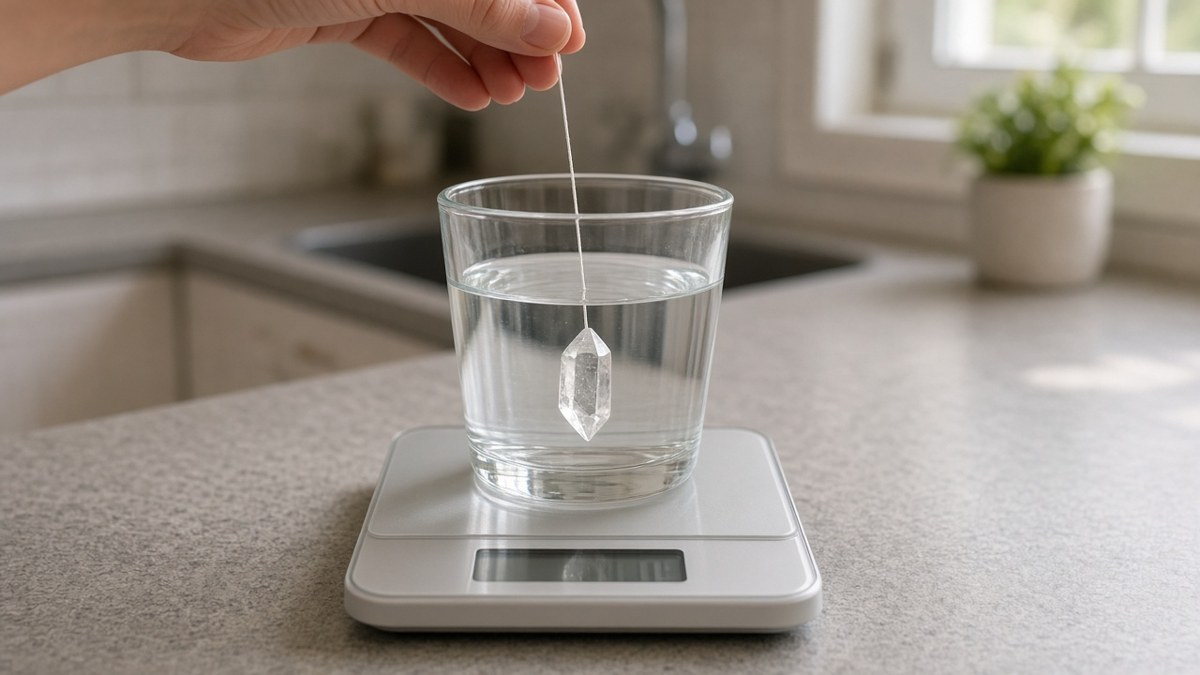
For example, a stone that weighs 26.5 grams and reads 10.0 grams in the water gives 26.5 ÷ 10.0 = 2.65.
Here's what the numbers mean:
Before you read the scale, check that no air bubbles are clinging to the stone, because they make the result come out too low. The test also won't work on stones in a setting, glued pieces, or anything with hollow spaces inside.
If the stone is expensive, cut as a gem, sold under a rare-sounding name, or your tests disagree, take it to a gemologist. With a tool called a refractometer, they can tell quartz from glass in under a minute. They're also the only ones who can tell natural quartz from lab-grown quartz.
Want to learn more? Take a look at our quartz guide and amethyst guide, our step-by-step How to Identify a Mineral: A Practical Guide, No Lab Required, and, before your next order, How to Buy Minerals Online Without Getting Burned.
Can real quartz have bubbles? Yes. Quartz can trap tiny drops of liquid while it grows, and some of them hold a bubble that moves when you tilt the stone. Those pockets usually have sharp, angular edges, unlike the round bubbles in glass.
Is smelting quartz real quartz? No. Smelting, smelted and cherry quartz are all names for glass.
Is aura quartz fake? It's real quartz with a thin metal coating on top. It's treated, but it isn't glass.
Will lab-grown quartz fail these tests? No. Lab-grown quartz is real quartz, so it passes all of them. Only a lab can tell it apart from natural quartz.
Can I use my phone instead of a laptop for the sunglasses trick? Often, yes. A bigger white screen is just easier to work with. Check first that your sunglasses make the screen go dark at one angle.
Can I scratch-test tumbled stones? Only on a spot you don't mind marking, and always by scratching a piece of glass with the stone, not the other way round.






