Spot clues to heat-treated amethyst sold as citrine, learn what burnt citrine means, and check natural exceptions before paying an untreated premium.
Orange-brown tips, a white quartz base and a geode shape can help you recognise familiar heat-treated amethyst sold as citrine. But natural citrine can share those features. Examine the whole specimen, check its locality and ask what supports an untreated-colour claim before paying extra for it.
Collectors searching for “fake citrine”, “burnt amethyst” or “baked citrine” are often investigating the same treatment. Amethyst-lined geodes from Brazil and Uruguay have long been heated to produce material sold as citrine, including whole geodes. GIA, “Interesting heated citrine,” Summer 2005, p. 183
The useful question is whether the specimen’s yellow or orange colour was present when it came out of the ground.
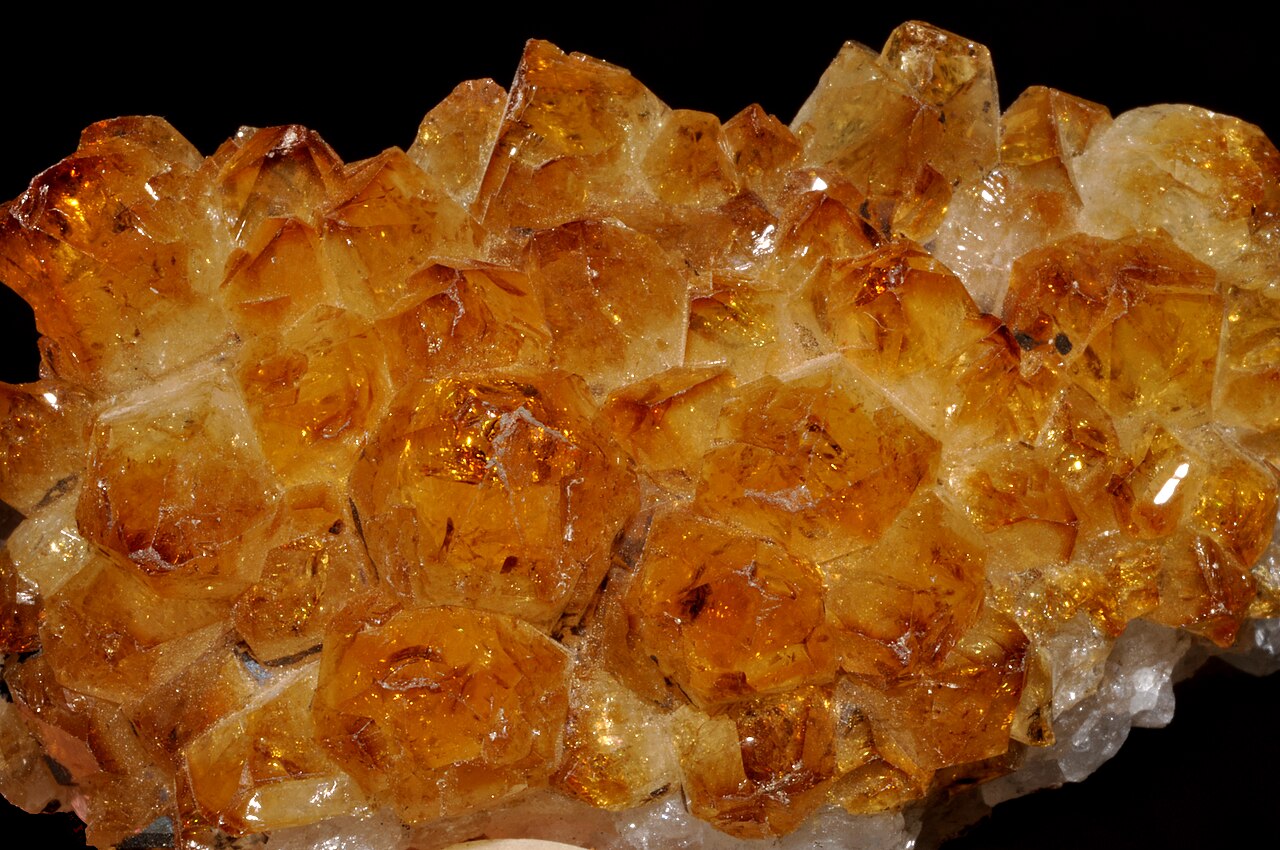
The photographer identifies this Brazilian specimen as heated amethyst. This front view shows golden-orange terminations and a little pale quartz along the lower-right edge; it does not show the full base. Photo: Parent Géry, public domain, via Wikimedia Commons, displayed at reduced resolution.
First, follow the colour down an individual crystal. Turn the specimen sideways. Is colour concentrated near the termination (the pointed end) or visible throughout the crystal? Does it fade gradually into pale quartz, or stop at a sharp boundary? Repeat the inspection across several points.
For an online purchase, request a side view that includes the crystal roots and underside. A tightly cropped photograph of sparkling tips can hide most of the features you need to compare.
Record the pattern, but do not treat a white base as a burn mark. Natural crystals with milky bases and darker coloured tips are documented at Anahí, discussed below.
Next, consider the orange-brown colour in context. Dense, rusty or caramel-coloured tips are characteristic of familiar heated clusters. But a colour chart cannot separate every untreated specimen from every treated one. Natural citrine from Anahí can be orange-yellow or brownish/greenish yellow; heated amethyst also varies in colour with locality. Vasconcelos, Wenk and Rossman, “The Anahí Ametrine Mine, Bolivia,” 1994
A pale yellow specimen is not automatically untreated either. GIA notes that heating amethyst can produce yellow citrine, while heating smoky quartz can produce lime-coloured material. “Not orange” is a poor substitute for a treatment history. GIA, Citrine Quality Factors
Finally, look at the structure supporting those points. Is it a dense lining of crystals inside a hollow shell? A broken slice with a curved outer rind? A tall, cut-open geode sold as a “citrine cathedral”? Those are more useful observations than the word cluster.
The familiar orange-brown drusy geode is a sensible place to suspect heating. Yet “citrine never occurs in geodes” overlooks reports of natural examples. In his 1988 field report, David Stanley Epstein relayed accounts from miners at Iraí, Rio Grande do Sul, who described natural citrine as a “once-in-a-lifetime occurrence”, found in geodes like the amethyst. The miners suggested that those sections of rock had been “heated in the earth”. That was a proposed geological explanation. Colour alone cannot establish whether a specimen was heated underground or after extraction. Epstein, “Amethyst Mining in Brazil,” p. 228
Use the combination of form, colour and locality to decide how closely to question the treatment history. A claim of rare, natural geode citrine needs specimen-specific evidence. The existence of an exception does not authenticate an ordinary shop specimen.
Amethyst and citrine are varieties of quartz. Heating suitable amethyst changes its colour while leaving a quartz specimen with its crystal form intact. The result can therefore be a naturally grown crystal with an artificially altered colour. GIA uses citrine for this material in its gemmological descriptions. GIA, Citrine Quality Factors
That explains why “Is it real quartz?” gets you only halfway. So does a label saying “natural crystal.” If you suspect a glass imitation, start with Quartz or Glass? Five Tests You Can Do at Home. Establishing that a specimen is quartz does not establish whether its colour was altered.
For a collection label, “quartz, heat-treated amethyst” tells the history clearly. “Heat-treated citrine” also makes the treatment explicit. The problem arises when that specimen is represented as having untreated, natural colour.
Calling every heated piece “fake” loses this distinction. A correctly described heated cluster can be an enjoyable, inexpensive purchase. An untreated-citrine price requires an untreated-citrine claim that can be supported.
At Anahí, Bolivia, researchers described quartz developing from milky material into crystals with purple and orange-yellow tips. The crystals line natural chambers, some up to five metres long. Large ametrine crystals have milky bases, with colour becoming stronger towards their tips. The paper also illustrates a 37.5 kg ametrine cluster collected by one of its authors. Field and experimental work established that the amethyst–citrine colour combination there is natural. Anahí mine study, figures 5, 6 and 9
These are naturally coloured amethyst–citrine crystals, rather than a claim that every yellow cluster is untreated. They show why a milky base, stronger colour at the tips and growth inside a cavity cannot independently prove artificial heating.
For locality research, distinguish this documented natural colour at Anahí from the rare natural geodes reported at Iraí, and from material whose treatment history remains a supplier's claim.
The Kitwe area, Zambia illustrates the last category. GIA examined material represented by its supplier as natural-colour citrine and retained that qualification in its report. GIA, “Citrine from Zambia”
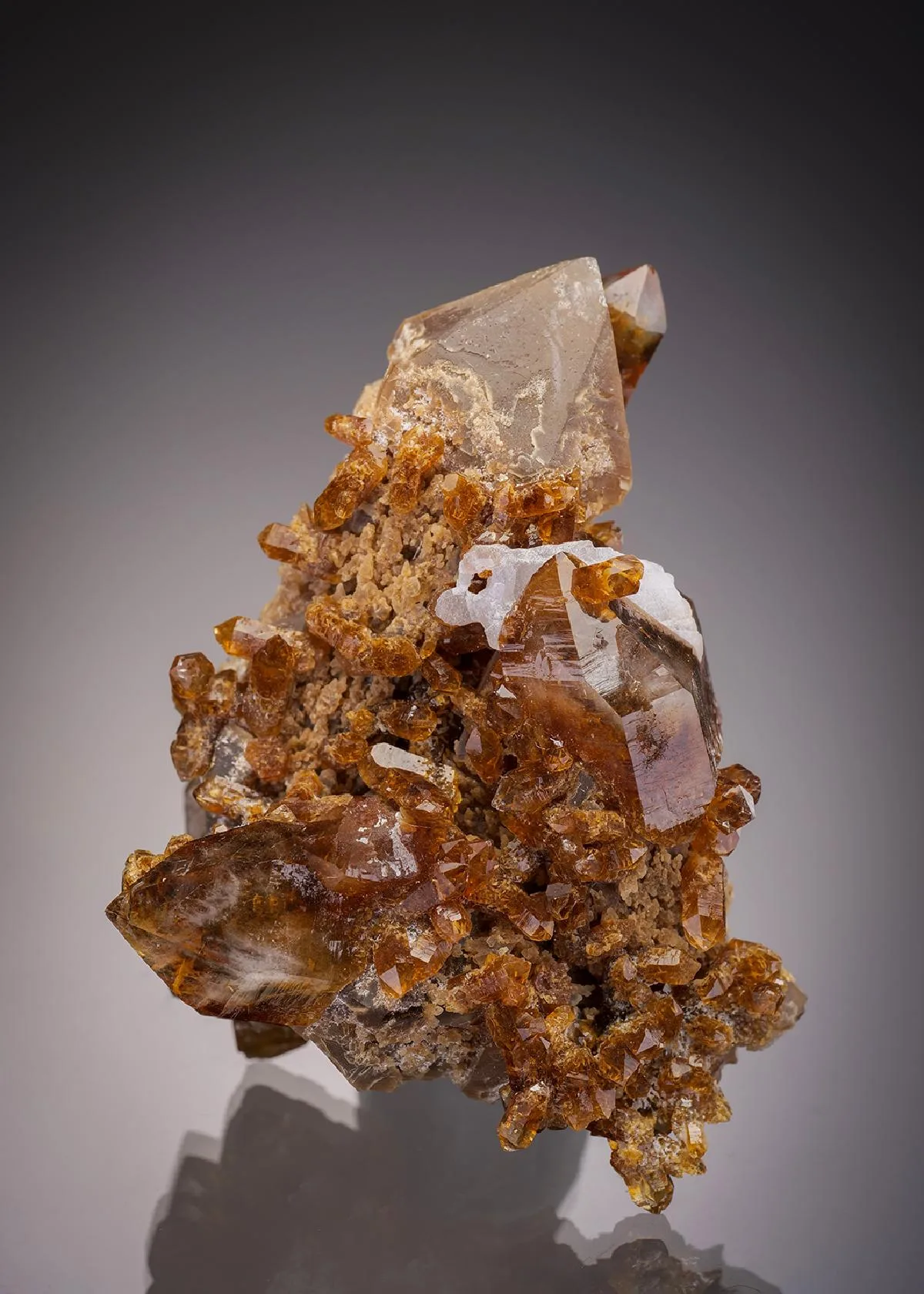
Citrine crystals to 2.9 cm on partly corroded quartz, from Masca-Băişoara, Romania, offered by Crystal Classics on EarthWonders. The listing does not state whether the colour is untreated, so treat this photo as a visual reference rather than proof of natural colour. View the specimen.
“From Zambia”, “from Russia” or “from Brazil” on a sales card cannot authenticate colour. Ask how the seller connects this particular specimen to the locality and treatment history claimed.
GIA's 2005 market note explained that “the trade typically assumes that all citrine is heated and this yellow quartz is priced accordingly.” For a collector, that historical observation offers useful context: if a seller charges a premium for untreated colour, ask what evidence supports the claim. GIA, Summer 2005, p. 183
When browsing citrine specimens on EarthWonders, compare pieces with similar dimensions, intact terminations, transparency and crystal arrangement. Check their locality documentation and stated treatments, and keep polished points separate from crystals with their original growth surfaces.
A large, attractive heated geode can cost more than a small natural-colour crystal. Price alone cannot establish treatment history. The avoidable mistake is paying extra for an untreated origin that nobody can substantiate.
An orange geode leaves you plenty to inspect. A faceted stone, tumbled piece or polished tower may have lost the base and surrounding crystal structure that made the comparison useful. You cannot reconstruct those missing features from its yellow colour.
Even “natural origin confirmed” needs careful reading. In the Kitwe report, GIA found inclusions establishing that the quartz was natural, yet still qualified the claim that its colour was natural. Crystal origin and colour origin are separate questions. GIA, “Citrine from Zambia”
For a costly purchase, ask a laboratory whether it can address colour treatment in that particular specimen, and what an inconclusive result would mean. A report identifying natural quartz may not answer the question you are paying to resolve.
For the orange cluster, request a side photograph and ask:
Was this specimen heated to change its colour? If you are selling it as untreated, what locality and sourcing evidence support that description?
For a pale point or polished stone, broaden the treatment question:
Has its colour been altered by heating or irradiation? Does “natural” describe the quartz’s origin, its colour, or both?
Keep the reply with the invoice and specimen photographs. If the history remains unknown, record it as “quartz, sold as citrine; colour treatment unknown.”
For the wider buying routine, including seller history, additional photographs and return terms, see How to Buy Minerals Online (Without Getting Burned).
If your existing orange cluster is confirmed as heated amethyst, update its label with that information and the locality, if known. The next person who handles it should not have to solve the same mystery again.
No. Heating suitable amethyst changes its colour but leaves a quartz crystal with its form intact, so the result can be a naturally grown crystal with an artificially altered colour. Label it as treated, for example “quartz, heat-treated amethyst” or “heat-treated citrine”.
Rarely, according to reports. Miners at Iraí, Rio Grande do Sul, described natural geode citrine as a “once-in-a-lifetime occurrence”. That exception does not authenticate an ordinary shop specimen; a claim of rare, natural geode citrine needs specimen-specific evidence.
Look at form, colour pattern and locality together: dense orange-brown tips on a drusy geode are a sensible reason to suspect heating, but natural citrine can share those features. Visual clues cannot prove a treatment history, so ask the seller what evidence supports an untreated-colour claim, or ask a laboratory whether it can address colour treatment in that particular specimen.
GIA noted in 2005 that the trade typically assumes all citrine is heated and prices it accordingly. If a seller charges a premium for untreated colour, ask what evidence supports the claim; price alone cannot establish treatment history.