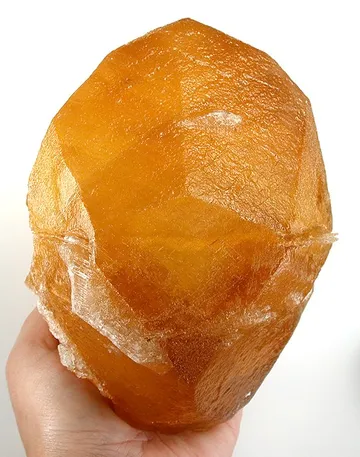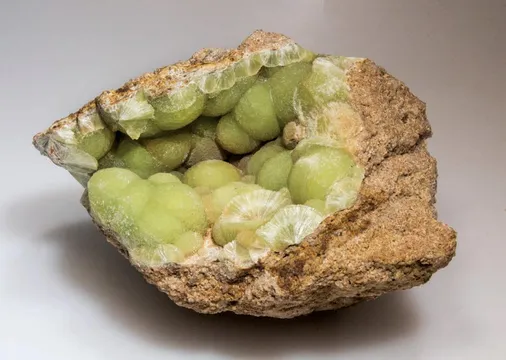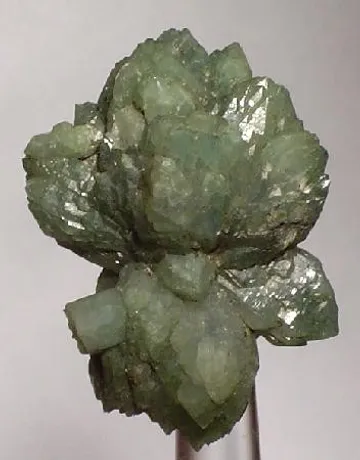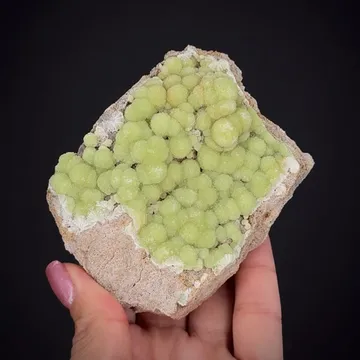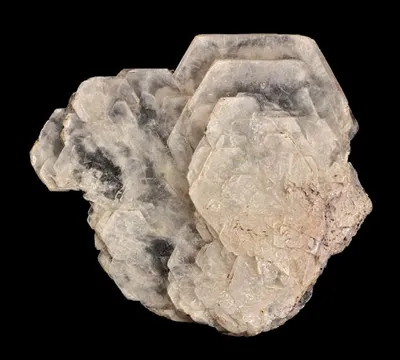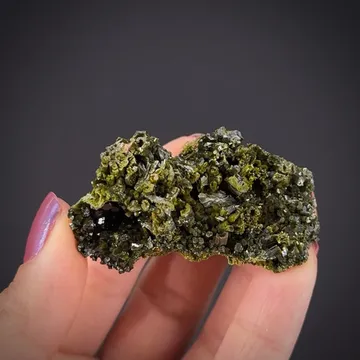
Wheatley Mines, USA, a historic 19th-century lead-zinc locality near Phoenixville, PA, famed for pyromorphite and other oxidized sulfides prized by collectors.
Key facts
Wheatley Mines is one of the defining old American lead localities: a compact 19th-century silver-lead-zinc mining district near Phoenixville, Pennsylvania, whose specimens entered cabinets while American descriptive mineralogy was still taking shape. The name most often points to the historic Wheatley mine group in the Phoenixville Mining District of Chester County, but collectors should understand it as part of a cluster of related workings—Wheatley, Brookdale, Phoenix, Chester County, Southwest Chester County, Charlestown, Montgomery, and others—set along lead-bearing lodes in the Pickering Creek area.
Geologically, the mines worked steeply dipping quartz-sulfide veins cutting Precambrian felsic to intermediate gneisses and, locally, the overlying red beds of the Triassic Stockton Formation. The primary ore was galena with sphalerite and other sulfides; the collector fame comes from the oxidized lead suite developed above and around those sulfides: pyromorphite, anglesite, cerussite, wulfenite, leadhillite, mimetite, and related secondary minerals, joined by quartz, calcite, fluorite, malachite, azurite, native copper, native sulfur, and rarer species.
For mineral collectors, Wheatley is above all a pyromorphite locality. Its best pieces are not oversized modern show specimens, but intensely historic Eastern U.S. classics: mossy to olive-green druses, sharp short hexagonal prisms, barrel-shaped crystals, hollow or hoppered terminations, and botryoidal or reniform masses on rusty gossan, limonite, quartz, or old sulfide matrix. A strong Wheatley specimen has an immediately recognizable look—green lead phosphate against orange-brown iron staining or white-to-smoky quartz, sometimes with cerussite or anglesite nearby—and the better pieces carry a pedigree that may reach back to mid-1800s mining.
Regional View
Country View
The locality also matters because Charles Moore Wheatley was not merely a mine operator; he was a serious mineral collector. His Phoenixville mines supplied scientific collections and museums on both sides of the Atlantic, and Wheatley material was studied by J. Lawrence Smith in 1855 in one of the classic early papers on an American mineral locality. Later, the same district gave its name to wheatleyite, a very rare sodium copper oxalate mineral described from mine-dump material at Wheatley.
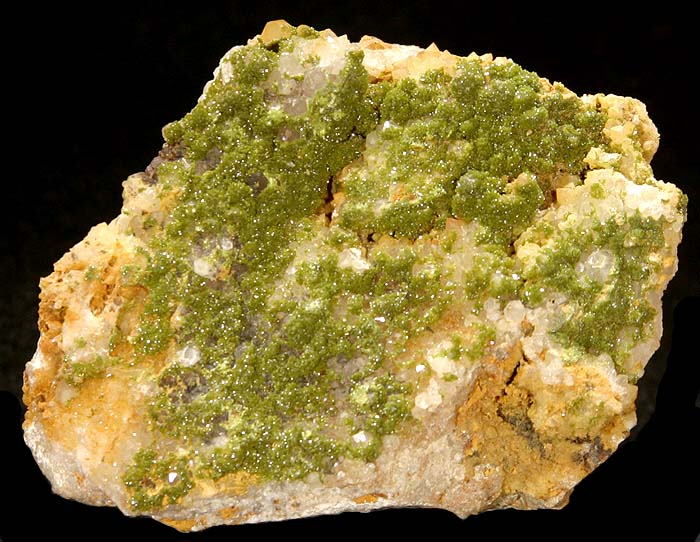
Photo: Rob Lavinsky, iRocks.com via Wikimedia Commons
Search for specimens: View all specimens from Wheatley Mines, USA
The Wheatley Mines are in Schuylkill Township, Chester County, Pennsylvania, near Phoenixville and the Pickering Creek valley, a short distance from the Schuylkill River. The deposit belongs to the Phoenixville Mining District, a small but historically important group of silver-lead-zinc-copper vein deposits. The ore bodies followed northeast-trending lodes that dip steeply southeast and cut older crystalline rocks; modern descriptions place the veins chiefly in Precambrian granitic to intermediate gneiss, with local penetration into red siltstone of the Triassic Stockton Formation. In collector language, this means Wheatley specimens are usually pieces of oxidized vein material: quartz, limonite, gossan, galena remnants, sphalerite, and secondary lead and copper minerals.
The ore sequence is well expressed in the surviving specimens. Quartz was an early and abundant gangue, with chalcopyrite, galena, sphalerite, ferroan dolomite, calcite, and fluorite in the primary and later vein assemblage. Near the surface and along oxidized fractures, galena altered to anglesite, cerussite, pyromorphite, mimetite, wulfenite, and other lead minerals. Shallow levels were especially rich in pyromorphite, cerussite, and galena, while sphalerite, galena, and dolomite became more important at depth. The shallow pyromorphite-rich zone is the reason so many old Wheatley and Phoenixville-district specimens are green, heavy, and iron-stained.
The earliest reported discovery of mineralized veins in the Phoenixville area is traditionally connected with Charles Pickering soon after his arrival in Pennsylvania with William Penn in 1682, but serious mining waited until the 19th century. Charles M. Wheatley, then manager of the Perkiomen copper mine at Audubon, leased the ground in 1850 and began work at the Wheatley Mine early in 1851. That first season produced only 11 tons of silver-lead ore, but the operation developed rapidly. By January 1852 the shaft had reached 135 feet and required better pumping. Wheatley organized the Wheatley Mining Company in February 1852 and installed a 60-horsepower single-acting Bull engine with a 24-inch cylinder and a 6-foot stroke.
By 1854, the main Wheatley engine shaft—Cocking’s shaft—had reached its final depth of 300 feet, and several levels had been driven. The mine also had whim shafts, waterwheels, stamping equipment, crushers, and dressing floors. By September 1854, contemporary accounts credited the Wheatley operation with about 1,800 tons of ore averaging roughly 60 percent lead. The galena ore was reported at 70–85 percent lead with 15–120 ounces of silver per ton; the pyromorphite ore itself assayed high enough to be treated as lead ore, at roughly 66–72 percent lead and about 5 ounces of silver per ton. This is an important point for collectors: Wheatley pyromorphite was not just an accessory mineral saved for cabinets; much of it was mined, dressed, and smelted.
The broader mine group developed quickly. The Brookdale Mine opened in October 1852 on the same lode, a little over a third of a mile southwest of Wheatley. It had its own 24-inch pumping engine and eventually reached a depth of 192 feet. The small Phoenix Mine lay farther southwest on the same lode and was a much more modest operation. The Charlestown Mine, on a parallel lode to the northwest, worked a poorer vein and used a 24-inch rotative beam engine built by John West of Norristown; that engine was later moved to the Wheatley property during the 1860s revival.
The first mining phase ended in difficulty. Work was suspended in 1855 amid financial pressure, and the Wheatley, Brookdale, and Phoenix mines were merged into the Pennsylvania Lead Company. The company failed to raise the capital needed for expanded pumping and declared bankruptcy in 1857. A second major phase began during the Civil War, when lead demand encouraged Wheatley to repurchase the mines and machinery in 1864 and organize the New York and Boston Silver-Lead Company. The Wheatley Mine was dewatered and reworked, a nearly 600-foot adit was driven at the 48-foot level, and the Charlestown engine was re-erected between the Wheatley and Brookdale shafts to assist with pumping, hoisting, and crushing. By March 1865 the workings had been cleared and retimbered, and the stopes were again yielding dressed ore.
Records grow thin after 1865. Mining had probably ceased by about 1870, and the New York and Boston Silver-Lead Company went bankrupt in 1873. A brief 20th-century attempt followed when the Eastern Mining and Milling Company reopened the Wheatley Mine in January 1917. Work was interrupted by a coal shortage, resumed in November 1918, and by August 1919 roughly 500 tons of lead and zinc ore had been raised. Production remained limited, and operations ended permanently in 1920. A 1923 capital-raising attempt by later companies failed.
Collecting access today is complicated and must be treated seriously. The original Wheatley dumps are on private property and are not open public collecting ground. Some related Phoenixville-district dump material, especially at Brookdale and Southwest Chester County on or near the Pickering Valley Golf Club property, has historically been accessible by permission or fee arrangement, but access conditions have changed over time and must never be assumed. Collectors should obtain explicit permission from the current landowner or property manager before entering any site, and should remember that old mine shafts, subsidence, capped openings, unstable dumps, and lead-bearing dust are genuine hazards.
Specimens in the marketplace may come from the original Wheatley Mine, from the Wheatley mine group, from Brookdale, from the Chester County Mine, or simply from the Phoenixville district. This matters. The district produced many fine pyromorphites and secondary lead specimens, and many old labels say only “Phoenixville.” Because Wheatley was the best-known name, later labels sometimes upgraded vague district pieces into “Wheatley Mine” specimens. For the most exacting locality collectors, an original label, documented old collection history, or reliable dealer/museum chain of custody is the difference between a true Wheatley attribution and a broader Phoenixville-district attribution.
Pyromorphite is the signature Wheatley mineral and occurs in a wide range of green tones: yellowish green, grass green, moss green, deep olive, and almost blackish olive on some old specimens. Classic habits include short hexagonal prisms, barrel-shaped crystals, cavernous or hollow forms, sheaf-like aggregates, botryoidal crusts, reniform masses, and rich druses on limonite, quartz, gossan, galena, or cerussite-bearing matrix. Much Wheatley pyromorphite is small-crystal material, but crystals in the several-millimeter range are attractive, crystals approaching 1 cm are strong for the locality, and historic reports record occasional crystals to about half an inch in diameter. The best pieces show sharp undamaged terminations, bright resinous luster, strong three-dimensional coverage, and contrast between green crystals and iron-stained or quartz matrix; ordinary pieces are flat, sooty, patchy, or made only of scattered green grains.
Anglesite from Wheatley is a much scarcer prize than pyromorphite and is most valued as well-formed crystals in cavities in galena, limonitic matrix, or oxidized sulfide-rich rock. The Wheatley material is typically colorless, white, pale yellowish, grayish, or iron-stained, with blocky, tabular, prismatic, or pyramidal crystals; historic descriptions record unusually large examples for the locality, including crystals substantial enough to weigh up to half a pound and measure several centimeters, though most collectible specimens encountered today are far smaller. Good pieces show lustrous, isolated crystals with transparency or translucency and clear placement in a vug, often with galena, limonite, sulfur, copper minerals, cerussite, or pyromorphite. The most common practical problem is confusion with cerussite, especially on old labels, so crystal habit, density, cleavage, and testing history matter when assigning a Wheatley anglesite.
Other documented Wheatley and Phoenixville-district minerals include cerussite, galena including silver-bearing galena, sphalerite, quartz, calcite, fluorite, wulfenite, mimetite, vanadinite, leadhillite, hemimorphite, hydrozincite, smithsonite, chalcopyrite, bornite, chalcocite, covellite, cuprite, malachite, azurite, linarite, brochantite, descloizite, mottramite, pseudomalachite, native copper, native silver, native sulfur, hematite, goethite, baryte, dolomite, ankerite, aragonite, and chlorite-group minerals. The great rarity is wheatleyite, Na2Cu(C2O4)2·2H2O, a very rare bright-blue sodium copper oxalate described as thin acicular crystals to about 2 mm in aggregates on mine-dump material from the Wheatley Mine, associated with sphalerite, galena, cerussite, and quartz. Wheatleyite is the locality’s type-mineral distinction and is primarily of species-collector interest rather than cabinet-specimen interest.
The main authenticity issue with Wheatley specimens is not artificial manufacture; it is locality inflation. “Wheatley Mine” is a prestigious old label, but many 19th- and early 20th-century specimens were labelled simply “Phoenixville,” “Chester Co.,” or “Phoenixville lead mines.” Later dealers and collectors sometimes assigned such pieces to Wheatley because it was the most famous mine in the district. That may be reasonable for a broad Wheatley Mines/Phoenixville-district listing, but it is not the same as a specific old Wheatley Mine provenance. A period label, a Wheatley collection connection, a museum record, or an uninterrupted old collection history adds real value.
Condition should be judged with an old-locality eye. Many specimens were mined in the 1850s or collected from dumps long afterward, so abrasions, rust staining, trimmed backs, broken edge crystals, bruised terminations, and dirt in cavities are common. On pyromorphite, the best crystals are often tiny and easily damaged; inspect under magnification for intact terminations rather than relying on green color alone. Rich coverage, protected vugs, and three-dimensional clusters are preferable to flat drusy coatings. On anglesite and cerussite, watch for cleaved or bruised crystals and for misidentified labels, since both species can be pale, heavy, and associated with oxidized galena.
There is no prominent, well-documented fake or treatment tradition specific to Wheatley pyromorphite or anglesite, but cleaning can be a problem. Acid or aggressive mechanical cleaning may damage associated carbonates, loosen drusy pyromorphite, remove natural limonite character, or destabilize old matrix. Lead minerals should be handled with ordinary mineral-collector caution: do not create dust, do not lick or acid-test casually, wash hands after handling, and keep specimens away from children and food-preparation areas. Wheatleyite, where encountered as verified species material, is exceptionally rare, soft, brittle, and water-soluble enough that it should be kept dry and left in a protected micromount or vial.
Fluorescence is not the reason collectors pursue Wheatley pyromorphite; the pyromorphite itself is generally not noted for useful fluorescence. Some fluorite-on-calcite Wheatley specimens have been documented as fluorescent, but these are separate associated-mineral pieces rather than the standard pyromorphite style. Market availability is limited: modest drusy pyromorphites and old Phoenixville-district pieces appear periodically, but sharp, aesthetic Wheatley-attributed specimens with large-for-locality crystals, good coverage, and old labels are scarce. Fine anglesite is rarer still, and confirmed wheatleyite is a species-level rarity.
Today the most evocative remnant of the Wheatley story stands in an unlikely setting: a solitary Cornish stack in a small patch of woods between the 15th and 16th greens of Pickering Valley Golf Club. Locally it has long been called the “smelter stack,” but that name is misleading. It was the stack of the small pumping and crushing engine at the Brookdale Mine, standing beside Smith’s engine shaft. The landscape has changed from mine yards, engine houses, and dressing floors to golf fairways and suburban Chester County, but that stack is still a physical witness to one of America’s classic old lead-mineral districts.
The first Wheatley operation was ambitious from the beginning. Charles Wheatley started work in 1851 with a small pumping engine of about 50 horsepower, but the shaft was already 135 feet deep by January 1852 and water was winning the argument. Wheatley formed the Wheatley Mining Company and bought a larger Bull engine: a 24-inch cylinder, 6-foot stroke, 60 horsepower, mounted directly over the shaft. By 1854, Cocking’s shaft had reached 300 feet. Around it were whim shafts, waterwheels, stamps, crushers, and dressing floors—an industrial layout that looked to Cornwall for its technology and to Pennsylvania’s lead veins for its promise.
The engineering dreams grew even larger. In 1853, the company began Sanderson’s shaft between Wheatley’s Cocking shaft and Brookdale’s Smith shaft. The plan was to connect the two mines underground and drain both with an 80-inch Cornish pumping engine with a 12-foot stroke. The estimate was prepared, the plan was serious, and the engine was never purchased. Wheatley’s history is full of such near-transformations: enough ore and ambition to imagine a large mining enterprise, but not enough capital, legal luck, or sustained production to make it permanent.
By September 1854, five levels had been developed and about 1,800 tons of ore had been raised. For mineral collectors, the striking detail is that pyromorphite was part of the ore accounting. The galena averaged 70–85 percent lead and carried 15–120 ounces of silver per ton; the pyromorphite averaged 66–72 percent lead and about 5 ounces of silver per ton. The green crystals that collectors now prize in cabinets were once weighed, dressed, assayed, and smelted.
Brookdale’s first shutdown came not from a spectacular underground failure but from a neighbor’s water. The mine opened in October 1852 on the same lode, a little over a third of a mile southwest of Wheatley. Its pumping engine could raise 216 gallons per minute at 6 strokes per minute, and the shaft ultimately reached 192 feet. But neighboring farmer John Chrisman objected that Wheatley had diverted and polluted a stream used for watering livestock. A summons was issued in December 1853, a verdict followed the next month, Wheatley appealed, and in January 1855 the jury again sided with Chrisman. The Pennsylvania Supreme Court upheld the decision in June 1855, and Brookdale mining stopped. A mine with engines, shafts, and lead-silver ambitions was checked by a farmer, a stream, and livestock water.
The Civil War brought a revival. In 1864, with lead in demand, Wheatley repurchased the mines and machinery and organized the New York and Boston Silver-Lead Company. Work resumed at Wheatley in April. The old Bull engine was cleaned and repaired over about six weeks, but it still could not adequately drain the mine to the 60-foot level. A new adit was driven nearly 600 feet at the 48-foot level, and the Charlestown engine—a 24-inch rotative beam engine built by John West of Norristown—was moved to Wheatley and re-erected in an enclosed house between the Wheatley and Brookdale shafts. From there it could work the mine by reciprocating flat rods and also serve for hoisting and crushing.
By March 1865, the mine was again alive: cleared out, retimbered, equipped with new dressing floors and crushers, and yielding dressed ore from the stopes. Twenty-five tons had been shipped; another 65–70 tons of lead ore and 12 tons of zinc ore had been raised. Brookdale’s engine was being readied with the expectation that pumping would begin within two weeks. Then the record fades. By about 1870 mining had likely stopped, and the company went bankrupt in 1873.
The last chapter was brief. Eastern Mining and Milling Company reopened Wheatley in January 1917, stopped because of a coal shortage, resumed in November 1918, and by August 1919 had raised about 500 tons of lead and zinc ore. Operations ended for the final time in 1920. A 1923 attempt to raise new capital failed. After that, Wheatley belonged to old labels, museum drawers, private cabinets, dump-collected fragments, and the rare specimen whose green crystals still carry the feel of a 19th-century Pennsylvania lead mine.