Lime Ridge, USA - renowned wavellite locality in Devonian sandstone, with calcite, fluorite, celestine; prized for color contrast and pocket richness.
Key facts
Lime Ridge, near Mount Pleasant Mills in Perry Township, Snyder County, Pennsylvania, is one of the defining modern American localities for wavellite. The collecting locality is on the National Limestone Quarry No. 2 property, but the phosphate occurrence that made the site famous is not simply a limestone-vug mineral occurrence. The quarry works carbonate rocks of the Keyser and Tonoloway formations in the folded Valley and Ridge province, while the coveted wavellite occurs just over the crest of Lime Ridge in sandstone of the Ridgeley Member of the Devonian Old Port Formation. That geological split gives the locality two personalities: a long-established carbonate-quarry suite of calcite, dolomite, strontianite, celestine, and fluorite, and a younger collecting story centered on wavellite and associated phosphates in steep, fractured siliciclastic beds.
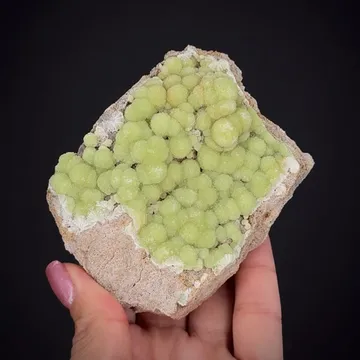
The best Lime Ridge wavellites are immediately recognizable. Instead of the deep emerald balls of the classic Arkansas localities, good Mount Pleasant Mills pieces tend toward yellow-green, apple-green, chartreuse, pale lemon, colorless, or mixed green-and-white radiating aggregates on tan to buff sandstone. They occur as hemispherical to spherulitic masses, circular sprays, botryoidal coatings, thin fracture linings, and occasional balls in small openings and fossil cavities. On top pieces, the contrast between pale sandstone matrix and glowing phosphate is part of the appeal: sharp radial terminations flash across broken hemispheres, intact rounded lobes rise cleanly from matrix, and some specimens preserve both colorless and vanadium-tinted green growth in the same pocket.
Regional View
Country View
Historically, Lime Ridge was first important to collectors as an accommodating active quarry where clubs could collect calcite, strontianite, fluorite, celestine, and fossils. Wavellite changed its status. The “green” was noticed around the beginning of the 2000s during work along the upper-bench perimeter road; local collectors confirmed the identity, and the locality quickly became a serious field-trip destination. By the 2020s, laboratory work, club digs, and machine-assisted excavations had shown that Lime Ridge was not a minor Pennsylvania curiosity but a locality capable of producing cabinet-size, attractive, and scientifically interesting wavellite specimens.

Photo: Wikimedia Commons / Rob Lavinsky, iRocks.com
Search for specimens: View all specimens from Lime Ridge, USA
National Limestone Quarry No. 2 lies on Lime Ridge about half a mile west-northwest of Mount Pleasant Mills. It is the smaller of two National Limestone quarries in the Mount Pleasant Mills–Middleburg area and has long produced limestone for aggregate, pulverized limestone, poultry grit, agricultural lime, concrete, and related stone uses. The quarry is an active industrial site, not an abandoned collecting ground, and access has historically been through arranged club trips rather than individual entry.
The quarry pit itself is in limestones of the Silurian Tonoloway Formation and the overlying Keyser Formation, with the Keyser spanning the Silurian–Devonian boundary. These carbonate units supplied the older collector reputation of the site. Calcite occurs as clear, tan, rhombohedral, scalenohedral, drusy, and sometimes fluorescent crystals in openings and on limestone. Strontianite is a notable species here, commonly appearing as white to colorless radiating balls or acicular sprays in cavities. Fluorite and celestine are less abundant but well established from the quarry suite, and Devonian fossils add another layer of interest for field collectors.
The wavellite occurrence is spatially and geologically distinct. It is on the quarry property but just over the crest of Lime Ridge on the south side, near the upper bench and southern perimeter road. The host is the Ridgeley Member of the Old Port Formation: a Lower Devonian, white to pale gray or buff, medium-grained quartz arenite that is slightly limonitic and fossiliferous. The productive beds dip steeply to nearly vertically and occupy a relatively narrow zone running roughly parallel to the perimeter road along the southern boundary of the quarry. In collector terms, wavellite is not scattered uniformly through the quarry; it is localized in fractures, small cavities, breccia zones, and seams within the Ridgeley sandstone.
Recent field interpretation has treated the locality’s mineralization as structurally controlled. The calcite, fluorite, strontianite, and celestine of the carbonate quarry appear tied to deformation in the carbonate rocks, while the phosphate mineralization in the Ridgeley sandstone is interpreted as a later epigenetic event associated with brittle deformation and renewed tectonism. That interpretation matches the field experience: productive wavellite is found where fractures, small openings, and brecciated sandstone gave phosphate-bearing fluids room to move and crystals room to grow.
The modern collecting history begins with the discovery of green mineralization by quarry owner Eric Stahl around 2000 or in the early 2000s during work on the upper-bench perimeter road. Local rockhounds were invited to investigate and confirmed wavellite. Word moved quickly through the club network, and by 2007 the locality was already being described in field-trip reports as a place where wavellite, cacoxenite, turquoise, strontianite, calcite, fluorite, celestine, and fossils could be found. A 2007 club notice was already calling the wavellite outstanding and reported that the A. E. Seaman Mineral Museum had requested specimens.
Important collecting phases followed. Early club digs produced abundant grass-green to yellow-green wavellite, often heavily dirt-coated or stained by iron oxides, requiring washing before the color and condition could be judged. Material documented from 2007 and 2008 includes cabinet-size sandstone plates with dense rounded wavellite and brighter chartreuse pockets. Deeper excavation around May 2012 produced more lustrous small wavellite aggregates. By about 2015, collectors were working an open adit and could reach veins in solid rock rather than relying only on old spoils.
The 2022 reopening was a major turning point. Bill Stephens arranged machine-assisted excavation and documentation before the first scheduled club trip of the season. The road was cleared, overburden was removed, the western wavellite pit was expanded downward and eastward, and a pad was built for a track hoe. Work took place over five days spread across about a month. The project was not merely specimen recovery: the quarry was mapped by drone, ground-control points were used to constrain the model, and structural measurements were collected remotely with surveying equipment. Fresh specimens again entered collections, and the work sharpened the geological understanding of the deposit.
A second machine dig in March 2024 pushed approximately 35 feet east from the eastern limit of the west pit and as much as 20 feet below the road level. Hundreds of specimens were recovered. The most memorable change was a shift from darker green exterior colors to yellow, producing the zone collectors called the “Lemon Drop” zone. A one-inch yellow ball matrix specimen collected by Ryan Klockner was described in the field-study literature as the largest free-standing individual crystal known from that work, while other 2024 specimens included yellow-dominant balls and richly textured pieces nicknamed in the collector shorthand of the dig. The Lemon Drop zone was reportedly dug out during that 2024 work, while the eastern adit was reopened and producing wavellite at the end of the dig.
Collecting access today should be understood as conditional and fragile. The locality has benefited from unusually generous quarry ownership, but it remains an active quarry with hazards, insurance requirements, safety rules, and controlled entry. Published field-trip notes state that individuals are not permitted to enter on their own; club trips require safety gear, sign-in sheets, insurance, and quarry permission. Collectors should not appear uninvited, should not assume that past access implies present access, and should treat every visit as a privilege that depends on careful behavior.
Wavellite is the signature mineral of Lime Ridge, occurring in Ridgeley Member sandstone as hemispherical aggregates, spherulitic masses, circular radiating fibrous forms, thin fracture veins, botryoidal coatings, and occasional fossil-hosted balls; documented sizes range from millimetric sprays to matrix specimens over 20 cm, with individual spherules commonly in the 1–16 mm range and exceptional free-standing yellow balls approaching an inch. The finest pieces show strong yellow-green, apple-green, chartreuse, pale lemon, or mixed green-and-colorless color on clean tan sandstone, with intact rounded lobes, crisp radial interiors, good separation between aggregates, and minimal iron staining or abrasion. Colorless wavellite is locally abundant in narrow fractures, where the opening was too tight for spheres to form, while green material owes its color to vanadium; the best specimens from the 2024 Lemon Drop zone are prized for yellow-dominant color, rounded development, and sharp visual contrast against pale sandstone.
Other documented Lime Ridge minerals make the locality more than a one-species occurrence. The phosphate assemblage includes cacoxenite, planerite, turquoise, variscite, and vauxite, with planerite especially notable as massive orange veins up to 1 cm thick found in sandstone in the west wavellite pit and analyzed by SEM-EDS at West Chester University. Turquoise occurs as thin fracture coatings and seams, in some cases difficult to distinguish visually from members of the turquoise–planerite series without analysis. Cacoxenite, variscite, vauxite, and reported strengite associations are chiefly of micromineralogical interest. The broader quarry suite includes calcite, dolomite, quartz, fluorite, celestine, sphalerite, strontianite, and limestone matrix, while the Ridgeley sandstone also yields fossils of brachiopods, gastropods, pelecypods, trilobites, crinoids, and related Devonian marine life; some fossil cavities are lined or filled with quartz crystals and, rarely, wavellite.
The chief authenticity issue for Lime Ridge wavellite is not sophisticated fakery so much as locality discipline. The best Pennsylvania pieces have a distinctive look—yellow-green to lemon or chartreuse wavellite on tan Ridgeley sandstone—but mediocre, broken, or stained pieces can be confused with wavellite from other Pennsylvania phosphate localities or with Arkansas material by sellers who use broad labels. A credible label should specify National Limestone Quarry No. 2, Lime Ridge, Mount Pleasant Mills, Perry Township, Snyder County, Pennsylvania, or a close equivalent. Older labels may say National Limestone County Quarry, National Limestone Co. Quarry, Mount Pleasant Mills quarry, or simply Lime Ridge; those variants are common enough that they should be evaluated with the specimen rather than dismissed automatically.
Condition matters greatly. Wavellite is not hard, and the radial balls are easily bruised, flattened, or rubbed during extraction and trimming. Many specimens came from rubble, old spoils, roadcuts, breccia zones, or narrow fractures, so broken hemispheres and incomplete sprays are common. Iron-oxide staining and buff quarry dust can mask good color; washing or careful cleaning is often needed before a specimen can be fairly judged. Some specimens have been treated with oxalic acid to remove rust, and that is not automatically disqualifying when disclosed, but overcleaning can leave a specimen looking pale, etched, or unnatural. Sawn bases occur on some market pieces and may be acceptable for display if disclosed and if the display face is undamaged.
The most desirable specimens preserve full or near-full rounded aggregates rather than only flat fracture coatings. Look for strong color, clean matrix contrast, intact luster on radial terminations, three-dimensional relief, and interesting textural variety—green plus colorless growth, yellow Lemon Drop material, wavellite over quartz, fossil-hosted spheres, or associated cacoxenite/planerite/variscite/turquoise. Thin fracture-vein pieces can be scientifically interesting, especially colorless wavellite, but they generally do not compete visually with open-pocket balls and rosettes.
Under ultraviolet light, Lime Ridge wavellite can add another dimension. Fourteen-specimen testing reported blue-green to emerald-green fluorescence under shortwave, mid-wave, and longwave lamps, with longer wavelengths often giving the more vivid response; phosphorescence was variable and ranged from none to blue-green, white, or white with a green tint, commonly lasting only a few seconds. Fluorescent response should not be used alone for authentication, but it is worth documenting on better specimens. Calcite and strontianite from the quarry are also fluorescent and phosphorescent, so mixed labels and display lighting can lead to confusion if the mineral species are not checked carefully.
Market availability is better than for many classic Eastern U.S. mineral localities because the discovery is modern and club trips, machine digs, and internet sales have put material into circulation. Common small pieces, stained fracture coatings, and partial aggregates remain accessible. Fine cabinet pieces with clean matrix and strong color are much scarcer, and large, undamaged, three-dimensional wavellite from the 2022 and 2024 excavations should be treated as premium contemporary American phosphate material.
The Lime Ridge story begins with a quarry owner spotting a color that did not belong in an ordinary road job. Around the beginning of the 2000s, Eric Stahl was clearing or improving a perimeter road on the upper bench of the Mount Pleasant Mills quarry, close to the southern property line. In the steep sandstone beds over the crest of Lime Ridge, he noticed “green.” Rather than ignoring it as a stain, he invited local rockhounds to investigate. They dug, confirmed wavellite, and the news moved through the Pennsylvania club world. Within a few years, a quarry already liked for calcite and strontianite had acquired a new identity.
By June 2007, the excitement was open enough that a regional club notice described “exciting finds” at National Limestone. The quarry was expected to yield dogtooth calcite, strontianite, possible fluorite and celestine—but the real spark was the Ridgely sandstone on the south side, then producing wavellite, cacoxenite, and possibly other phosphates. The notice called the wavellite outstanding and added the delicious collector detail that the A. E. Seaman Mineral Museum in Michigan had requested specimens. It also captured Eric Stahl’s personality in one line: he asked visiting collectors to bring him labeled specimens from other quarries because he loved minerals but did not get much chance to collect away from his own operation.
On August 4, 2007, Mike Streeter’s small group arrived after a nine-hour drive from near Asheville, North Carolina. They met RJ Harris at 8:00 in the morning with only five people and Opal the dog on hand. The day was bright, dry, and punishing; by afternoon the temperature reached 94 degrees in the shade. RJ led the group to three spots—wavellite, strontianite, and calcite—with the wavellite on the southern flank of Lime Ridge. The productive rock was a siliceous sandstone broken into rubble from pebbles to boulders. One collector pulled material down with a potato rake; another worked with a prybar and mattock; hammers and sledges came out whenever green showed on the outside of a rock.
After about an hour, Eric Stahl appeared. Streeter’s account presents him not as a distant quarry operator but as an owner “who gets as excited as any rockhound” over his minerals. He pointed out turquoise on a piece Bruce Skubbon had collected for wavellite, then later told RJ that he had directed employees to extract and set aside large boulders with strontianite and calcite specifically for the visitors. The generosity was memorable, but so was the heat. Streeter developed nausea and muscle cramping, retreated to shade beside the truck, and eventually drove five minutes to a convenience store for Gatorade and food. Bruce’s remedy for the heat was two hot dogs washed down with Gatorade. Opal made friends with nearly every customer who passed by. Then, cooled enough to continue, they returned to the quarry and collected calcite until the body finally refused to keep swinging.
In April 2014, the Wayne County Gem and Mineral Club made its own pilgrimage south. Thirteen members crossed into Pennsylvania for warmer weather and minerals, and at Mount Pleasant Mills they found Eric Stahl waiting, having cleared the road up to the ridge in anticipation of their visit. Vehicles had to back into the final section until the group was lined up beside a wavellite spot on the hill. Fred Haynes described the spot as an unimpressive-looking roadcut along the dirt road capping the ridge, but one visited for years by collectors seeking yellow-green wavellite balls. Wavellite was abundant, yet most fractures were too narrow to grow complete balls; many surfaces showed sprays, broken crystals, dust, and iron staining. Only after washing could the real color be judged. On one cleaned specimen, Andrew Zieto found a small double-terminated clear quartz crystal among wavellite balls of two sizes, the larger greener balls approaching a quarter inch across.
The fossils kept surprising collectors as well. Brachiopods were found in the sandstone, some coated with wavellite, and Scott Jones collected a notably complete gastropod. In 2022, Ronald Sloto documented the same strange miniature world more analytically: fossils in the Ridgeley sandstone were filled with clear quartz crystals, one fossil resembled a tiny geode, and another contained both quartz crystals and a wavellite sphere. The wavellite ball in that fossil was 1.1 cm across, with interlocking terminations visible on the outside of the sphere.
The 2022 machine-assisted reopening reads like the moment when a club locality became a studied mineral deposit. Bill Stephens had first worked the occurrence around 2015, when an adit was open and collectors could reach veins in solid rock. After several years, however, the road and site had grown over, and short club trips were no longer finding fresh material. Before the first club visit scheduled for April 9, 2022, he arranged excavation with Eric Stahl. Stahl’s son cleared the road so any vehicle could pass, removed overburden, and expanded the hole downward and eastward. Spoils were used to ease a grade change and to build room for a track-hoe pad over the old mined-out area. Five days of machine-assisted excavation and documentation were spread across about a month.
That dig was also an exercise in field geology. Drone mapping followed the excavation, using surveyed ground-control points to build a high-resolution orthomosaic and 3D model. Structural measurements on bedding, joints, and fractures were taken remotely with a Total Station, using a modified spreadsheet method to gather strike-and-dip data in areas too dangerous or inaccessible to measure by hand. The practical outcome for collectors was fresh wavellite; the larger outcome was a clearer picture of a structurally controlled phosphate occurrence.
The November 13, 2022 Friends of Mineralogy Pennsylvania Chapter field trip yielded subtler discoveries. Sloto found massive orange planerite in sandstone veins in the west wavellite pit, up to 1 cm thick—material he had not previously seen there in the field or in collections. SEM-EDS analysis showed the mineral to be planerite, with the orange color likely caused by 2.22 wt % iron. The same trip produced abundant colorless wavellite in very narrow fractures. When split open, those veins showed radiating wavellite, but the fractures were too tight for spheres or partial spheres to form. The color story became sharper too: green Lime Ridge wavellite contained vanadium, while colorless wavellite did not.
In March 2024, the deposit changed color in front of the diggers. The machine work moved about 35 feet east from the eastern limit of the west pit and reached as much as 20 feet below the road. Andrew “Rockhound” Eppig took the week off to video-document the effort. Hundreds of specimens were recovered. The outside color shifted from dark green to yellow, and the diggers began calling the yellow-dominant area the “Lemon Drop” zone. Ryan Klockner’s one-inch yellow ball on matrix remained the largest free-standing individual crystal reported from the work, but many other yellow specimens came out before the zone was completely dug out. At the end of the dig, the eastern adit was reopened and still producing wavellite.
The public afterglow came in April 2024, when an exclusive joint Friends of Mineralogy Pennsylvania Chapter and Central Pennsylvania Rock and Mineral Club field trip followed the machine dig, with the Franklin club attending the first Saturday. About 125 people were present. Fine wavellite specimens were recovered, and, fittingly for a sandstone that keeps reminding collectors of its Devonian past, someone also found a trilobite.