Vesper Peak, USA - defining American locality for grossular garnet, notable for lustrous orange to cinnamon crystals and rugged alpine collecting history.
Key facts
Vesper Peak is one of the defining American localities for grossular garnet: a small, high, stubbornly inaccessible skarn on the northeast rim of Washington’s Sultan Basin, famous not for tonnage but for crystals. The classic collecting site is the 48-55 garnet prospect near the summit area of Vesper Peak in Snohomish County, where a limestone pod enclosed in older metamorphic rocks was converted by contact metasomatism into a compact calc-silicate body rich in grossular, hedenbergite, quartz, calcite, prehnite, clinozoisite, axinite-(Fe), titanite, vesuvianite, and related skarn minerals. The setting is pure North Cascades: steep ridges, snowfields, tonalite and quartz diorite intrusions, ribbon chert, and a prospect so awkwardly placed that its best collecting history reads more like alpine fieldwork than ordinary mining.
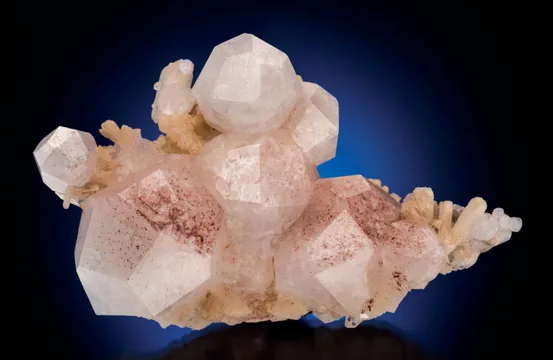
Collectors know Vesper Peak above all for lustrous orange, cinnamon, sherry-red, honey, and green grossular, commonly as intergrown dodecahedral clusters lining cavities or sitting on dark green to black pyroxene-rich matrix. The finest examples have an internal glow that is immediately recognizable: bright glassy faces, warm color, sharp geometry, and a distinctive habit in which some crystals show rare cube-face modifications. Good pieces are not merely “Washington garnets”; they are American skarn classics, and the best miniatures can stand comfortably beside grossular from better-known world localities because of their combination of color, luster, contrast, and locality character.
Regional View
Country View
The locality’s historical importance rests on a short but productive specimen-mining period and on the fact that it brought genuine, facetable-quality grossular to the Pacific Northwest collecting world. Earlier Washington state reports treated the occurrence as a small garnet deposit with museum-piece potential; by the late 1970s and early 1980s, Bart Cannon and associates had shown what the skarn could really produce: bright grossular druses, isolated crystals, hessonite-colored specimens, unusual prehnite combinations, and pocket material that still circulates with pride in old collections.

Photo: Wikimedia Commons

Photo: Wikimedia Commons
Search for specimens: View all specimens from Vesper Peak, USA
The collector locality is the Vesper Peak skarn, especially the 48-55 garnet prospect, in the Sultan Mining District of Snohomish County, Washington. Published coordinates for the broader Mindat locality place Vesper Peak at approximately 48.013° N, 121.518° W; the USGS MRDS-derived listing for the 48-55 prospect gives approximately 48.01556° N, 121.53000° W at about 5,499 feet elevation. The historical Washington reports describe the prospect near the center of sec. 9, T. 29 N., R. 10 E., reached from the Sunrise prospect by climbing to the Vesper Peak summit area and then traveling roughly a third of a mile northwest along the ridge toward Little Chief Peak, with the deposit lying southwest of the ridge crest.
Geologically, the occurrence is a compact contact-metamorphic skarn formed where carbonate material was caught within older sedimentary and metamorphic rocks near an intrusive body. The surrounding bedrock in the Vesper Peak area includes metamorphosed ribbon chert and related older units intruded by Oligocene tonalite to quartz diorite of the Vesper Peak–Squire Creek–Index intrusive family. The skarn itself is interpreted as an altered limestone lens: calcium-rich original rock was transformed into grossular-pyroxene-calcite-quartz-wollastonite-style assemblages during intrusion-related metasomatism. That origin explains both the calcium-aluminum garnet dominance and the abundance of calc-silicate companions such as hedenbergite, diopside, clinozoisite, epidote, prehnite, vesuvianite, and titanite.
The 48-55 body was described in the 1940s as a lenticular mass about 70 feet long and 50 feet wide, striking northwest and dipping about 50 degrees southwest, enclosed by hornfelsic rocks of the old metamorphic series. The wall-rock foliation was reported to bend around the garnetiferous lens, a useful field clue that the skarn body behaved as a discrete pod rather than a broad replacement blanket. Within a few hundred feet, the contact between metamorphic rocks and intrusive quartz diorite is exposed, and nearby thin garnet-amphibole layers reinforce the interpretation that the deposit belongs to a local contact-metasomatic system rather than a conventional vein.
The specimen-producing cavities occur within a coherent mass of intergrown skarn minerals. Grossular appears both as massive material and as clusters of intergrown crystals lining vugs; older reports note that isolated crystals were rare. Quartz crystals, generally small and imperfect, may be intergrown with the garnet; calcite occurs in coarse masses; chalcedony lines some vugs; and sulfides including arsenopyrite and chalcopyrite occur in minor amounts in a bordering siliceous zone. The broader Vesper Peak mineral list now includes apatite, arsenopyrite, augite, axinite-(Fe), calcite, chalcopyrite, clinozoisite, diopside, epidote, fahlunite, grossular including hessonite, hedenbergite, possible hillebrandite, laumontite, molybdenite, montmorillonite, prehnite, pyrrhotite, quartz, scapolite, titanite, vesuvianite, and wollastonite.
Mining history was small-scale and specimen-driven. P. C. Crane of Snohomish staked the 48-55 claim in 1937, and the early state surveys recorded only a few shallow cuts, no equipment, and no conventional mine development. The deposit was recognized as a source of “beautiful crystal clusters of grossularite garnet” and as capable of producing museum specimens, ornamental material, and perhaps abrasive garnet, but it never became an industrial garnet operation. Its collector reputation was built later, especially from material mined between about 1975 and 1982 by Bart Cannon of Cannon Microprobe/S.E.M. and associates. In that era, orange to dark yellowish-brown grossular crystals and druses were recovered from a small open cut in an outcrop near the summit area, above a persistent snowfield.
Access today is not open collecting. The locality has been described by WashingtonMinerals.com as under private claim, with collecting prohibited. Even apart from claim status, the site is a serious alpine locality: steep terrain, seasonal snow, fragile ridges, weather exposure, and no easy trail directly to the historic garnet body. Specimens now reaching the market are mostly older pieces from the Cannon era, named pockets such as the 1981 “Mud Bunny” pocket, documented private collections, and occasional later collecting with explicit permission.
The most notable finds include the classic 1970s and early-1980s grossular pockets, orange and cinnamon clusters on hedenbergite- or diopside-rich matrix, rarer hessonite-red crystals, prehnite-grossular combinations from mid-1970s local-collector finds, and the “Mud Bunny” pocket material of 1981. The larger and cleaner grossular crystals are exceptional for the locality; most strong specimens are thumbnails to miniatures, while crystals over 1 cm already draw attention, and crystals above 2 cm are notable.
Grossular is the signature mineral of Vesper Peak, occurring in lustrous dodecahedral crystals and intergrown vug-lining clusters in colors ranging from greenish and honey through amber-orange, cinnamon, sherry-red, and dark yellowish brown; crystals around several millimeters to about 1 cm are the familiar size range, while examples over 2 cm are exceptional and crystals reported over 2.5 cm are important locality pieces. The best specimens show sharp, glassy, undamaged crystals set against dark hedenbergite or diopside-rich matrix, sometimes with quartz, axinite-(Fe), clinozoisite, or prehnite, and the locality is especially prized for the uncommon cube-face modifications seen on some crystals—a habit often mentioned by garnet specialists because cube faces are rare in garnets generally but characteristic enough at Vesper Peak to become part of the locality’s visual identity. Ordinary pieces are massive, contacted, dull, or crowded into dark skarn; fine pieces have open display, saturated orange-to-cinnamon color, bright luster, and enough crystal separation to show the geometry.
At Vesper Peak, older labels and many collector descriptions use “garnet” for what is overwhelmingly grossular-group skarn material, especially the orange to cinnamon hessonite-like grossular recovered from the 48-55 prospect and related Vesper Peak skarn zones. Historically, the Washington surveys called the product “grossularite garnet,” while specimen labels may read simply “Garnet, Vesper Peak” or “Garnet Mine,” so collectors should treat generic garnet labels from this locality as requiring species-level interpretation rather than assuming almandine, andradite, or another garnet species. The desirable “garnet” specimens are the same cabinet classics that made Vesper famous: bright, transparent to translucent dodecahedral clusters, commonly on dark pyroxene matrix and sometimes modified by cube faces; lower-grade examples tend to be massive garnet skarn, broken crystal plates, or small druses with heavy contact and little individual crystal definition.
Hessonite from Vesper Peak is the cinnamon-orange to sherry-red variety expression of grossular, best known from the 48-55 Mine and the classic Vesper Peak garnet pockets where crystals occur as lustrous dodecahedra and intergrown clusters on skarn matrix, commonly with hedenbergite, diopside, quartz, axinite-(Fe), or smaller grossular crystals. Good hessonite-labeled pieces are valued for saturated warm color and glassy luster rather than size alone: a sharp 1 cm sherry-red crystal perched visibly on matrix may be more desirable than a larger crowded plate with dull faces or heavy edge wear. The finest examples have the rich burnt-orange to red-brown tone that separates Vesper Peak visually from pale green grossular localities, yet still retain transparency, crisp form, and a distinctly alpine skarn association.
Prehnite is a notable but much scarcer Vesper Peak companion, occurring as light green to white clustered fan-like sheaths and, in rarer specimens, sharp euhedral or pseudo-cubic-looking crystals associated with grossular; individual prehnite crystals to about 4 cm have been reported, though much of the material is etched, contacted, or subordinate to the garnet. The classic prehnite pieces are mid-1970s local-collector finds and later old-collection specimens, including prehnite perched with cinnamon grossular or on dark pyroxene-rich skarn; the best examples combine identifiable, well-formed prehnite with bright grossular contrast, while ordinary examples are etched pale masses without sharp form. Because Vesper Peak is primarily a garnet locality, prehnite specimens with real crystal definition and secure provenance are considerably more interesting than loose or generic pale prehnite lacking the Vesper association.
Beyond the headline garnets, Vesper Peak is a serious calc-silicate locality. Hedenbergite is especially important as a dark green to black matrix and companion mineral, with crystals reported to several centimeters and microprobe work indicating that the Vesper pyroxenes fall within the hedenbergite compositional range. Clinozoisite occurs as honey-yellow prismatic crystals and vug fillings, axinite-(Fe) appears on quartz and with grossular in good combination pieces, and titanite is known as loose gemmy honey-colored crystals from at least one pocket. Calcite, quartz, epidote, augite, diopside, vesuvianite, wollastonite, scapolite, laumontite, molybdenite, arsenopyrite, chalcopyrite, pyrrhotite, and possible hillebrandite complete the locality’s skarn-and-sulfide character. No Vesper Peak species is generally treated as a type-locality mineral, but the site remains mineralogically distinctive because of its compact skarn assemblage, rare garnet morphology, and unusually collectible Pacific Northwest grossular.
Provenance matters greatly for Vesper Peak. The finest specimens generally trace to the Bart Cannon collecting period from the mid-1970s through early 1980s, to named pockets such as “Mud Bunny,” or to recognized old collections. Labels naming the 48-55 Mine, 48-55 prospect, Vesper Peak skarn, Sultan Basin, Sultan District, or Snohomish County all appear in circulation; older labels may simply say “Vesper Peak, Washington” or “Vesper Peak garnet.” Generic “garnet” labels should be interpreted cautiously but not automatically distrusted, because “garnet” was historically used for the grossular material. More problematic are pieces misrepresented as open-access, recently self-collected material without permission, or specimens with locality labels migrated from other orange grossular localities.
No well-documented treatment industry is associated with Vesper Peak grossular specimens. The main authenticity issue is locality attribution, not enhancement. Orange grossular from Jeffrey Mine in Québec, Belvidere Mountain in Vermont, Mexico, Mali, Pakistan, and other localities can superficially resemble Vesper material in color, so matrix and habit are useful: Vesper pieces commonly show cinnamon to sherry grossular on dark pyroxene-rich skarn, with occasional prehnite, axinite-(Fe), clinozoisite, quartz, or a distinctive cube-modified garnet morphology. A clean Vesper label from Cannon, John Lindell, Alex Schauss, John White, George Elling, or a reputable dealer is a significant value feature.
Condition is the hardest quality factor. Vesper garnet clusters are intergrown, vuggy, and often contacted on the back or edges; many pieces have broken peripheral crystals, bruised high points, or trimming scars where the skarn was separated from tough matrix. The best specimens are not necessarily flawless floaters but present a clean, lustrous front with sharp crystals, minimal face abrasion, and natural-looking contacts confined to the rear or base. Examine under strong side light: tiny chips on orange grossular can flash white or dull compared with the glassy faces. Prehnite combinations require additional care because the prehnite is commonly etched and can be more visually fragile than the garnet.
Fluorescence is not a principal collecting criterion for this locality. Vesper grossular is valued for form, color, luster, and association, not for ultraviolet response. Standard handling precautions apply: avoid ultrasonic cleaning for delicate druses or prehnite combinations, avoid acid cleaning unless mineral associations are fully understood, and do not over-trim dark matrix that provides the visual contrast and locality identity collectors want.
Market availability is limited but persistent. Ordinary thumbnails and small miniatures appear occasionally; strong miniatures with bright cinnamon crystals over 1 cm are much less common; large, aesthetic, three-dimensional plates or specimens with crystals approaching or exceeding 2 cm are rare and can command strong prices. Prehnite-grossular combinations, hessonite-red crystals, documented Cannon-era specimens, and pieces showing obvious cube-face modification are especially desirable. The locality’s private-claim status and alpine access mean that supply is not being replenished in the way it was during the classic collecting years.
The first striking thing about Vesper Peak is how small the famous deposit was. Early state geologists did not describe a mine in the usual industrial sense, but a single unpatented claim, staked in 1937 by P. C. Crane of Snohomish, reached by mountain travel rather than by road. Their description places the skarn at roughly 5,500 feet, beyond the Sunrise prospect, past the summit area, then northwest toward Little Chief Peak, with no trail to the actual property. Development consisted only of shallow cuts. Yet in that small lens—about 70 feet long and 50 feet wide—they saw a mass of calc-silicate crystals, with garnet both massive and lining cavities in spectacular clusters.
The modern specimen story belongs to the 1970s and early 1980s. Bart Cannon, later cited as the main field collector in several specimen histories, worked the deposit during the heyday of good finds, and the material entered the gem and mineral literature as something unusual for the Pacific Northwest: bright orange to dark yellowish-brown grossular crystals and druses, mined from a small open cut above a persistent snowfield near the summit of Vesper Peak. The crystals were described as averaging about half an inch—just over 1 cm—and occurring either as individual crystals or as druses on dark green pyroxene matrix. That combination of alpine hardship and jewelry-grade color gave the locality its romance.
One of the best surviving field anecdotes comes from an August 1978 specimen history. Alex Schauss reportedly collected a small but fine cinnamon-red grossular cluster with permission of lease holder Bart Cannon, on what was remembered as the Des Hines and Gil Newman claim. The note says he hiked to the exposed mine outcrop, a place otherwise accessible only by helicopter, and later in Tucson, at the Old Desert Inn, Bart gave him one of his labels for the specimen—apparently taken from a small crystal Bart was selling for $20—because Bart, Des, and Gil “couldn’t believe” he had reached the claim on foot rather than by helicopter. For Vesper Peak, that is more than a charming provenance detail; it captures the reality of the locality. The crystals may be thumbnails, but the mountain was not.
The pocket names also matter. “Mud Bunny,” dated 1981 on at least one important specimen record, produced unusually large, deep honey-colored grossular with prehnite. In a locality where many good crystals are measured in millimeters, a main crystal over 2 cm from a named pocket becomes a serious locality document. The “Mud Bunny” material also shows why Vesper Peak specimens are best judged as complete skarn objects rather than loose garnets: color, matrix, associated prehnite, and pocket provenance all work together.
Prehnite has its own quieter story. Several classic specimens are described as mid-1970s finds by local collectors, including sharp euhedral prehnite crystals with grossular and pseudo-cubic-looking prehnite forms. Those pieces are easy to overlook if one comes to Vesper only for orange garnet, but they reveal the richness of the cavities: the same skarn system that made cinnamon grossular also made pale green to white prehnite, honey clinozoisite, axinite on quartz, and loose gemmy titanite crystals.
The locality has not entirely vanished from living collecting memory. In 2021, a fundraising auction for Oregon’s Rice Museum reportedly included an invitation to collect at Vesper Peak, and in late summer of that year Scott Werschky, Scott Ankenbrand, and John Gordon spent several nights on the mountain collecting. That modern episode stands out because it was permission-based and exceptional, not a sign that the locality is generally open. It also reinforces the old lesson: Vesper Peak specimens are inseparable from access, weather, and effort.