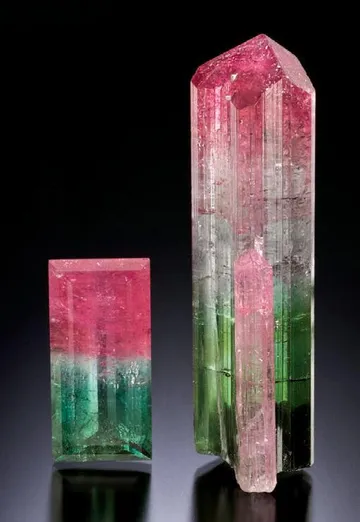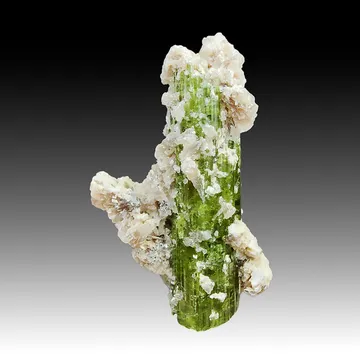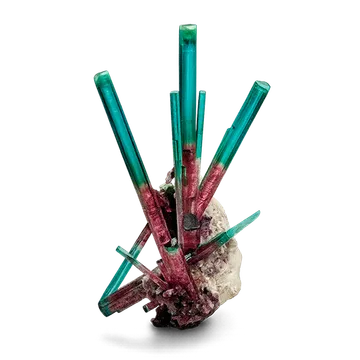
Tourmaline from Cruzeiro Mine, Brazil - vivid color zoning, large elbaite crystals, and rich pocket contexts, prized by collectors for variety and quality.
Key facts
Cruzeiro is one of the great names in Brazilian tourmaline: a long-running, hard-rock pegmatite mine in Minas Gerais whose production ranges from clean verdelite and blue-green indicolite to cranberry rubellite, watermelon zoning, polychrome crystals, etched terminations, and specimen-grade crystals still wrapped in lepidolite, albite, quartz, and pocket clay. For collectors, the locality’s appeal is not simply that it produces tourmaline in quantity; it is that the mine has produced the full grammar of lithium-pegmatite tourmaline in crystals large enough, colorful enough, and varied enough to become a collecting category of its own.

Photo: Wikimedia Commons
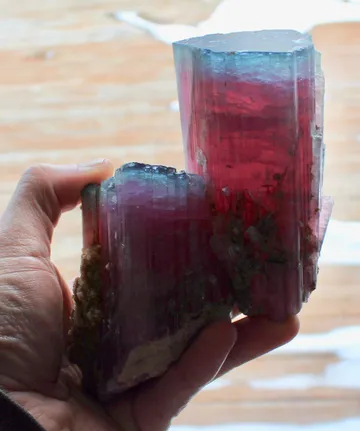
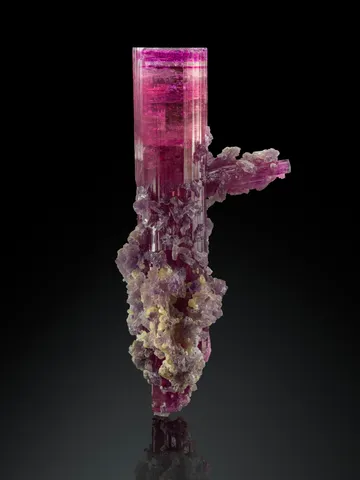
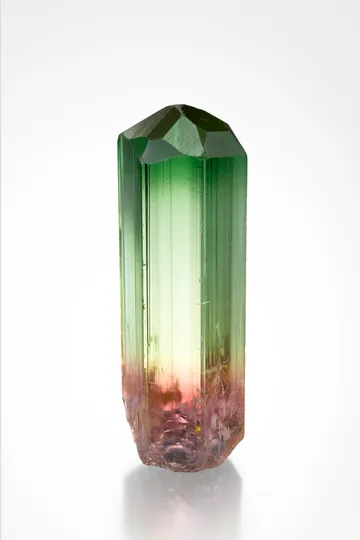
The classic Cruzeiro look is a prismatic, vertically striated elbaite with abrupt or subtly blended color zoning: pink to green, green to blue, cranberry to colorless to indicolite, or pink and green “watermelon” structures. Some crystals are slender pencils; others are stout, flat-topped prisms with complex etched faces. The best pieces combine saturation, transparency, intact terminations, and a believable pocket context: lepidolite, cleavelandite, quartz, and mica are not decorative afterthoughts here, but part of the mineralogical language of the deposit.
Geologically, Cruzeiro is an LCT-type granitic pegmatite system in the Eastern Brazilian Pegmatite Province, north of Governador Valadares and near São José da Safira. The pegmatites intrude quartzite of the Serra da Safira area and are sharply zoned around quartz cores. Gem tourmaline is especially associated with the intermediate zone and the peripheral parts of the core, commonly near albite rather than microcline. That relationship matters to collectors because it explains why so many fine Cruzeiro specimens show tourmaline with cleavelandite, lepidolite, quartz, or mica rather than on a heavy feldspar matrix.

Photo: Wikimedia Commons
Cruzeiro is also scientifically important. Tourmalines from the mine have been used in major studies of pegmatite evolution, zoning, and fluid history. Fluor-elbaite, Na(Li1.5Al1.5)Al6(Si6O18)(BO3)3(OH)3F, was formally described from Cruzeiro and the Urubu mine as a tourmaline-supergroup mineral species. Recent work on multicolored, zoned Cruzeiro crystals has shown how a single crystal can preserve a progression from schorlitic cores to fluor-elbaitic rims, mirroring the chemical evolution of the pegmatite itself.
For the collector, the ideal Cruzeiro specimen has more than bright color. It should have strong luster, good termination quality, crisp striations, visible gemminess in at least part of the crystal, and honest condition. Old-time green and blue-green crystals from the 1960s and 1970s, rich rubellite crystals, and complete multicolored pencils remain especially desirable. Matrix pieces with natural albite, quartz, and lepidolite associations are scarcer than loose crystals and command a premium when the composition is aesthetic and the tourmaline is undamaged.

Photo: Wikimedia Commons
Search for specimens: View all tourmaline specimens from Cruzeiro Mine, Brazil
Cruzeiro Mine is in São José da Safira, Minas Gerais, Brazil, in the Governador Valadares region of the Eastern Brazilian Pegmatite Province. The locality is also recorded as Lavra do Cruzeiro or Mina do Cruzeiro. Mindat places it at approximately 18° 16' 15'' South, 42° 10' 58'' West, and describes it as a gemstone and specimen mine in the Safira pegmatite district.
The deposit is a complex granitic pegmatite system enriched in lithium, boron, beryllium, manganese, tin, niobium, tantalum, phosphorus, uranium, and copper. Earlier descriptions treated the Cruzeiro mine as several workings on three largely unweathered granitic pegmatite bodies, while the modern operation describes its main mining area as four principal parallel pegmatites, 01, 02, 03, and 04, plus pegmatite 01½ between 01 and 02. The bodies dip steeply southwest and intrude quartzite. Pegmatite 01 has been described as about 1300 meters long and up to 60 meters wide; pegmatite 02 about 900 meters long and roughly 20 meters wide; pegmatite 03 about 700 meters long, with a maximum outcrop width of about 8 meters; and pegmatite 01½ with a known maximum width of about 30 meters.
The mine sits high in the Serra Safira area, reached historically by roads north from Governador Valadares toward Frei Inocêncio and then toward São José da Safira. Older accounts place workings near 1100–1200 meters elevation, while GIA’s 2014 field report gives the mine elevation as 4,593 feet. The district’s name carries a bit of mineralogical misdirection: early explorers reportedly mistook blue tourmaline for sapphire, giving São José da Safira and Serra Safira their “sapphire” association.
The pegmatites are internally zoned. A very thin border zone passes inward to a muscovite-quartz-feldspar wall zone, then to a quartz-microcline-albite intermediate zone, and finally toward a quartz core. Gem tourmaline is most often found in the intermediate zone and near the margins of the core, especially where albite is present. Miners have long watched for cleavelandite, lepidolite with black tourmaline, and iron-manganese oxide or phosphate coatings on quartz as signs that gem pockets may be close.
Mining history at Cruzeiro began in the mica era. Pegmatites in the region were worked for electronic-grade mica as early as World War I, and a formal mining concession was granted in 1916. During World War II, Cruzeiro became a major mica producer; at peak wartime activity, hundreds of garimpeiros worked dozens of sites in the pegmatites. Tourmaline was initially an incidental treasure, with dealers from Teófilo Otoni acquiring significant quantities while mica paid the bills. After wartime production declined, the rediscovery of large, fine tourmaline crystals in the 1950s began the modern tourmaline chapter.
The Neves family has been central to Cruzeiro’s modern identity. The mine’s official history describes Cruzeiro as operating since 1940 and being managed by the Neves family since 1980. Later reporting describes brothers Antonio and Jose Neves acquiring the mine in the early 1980s and developing Nevestones. The operation was restructured in 1996 with more modern mining methods, and the current company emphasizes formal mining, traceability, sustainability, and a mine-to-market model.
Collecting access should be understood as commercial-mine access, not casual fee digging. Cruzeiro is an active producing mine with underground galleries, vertical and near-vertical ladders, private operations, and formal production controls. Specimens reach collectors through mine owners, dealers, wholesalers, shows, auctions, and old collections rather than through public collecting.
The mine’s production is unusually consistent for a gem pegmatite. Historical accounts give extraordinary numbers: from 1955 to 1970 the Cruzeiro mine reportedly averaged 200 kilograms of tourmaline crystals per week, though only about 1–2 kilograms of that weekly total was gem-quality. A 2014 GIA field report described annual production at about eight tons, divided approximately into 70 percent carving and bead quality, 10 percent clean facet grade, 10 percent cabochon grade, and 10 percent specimen quality. Green was described as the largest color category, with pink and rubellite around 30 percent and blue around 10 percent, though bicolor and multicolor crystals complicate simple color accounting.
Notable historical finds include a 14-kilogram deep red rubellite crystal found in 1966 that yielded an estimated 10,000–12,000 carats of clean stones; a 1968 pocket with more than 2,000 kilograms of largely opaque but fine-colored green crystals used for carving and specimens; and a mid-1971 rubellite find of about 400 crystals from several pockets. The adjacent Aricanga operation, intimately tied to the Cruzeiro pegmatite area in older literature, produced a 1982 pocket with more than 700 kilograms of mostly clean tourmaline pencils, about 90 percent green with the balance blue-green and red.
Cruzeiro tourmaline is chiefly collected as elbaite and fluor-elbaite, with schorlitic and foititic compositions also recorded in the broader tourmaline assemblage. The mine is a type locality, with the Urubu mine, for fluor-elbaite. In collector language, Cruzeiro specimens are usually sold as tourmaline, elbaite, rubellite, verdelite, indicolite, or bicolor tourmaline; in scientific language, the chemistry can shift from Mg-bearing schorl and schorl in outer pegmatite zones to lithium- and fluorine-enriched fluor-elbaite and elbaite in more evolved zones and cavities.
The crystals are typically prismatic, strongly striated parallel to the c-axis, and often terminated by flat, pyramidal, or complex etched faces. Older literature emphasizes the diversity of habits: long thin crystals, short thick prisms, flat terminations, crystals with black velvety-looking ends, and stout dark rose to red rubellites that can weigh several kilograms. Many specimens are individual loose crystals rather than matrix pieces, but groups and wall-attached crystals are both known; the less common freestanding crystals attached to pocket walls are often among the gemmiest.
Color is the locality’s strongest collecting signature. Green ranges from yellow-green to saturated verdelite and blue-green. Blue and blue-green material is sold as indicolite when the color is sufficiently blue. Pink runs from pale pink through rich fuchsia into rubellite. Multicolored crystals are common enough to be a Cruzeiro hallmark, especially pink-to-green, green-to-blue, pink-to-colorless-to-blue, and watermelon zoning. Many crystals show black terminations or black zones, and black tourmaline in the mine is often highly fractured.
Size varies widely. Fine thumbnail and miniature crystals exist, but classic collectible Cruzeiro crystals are often several centimeters long. Historical accounts describe many green, blue-green, and pink crystals in the 10–25 centimeter range, while rubellite crystals of 5 centimeters or more have been singled out as notable gem producers. Large pocket finds have supplied masses of crystals for carving, cutting, bead material, specimens, and industrial uses.
Associated minerals include albite, especially cleavelandite, quartz, lepidolite, muscovite, microcline, beryl, spodumene, garnet, amblygonite, columbite-tantalite, cassiterite, and phosphate or oxide coatings. For display specimens, the most collector-relevant associations are cleavelandite, lepidolite, quartz, and mica. Pink or green tourmaline rising from white cleavelandite or purple lepidolite is more desirable than a detached crystal of comparable color, provided the association is natural and the piece is not heavily repaired.
Quality is judged by a combination of color, transparency, luster, form, termination, zoning, and condition. The finest green and blue-green crystals have strong saturation without going overly dark, enough internal clarity to glow in transmitted light, and sharp lustrous prism faces. Rubellite is judged by rich cranberry to red-pink color, clarity, and intact terminations; large clean rubellite from Cruzeiro has long been a prestige material. Bicolor pieces are strongest when the zoning is crisp, the colors are balanced, and the crystal remains complete and naturally terminated.
Cruzeiro pieces often reward backlighting. A crystal that appears dark on a shelf may reveal emerald green, teal, cranberry, or subtle internal zoning when placed against a fiber-optic or daylight source. Conversely, backlighting can expose healed fractures, internal stress, and repaired breaks. For serious collectors, both views matter: the specimen must display well in ordinary light, but transmitted light reveals whether the color is truly alive.
Cruzeiro is not a rare locality in the sense of being obscure or short-lived; it is rare in the sense that few mines have produced such a long, deep, and varied supply of collectible tourmaline. Commoner material includes loose green or dark green crystals, broken or partial crystals, included watermelon pieces, and carving-grade or bead-grade rough. Fine specimens—complete, lustrous, saturated, gemmy, and unrepaired—are much less common, especially old-time crystals with strong provenance or matrix pieces with natural cleavelandite, quartz, or lepidolite.
The most important authenticity issue is not usually fake tourmaline, but condition and preparation. Tourmaline is hard enough for jewelry, but specimen crystals are brittle, internally stressed, and easily broken during extraction. Repairs are common in the broader tourmaline market, and Cruzeiro specimens are no exception. A single clean repair on a significant crystal may be acceptable if disclosed; multiple joins, rebuilt terminations, composite matrix arrangements, or undisclosed restoration should reduce value sharply.
Inspect terminations carefully. Natural Cruzeiro terminations may be flat, pyramidal, etched, or complex, but they should show compatible growth texture, striations, or natural etching. A suspiciously glossy, perfectly planar end may indicate polishing. Check color transitions and prism striations under magnification; repaired breaks can show slight misalignment of striations, a straight seam, small glue menisci, or a change in luster along a junction. Longwave UV can sometimes reveal modern adhesives, though not every glue fluoresces.
Matrix specimens deserve special scrutiny. Natural associations from Cruzeiro—tourmaline with cleavelandite, lepidolite, quartz, and mica—are expected, but a high-value tourmaline perched too neatly on an unrelated-looking matrix should be questioned. Look for real contact growth, pocket clay residue, matching mineralogy, and undisturbed attachment surfaces. A crystal glued to matrix from another locality or another pocket can be visually convincing in photographs but usually fails under a loupe.
Treatments are more relevant to cut stones than to mineral specimens. Tourmaline gems may be heated or irradiated in the trade, depending on color and material, but collectible crystals are valued for natural surface, termination, zoning, and pocket context. Any polished faces, sawn bases, oiling, resin filling, glued attachments, or restoration should be disclosed. For faceted Cruzeiro stones, laboratory documentation becomes important when origin, treatment status, or high-value rubellite is part of the price.
Current availability is unusually good compared with many classic pegmatite localities because Cruzeiro remains active and well represented in the gem and mineral trade. Recent reporting shows that the mine continues to bring new material to market, including cabochon-grade “Winter Tourmaline” in muted silver, lilac, and mauve tones from a 2025 pocket. For specimen collectors, however, the best vintage crystals from the 1960s–1980s and top modern pocket pieces are still competitive, especially when clean, unrepaired, and accompanied by credible provenance.
The old story of Cruzeiro begins with the mistake that gave the district its poetic name. Early explorers in the Serra Safira country reportedly saw blue stones and took them for sapphire. The stones were not sapphire, but blue tourmaline—indicolite from the pegmatites above the Governador Valadares region. That error survives in São José da Safira and Serra Safira, a place-name memory of tourmaline masquerading as corundum.
The mine’s first great industrial chapter was not pink and green gemstone romance but mica. The pegmatites were rich in electronic-grade muscovite, and by World War II the Cruzeiro region was a serious wartime producer. At peak production, 600 to 800 garimpeiros worked more than 40 locations in the pegmatites, and the Cruzeiro region supplied 12 percent of Brazil’s wartime mica. The irony is delicious: while American interests were exploiting mica in the 1940s, German gem dealers came down from Teófilo Otoni and bought tons of tourmaline crystals that the mica work had produced incidentally. The gemstone future of the mine was being carried away almost as a byproduct.
After the war, activity fell sharply. Then came the 1950s rediscovery of large fine tourmaline crystals, the moment that began Cruzeiro’s modern reputation. The mine was no longer merely a mica operation that happened to produce colorful crystals; it was becoming one of Brazil’s most consistent sources of gem and specimen tourmaline. From 1955 to 1970, the mine reportedly averaged about 200 kilograms of tourmaline crystals per week. Most of that material was not clean gem rough, but the constancy of production was extraordinary for a pegmatite.
The great individual finds read like figures from a mining ledger and a collector’s dream at once. In 1966, a hard-rock pocket produced a single superb deep red rubellite crystal weighing 14 kilograms, with no other gem-quality crystals in the pocket. That one crystal cut an estimated 10,000 to 12,000 carats of clean stones. In 1968, a single pocket yielded more than 2,000 kilograms of largely opaque crystals of fine green color, material that traveled the world as carvings and mineral specimens. In mid-1971, about 400 rubellite crystals came from several pockets, establishing Cruzeiro as one of Brazil’s premier rubellite mines.
The neighboring Aricanga workings produced their own spectacular chapter in 1982, when a large pocket yielded more than 700 kilograms of mostly clean tourmaline pencils. About 90 percent were green; the rest were blue-green and red. The word “pencils” is perfect: it evokes the long, straight, prismatic crystals that made Brazilian tourmaline so recognizable in the trade.
GIA’s 2014 visit gives the modern mine a vivid physical scale. The team drove to the top of Serra Resplendecente do Cruzeiro and entered a world of horizontal galleries at different depths, reached by vertical and near-vertical ladders. One gallery extended 500 meters. At the deepest mining area, the pegmatite was described as 32 meters wide and more than one kilometer long. The overall property was close to 3,000 hectares, while the actively mined area was only around 100 hectares.
The mine team had names for the veins that sound like working miners’ names rather than geological labels. Pegmatite 01½ was discovered while miners were trying to tunnel into vein 01 from another direction. They realized they had entered a new vein connecting 01 and 02. It became the most productive vein at the time of the GIA visit, and the miners called it Umbezão—“the big one.”
Inside the workings, tourmaline occurred in two modes: crystals scattered through pegmatite walls in a pattern the miners called “staining,” and crystals concentrated in pockets, some massive. Extraction could be as simple and intimate as picks followed by hand tools. At the washing stage, rough was placed in wire baskets and rotated through drums of water. Lighter overburden washed away; large tourmaline crystals remained. During the GIA visit, several large multicolored crystals appeared in the baskets—red-to-pink rubellite grading to green, with black terminations—alongside large blue and green crystals. Some were then cleaned further and wrapped in newspaper, a plain protective ritual for specimens that might later sit in elite collections.
Douglas Neves and his aunt Beatrice described pocket discovery with the urgency of people who have lived the moment many times and still feel it fresh. They were ready to come to the mine at any hour, 24 hours a day. Even after thousands of discoveries, they compared the excitement to a child receiving the best present or a parent witnessing birth. When an important pocket opened, the first impulse was to keep the tourmaline and never sell it. Then reality returned: the stones had to be sold to keep the mine alive. A major pocket could mean working all night to remove the crystals safely.
There is also a family story behind the business. GIA summarized it as tragedy, perseverance, and triumph: after two brothers were killed in a plane crash, the widow and son of one brother and a son of the other took over the mine and developed Cruzeiro into a reliable source for the global tourmaline market. Later reporting on the Neves family emphasized the scale of the gamble: Antonio and Jose Neves sold nearly everything they had to support their vision for Cruzeiro, and the mine soon rewarded them with major finds.
The market shifted under their feet. During GIA’s 2014 visit, Douglas Neves looked back at prices from only five years earlier and said, “I did not sell it, I gave it away.” Carving- and bead-grade rough that had struggled to bring $1,000 per kilogram had risen to around $7,000 per kilogram; facet-grade green tourmaline that had sold for $10 to $20 per gram had risen to about $150 per gram. Much of the demand came from China, especially for rubellite, and then for bicolor, green, and blue material as well.
Cruzeiro’s modern story is therefore not just a miner opening cavities in pegmatite. It is a story of mica huts and wartime garimpeiros, German dealers buying “incidental” tourmaline, a 14-kilogram red crystal that became thousands of carats, wire baskets turning in drums of water, newspaper-wrapped specimens, a vein nicknamed Umbezão, and a family that still treats a pocket discovery as an event worth answering the phone for at any hour of the night.