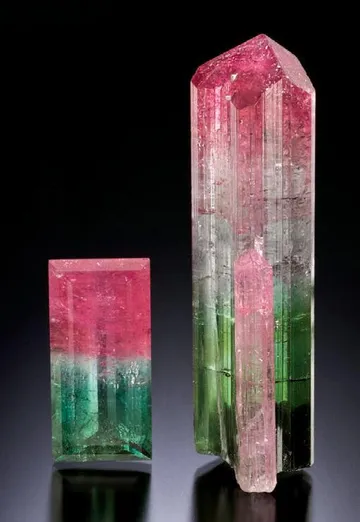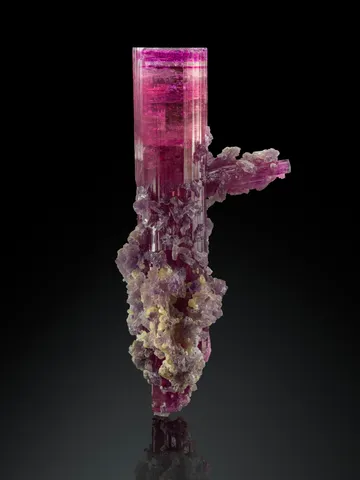
Cruzeiro Mine lepidolite - lavender lilac lithium mica from a famed Minas Gerais pegmatite, a locality signature prized with tourmaline for collectors.
Key facts
Lepidolite from the Cruzeiro Mine is not the principal commodity of this famous Minas Gerais pegmatite, but it is one of the locality’s most important visual and geological signatures. In the mine, purple to lilac lithium mica appears where collectors most want to see it: with albite, quartz, elbaite tourmaline, rubellite, and the iron-manganese coatings that miners have long read as signs that a gem pocket may be near. For a lepidolite collector, Cruzeiro material is appealing precisely because it belongs to that world-class tourmaline paragenesis rather than standing apart from it.

Photo: Rob Lavinsky, iRocks.com / Wikimedia Commons
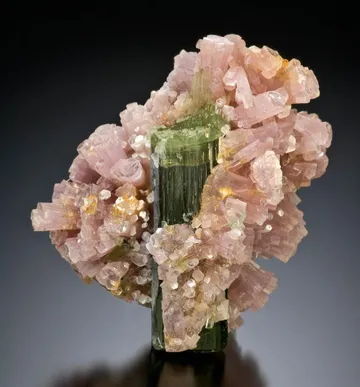
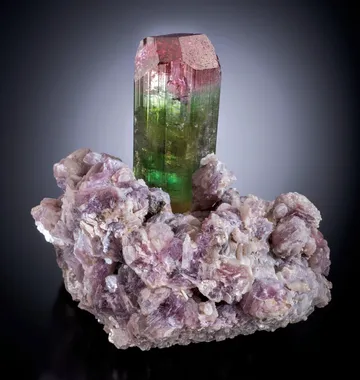
The best-known Cruzeiro lepidolite specimens are combination pieces. Thin, sparkling lilac scales may coat cleavelandite, dust quartz, wrap the base of green or bicolored elbaite, or form richer purple swaths around pink tourmaline. The color is typically lavender, lilac, pinkish purple, or silvery mauve rather than the saturated grape-purple seen in some massive lapidary lepidolite from other Brazilian deposits. Its beauty is subtler: a soft mica sheen, an intimate association with elbaite, and the unmistakable pegmatite-pocket texture of the Governador Valadares district.
Geologically, Cruzeiro is an LCT rare-element granitic pegmatite system enriched in lithium, boron, beryllium, niobium, tantalum, fluorine-bearing phases, and other incompatible elements. The mine lies near São José da Safira in the eastern Brazilian pegmatite province, where steep, lens-like pegmatite bodies intrude resistant quartzite. The internal zoning is classic for a large complex pegmatite: border and wall zones giving way inward to intermediate zones and quartz-core margins where albite, lithium mica, gem tourmaline, beryl, spodumene, amblygonite, garnet, cassiterite, and Nb-Ta minerals appear.

Photo: Rob Lavinsky, iRocks.com / Wikimedia Commons
For serious collectors, Cruzeiro lepidolite is judged less as a single-species mica and more as a locality witness. The strongest pieces show sharp association: lilac mica on cleavelandite, lepidolite partly wrapping elbaite, sparkling purple crystals on quartz, or rosettes and plates that make the tourmaline association feel geologically inevitable rather than decorative. Labels matter here. “Brazilian lepidolite” is common; “Cruzeiro Mine lepidolite with elbaite, albite, or quartz” is much more specific, and good examples carry the same pedigree aura that surrounds Cruzeiro tourmaline.
Search for specimens: View all lepidolite specimens from Cruzeiro Mine, Brazil
The Cruzeiro Mine is near São José da Safira, in the Governador Valadares region of Minas Gerais, Brazil. Published descriptions place it in the Safira pegmatite district of the eastern Brazilian pegmatite province, an area famous for gem-bearing pegmatites and especially for tourmaline. The mine is reached from the Governador Valadares region and sits high in the Serra do Cruzeiro or Serra Resplandecente landscape, where the pegmatites cut quartzite and schistose country rocks.
The deposit is a complex rare-element granitic pegmatite system of the LCT family. The principal pegmatite bodies are steep, subparallel, internally zoned dikes or lenses. Older descriptions emphasized three bodies, commonly called veins or pegmatites 01, 02, and 03; later field accounts of the modern operation describe four main pegmatites plus an intermediate 01½ body. The best-documented dimensions are impressive: pegmatite 01 is about 1,300 m long and up to 60 m wide, pegmatite 02 about 900 m long and around 20 m wide, and pegmatite 03 about 700 m long with a maximum outcrop width of roughly 8 m. Pegmatite 01½, discovered in the course of underground work, has been described by the mine operators as a particularly productive body and nicknamed “Umbezão,” “the big one.”
Cruzeiro’s internal zoning is central to understanding its lepidolite. The outer parts contain quartz, K-feldspar, muscovite, black schorl, blue beryl, garnet, and columbite-tantalite. Inward, the intermediate and quartz-core-margin zones carry the more evolved assemblage: lithium-bearing mica, cleavelandite, multicolored elbaite, pink beryl, spodumene, amblygonite, Mn-rich garnet, apatite, cassiterite, and tantalite-columbite. This is where lepidolite becomes both a specimen mineral and a practical field sign. Miners have watched for whitish albite, purple lepidolite, black tourmaline, and yellowish to brownish iron-manganese coatings as indicators that gem tourmaline pockets may be close.
The mining history has several overlapping chapters. A geological thesis records small-scale work for gem tourmaline beginning around 1914, while GIA’s field account states that the Cruzeiro-area deposit was discovered in 1915 and that the first mining lease was established in 1938. During World War II, mica became the strategic target. Contemporary and later accounts describe hundreds of men working the pegmatites for mica; one GIA account gives 800 men and an estimated 20 percent of global mica production, while an older Gems & Gemology article records 600–800 garimpeiros working more than 40 locations and says the Cruzeiro region supplied 12 percent of Brazil’s wartime mica production. The numbers differ by source and scope, but the message is the same: before Cruzeiro became a tourmaline legend, mica paid the bills.
Tourmaline mining rose after the mica market softened. José Neves and Antonio De Assis Neves, already involved in mica mining and trading, shifted toward tourmaline in the 1950s. Julius Sauer of Amsterdam Sauer later bought much of the production and then the mine, operating it for about fifteen years from the late 1960s into the early 1980s. José Neves and Antonio De Assis Neves bought the mine in 1982. After a family tragedy in January 1992, Beatrice Neves, Antonio de Neves Jr., and Douglas Williams Neves carried the operation forward. In 1996 the mine was restructured with more modern mining methods, and the current Cruzeiro Mine company presents itself as a traceable, mine-to-market gemstone operation managed by the Neves family.
Collecting access should be understood accordingly: Cruzeiro is an active commercial mine, not a casual public collecting site. Specimens on the market come through mine production, dealers, old collections, and estate material rather than open amateur collecting. The mine has worked underground galleries at multiple levels, with some galleries extending hundreds of meters, and it has also used open-pit mining in wider exposed parts of the veins. Modern work focuses on controlled extraction of tourmaline and associated gem minerals, with crystals removed from pocket walls and pegmatite zones using picks and hand tools where appropriate.
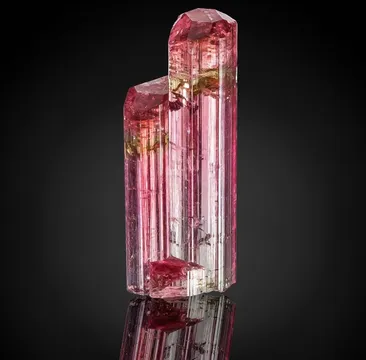
Notable finds are overwhelmingly tourmaline-centered, but lepidolite is often part of their mineralogical context. Cruzeiro has produced green, blue-green, indicolite-blue, pink, rubellite, bicolored, and watermelon tourmalines in great quantity. Older accounts mention green, blue-green, and pink crystals 10–25 cm long, red tourmalines 5 cm or more in length, and some stubby red crystals weighing several kilograms. The mine’s own recent presentation emphasizes its rubellite, including the 2012 “Legend Pocket.” For lepidolite collectors, the notable finds are the combination specimens preserved from these same pocket environments: elbaite partly wrapped in mica, albite coated with lepidolite, quartz carrying purple mica and green tourmaline, and cabinet-size assemblages where the lithium mica forms the purple ground from which the tourmalines emerge.
“Lepidolite” on Cruzeiro specimen labels should be read in the traditional collector’s sense: a lithium mica in the polylithionite-trilithionite series, rather than a single IMA-approved species name. In hand specimens it is usually best identified by its micaceous cleavage, pearly to sparkly luster, softness, lavender to pinkish-purple color, and association with the evolved inner pegmatite assemblage. Analytical work on Cruzeiro micas has distinguished light-colored muscovite, pink lithium-bearing mica described as possible lepidolite or lithium mica, and polylithionite; for collectors, the label “lepidolite” remains the familiar market and museum-language term for the purple lithium mica.
The habit is typically micaceous and aggregate-forming. Cruzeiro lepidolite may appear as thin platy scales, compact sparkly coatings, small rosettes, flaky masses, or crystalline crusts. A documented Mindat specimen shows pale lavender lepidolite rosettes formed as secondary growth on a dark green elbaite prism, with the largest rosette about 0.6 cm across and the elbaite measuring 3.2 cm tall. Another documented specimen shows a terminated rubellite crystal partially covered by lilac lepidolite crystals. Large masses occur, but the most desirable collector pieces tend to show visible crystal texture rather than a featureless purple mica lump.
Color ranges from pale lavender and silvery lilac to pinkish purple and richer purple. The color commonly looks best in contrast: against white cleavelandite, smoky or milky quartz, dark schorl, green elbaite, or pink rubellite. In the mine setting, purple lepidolite is important enough that field descriptions repeatedly mention it as an indicator mineral beside whitish albite and yellow-brown iron-manganese coatings. On display specimens, that same purple gives Cruzeiro combinations their distinctive palette: green tourmaline, white albite, glassy quartz, and lilac mica.
Associated minerals are a major part of the locality’s appeal. The most important are elbaite, rubellite, indicolite, schorl, albite var. cleavelandite, quartz, muscovite, K-feldspar, beryl including aquamarine and morganite, spodumene, amblygonite-montebrasite, garnet including spessartine-rich material, cassiterite, columbite-tantalite, tantalite, apatite, and rare phosphate or uranium-bearing secondary minerals recorded from the pegmatite. Fine lepidolite pieces should be evaluated as miniature pegmatite ecosystems: the species list is impressive, but the collector value comes from visible, balanced, undamaged association.
Typical size ranges vary widely by specimen type. Small cabinet and miniature pieces may carry millimeter-scale lepidolite rosettes or sparkling coatings on tourmaline. Cabinet specimens can show broad swaths of purple mica across quartz or albite, with tourmaline crystals from a few centimeters to much larger. Massive lepidolite-rich material from Brazil is not rare in a broad market sense, but Cruzeiro-attributed material with attractive elbaite, rubellite, cleavelandite, or quartz associations is much more selective.
The strongest quality factors are locality confidence, color, contrast, texture, association, and condition. A top Cruzeiro lepidolite specimen does not need a large isolated mica crystal to be important; it needs a convincing Cruzeiro story in mineral form. Look for clean lilac mica on undamaged albite, lepidolite wrapping but not smothering tourmaline, sharp elbaite terminations with mica at the base, sparkling mica on quartz, and natural pocket relationships with no suspicious glue lines or mismatched matrix. Lepidolite that merely sits as a purple mass without associated Cruzeiro minerals is less diagnostic and usually less compelling.
The main authenticity issue is locality attribution. Lepidolite is widespread in Brazilian pegmatites, and loose purple mica, polished material, and massive lapidary lepidolite are often sold with only broad country-level labels. A specimen claimed as Cruzeiro should ideally show a chain of provenance, an old dealer or collection label, or a mineral association consistent with the mine: elbaite, rubellite, cleavelandite, quartz, and the evolved LCT assemblage. A vague “Minas Gerais” label should not be upgraded to Cruzeiro simply because the color is attractive.
There are no well-established, widely documented fakes unique to Cruzeiro lepidolite in the way that some classic mineral localities have notorious fabricated specimen types. The broader mineral market, however, does have familiar problems that apply here: glued composites, repaired tourmalines, incorrect locality labels, resin-stabilized crumbly material, dyed purple mica or dyed look-alikes, and polished or carved material sold in language that implies a natural crystal specimen. With Cruzeiro combinations, examine the contact between lepidolite and tourmaline or albite under magnification. Natural mica should follow surfaces, crevices, and growth relationships; a crystal planted into mica or quartz may show glue, a gap, an unnatural pedestal, or a mismatch in weathering and luster.
Condition is the other major concern. Lepidolite is soft and cleaves readily, so edge bruising, rubbed high points, flaking, and small losses are common. Because the best pieces are combinations, the associated minerals bring their own vulnerabilities: elbaite terminations can be chipped or repaired; cleavelandite blades may be bruised; quartz may be contacted; mica can shed if handled carelessly. For cabinet display, avoid repeated handling and do not clean aggressively. Water and a soft brush may be safe for some specimens, but crumbly mica, repaired tourmaline, iron-stained pocket material, or older labels should be treated conservatively.
Rarity depends on the level of ambition. Purple lepidolite from Brazil is readily available. Cruzeiro lepidolite in combination with attractive elbaite, rubellite, indicolite, quartz, or cleavelandite is much more competitive, especially when the piece has older provenance from the 1960s–1980s tourmaline era or comes from a documented modern find. The finest combination specimens are collected as Cruzeiro tourmalines as much as lepidolites, so their prices are often driven by the tourmaline: color, luster, termination, transparency, and damage dominate the value equation.
Current market availability is intermittent but real. Cruzeiro remains an active commercial gemstone mine, and older specimens continue to circulate through dealers, auctions, and private collections. Fresh lepidolite-only specimens are not the mine’s headline product; the market usually sees lepidolite as an associate on tourmaline, albite, or quartz. Collectors who want a truly representative Cruzeiro lepidolite should therefore search in both directions: under “lepidolite” for mica-rich examples, and under “elbaite,” “rubellite,” or “tourmaline with lepidolite” for the best locality combinations.
In the Cruzeiro story, purple mica sits in the shadow of tourmaline, but it appears at exactly the moments when the mine feels most alive. GIA’s 2014 field team described huge pegmatites where large crystals seemed to be waiting in the walls, removed by picks and hand tools. In that underground language, purple lepidolite is not background color; it is a clue. Beside whitish albite and yellow-brown iron-manganese coatings, it is one of the signs miners read when they are closing in on a pocket.
One of the oldest stories attached to the district is a case of mistaken identity. Portuguese explorers searched for emeralds in Brazil as early as the sixteenth century, and later green stones from the Minas Gerais region were again taken for emerald. The green was tourmaline. Even São José da Safira carries the echo of that confusion: the town’s name refers to sapphire, probably because blue tourmalines were also mistaken for something else. Cruzeiro’s modern fame rests on correct identification, but its mythology begins with the repeated human urge to name a gem before understanding it.
World War II changed the mine’s purpose. The mica that collectors now treat as an accessory mineral became a strategic material. Accounts differ in exact production figures, but they agree on the scale: hundreds of men worked the pegmatites, and Cruzeiro became a significant wartime mica source. In one later field account, an American company employed 800 men and produced an estimated 20 percent of global mica production. An older Gems & Gemology account gives 600–800 garimpeiros working more than 40 pegmatite locations and says the Cruzeiro region supplied 12 percent of Brazil’s wartime mica production. During that period, mica mattered more than the colored crystals that would later make the mine famous.
The tourmaline chapter began humbly. José Neves and Antonio De Assis Neves had been mining and trading mica, carrying it to Governador Valadares, and buying production from other miners. When the mica market softened, they turned more seriously to tourmaline. At first they wanted only large, clean crystals; material that might interest cutters or collectors today could be thrown into waste piles. Then Julius Sauer of Amsterdam Sauer entered the story, buying much of the production and then the mine itself. Sauer operated Cruzeiro for about fifteen years, from the late 1960s into the early 1980s, before offering it to José Neves.
The purchase was a gamble. José Neves sold everything he owned and invited Antonio to join him. Sauer warned him not to take too many risks because gemstone mining never promises what it will give. One month later, José hit a large deposit of pink tourmaline. Soon the mine was producing red and pink, green, blue, and bicolored tourmaline, including 26 kilos of very clean rubellite. For a collector holding a Cruzeiro combination specimen, the lepidolite around the tourmaline is part of that same gamble: the purple lithium mica marks the evolved zone where the mine’s greatest surprises were hiding.
The hardest chapter came in January 1992. Both Neves brothers died in a plane crash in Brazil. Douglas Williams Neves, still a teenager, had already spent time at the mine with his father, using a pick to mine tourmaline, washing and cleaning what he found, and selling the stones directly back to him. After the crash, Douglas, his aunt Beatrice Neves, and Antonio de Neves Jr. took over. The tragedy also took Douglas’s mother and another aunt. The modern Cruzeiro operation, with its global gemstone supply chain and formal mine-to-market identity, grew from that family rupture.
GIA’s field report preserves a more intimate scene. Douglas Neves and Beatrice described being ready to come to the mine “24 hours a day” if an important pocket was found. They had experienced major discoveries thousands of times, yet still compared the feeling to a child receiving a best present or a parent giving birth. Their first impulse, they said, was to keep the tourmaline and never sell it; then business reality took over. If the pocket was important enough, they might work all night removing the crystals.
A visitor’s route into the mine reinforces the scale. The mine is roughly 36 miles northwest of Governador Valadares and about six miles from São José da Safira, high on Serra Resplandecente do Cruzeiro at 4,593 feet. Underground, galleries run at different depths, and one has been described as extending 500 m. At the deepest mining area visited by GIA, the pegmatite was 32 m wide and more than one kilometer long. This is not a delicate little pocket mine; it is a large, living pegmatite system, and lepidolite is one of the minerals that tells miners when they are in the right part of it.