






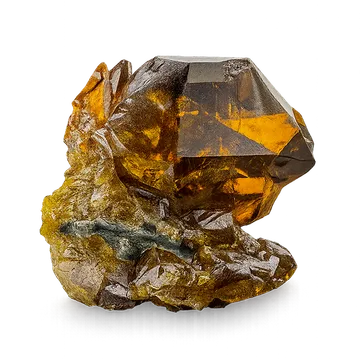
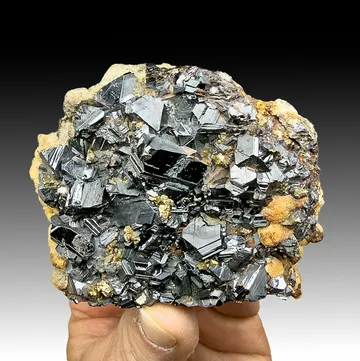
Naica Mine, Chihuahua, Mexico - famed for black, lustrous sphalerite crystals (often twinned) with galena, pyrite, and fluorite, a key locality for collectors.
Key facts
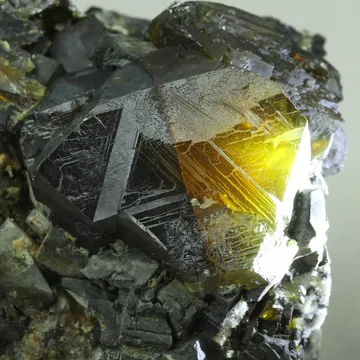
Naica sphalerite is classic Mexican sulfide material: sharp, lustrous, iron-rich black to very dark brown ZnS, usually seen as twinned crystals in the company of galena, pyrite, calcite, quartz, and the pale green to colorless fluorite that made the mine famous among specimen collectors. It is not the transparent, honey-red cutting sphalerite of Spain, nor the amber calcite-sphalerite association of Elmwood; Naica’s best sphalerite is darker, more architectural, and often strongly sculptural, with stepped or geometric growth on glossy faces.

Photo: Wikimedia Commons
The locality’s identity is inseparable from its geology. Naica is a carbonate-replacement and skarn-related Ag-Pb-Zn-Cu system in Cretaceous limestone, fed and localized by felsic intrusions and structural pathways. In practical collector terms, that means sphalerite did not form as an isolated curiosity: it belongs to a hard, vuggy, polymetallic assemblage where sulfides, calc-silicates, fluorite, quartz, calcite, anhydrite, and gypsum record a long-lived hydrothermal system.
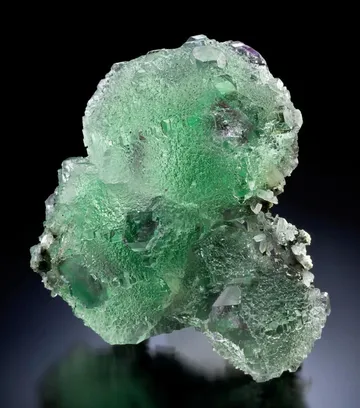
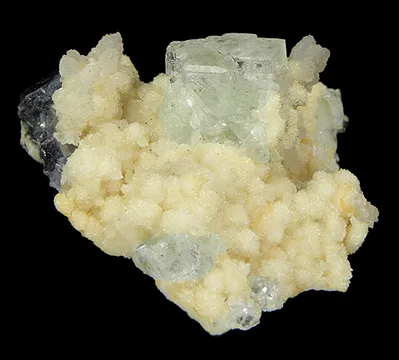
The mine’s worldwide fame rests on the giant selenite caves, especially the Cave of Crystals discovered in 2000, but the same mining system also supplied old-time cabinet sulfide specimens. A good Naica sphalerite has a recognizable look: black, lustrous, twinned crystals; crisp terminations; an association with bright galena or pyrite; and, in the most desirable combinations, green or colorless fluorite perched among the dark sulfides. The contrast is what collectors remember: black sphalerite as the anchor, galena as the metallic foil, pyrite as sparkle, calcite as a pale accent, and fluorite as the transparent architectural centerpiece.

Photo: Wikimedia Commons
Search for specimens: View all sphalerite specimens from Naica Mine, Mexico
Naica lies at the town of Naica in Saucillo Municipality, Chihuahua, in the Sierra de Naica south-southeast of Chihuahua City. The mine is a large underground polymetallic system best described as a limestone-hosted manto-and-chimney replacement deposit with important skarn development. The principal ore metals were lead, zinc, silver, and lesser copper, with tungsten also noted historically through scheelite-bearing zones.
The geological frame is a Cretaceous carbonate sequence, chiefly limestone with subordinate marl and dolomite. Hydrothermally altered felsic dikes and sills cut the carbonate rocks and helped localize the mineralization. Classic Naica descriptions distinguish “mantos” and “chimneys,” though local usage can be confusing: skarn-rich, calc-silicate bodies have often been called mantos, while massive sulfide replacements have been called chimneys even where geometry is not strictly chimney-like. For collectors, the important point is that sphalerite belongs to the sulfide stage of a replacement-skarn system rather than to a simple open vein.
The ore assemblage is dominated by pyrite, galena, and sphalerite, with lesser chalcopyrite, arsenopyrite, pyrrhotite, molybdenite, and several uncommon sulfosalts reported from the district. Fluorite, quartz, adularia, and calcite occur both with sulfides and as crystals in vugs within sulfide and silicate ore. This explains the familiar specimen combinations: black sphalerite with galena and pyrite; sphalerite carrying calcite; and, at its most aesthetically Mexican, sphalerite associated with green to colorless fluorite.
Naica’s mining history began with discovery in 1794 and grew from small-scale workings into one of Mexico’s important lead-zinc-silver mines. Formal modern exploitation began in the early twentieth century, and Peñoles later controlled the mine. The mine was significant enough that Naica specimens circulated internationally for decades, especially fluorite-galena-sphalerite combinations and black twinned sphalerite groups.
The modern collecting situation is constrained by industrial mining and water. Naica is not a public collecting locality. The mine was affected by an extraordinary inflow of water on January 1, 2015, and Peñoles suspended operations indefinitely later that year after prolonged dewatering efforts failed to restore the mine to workable levels. As a result, contemporary specimen supply is mostly from older collections, dealer inventories, and occasional resales rather than from steady new production.
The locality’s most famous “finds” are not sphalerite pockets but gypsum caves. The Cave of Swords was discovered in the early twentieth century and produced swordlike selenite crystals; the Cave of Crystals, encountered in 2000 at roughly 300 meters depth, held giant gypsum crystals on a scale unmatched in normal collector experience. Those caves matter to sphalerite collectors because they give Naica a mythic status, but they should not be confused with the ordinary specimen-producing sulfide pockets and vugs from which sphalerite, fluorite, galena, pyrite, quartz, and calcite entered the mineral market.
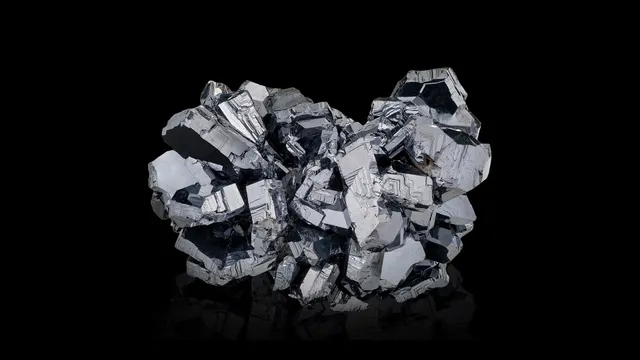
Naica sphalerite is typically dark and iron-rich in appearance: black, jet-black, or very dark brown, with a bright resinous-to-submetallic luster on fresh faces. Individual crystals are commonly described as twinned, and good examples show sharp modified forms rather than crude masses. Stepped growth, skeletal-looking surface texture, and geometric face markings are seen on better specimens.
The best stand-alone sphalerite pieces are small cabinet specimens with prominent twinned crystals, often in the 1 to 4 cm range. Verified dealer and museum examples include twinned crystals around 1 cm on calcite-rich matrix, sharp black crystals around 2.2 cm on small cabinet pieces, and old material with dominant twinned crystals around 4 cm. Miniature to small-cabinet specimens are the normal market scale; large cabinet plates with undamaged, well-isolated sphalerite crystals are much less common.
Associations are central to the locality’s appeal. Calcite is common, sometimes as white or pale crystals on and around black sphalerite. Quartz may form a crystallized matrix, with sphalerite scattered across it and minor chalcopyrite or galena present. Galena is a frequent partner and may appear as modified cuboctahedral crystals or twinned metallic forms. Pyrite adds brassy sparkle and contrast. Fluorite is the prestige association: green, colorless, or color-zoned crystals with black sphalerite and metallic sulfides form the most immediately recognizable Naica combinations.
Quality is judged first by crystal sharpness and luster. A Naica sphalerite with dull, abraded, or massive surfaces is much less desirable than one with crisp twinned crystals and reflective faces. Second is composition: sphalerite with attractive calcite is classic, but sphalerite with fluorite, galena, and pyrite has stronger locality character. Third is condition. These are sulfide specimens from a working underground mine, and contact points, cleaved backs, edge bruising, and pocket-wall damage are common. A specimen that is clean on the display face but contacted on the reverse can still be a strong collector piece if the principal sphalerite crystals are intact.
Color is not usually the premium factor here. Naica sphalerite is admired for black luster and form, not for transparency or gem color. If a specimen is being promoted primarily as bright orange, red, or transparent gem sphalerite from Naica, the locality should be examined critically and compared with Spanish, Bulgarian, Chinese, and other better-known gem sphalerite sources.
Naica sphalerite is available, but the best material is largely old-stock. Since mine operations were suspended after the 2015 flooding, collectors should expect most good pieces to come with older dealer labels, collection provenance, or auction history rather than current mine-run labels. “Old material,” “ex collection,” and 1970s–1990s style labels are believable for this locality, but labels should still be read carefully because “Naica” is sometimes used loosely for the district, for the town, or for neighboring named workings.
The most desirable specimens combine three traits: sharp black twinned sphalerite, good display orientation, and a classic association such as fluorite, galena, pyrite, quartz, or calcite. A single black sphalerite twin can be very appealing if it is lustrous and undamaged; a mixed Naica plate can be more valuable if fluorite is glassy, color-zoned, or well placed. Calcite that fluoresces under ultraviolet light is a nice bonus on some Naica pieces, but it should not substitute for basic specimen quality.
Condition issues are predictable. Sphalerite has excellent cleavage and moderate hardness, so crystal edges and protruding corners are vulnerable. Galena associations add weight and further cleavage sensitivity. Pyrite is generally stable in many Naica specimens, but any sulfide-rich piece should be stored dry and monitored for oxidation, especially if it came from humid storage. Calcite can be bruised, etched, or cleaved; fluorite can chip along edges and corners. On Naica combinations, inspect high points under a hand lens rather than judging only from the glitter of the whole piece.
No widely cited Naica-specific sphalerite treatment or fake problem defines the locality. The main authenticity concerns are misattribution and overly broad labeling. Black twinned sphalerite with calcite, galena, pyrite, quartz, and green or colorless fluorite is consistent with Naica, but similar dark sphalerite associations occur at many polymetallic deposits. A credible Naica piece should have a plausible assemblage, an old or dealer-recognizable label, or a provenance trail. Be especially cautious with specimens sold only as “Naica Cave” material: the famous caves are gypsum environments, not a normal collecting source for sphalerite specimens.
In the market, representative Naica sphalerite specimens can still be modestly priced, particularly small cabinet pieces with black crystals on calcite or quartz. Fine twinned crystals, strong fluorite associations, and pieces with old collection provenance are more competitive. The locality name adds interest, but sphalerite quality still rules: sharpness, luster, aesthetics, and damage determine whether a piece is merely a Naica label or a serious Naica specimen.
Naica is one of those localities where the orebody and the legend are braided together underground. The mine worked lead, zinc, and silver from limestone; the collectors remember fluorite, galena, sphalerite, pyrite, calcite, and quartz; the wider public remembers a chamber so hostile and beautiful that it seems fictional.
The first famous chapter came with the Cave of Swords, discovered in the early twentieth century. It lay above the later Cave of Crystals and held swordlike gypsum crystals large enough to make a sensation in their own right. Many Naica selenites in old collections were long attributed broadly or romantically to the Cave of Swords, but the mine contained multiple crystal-bearing cavities, and labels have not always kept pace with the complicated underground geography.
The great modern episode came in April 2000. Deep in the Naica Mine, miners driving new workings broke into a space no collector cabinet could prepare them for: a cavern filled with immense, translucent gypsum beams. Accounts differ on the names of the discovering miners, but the moment itself is consistent across the serious literature and reporting: a new tunnel, a deep level, a void in limestone, and crystals so large they turned a mine into a geological cathedral.
The chamber was roughly the size of a small room rather than a vast cavern, but scale behaved strangely inside it. The crystals were not hand specimens; they were beams, columns, and blades. Reports describe crystals up to about 11 meters long and weighing tens of tons. Juan Manuel García-Ruiz famously called the place the “Sistine Chapel of crystals,” a phrase that stuck because ordinary mineral language fails there.
The beauty had a price. Heat and humidity made the cave nearly uninhabitable. Explorers described entering a blast furnace. One early visitor, photographer Richard Fisher, recalled that within seconds clothing became saturated with sweat and that awe could turn quickly to panic. The door might be only 30 or 40 feet away, but in that atmosphere distance became treacherous. Without protection, time inside was measured in minutes; with ice-cooled suits and breathing equipment, scientific teams could push the limit, but never casually.
The scientific explanation is as memorable as the discovery. Naica’s giant gypsum grew underwater in a hydrothermal system held near the boundary where anhydrite gives way to gypsum. Above about 58 °C, anhydrite is favored; below it, gypsum becomes stable. The cave water sat in the narrow thermal window where calcium and sulfate could feed extraordinarily slow, steady crystal growth. The crystals were giants not because they grew fast, but because the environment stayed improbably consistent.
When pumping kept the mine dry, humans could enter. When pumping stopped, the caves could flood again. That is not merely a preservation problem; it is part of the cave’s life. The water that excludes people is also the medium in which the crystals formed and the environment that protects them from the damaging conditions of air exposure. For collectors, the lesson is humbling: the same mine that produced hand-sized sphalerite twins also produced crystals too large and too fragile in context to belong to the specimen trade at all.


.jpg)