Silver Bell Mine, USA — notable Arizona oxide locality known for rosasite, wulfenite, smithsonite, azurite and malachite; prized pockety specimens.
Key facts
For collectors, the name on this EarthWonders locality is best understood as the classic Silver Bill Mine material from the Costello Mine group near Gleeson, Cochise County, Arizona—a locality that is often confused in labels and listings with the quite different Silver Bell copper mine of Pima County. The specimens represented here are not products of the large porphyry-copper operation in the Silver Bell Mountains; they are the small, high-grade oxidized lead-zinc-silver-copper mine on Gleeson Ridge that became a minor Arizona legend for rosasite, wulfenite, smithsonite, aurichalcite, malachite, and azurite.
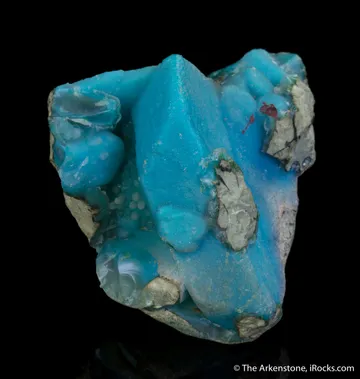
The collecting importance of this mine lies in the chemistry of an intensely oxidized carbonate-replacement system. Ore fluids and later weathering worked through Naco Group limestone near quartz monzonite porphyry, with faults, fractures, dikes, and limestone-intrusive contacts controlling small stringers, pockets, and replacement bodies. That setting made Silver Bill a pockety mine rather than a bulk specimen factory: the best pieces are compact, richly colored, and highly textured, with blue to turquoise rosasite in rounded botryoidal aggregates, powder-blue rosasite replacing earlier green malachite and blue azurite forms, butterscotch-yellow wulfenite, pale smithsonite, and delicate aurichalcite. The finest specimens have the look collectors want from old Arizona oxide zones—limonite-stained matrix, strong color contrast, and visible paragenetic history preserved in miniature.
Regional View
Country View
Silver Bill is also historically interesting because it belongs to the Courtland-Gleeson, or Turquoise, mining district east of Tombstone, a landscape of old shafts, connected workings, patented claims, and small mines that shifted from silver-lead-zinc production into collector-mineral fame after the commercial ore was gone. The mine’s 271-foot inclined shaft, its connection at the 200-foot level with the Mystery workings, and its long intermittent life from the 1890s into the late 1970s all help explain why old labels, dealer labels, and field labels can vary in wording. For specimen purposes, the safest interpretation is to read “Silver Bell” here as the EarthWonders locality label for the Silver Bill/Mystery mine system near Gleeson.

Photo: Rob Lavinsky, iRocks.com / Wikimedia Commons

Search for specimens: View all specimens from Silver Bell Mine, USA
The specimen locality behind these listings is the Silver Bill Mine of the Costello Mine group, about three-quarters of a mile northeast of the former town of Gleeson and roughly 25 kilometers east of Tombstone in Cochise County, Arizona. The workings are on the west slope of Gleeson Ridge, immediately north of the Tom Scott Mine and about 100 yards southeast of the Defiance Mine. This is not a porphyry-copper collector locality in the Pima County sense; it is a small underground lead-zinc-silver-copper-gold-molybdenum-manganese occurrence where oxidized ore pockets in limestone produced specimen minerals far out of proportion to the mine’s economic size.
Geologically, the mine sits in Pennsylvanian-Permian Naco Group limestone near a quartz monzonite porphyry contact, with the Gleeson Quartz Monzonite and Sugarloaf Quartz Latite Porphyry recorded as associated rock units. Mineralization took the form of irregular replacement bodies, stringers, and pockets of oxidized base-metal sulfides, with faults, fractures, dikes, bedding, and the limestone-intrusive contact acting as the main controls. The ore zone occupied a relatively elevated block bounded by subparallel faults; descriptions of the workings note a block only about 50 feet wide at the surface, widening to about 80 feet on the 200-foot level. These dimensions are important to collectors because they help explain the pockety, small-scale nature of good specimens: the mine did not yield giant open-space crystal chambers, but rather concentrated local seams and vugs in altered carbonate rock.
The primary ore suite included galena, sphalerite, chalcopyrite, and pyrite, with silver represented in part by chlorargyrite and by argentiferous lead ore. Oxidation overprinted that suite into the minerals collectors know: malachite, azurite, rosasite, smithsonite, aurichalcite, cerussite, anglesite, wulfenite, hemimorphite, jarosite, calcite, aragonite, iron oxides, and manganese oxides. The richest specimen character comes from that late supergene stage, where meteoric water and groundwater moved along post-ore structures and reworked copper, zinc, lead, carbonate, sulfate, and molybdate components into bright secondary minerals.
The mine was discovered around 1890 and produced intermittently from 1893 to 1978. It began with rich oxidized silver-lead ore mined from shallow workings in the 1880s and 1890s, then developed into a more substantial underground operation with a 271-foot inclined shaft, several hundred feet of drifts, winzes, and stopes, and a connection to the Mystery Mine at the 200-foot level. Production figures are fragmentary for the earliest years, but the documented periods 1922-1930 and 1938-1941 yielded 6,570 tons, and district accounts record periods when as much as 1,900 tons of ore per month averaging about 10 ounces of silver per ton went to the El Paso smelter. Gleeson Heights Minerals Co. operated the property late in its life, and the Silver Bill is described as the last major operational mine in the district, closing in 1978.
Specimen production continued to matter after mining ended. Old material entered collections from the Silver Bill-Mystery system, and later field-collected pieces—particularly rosasite and wulfenite—became cherished examples of an Arizona locality that is well known among specialists but far less abundant on the market than Red Cloud, Rowley, 79 Mine, or Tiger material. The most desirable pieces are those that clearly show the mine’s oxidation sequence: rosasite balls perched on smithsonite or goethite; powder-blue rosasite coating malachite pseudomorphs after azurite blades; yellow wulfenite plates with calcite, allophane, chrysocolla, or malachite; and miniature vugs that combine strong color with an unmistakably old Southwestern matrix.
Collecting access today should be treated as closed unless permission has been specifically secured. The Gleeson area contains patented mining claims, old workings, private holdings, residential development, unstable underground openings, and historically connected mine systems. Material now available to collectors comes overwhelmingly from old collections, past field collecting, dealer inventories, and specimens recovered when access was possible—not from routine modern collecting.
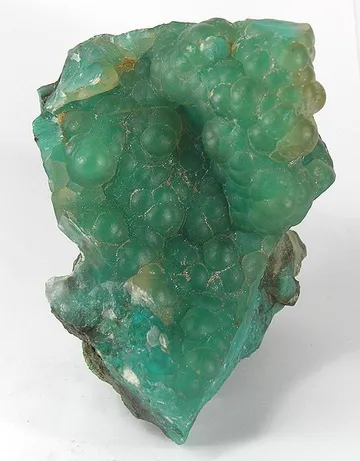
Rosasite is the signature collector mineral of the Silver Bill/Silver Bell-labelled material: it occurs as turquoise to robin’s-egg-blue spheroidal and botryoidal aggregates, as richer blue-green crusts, and most distinctively as powder-blue coatings and pseudomorphs over malachite after earlier azurite. Documented pieces range from thumbnail and miniature specimens to cabinet examples around 8.5 centimeters, with individual rounded aggregates reaching about 1 centimeter on some specimens; associations include smithsonite, goethite, aurichalcite, malachite, azurite, calcite, and oxidized limonitic matrix. Good pieces here are judged by saturation and texture—complete, unabraded botryoids with velvety or granular surfaces, clear separation from pale smithsonite or dark iron oxides, and any preserved pseudomorphic blade structure are much more desirable than flat blue-green coatings with weak relief.
Wulfenite from the Silver Bill/Silver Bell-labelled locality is much scarcer than the mine’s rosasite but has a loyal following because it represents one of Arizona’s smaller, less commercial wulfenite sources. Specimens are reported as translucent to butterscotch-yellow, typically lustrous, with small tabular crystals; known associations include calcite, allophane, chrysocolla, malachite, and locally the broader oxidized lead-zinc-copper assemblage of the Silver Bill-Mystery workings. The best examples are crisp, isolated yellow plates or sparkling groups that remain undamaged on limonite-stained matrix, especially when accompanied by contrasting calcite or secondary copper minerals; ordinary examples are small, incomplete, or visually lost in brown gossan.
Malachite at Silver Bill is important less as a stand-alone show mineral than as a key stage in the mine’s oxidation sequence: it formed by redeposition of copper in strongly oxidized limestone replacement ore and in some cases replaced earlier azurite before being coated or pseudomorphed by rosasite. It appears as green coatings, botryoidal crusts, and pseudomorphic forms associated with azurite, rosasite, wulfenite, chrysocolla, calcite, allophane, and iron oxides. The most collectible malachite-bearing Silver Bill pieces are those that reveal the succession azurite to malachite to rosasite, where green malachite can be seen beneath pale blue rosasite on bladed forms; plain green crusts, while authentic, are comparatively common and less distinctive.
Azurite from the Silver Bill/Silver Bell-labelled locality is documented from the oxidized ore bodies and is most prized when its original crystal form survives as a ghost through later alteration. In the classic pseudomorph specimens, azurite blades or blocky crystals were altered first to malachite and then coated or replaced by pale powder-blue rosasite, preserving sharp or ribbed bladed forms inside vugs in quartz-rich, limonitic, carbonate matrix. Fine azurite-related specimens here are therefore valued for form rather than for deep-blue pristine azurite faces: the collector wants visible pseudomorphic architecture, good contrast between blue-green rosasite and underlying malachite, and enough matrix to make the sequence readable.
Other documented minerals from the Silver Bill Mine include anglesite, aragonite, aurichalcite, calcite, cerussite, chalcopyrite, chlorargyrite, chrysocolla, coronadite, copper-bearing fraipontite, galena, hematite, hemimorphite, jarosite, kaolinite, limonite, plattnerite, pyrite, pyrolusite, sauconite, smithsonite, and tenorite. The noteworthy rarities for advanced collectors are copper-bearing fraipontite and sauconite from the Defiance-Silver Bill mine system, as well as good old smithsonite-rosasite combinations and aurichalcite specimens from the connected Silver Bill-Mystery environment. No approved modern mineral species is best treated here as a Silver Bill type-locality mineral, but the mine is a cited locality in the Arizona literature for several secondary lead-zinc-copper species.
The first authenticity issue is locality name discipline. “Silver Bell Mine” and “Silver Bill Mine” are easy to confuse, and the confusion is not trivial: Silver Bell in Pima County is a large porphyry-copper mine in the Silver Bell Mountains, whereas Silver Bill near Gleeson in Cochise County is the small lead-zinc-silver-copper mine that produced the rosasite, wulfenite, malachite, and azurite specimens represented here. Labels that say only “Silver Bell, Arizona” should be checked carefully against the mineral assemblage. Rosasite on smithsonite, rosasite after malachite after azurite, and small butterscotch wulfenite from the Costello/Mystery system point toward Silver Bill; porphyry copper ore suites, chalcocite blankets, or Pima County mine labels point toward the true Silver Bell district.
Rosasite is the mineral most likely to be over-attributed. Arizona has several excellent rosasite localities, including the 79 Mine, Silver Hill, Bisbee-area mines, and the Silver Bill/Mystery system. Silver Bill pieces commonly show bright turquoise to powder-blue botryoids or pseudomorphs on limonitic or pale carbonate-rich matrix, often with smithsonite or malachite. A generic blue botryoidal rosasite with no old label should not be casually assigned here unless the matrix, associations, provenance, and dealer history support it.
Condition is central. Rosasite aggregates can be abraded on exposed high points, and the powdery pseudomorphic material is easily dulled by rubbing. Wulfenite plates are small and fragile; even slight edge chipping changes the value of a thumbnail. Aurichalcite needles, hemimorphite sprays, and soft alteration minerals on Silver Bill matrix should be handled with tweezers at the matrix, not by the crystals. Avoid washing old Silver Bill secondary-mineral specimens: porous limonite, smithsonite crusts, clayey kaolinite, and delicate rosasite surfaces can trap moisture or lose visual crispness.
No strong, locality-specific fluorescence is a major collecting feature here. The value lies instead in paragenesis, color, and provenance. Old collection labels—especially those tying material to the Mystery Tunnel, Costello Mine group, Gleeson, or collectors active in southern Arizona—add real value because much of the best material is no longer being freshly produced. Current market availability is intermittent: small rosasite specimens and occasional wulfenites surface from collections, but top pseudomorphs, large bright botryoidal rosasite plates, and sharp wulfenite groups are scarce and should be treated as old Arizona classics rather than routine stock.
The most memorable Silver Bill story is a story of underground connection. The mine was not an isolated hole in the hillside but part of the Costello group’s compact tangle of workings on Gleeson Ridge. A 271-foot inclined shaft went down into oxidized lead-silver-zinc ore, with drifts, winzes, and stopes following the favorable ground. At the 200-foot level, the Silver Bill workings connected with the nearby Mystery Mine. That connection matters to collectors because some old specimens carry “Mystery Tunnel,” “Mystery Mine,” “Silver Bill,” or broader Costello group labels, yet they may have come from the same physical mineralized system.
At its productive height, the mine was not just a quaint specimen source. Ore was shipped in meaningful quantities: accounts describe as much as 1,900 tons per month going to the El Paso smelter, averaging about 10 ounces of silver per ton. For a small underground mine in a rugged Arizona district, those numbers explain the extent of the workings and the persistence of mining into the twentieth century. They also explain why later collectors could still find mineralized pockets and dumps: Silver Bill was not a single prospect pit, but a mine that had moved a substantial amount of oxidized carbonate ore before the collector minerals became its lasting fame.
One of the best collector vignettes comes from a rosasite-smithsonite specimen formerly in the Harold Urish collection. The accompanying note recorded that Urish self-collected the piece in 1988 through the so-called Mystery Tunnel, when he was approaching 70 years old. The specimen itself is exactly the kind of object that makes that story believable and desirable: bright blue rosasite balls on a sparkling white microcrystalline smithsonite matrix, a pocket-scale survivor from a mine that had closed commercially a decade earlier.
There is also a post-mining wulfenite story. Modern dealer records note that good wulfenite specimens were found after commercial mining had ceased, including material field collected by Ed Pedersen. These are not the large blazing plates of Red Cloud or the orange showpieces of the 79 Mine; their charm is more intimate—small translucent, butterscotch-yellow crystals from a locality better known for blue rosasite. That contrast gives Silver Bill wulfenite its appeal: it is a connoisseur’s Arizona wulfenite, not an obvious trophy from a famous wulfenite mine.