A collector's guide to San Manuel Mine, USA: its geology, mining history and notable minerals, illustrated with the 49 specimens documented from this locality on EarthWonders.
Key facts
San Manuel is one of those paradoxical Arizona localities: an industrial giant that remained oddly elusive to specimen collectors. The mine lies near Mammoth and the town of San Manuel in Pinal County, in the Old Hat Mining District, only about a mile from the famous Tiger-Mammoth-Saint Anthony specimen ground. Its fame in economic geology rests on the San Manuel-Kalamazoo porphyry copper system, a Laramide copper-molybdenum deposit hosted chiefly in and around San Manuel porphyry and Precambrian Oracle Granite, later faulted, tilted, oxidized, enriched, and mined on a scale that dwarfs most collectible-mineral localities. To collectors, however, its importance is more selective: San Manuel produced relatively few specimens, but some of those few — crystallized azurite, delicate malachite, drusy chrysocolla-quartz plates, native copper with cuprite, and surprisingly good pyrite — are major Arizona pieces when the locality is correct.
Regional View
Country View
The deposit is historically important because the San Manuel and Kalamazoo orebodies helped shape the modern exploration model for porphyry copper deposits. J. David Lowell’s interpretation of a displaced, tilted porphyry system led to the recognition of the concealed Kalamazoo orebody west of the mine, and Lowell’s later work with J. M. Guilbert became a cornerstone of porphyry-copper zoning models. For mineral collectors, the same geology explains the specimen suite: hypogene pyrite, chalcopyrite, chalcocite, molybdenite and related sulfides below; an oxidized zone above, rich in chrysocolla, malachite, azurite, cuprite, tenorite, atacamite, and native copper; and post-mining sulfate minerals in humid underground workings, including the type-locality mineral jurbanite.

Photo: Arizona Geological Survey
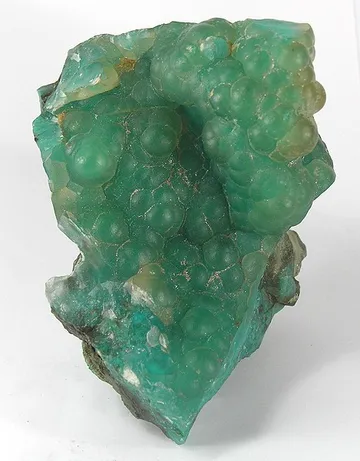
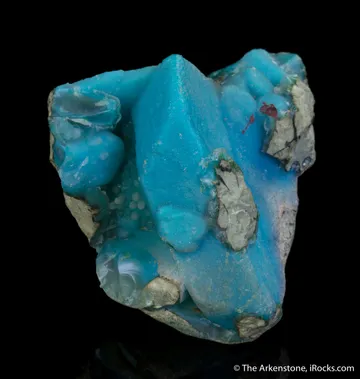
The best San Manuel pieces have a look that is easy to underestimate until one sees a fine example in hand. The chrysocolla is often rich sky-blue rather than merely greenish-blue, and when it is covered by sparkling drusy quartz it has the bright, sugary flash associated with the classic Arizona oxide mines. Malachite can occur as mint-green, radiating, acicular balls or as pseudomorphs after earlier barite or azurite. Native copper from the mine is prized when it is sculptural, dendritic, or spinel-law twinned, especially with a cuprite patina. Pyrite specimens tend to be modest in number but much better than the locality’s broad industrial reputation would suggest, with well-formed cubes recovered from specific underground levels.
Search for specimens: View all specimens from San Manuel Mine, USA
San Manuel is a porphyry copper-molybdenum deposit of the southeastern Arizona copper province. The San Manuel-Kalamazoo system is centered on Laramide porphyry intrusion into older crystalline rocks, with mineralization distributed through altered monzonitic to quartz monzonitic rocks and adjacent Oracle Granite. The primary ore minerals were dominated by disseminated pyrite and chalcopyrite with chalcocite, bornite, molybdenite, silver and gold values. Above the deeper sulfide ore, oxidation and supergene enrichment produced the colorful copper minerals of most interest to collectors: chrysocolla, malachite, azurite, cuprite, tenorite, atacamite, native copper, and related silicates.
Structurally, the locality is inseparable from the Kalamazoo story. The San Manuel orebody represents the exposed, oxidized part of the system, while the Kalamazoo orebody is a displaced concealed segment that tops out roughly 2,600 feet below the surface. The San Manuel fault separated the two principal fragments of the original porphyry system, and later work on tilting and displacement made the deposit a textbook case in porphyry-copper exploration. The orebodies and their alteration zones were important because they showed that a seemingly incomplete porphyry system could be reconstructed in three dimensions, then searched for along its displaced continuation.
The early surface showing at Red Hill was not impressive enough to announce a giant mine. Prospectors noticed green copper staining on the south slope of Red Hill around the time of the nearby Mammoth discovery in 1879, and shallow pits probably date to the early 1880s. For decades, the ground remained tantalizing but disappointing. The original San Manuel Claims No. 1 through No. 5 were staked in July 1925 by Anselmo Laguna, and interests were later acquired by James Douglas, Burns Giffin, Victor Erickson, and Henry Nichols. The property expanded to 21 claims before wartime strategic-metal interest and federal drilling helped draw serious attention to the concealed low-grade copper system.
Magma Copper and its principal owner, Newmont Mining, drilled through gravels and conglomerates in the 1940s and by 1948 had outlined an ore reserve reported at 367 million tons grading 0.785% copper. Development followed on a scale suitable for a giant low-grade deposit rather than a small high-grade mine. In 1952, federal financing helped Magma Copper build the mine, plant, railroad connections, and the planned community of San Manuel. Underground block-caving began in the mid-1950s, with commercial production following in 1956. By 1972, the mill was processing more than 60,000 tons of ore per day.
The mining method explains why San Manuel specimens are scarce. Much of the deeper sulfide ore was mined by block caving: undercut the ore, let the mass fracture and collapse, then draw broken ore from below. It is efficient for enormous low-grade orebodies, but terrible for selective specimen recovery. Crystal-lined cavities and delicate copper-oxide pockets that might have been collected in a stope mine were instead broken, mixed, buried, or sent to the mill. The oxide zone, open-pit work, and certain underground panels and levels therefore supplied a disproportionate share of the collectible material.
Open-pit mining began in 1985 to exploit shallower oxide ore, and by the 1990s the operation included an open pit, solvent-extraction/electrowinning facilities, in-situ leaching, and the underground sulfide mine. Underground mining ceased in August 1999 during a period of low copper prices, and BHP announced closure of the remaining in-situ leach operations in January 2002. By the time mining stopped, San Manuel had produced more than 700 million tons of ore hoisted from underground workings, and published mineral-collecting accounts place total copper output at more than 4.6 million tons.
Collecting access today should be regarded as closed. The property is a large industrial and reclamation site, not a public collecting locality. As of September 2026, BHP and Faraday Copper had signed definitive agreements for Faraday to acquire the San Manuel property, with the transaction announced as subject to customary approvals and expected to close by the quarter ending September 30, 2026. That prospective restart and redevelopment context makes unauthorized entry especially inappropriate. Serious collectors should pursue San Manuel material through old collections, documented dealer stock, and specimens with mine-level or panel information where available.
The best documented specimen sources include the Oxide pit, Panel 50, Panel 7 on the 1475 level, the 1715 level, and pyrite-bearing underground levels such as the 2375, 2615, 2675 and 2765 levels. Published and photographed examples include chrysocolla coating malachite pseudomorphs after barite from the Oxide pit; chrysocolla pseudomorphs after gypsum; drusy quartz over chrysocolla pseudomorphs after gypsum; native copper with cuprite from Panel 7 on the 1475 level; an 11.1 cm spinel-law twinned copper cluster collected in 1970 from Panel 50 on the 1715 level; and pyrite cubes from the 2675 level.
Azurite from San Manuel is far less common than the mine’s chrysocolla and malachite, but it is one of the locality’s prestige species when crystallized or sharply expressed. It belongs to the oxidized zone of the San Manuel orebody and is recorded as both independent blue mineralization and as later blue azurite overgrowth on malachite pseudomorphs after azurite; a published 5.2 cm specimen of this latter style shows the kind of blue-green contrast that makes the locality desirable. San Manuel azurite also appears in miniature-scale associations, including gypsum rods encrusted by azurite in a field of view of about 1.5 mm, so not every worthwhile piece is cabinet-size. The best specimens show crisp blue color, obvious crystal texture or pseudomorphic form, and convincing association with malachite, chrysocolla, gypsum, or quartz rather than featureless blue staining on ore.
Malachite is one of the defining collector minerals from San Manuel’s oxide zone, occurring as radiating mint-green balls, acicular crystal aggregates, coatings, and pseudomorphs. Documented specimens include a 4.2 x 4.0 x 2.6 cm piece with thin acicular radiating groups, the largest ball about 7 mm across, and a self-collected 1995 open-pit specimen about 10 x 8 cm with malachite balls ranging roughly 0.5 to 1.5 cm. The locality is also known for malachite pseudomorphs, including malachite after barite from the Oxide pit, sometimes partly coated or replaced by chrysocolla. Better San Manuel malachite is not merely green ore: it shows separated balls, fibrous or acicular structure, pseudomorphic geometry, or attractive contrast with chrysocolla, quartz, azurite, tenorite, or limonitic matrix.
Chrysocolla was reported by L. A. Thomas as the most abundant copper mineral in the oxidized zone of the San Manuel orebody, and it is the species most responsible for the locality’s vivid blue-green specimen identity. It occurs with azurite, atacamite, calcite, cuprite, dioptase, gypsum, malachite, quartz, and tenorite, and the finest pieces are rich sky-blue botryoidal plates or pseudomorphs coated by sparkling drusy quartz. Published examples include chrysocolla coating malachite pseudomorphs after barite, 3.5 cm, from the Oxide pit; chrysocolla pseudomorphs after gypsum, 4.2 cm, from the Oxide pit; and drusy quartz coating chrysocolla pseudomorphs after gypsum, 4.5 cm, also from the Oxide pit. Pieces from the Oxide pit, Panel 50, and Panel 7 on the 1475 level are especially desirable when the chrysocolla has saturated color, clean botryoidal or pseudomorphic form, and a bright quartz druse rather than dull massive silica.
Pyrite at San Manuel belongs to the hypogene sulfide and alteration assemblage rather than the showy copper-oxide suite, yet crystallized pyrite from the mine can be a surprisingly good and very locality-specific collectible. Mindat-documented examples include pyrite cubes from the underground 2675 level, including a 4 x 2.5 x 2.5 cm miniature formerly in the Frank Valenzuela collection, and pyrite from the 2375 level collected or attributed to 1980. Pyrite also appears in associations such as calcite-chalcopyrite-pyrite from the 2615 level, a useful reminder that underground sulfide specimens generally come from mine workings rather than the later open-pit oxide environment. The most collectible San Manuel pyrites are sharp cubes or bright aggregates with reliable level information; ordinary brassy sulfide masses from a porphyry deposit carry much less interest unless accompanied by a strong mine label and association.
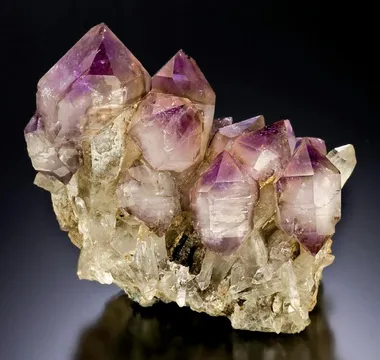
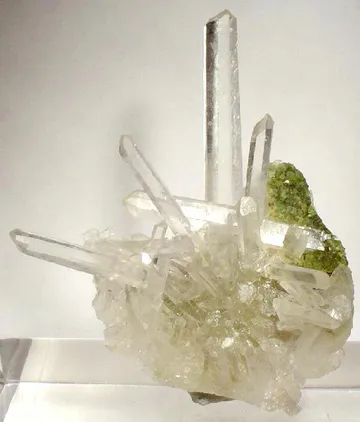
Quartz from San Manuel is most important as a visual amplifier of the copper minerals rather than as isolated quartz crystals. The classic style is drusy quartz coating chrysocolla, malachite, or chrysocolla pseudomorphs, producing a bright glitter over sky-blue to green copper minerals. A documented 1996 self-collected specimen from the oxide zone measured about 5.5 x 4.0 cm and consisted of druzy quartz with chrysocolla and malachite, while published Mineralogical Record examples show drusy quartz on chrysocolla pseudomorphs after gypsum from the Oxide pit. Good San Manuel quartz specimens are judged by the sparkle, completeness, and contrast of the druse: fine, glassy quartz over intense chrysocolla is far superior to chalky silica over dull massive material.
Native copper is one of San Manuel’s great underappreciated prizes, especially where it escaped crushing with sculptural form intact. Documented specimens include native copper with cuprite from Panel 7 on the 1475 level, a cabinet-size example about 12.5 x 7.5 cm from the Frank Valenzuela collection, as well as an 8.1 cm dendritic copper with cuprite patina and an 11.1 cm cluster of spinel-law twinned copper crystals collected in 1970 from Panel 50 on the 1715 level. The best San Manuel copper is not just a reddish metallic seam: it is dendritic, branching, crystallized, twinned, or naturally accented by cuprite. Because native copper can be cleaned, lacquered, oiled, or confused with copper from many other Arizona districts, old labels naming the panel, level, collector, or mining source add real value here.
Other documented San Manuel minerals include atacamite, bornite, chalcocite, chalcopyrite, covellite, cuprite, dioptase, goethite, gypsum, hematite, molybdenite, plancheite, shattuckite, tenorite, and a suite of alteration and post-mining sulfate minerals. The locality’s most scientifically notable species is jurbanite, Al(SO4)(OH) · 5H2O, for which the San Manuel orebody is the type locality. Jurbanite formed as a post-mining aluminum sulfate associated with humid underground environments and related sulfate salts such as epsomite, hexahydrite and pickeringite. Dioptase on chrysocolla from Panel 50 on the 1715 level is another noteworthy rarity for the locality, and calcite crystals with cuprite inclusions have been figured from the mine.
San Manuel specimens should be bought with labels. Because the mine was enormous, industrial, and not primarily a specimen locality, the most valuable pieces are those tied to a credible source: Oxide pit, Panel 50, Panel 7, the 1475 or 1715 levels, or underground levels such as 2375, 2615, 2675 or 2765. A generic “San Manuel, Arizona” label is still useful, but a level, panel, collector, or old collection name greatly strengthens the attribution.
The most common locality problem is mislabeling, not famous fabricated fakes. There are several “San Manuel Mine” localities outside Arizona, and dealer listings can also confuse San Manuel with nearby Tiger-Mammoth-Saint Anthony material or with other Arizona copper mines such as Ray, Globe-Miami, Morenci, and Bisbee. Some chrysocolla-quartz pieces from San Manuel resemble Globe-Miami or Ray material, so labels matter. Malachite pseudomorphs require particular care: at least one documented dealer description notes a San Manuel malachite pseudomorph after barite that had been labeled as malachite after azurite, and San Manuel is known for both pseudomorphic and non-pseudomorphic copper carbonates. Form should be examined, not assumed.
Condition varies by species. Chrysocolla and malachite can be friable where the matrix is porous or limonitic, and drusy quartz coatings may hide bruising or edge repairs. Azurite can be dulled or partly altered; the best pieces retain deep blue color and crisp surface texture. Native copper with cuprite should be inspected for artificial brightening, lacquer, excessive acid cleaning, or repaired branches. Pyrite from underground levels should be kept dry and stable; although San Manuel pyrite is not notorious as a pyrite-disease locality, any pyrite from a sulfide-rich mine deserves humidity control and periodic inspection.
The post-mining sulfate suite demands separate handling. Jurbanite, epsomite, hexahydrite, pickeringite, and related hydrated sulfates may be delicate, soluble, and humidity-sensitive. Such specimens should not be washed, should not be stored in damp cabinets, and should be isolated from showy copper minerals that can tolerate more normal handling. Jurbanite’s importance is scientific rather than aesthetic; even small white crusts or microcrystalline material can be significant if well documented.
Market availability remains thin. San Manuel was once one of the great copper operations of North America, but published accounts stress that specimen recovery was limited by block-caving methods and that collectors who own fine pieces tend to keep them. Good chrysocolla-quartz plates, malachite pseudomorphs, crystallized copper, and pyrite with level data are all much scarcer than comparable-looking pieces from more specimen-rich Arizona mines. Expect fine pieces to appear sporadically from old Arizona collections rather than in steady supply.
San Manuel began as a green stain on Red Hill. The clue was visible enough to attract prospectors around the time the nearby Mammoth mine was discovered in July 1879, but it was too low-grade and too deeply concealed to reward the early men who scratched at it. Shallow pits and short workings followed, probably as early as the 1880s, yet for decades the ground refused to behave like a bonanza. The old-timers could see copper, but not enough copper. By July 1925, Anselmo Laguna had staked the original San Manuel Claims No. 1 to No. 5; later James Douglas, a saloon owner from Superior, bought into the claim group, and Burns Giffin, Victor Erickson, and Henry Nichols became part of the story. Nichols was an assayer at Magma Copper, and his involvement came when the claim owners realized they needed someone with mining experience. What they had was not a rich little mine but the barely visible top of a very large system.
World War II changed the tempo. Federal concern over strategic materials brought the U.S. Geological Survey and U.S. Bureau of Mines into ground that earlier prospectors could not make pay. Churn drilling in the 1940s showed that the unimpressive surface was not the whole story. Magma Copper and Newmont then drilled deep holes through the gravels and conglomerates, and by 1948 they had proved hundreds of millions of tons of copper ore. San Manuel’s future was no longer a prospector’s gamble; it became a planned industrial undertaking with shafts, railroads, a mill, a smelter, a refinery, and an entire company town.
The Kalamazoo discovery is the geologist’s campfire story. The San Manuel orebody seemed incomplete: part of the original porphyry system was missing. J. David Lowell recognized patterns in surface rocks about a mile west of the mine and interpreted them as the displaced continuation of the system. The resulting drill program located the concealed Kalamazoo orebody at a depth of about 2,500 feet and identified an additional 560 million tons averaging about 0.72% copper. That success was not merely an added ore reserve; it helped establish a new way of thinking about porphyry copper deposits. San Manuel-Kalamazoo became a place where an orebody could be mentally reassembled across faulting and tilting, then found again underground.
For the specimen collector, the drama has a bitter edge. The very mining method that made San Manuel economically powerful worked against the survival of mineral specimens. Block caving is magnificent engineering and brutal collecting geology. The orebody is undercut from below, the rock mass breaks and caves, and the broken ore is drawn off through the mine. Cavities, seams, copper branches, and crystal-lined pockets do not remain as tidy openings waiting for a collector. They collapse, grind, mix, and disappear into the flow of ore. That is why San Manuel, despite its size, produced so few collectible specimens compared with older stope mines where miners could see and save pockets.
Onofre “Taffy” Tafoya gave the mine a human voice. He began a 37-year career at San Manuel in 1956, the year commercial underground mining took hold, and later wrote Mother Magma: A Memoir of Underground Life in the San Manuel Copper Mine. When he started, he recalled being told that the mine would still be going when his grandchildren were around; in a literal family sense, it was true, because both his son and grandson later worked there. Tafoya remembered the orebody as almost unimaginably large — about 8,000 feet long, 5,000 feet wide, and more than 2,500 feet thick — and he described the job as steady, well-paid work that seemed permanent. When closure came in 1999 after copper prices fell, more than 2,000 jobs were lost. His short verdict carried the weight of a whole town: “I felt betrayed.”
Even the best mineral specimens from San Manuel often carry the names of working miners and local collectors rather than glamorous collecting expeditions. Frank Valenzuela, a miner at San Manuel and a serious Arizona field collector, is associated with a number of documented specimens: pyrite from the 2375 and 2675 levels, native copper with cuprite from Panel 7 on the 1475 level, and dioptase on chrysocolla from Panel 50 on the 1715 level. That is the San Manuel pattern: a giant mine, a hard industrial method, a few people in the right places at the right times, and a small surviving population of specimens that now carry more history than their size might suggest.