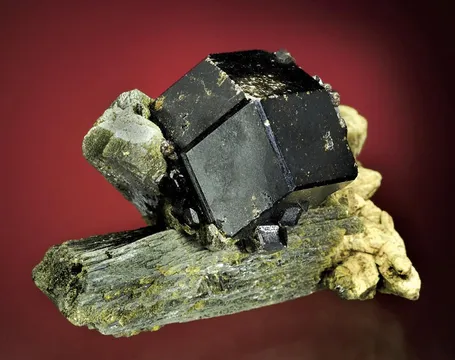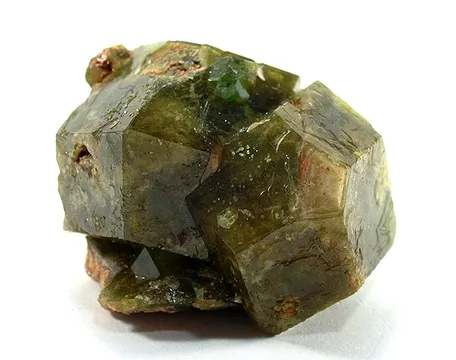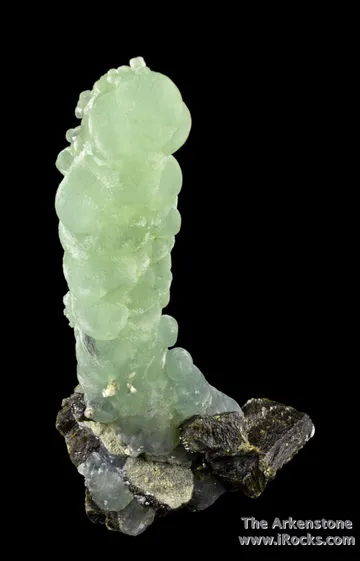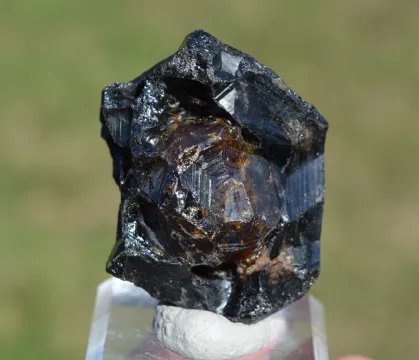
Sadiola Hill, Mali — Kayes Region locality famed for prehnite-epidote specimens: translucent prehnite spheres with epidote prisms, prized by collectors.
Key facts
Sadiola Hill sits in western Mali’s Kayes Region, in the gold country of the Kédougou-Kéniéba inlier near the Senegal–Mali shear zone. In mining geology it is a major Paleoproterozoic, carbonate-influenced, shear-hosted gold system: impure limestones, greywackes, pelites, black shales and intrusive rocks were deformed, altered and oxidized deeply enough to create a large open-pit mine famous far beyond Mali. For mineral collectors, however, “Sadiola Hill” has a second and more complicated life: the name became attached in the trade to some of the most recognizable modern African prehnite-epidote specimens—soft apple- to water-green prehnite balls and hemispheres perched on dark, thick, prismatic epidote crystals.
The best pieces sold under the Sadiola Hill label have an unmistakable look. Prehnite occurs as translucent, frosted, botryoidal spheres, commonly 2–3 cm across and sometimes larger, with a finely bladed or velvety surface under magnification. Epidote provides the architecture: blackish green to green-brown, lustrous, stout prisms, some doubly terminated, forming jacks, sprays, and sculptural floater bases. Good examples are not just “green balls on black sticks”; they have separation between the prehnite globules, visible epidote terminations, strong three-dimensionality, and minimal bruising on the high points of the prehnite.
Regional View
Country View
The collecting story must be handled carefully. The industrial Sadiola gold mine is real, large, and mineralogically important, but specialists who studied the Mali prehnite finds have long noted that many prehnite-epidote specimens labeled “Sadiola Hill” are almost certainly from small artisanal calc-silicate workings in the broader Kayes Region, especially the Bendougou-Diakon-Djouga area, rather than from the Sadiola open pit itself. This does not make the specimens less desirable; it makes label history part of the specimen. Older labels may say Sadiola Hill, Sadiola Mine, near Sadiola Gold Mine, Sandaré, or simply Kayes Region, Mali, while more corrected labels may specify Djouga, Bendougou, Guedigui, Diakon Commune, or other nearby skarn diggings.

Photo: Wikimedia Commons
The true Sadiola ore assemblage is a different mineralogical world: pyrite, arsenopyrite, pyrrhotite, stibnite, gudmundite, native gold, aurostibite, maldonite, tellurobismuthite, scheelite, fluorite, tourmaline-group minerals, actinolite-tremolite, clinozoisite, epidote, garnet-group minerals, calcite, dolomite, quartz, magnetite, hematite, titanite and accessory phases tied to calc-silicate and potassic alteration. For the display collector, the locality name therefore straddles two traditions: a world-class gold deposit in economic geology, and a celebrated trade locality for Mali prehnite-epidote combinations whose precise source has often been blurred.
Search for specimens: View all specimens from Sadiola Hill, Mali
Sadiola is an operating open-pit gold mine in the Kayes Region of western Mali, southwest of Kayes and northwest of Bamako. The deposit lies in the northern part of the Kédougou-Kéniéba inlier, on the eastern side of the Senegal–Mali shear zone, within the Kofi Formation. The local stratigraphy includes impure limestone and carbonate units with greywacke, sandstone, pelite, black shale, feldspathic detrital rocks, and felsic to intermediate hypabyssal intrusions. Dioritic bodies and dikes are important locally, not as specimen-producing cavities in the collector sense, but as part of the structural and hydrothermal architecture of the ore system.
The gold deposit is best understood as a structurally controlled, carbonate-reactive, mesothermal to orogenic-style system with unusually strong calc-silicate and high-temperature alteration for this part of the West African craton. Mineralization is concentrated along the Sadiola Fracture Zone and related splays, where faulted greywacke-carbonate contacts, carbonate lenses, breccia zones, and intrusive contacts provided permeability and chemical traps. The Sadiola trend includes the Sadiola Main pit and northern satellite areas; the Farabakouta East or FE trend follows mineralized contacts between weathered carbonates and graphitic metapelites; Tambali lies south-southwest of the main pit in greywacke adjacent to a faulted carbonate footwall; and Sekekoto lies farther south-southeast along carbonate-greywacke/arkose contacts with lateritic, supergene and saprolitic mineralization.
The ore mineralogy is dominated by sulfide and sulfosalt associations rather than cabinet-specimen pockets. Pyrite, arsenopyrite, pyrrhotite, stibnite and gudmundite are central to the arsenic- and antimony-rich paragenesis, with native gold and gold-bearing compounds such as aurostibite and maldonite recorded from the system. The alteration assemblages include calc-silicate, potassic, chlorite-calcite, carbonate and silicification stages. In the economic-geology literature, the multi-stage sequence is often simplified into an early arsenic-rich sulfide stage followed by a gold-antimony stage. Deep oxidation and lateritic weathering were especially important to mining: the saprolitic oxide zone along permeable shears and fabrics was enriched by supergene processes and became the early high-value mining target.
Sadiola has a long human history. Historic workings in the district are said to go back at least several centuries, and the extent of old mining has been interpreted as possibly much older. Modern exploration began with regional geochemical work for the Government of Mali in the late 1980s, followed by work involving Klöckner INA, AGEM, IAMGOLD, Watts Griffis and McOuat, and Anglo American. SEMOS was incorporated in December 1994, Sadiola poured its first gold on 20 December 1996, oxide mining began in the Main pit, FE3 followed in April 2001, and Tambali was mined in phases beginning in 2013. Mining was suspended in April 2018 while stockpiles continued to feed the plant, then Allied Gold restarted mining in 2021 after acquiring the former IAMGOLD and AngloGold Ashanti interests. The mine is now operated by Allied Gold through SEMOS, with Allied holding 80% and the Republic of Mali 20%.
For collectors, access to the Sadiola industrial mine should be considered closed. It is an active, permitted, security-controlled gold operation with pit walls, heavy equipment, tailings and processing infrastructure, and no normal collecting access. Even if one were interested in ore minerals rather than prehnite-epidote display pieces, specimens would come only through legitimate mine channels, historic study material, or deaccessioned collections—not by casual field collecting.
The celebrated prehnite-epidote specimens connected with the Sadiola name came through a different route. In the mid-2000s, small-scale miners in western Mali were working calc-silicate zones associated with diabase intrusions near Bendougou and Diakon. The most active area reported by visiting mineral dealers and gemologists was Djouga, north of Bendougou village, where shafts were sunk by hand to follow prehnite-bearing rock. These workings produced crusts, balls, spherical clusters and thick botryoidal masses of prehnite, some intergrown with black prismatic epidote. Baga, another nearby area, produced grey to grey-green prehnite crusts and fine epidote crystals, but poorer color limited its appeal for prehnite production. Because specimens moved through local markets and Bamako before entering the international trade, the locality names were often generalized, displaced, or attached to better-known regional names such as Sadiola Hill.

Photo: Wikimedia Commons
Prehnite sold as Sadiola Hill, Mali is prized for rounded, translucent, apple-green to water-green botryoids and hemispherical balls, commonly thumbnail to miniature in overall size but occasionally forming dramatic cabinet pieces; individual balls around 2–3 cm are typical of the better-known Mali production, with some clusters reaching larger dimensions and massive crusts reported much thicker in the artisanal workings. The surface is usually satiny to frosted rather than glassy, and under close light the botryoids show the fine bladed texture that separates real prehnite from polished or waxy-looking imitations. Associations with dark epidote are the classic cabinet style, though prehnite crusts and nearly pure botryoidal masses also occur. The most desirable pieces are complete or nearly complete floaters, with separated globules, internal glow, fresh green color, no iron staining, and only inconspicuous contact points; ordinary examples are duller, greyer, oiled, bruised on the high spots, or cut down from crust material.
Epidote on Sadiola Hill-labeled Mali specimens occurs as dark green, greenish brown to nearly black prismatic crystals, typically stout rather than slender, and most familiar as the framework beneath green prehnite balls. Good miniature combinations may show doubly terminated epidote crystals jutting through or bridging prehnite botryoids; larger, epidote-dominant specimens are much scarcer and are valued when the crystals are thick, lustrous, terminated, and visually independent rather than merely serving as hidden matrix. Reported Mali material includes epidote crystals to several centimeters, with exceptional pieces around cabinet size, and nearby Baga production was noted for fine epidote crystals up to about 10 cm. The premium examples balance contrast and form: black-green epidote blades or prisms against glowing prehnite, clean terminations, limited chipping along the striated faces, and a natural sculptural composition rather than a sawn or massive base.
Beyond prehnite and epidote, the Sadiola gold system is documented for a serious ore-mineral suite: native gold, pyrite, arsenopyrite, pyrrhotite, stibnite, gudmundite, berthierite, jamesonite, chalcopyrite, sphalerite, galena, molybdenite, scheelite, fluorite, maldonite, aurostibite, tellurobismuthite, native antimony and several telluride- or bismuth-bearing accessory phases. The alteration and gangue minerals include actinolite, tremolite, clinozoisite, garnet-group minerals, titanite, quartz, calcite, dolomite, albite, K-feldspar, muscovite, biotite, chlorite, magnetite, hematite, rutile and zircon. Tourmaline is particularly interesting in the deposit record, with dravite, oxy-dravite, schorl and povondraite reported from Sadiola; these are research minerals rather than common cabinet specimens. No verified IMA type-locality mineral appears to come from Sadiola Hill itself, but the locality is important for the documented occurrence of unusual tourmaline compositions within a major West African gold system.
The central authenticity issue is locality, not species. Prehnite and epidote from Mali are distinctive and abundant enough that outright mineral identification is usually straightforward, but “Sadiola Hill” labels need scrutiny. Older specimens from respected dealers and collections may carry Sadiola Hill labels because that was the circulating trade attribution at the time. Later field work and locality corrections point much of this material toward artisanal calc-silicate diggings near Bendougou, Diakon, Djouga, Guedigui and related Kayes Region localities rather than the Sadiola open-pit gold mine. A fine old Sadiola label is still historically meaningful, but serious collectors should preserve all labels and note the likely Kayes Region prehnite-epidote source if provenance supports it.
Treatments are also worth watching. Mali prehnite was reported in the trade as commonly oiled to improve appearance, especially rough and lapidary material. On specimens, oiling can deepen color and mask whitened bruises or dryness on botryoidal surfaces. Examine high points under strong light: treated surfaces may look slightly greasy in recesses, collect dust, or show uneven luster. The best collector pieces have an internal glow without looking wet. Avoid aggressive solvents unless you are willing to risk changing the appearance of an oiled piece; any cleaning should begin with the gentlest possible dry or water-based approach.
Condition problems are predictable. Prehnite botryoids bruise easily at the high domes, producing pale scuffs or flat spots. Epidote crystals can chip along terminations, side edges and striated faces, and blackish epidote damage may be difficult to see without raking light. Many specimens are floaters or near-floaters, but pocket contact areas and separation scars are common on the underside and should not automatically be treated as damage if they do not affect display. Iron staining is common on lower-grade material and can be natural, but heavy brown staining suppresses the green translucency that collectors prize.
Fluorescence is not a selling point for this material. Gemological testing of Mali prehnite samples found them inert to long-wave and short-wave ultraviolet light, so ultraviolet response should not be expected as a diagnostic or display feature. The specimens are best appreciated with strong white light from behind or above, which reveals the prehnite’s translucency and the contrast with epidote.
Market availability remains good compared with many one-pocket discoveries, because thousands of Mali prehnite-epidote specimens entered the trade from the early 2000s onward and periodic supplies have continued. Fine examples are nonetheless selective: balanced prehnite balls on crisp, visible epidote; old Rock Currier, Demetrius Pohl, Ed David, Arkenstone, iRocks or other traceable provenance; and large epidote-dominant specimens are all markedly scarcer than ordinary small clusters. The most affordable pieces are thumbnails and small miniatures with one or two prehnite balls; the strongest cabinet specimens combine size, translucency, sculptural form and credible label history.
In December 2005, Rock Currier and Demetrius Pohl traveled through the Kayes Region and saw the prehnite economy at ground level. In Bamako, the material did not appear as a few precious hand specimens laid out on velvet. It appeared in abundance: piles of rough green prehnite more than a meter high, some fresh apple green, some weathered and dulled by iron staining. Much of the cobbed material was not destined for mineral cabinets at all. It was packed in 120 kg bags and shipped to lapidary factories, largely in Asia, where it became beads, cabochons and cut stones.
At Djouga, north of Bendougou, the collecting story narrowed from regional trade to individual shafts in the ground. The workings were not a mechanized mine in the industrial sense. They were hand-dug shafts, scattered across a compact area roughly 200 × 100 m. About 120 shafts were counted, some reaching approximately 24 m deep. Miners dug until they intersected prehnite-bearing rock, then followed it laterally by driving tunnels outward from the shaft. During the visit, 50–75 independent miners were observed, but the workforce was seasonal: after agricultural work eased at the end of the dry season, the number could swell to several hundred. In collector terms, that explains both the abundance of Mali prehnite and the erratic label history—specimens passed from miners to local buyers to Bamako dealers before the international market ever saw them.
The material itself must have been exhilarating to see fresh from the workings. There were crusts of translucent grey-green, blue-green and yellow-green prehnite, most 2–5 cm thick and some up to about 10 cm thick. Some crusts had flat undersides, interpreted as having grown on earlier crystals—possibly anhydrite—that later dissolved away. Then came the pieces collectors remember: balls and intergrown spherical clusters of prehnite, at times wrapped around or penetrated by stout black prismatic epidote crystals. This is the look that made Mali prehnite instantly recognizable at shows: pale green globes seemingly balanced on dark epidote beams.
Baga offered another lesson in how beauty, commerce and mineralogy diverge. It produced prehnite crusts, including pieces reportedly weighing at least 100 kg, but the color was generally grey to greyish green and the prehnite mining there ceased because the color was poor. Yet the same area yielded fine epidote crystals, some much larger than the usual supporting crystals on prehnite combinations, and small yellow-brown rhombic dodecahedral garnets associated with epidote. For specimen collectors, the great Mali find was never a single uniform pocket; it was a cluster of small, variable calc-silicate workings where color and crystal habit changed enough to create several distinct collecting styles.
Masurel, Q., Thébaud, N., Miller, J., Ulrich, S., Hein, K. A. A., Cameron, G., Béziat, D., Bruguier, O., & Davis, J. A. (2017). “Sadiola Hill: A World-Class Carbonate-Hosted Gold Deposit in Mali, West Africa.” Economic Geology, 112(1), 23–47. — The key peer-reviewed deposit paper for Sadiola Hill, covering its structural setting, carbonate-hosted ore controls, alteration stages and Au-As-Sb-rich paragenesis.
Allied Gold Corp and Mondavi Ventures Ltd. (2023). NI 43-101 Technical Report for the Sadiola Gold Project, Mali. Final, 12 June 2023. — The modern technical report for the operating mine, with production history, ownership, permit status, geology, mining areas, resources, reserves and expansion plans.
Currier, R. H., & Pohl, D. (2011). “Mineral collecting in Mali.” The Mineralogical Record, 42(3), 231–250. — The essential collector-oriented Mali reference; documents the Kayes Region prehnite-epidote-garnet occurrences and is central to later corrections of broad “Sadiola Hill” trade attributions.
Currier, R. H., Pohl, D., & Quinn, E. P. (2006). “Prehnite from Mali.” Gems & Gemology, Summer 2006, Gem News International. — A field-and-gemology report describing the Bendougou-Diakon-Djouga prehnite workings, mine layout, specimen habits, lapidary use, and gemological properties of Mali prehnite.
Moore, T. P. (2005). “What’s New in Minerals—Tucson Show 2005.” The Mineralogical Record, 36(3), 285–301. — Cited in locality databases for early Sadiola Hill-labeled prehnite; useful for understanding how the trade attribution entered collector literature.
Mindat: Sadiola (Sadiola Mine), Sadiola Commune, Kayes Cercle, Kayes Region, Mali. — Mineral list, coordinates and locality notes, including the important caution that many prehnite-epidote combinations attributed to Sadiola resemble material from Djouga-area diggings.
Wikimedia Commons: Minerals of Sadiola Hill. — Historical image set of prehnite, epidote and prehnite-epidote specimens carrying the Sadiola Hill label, mostly from Rob Lavinsky/iRocks photographs.
“Le prix de l’or,” Camille de Vitry / IEIM-UQAM — Documentary media on the social and local impacts of the Sadiola gold mine in Mali’s Kayes Region.
“L’exploitation de l’or en Afrique, le cas de Sadiola au Mali,” Survie / Radio Grésivaudan interview with Camille de Vitry — French-language media page tied to the documentary and book project on Sadiola and West African gold exploitation.
Allied Gold: Sadiola Mine — Current operator page with ownership, mine status, 2026 guidance, reserves/resources and expansion summary.
NI 43-101 Technical Report for the Sadiola Gold Project, Mali — Best single technical source for modern Sadiola geology, mining history, ore zones and operational context.
Economic Geology: Sadiola Hill: A World-Class Carbonate-Hosted Gold Deposit in Mali, West Africa — Definitive peer-reviewed scientific treatment of the deposit’s structure, alteration and ore paragenesis.
Mindat: Sadiola (Sadiola Mine), Mali — Locality database entry with mineral list, coordinates and the key label caution for prehnite-epidote specimens.
GIA Gems & Gemology: Summer 2006 Gem News International — Includes “Prehnite from Mali,” an important field report on the Djouga/Bendougou/Diakon prehnite workings and specimen habits.
Mindat reference: Currier & Pohl, “Mineral collecting in Mali,” The Mineralogical Record, 2011 — Reference page for the most important collector publication on Mali mineral localities.
Wikimedia Commons: Minerals of Sadiola Hill — Useful historical photo archive of specimens sold under the Sadiola Hill attribution.
IAMGOLD: Completion of sale of Sadiola interest — Corporate confirmation of the 2020 sale of IAMGOLD and AngloGold Ashanti interests to Allied Gold.
AngloGold Ashanti 2020 Integrated Report: Mali asset sales — Corporate context for AngloGold Ashanti’s exit from Sadiola.