Kouri 1 diggings, Mali — a West African locality known for sharp melanite-rich andradite garnets, amber cores, and green prehnite with epidote associations.
Key facts
Kouri 1 diggings belongs to the remarkable Diakon–Kouri–Bendougou mineral field of western Mali, a remote Kayes Region suite that became internationally known after the 1994 emergence of “Mali garnet” and the later wave of sculptural prehnite, epidote, vesuvianite, clinochlore, and garnet specimens. The geological setting is the key to its personality: calcareous and sandy sedimentary rocks of the Taoudeni Basin were intruded locally by diabase, producing contact-metamorphic and calc-silicate zones in which calcium-rich silicates crystallized. For collectors, Kouri 1 matters less as a large formal mine than as one of the named artisanal diggings in this compact but locality-confusing Diakon field, where individual pits and shafts have yielded small, aesthetically intense specimens with unmistakably West African color contrasts.
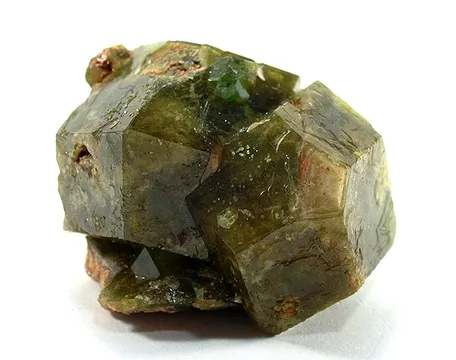
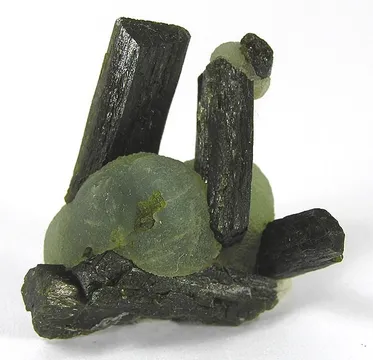
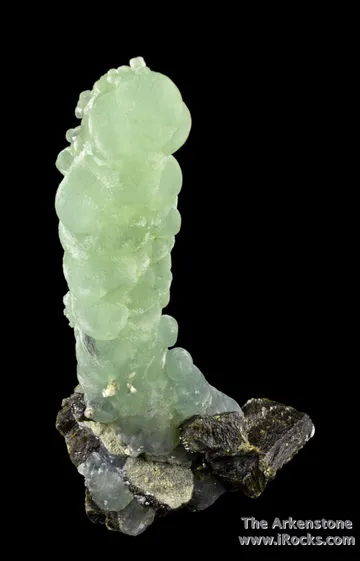
The best Kouri 1-attributed specimens are not bland matrix pieces. They tend to be sharp and graphic: black titaniferous andradite variety melanite forming lustrous skins or complete dodecahedral crystals around amber to orange-brown andradite-grossular cores; dark green clinochlore rosettes; and rare small arsenate pieces whose attribution deserves careful checking. The broader Diakon field’s fame rests on garnet first—especially grossular-andradite in yellow-green, brown, and rarer vivid green colors—but its specimen identity was enlarged by apple-green prehnite balls on dark epidote, green-to-black chlorite-group rosettes, and calc-silicate associations that look very different from the more familiar alpine or basalt-cavity prehnite localities.
Regional View
Country View
Kouri 1 is also a useful lesson in locality discipline. Older and commercial labels for the Mali garnet and prehnite field often used broad or imprecise names such as Sandaré, Diakon, Kayes Region, or simply Mali; later mapping and collector work separated many individual diggings around Kouri, Kembelé, Kandia, Loubana, Madina, Trantimou, Bendougou, and neighboring villages. Serious collectors should preserve every label and seller note, because a specimen marked Kouri 1 may sit in a chain of trade names that includes Diakon, Kayes, and, in some current market descriptions, Koukouri/Trantimou.
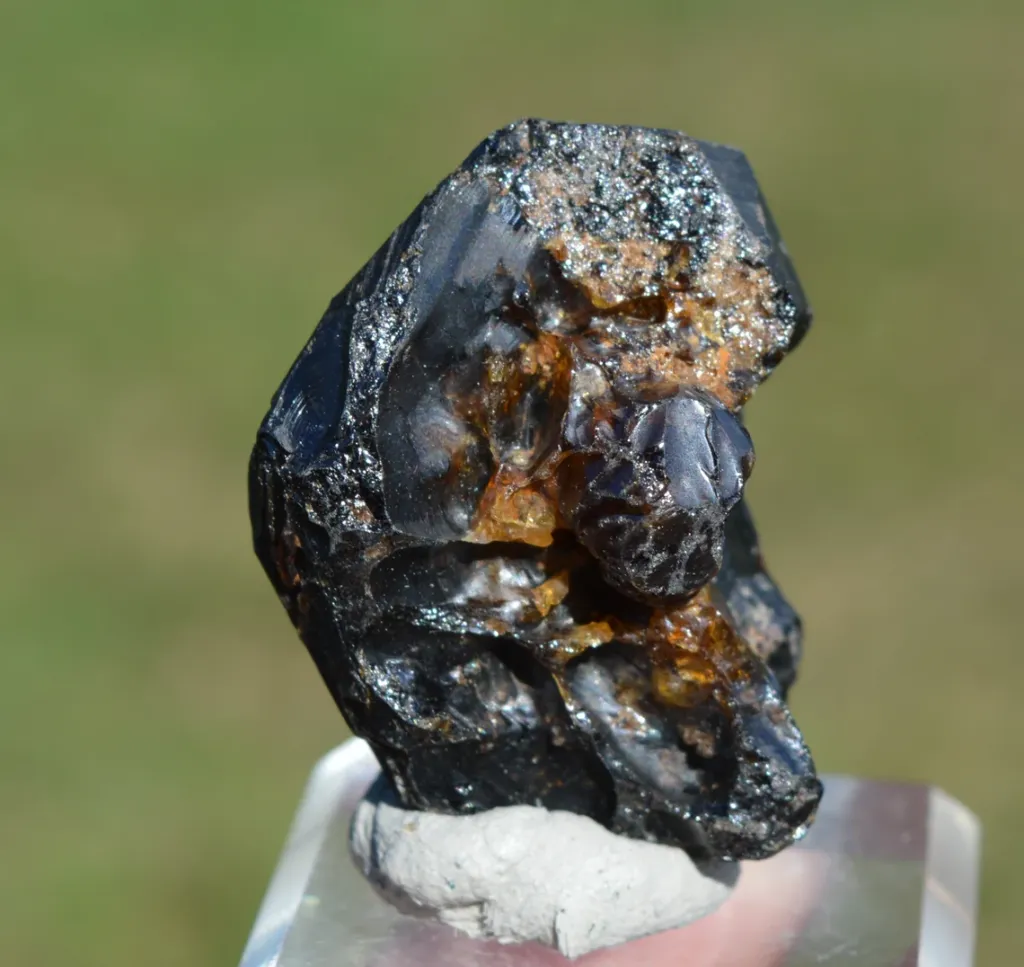
Photo: EarthWonders / JM IMPORT
Search for specimens: View all specimens from Kouri 1 diggings, Mali
Kouri 1 diggings is recorded near the village of Kouri in Diakon Commune, Bafoulabé Cercle, Kayes Region, western Mali. Its published coordinates place it within the same mineral-producing district as Kouri 2, Kembelé, Kandia, Madina, Loubana, Diakon, Trantimou, and Bendougou-area diggings. This is a district of small named workings rather than a single industrial orebody, and the mineral specimens are best understood as products of local contact-metamorphic calc-silicate lenses developed where diabase intrusions interacted with calcareous sedimentary rocks.
The regional host package is part of the Taoudeni Basin margin in western Mali. Reports on Mali garnet describe magnesian limestones and dolomitic limestones, with diabase dikes and related intrusions cutting the sedimentary sequence. Where the intrusions met favorable carbonate-rich beds, the chemistry was ideal for calcium-iron-aluminum silicate assemblages: grossular-andradite garnet, epidote, prehnite, vesuvianite, chlorite-group minerals including clinochlore, magnetite or titaniferous magnetite, and locally other accessory minerals. In collector terms, this is skarn or calc-silicate metasomatic mineralization, not a classic sulfide ore mine.
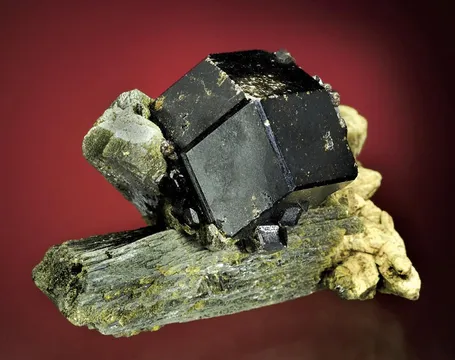
The “ore bodies” at Kouri 1 are therefore better described as specimen-bearing calc-silicate zones, pockets, seams, and weathered lenses reached by shallow artisanal pits. In the wider Diakon field, prehnite-bearing zones were followed from shafts into short tunnels; garnet-bearing material occurred both in contact-metamorphic rock and as alluvial or waterworn nodules near the source. Kouri 1’s most distinctive current marketplace identity is the black melanite-andradite-grossular association: compact miniatures in which an amber to reddish-brown garnet core is partly enclosed by a black, lustrous melanite shell, with dissolution textures suggesting that intervening calcite once separated phases and later vanished.
Historically, the Mali garnet field entered the gem and mineral trade in the mid-1990s. Gem-quality grossular-andradite appeared in Idar-Oberstein in 1994, and by spring 1995 specimens of garnet, epidote, prehnite, and vesuvianite from Mali were being sold in Tucson, often under broader locality names. The early gem rush focused on yellow-green to brown transparent grossular-andradite, while mineral collectors began seeing dodecahedral garnets, green garnets, black garnets, prehnite balls on epidote, and later clinochlore rosettes. Government and collector efforts in the early 2000s helped clarify that many “Sandaré” or broadly labeled Kayes pieces actually came from separate diggings around Diakon Commune.
Mining has been overwhelmingly artisanal and episodic. No large, continuously operating mine is documented for Kouri 1 as a specimen locality. Production appears to have moved with discoveries: a pocket, lens, or small zone is opened, material enters local and export channels, and then supply fades or the next named digging becomes active. Current Kouri 1 material on the collector market is therefore best treated as limited-run field production, often dealer-sorted and sometimes reattributed as locality databases refine the Diakon-area map.
Collecting access today should not be assumed. The site lies in a remote rural area of western Mali, and the documented production has come through local miners and dealers rather than through organized public collecting. Serious field access would require local permission, current security assessment, and coordination with community and administrative authorities. For most collectors, authentic Kouri 1 specimens are acquired through the mineral trade, and the label quality—Kouri 1 versus Kouri, Diakon, Koukouri, Trantimou, or general Kayes Region—matters as much as the specimen itself.
Melanite is the signature Kouri 1 species in current collector circulation, occurring as black, titaniferous andradite on or around amber to reddish-brown andradite-grossular cores; the best pieces are small miniatures, commonly around 3.5–4 cm across in documented EarthWonders listings, with glossy black dodecahedral faces, clean truncated edges, and a bright warm-colored “grandite” interior exposed by breakage or natural dissolution. The most interesting specimens from the 2023 discovery show a two-stage garnet story: a lighter garnet core, an inferred vanished calcite interval, and a later melanite rind, leaving etched or hollowed surfaces where the intervening carbonate dissolved. Ordinary pieces are dark, massive, or visually confused; the desirable ones have complete geometry, high luster, a strong black-versus-amber contrast, and enough exposed interior to show the unusual growth relationship rather than simply reading as a black garnet lump.
Clinoclase from Kouri 1 is a locality rarity rather than part of the classic Mali garnet-prehnite suite, and Kouri 1-attributed examples should be judged with more caution than the abundant calc-silicate minerals. The collector look to expect is small, dark blue-green to green, lustrous tabular crystals or compact sparkly coatings in cavities, more valuable for species-and-locality interest than for size. A good Kouri 1 clinoclase should show recognizable bladed or tabular crystal form, fresh luster, and a tight association consistent with a secondary copper-arsenate environment; ordinary pieces will be thin, nearly black crusts with little definition. Because published locality literature for clinoclase in the Diakon field is sparse compared with garnet, prehnite, epidote, and clinochlore, analytical confirmation or a strong provenance chain is especially important for any premium example.
Clinochlore is one of the most distinctive non-garnet minerals of the Diakon-area Mali suite and is represented around Kouri-style material by green to greenish-black rosettes and platy aggregates, sometimes with silvery highlights or orange-brown iron staining. The best crystals are large for the species, with sharply defined hexagonal rosette form, feathery growth striations on flat faces, good luster, and enough separation from associated garnet or magnetite to show the chlorite habit clearly. In this district, clinochlore often functions visually as the dark green structural foil for andradite-grossular, epidote, prehnite, and magnetite-bearing associations; common pieces are bruised, flattened, or overly matrix-bound, while good Kouri 1 examples retain crisp rosette geometry and a fresh, slightly translucent green edge.
Other minerals documented from Kouri 1 and the tightly associated Diakon–Kouri field include andradite-grossular series garnet, grossular, epidote, prehnite, vesuvianite, magnetite or titaniferous magnetite, and locally quartz or chalcedony-style silica. The broader field’s gemological fame rests on grossular-andradite “Mali garnet,” especially the yellow-green to brown transparent material first studied in the 1990s, but the mineral-specimen suite is more diverse: apple-green prehnite balls and crusts on dark epidote, brown to green dodecahedral garnets, black melanite, and dark chlorite rosettes are the recurring visual language. No recognized type-locality mineral is documented for Kouri 1 in the sources checked, and claims of unusual rare species from this locality should be treated as specimens requiring verification rather than as routine locality output.
Kouri 1 specimens demand careful locality scrutiny. The Kayes Region garnet-prehnite field has a long history of broad, shifting, and sometimes erroneous labels: Sandaré, Diakon, Nioro du Sahel, Kayes Region, Bendougou, Trantimou, Koukouri, Kouri, and individual named diggings all appear in collector and dealer usage. A Kouri 1 label is strongest when it comes with a modern database record, a dealer who can explain the source, or a provenance trail from the recent find. Specimens simply marked “Mali,” “Kayes,” or “Diakon” may be perfectly genuine but should not be upgraded to Kouri 1 without evidence.
The main authenticity concern is not widespread fabrication but over-specific relabeling. Melanite-andradite-grossular specimens of the 2023 style are visually distinctive, yet some EarthWonders listings and trade descriptions place them simultaneously in Kouri 1 and in Koukouri/Trantimou language. That may reflect database consolidation, translation, trader shorthand, or genuine uncertainty in the supply chain. Preserve all original wording rather than “cleaning up” the label.
Condition issues are predictable. Melanite garnet is hard, but the exposed amber core, dissolution cavities, and sharp black edges can chip; inspect for bruised corners, oil-darkened fractures, and glued repairs. Clinochlore rosettes are far more vulnerable: the platy crystals can be crushed, scuffed, or rubbed dull in transport. Clinoclase, when present, should be protected from abrasion and unnecessary washing; small secondary arsenates can be delicate, and all arsenate specimens should be handled with normal mineral hygiene—wash hands after handling, avoid dust, and do not cut, grind, or acid-clean them.
Treatments are not commonly reported for Kouri 1 melanite specimens, and recent EarthWonders melanite listings explicitly state no treatment. The broader Mali prehnite trade is different: gem and bead material from the Kayes region has often been oiled to improve appearance, so prehnite-rich specimens or polished material should be checked carefully. Fluorescence is not a major selling feature for the Kouri 1 suite; published testing of polished Mali prehnite found it inert to long- and short-wave ultraviolet radiation.
Market availability is limited but not impossible. Melanite from Kouri 1 appears in small batches and is currently the locality’s strongest EarthWonders identity. Clinochlore is scarcer and tends to be condition-sensitive. Clinoclase is a rarity for the label and should command attention only when identification and provenance are solid. The best buys are not necessarily the largest specimens, but those with clean geometry, original locality detail, and a visual association that could not easily be confused with the more generic Kayes Region material.