






Diakon, Mali — a premier prehnite–epidote locality and source of Mali garnet, prized for sculptural prehnite on dark epidote and strong gem-trade relevance.
Key facts
Diakon, in the Kayes Region of western Mali, is one of the defining modern localities for the prehnite-epidote collector combination and an important source area for the gem trade’s “Mali garnet.” The mineral occurrences lie in the Sahelian country northeast of Bafoulabé and east of Kayes, where localized skarns developed around diabase and dolerite intrusions cutting calcareous and arenaceous sedimentary rocks of the Taoudeni Basin. For collectors, the signature pieces are immediately recognizable: pale apple-green to blue-green prehnite in globular, hemispherical, botryoidal, crusty, and locally stalactitic growths perched on dark green to nearly black epidote prisms, commonly with a sculptural contrast rarely matched by other prehnite localities.
The locality’s historical importance is twofold. In the mid-1990s, yellow-green to brown grossular-andradite garnets from the Diakon area entered the international gem market, prompting careful gemological study and establishing “Mali garnet” as a commercial name for transparent intermediate garnets in the grossular-andradite series. A decade later, field observations around Bendougou and Djouga documented a flourishing small-scale prehnite trade, with numerous hand-dug shafts following prehnite-bearing calc-silicate rock underground. Those finds moved Diakon from a gemological curiosity into the front rank of specimen localities.
Regional View
Country View
The finest Diakon specimens are judged less by sheer size than by architecture. A complete prehnite ball or cluster should sit naturally on, or be penetrated by, sharp epidote rather than appearing as an undifferentiated green lump. The best examples have clean spherical form, a pleasant translucent glow when backlit, minimal iron staining, and dark epidote crystals that are terminated, lustrous, and not merely matrix rubble. The old labels can be confusing: specimens from Djouga, Bendougou, Diaboukara, Kembelé, Trantimou, Baga, and other nearby diggings have circulated simply as “Diakon,” “Kayes,” “Sandaré,” or “Nioro du Sahel.” For collecting purposes, Diakon is best understood as a small district of related skarn diggings, not as a single mine with one uniform habit.

Photo: Wikimedia Commons

Photo: Wikimedia Commons
Search for specimens: View all specimens from Diakon, Mali
The Diakon mineral field belongs to the skarn and contact-metamorphic environment of western Mali. The broader setting is the West African Craton and Taoudeni Basin margin, where sedimentary rocks including magnesian limestone, dolomitic limestone, calcareous rocks, sandstone, and clay- or feldspar-bearing sandstone were cut by diabase to doleritic intrusions. The collector minerals formed in localized calc-silicate zones adjacent to those intrusions. Garnet, epidote, prehnite, vesuvianite, magnetite, fluorite, and occasional chrysoberyl have all been reported from this general contact environment, with the commercial specimen-producing pockets especially concentrated around the Diakon-Bendougou-Djouga area.
At Djouga, the most famous Diakon sublocality for display specimens, the mineralization occurs on a hill near Bendougou village, in rolling savannah country where diabase-capped hills are associated with small skarn bodies. The site has been described as lying roughly 7 km northeast of Bendougou, east of the track toward Diabé. Field reports from the mid-2000s recorded prehnite-bearing rock followed downward from individual shafts, with tunnels radiating out once productive material was reached. The prehnite formed as crusts, balls, hemispheres, and intergrown spherical clusters; epidote occurred as stout prismatic crystals, in the best pieces large enough and dark enough to act as a dramatic pedestal or spine for the pale prehnite.
The first internationally important production phase was the 1994–1995 Mali garnet rush. The garnets came from multiple localities in the Zone of Sangafé near Diakon, with reports naming Sibinndi, Duvalé, Bindougou, Trantimou, and other villages or diggings in the district. Transparent yellowish green, green, orangy brown, and brown garnets were recovered from contact-metamorphic and alluvial sources. Gemological work showed the material to be intermediate in the grossular-andradite series, with most specimens on the grossular side but chemically and optically distinct from ordinary grossular. Production was sufficiently intense that the gem market was soon saturated, and few complete euhedral crystals survived unbroken because dealers preferred compact transparent nodules for cutting.
The second collecting phase was the prehnite-epidote boom of the early 2000s. By December 2005, Djouga was reported as the most active prehnite mining area, with approximately 120 shafts in an area only about 200 by 100 meters; the deepest workings reached about 24 meters. Seasonal labor was an important factor. Contemporary field observers saw 50 to 75 independent miners during their visit, but the workforce could expand to several hundred near the end of the dry season, when agricultural work allowed more people to dig. Mining was rudimentary, hand-sorted on site, and largely artisanal rather than an industrial operation under a single formal mining company.
The ore bodies are small, discontinuous, and highly variable. Djouga produced the classic pale green prehnite balls on blackish epidote; Baga produced gray to grayish green prehnite crusts and some fine epidote crystals, but its prehnite was less desirable because of poorer color; Koukouri near Trantimou is documented for grossular, andradite-grossular series garnet, vesuvianite, epidote, prehnite, clinochlore, and titanite; Diakon 3 and other Diakon-numbered prospects have yielded prehnite, epidote, quartz, chalcedony, and copper carbonates such as azurite and malachite. Because the productive lenses are small, exact sublocality matters: a “Diakon” prehnite may represent Djouga material with world-class aesthetics, or it may be from another nearby digging with a different color, association, or market value.
Collecting access today should be treated as local, informal, and changeable. These are not public collecting sites in the North American sense; they are rural Malian diggings, historically worked by local miners and dealers, with access dependent on land use, village permission, security, season, and the economics of current mineral buying. Most serious collectors obtain Diakon specimens through dealers, older collections, or parcels that have retained reliable sublocality information. Old-stock pieces with Rock Currier, Demetrius Pohl, Dudley Blauwet, Dave Bunk, iRocks, Fabre, or other early-market provenance are especially useful because they anchor specimens to the period when the material was being actively documented.
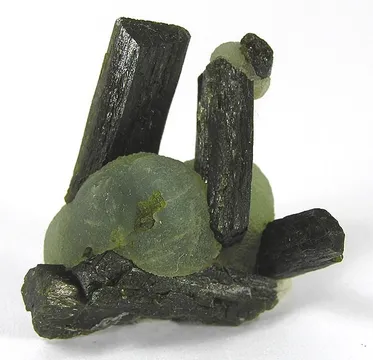
Prehnite is the mineral that made Diakon visually unmistakable: the best Djouga and Bendougou pieces show translucent apple-green, gray-green, blue-green, or yellow-green balls, hemispheres, botryoidal crusts, and radiating aggregates on dark epidote, with individual spherical growths commonly in the 2–3 cm range and documented examples reaching about 5 cm; crusts from the mining area may be 2–5 cm thick and rarely as much as 10 cm thick. Fine specimens have complete rounded forms, strong backlit glow, minimal iron staining, and an aesthetic relationship to the epidote rather than a shapeless coating. Ordinary pieces tend to be weathered, stained, bruised, or merely massive; the great pieces are three-dimensional, balanced, and immediately legible from across a room.
Epidote from Diakon is best known as the dark counterpoint to the prehnite: stout prismatic crystals, often olive-green to very dark green or nearly black, commonly enclosed by or supporting pale prehnite balls. At Djouga, epidote crystals to about 5 cm were documented in association with the spherical prehnite, while the Baga area is noted for much larger epidote crystals, reported to about 10 cm, along with garnet. The most desirable specimens show terminated, lustrous, freestanding epidote crystals that create height and contrast; lesser examples are broken, embedded, or so heavily covered by prehnite that the epidote contributes little more than dark matrix.
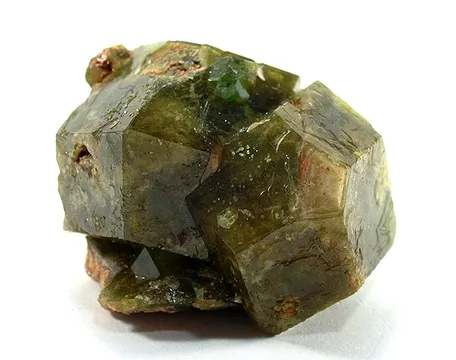
Grossular from the Diakon district belongs chiefly to the famous “Mali garnet” story: transparent to translucent yellow-green, greenish yellow, brownish orange, and brown grossular-andradite garnets formed in the same contact-metamorphic system that produced the prehnite and epidote specimens. Gemological studies found many Mali garnets to be grossular-dominant compositions in the grossular-andradite series, with color governed mainly by Fe3+ and, in the rare stronger green stones, chromium as well. Collector specimens are far scarcer than cut-gem rough because much production was broken for nodules; desirable mineral pieces preserve sharp dodecahedral or trapezohedral faces, good transparency or glow, and credible Diakon-area provenance rather than merely commercial “Mali garnet” labeling.
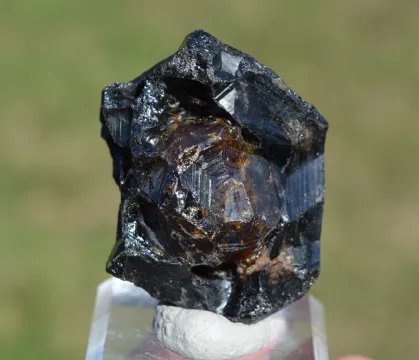
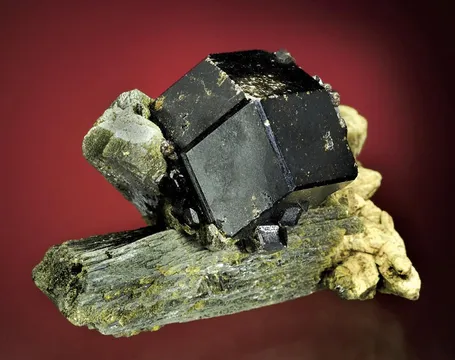
Andradite at Diakon appears both as part of the grossular-andradite garnet continuum and, most strikingly for specimen collectors, as dark melanite-style crystals from the skarn diggings. The black to brown-black garnets are typically sharper and more opaque than the yellow-green gem grossular-dominant material, and some classic Diakon melanite specimens show strong dodecahedral form, lustrous faces, and cabinet-scale presence. The best pieces are crisp, lustrous, and complete enough to stand as garnet specimens rather than as accessories to prehnite; mediocre examples are dull, abraded, or overgrown in a way that obscures crystal form.
Other minerals documented from the Diakon area add depth to the locality’s skarn identity. Vesuvianite occurs in the garnet-bearing calc-silicate assemblage and is recorded from Koukouri; clinochlore, titanite, quartz and chalcedony, pyrite, pargasite, and actinolite are also tied to specific Diakon sublocalities or specimens. Diaboukara is notable for stilbite-stellerite series material with prehnite and epidote, a distinctly different zeolitic accent within the district. Diakon 3 adds azurite and malachite to the list, indicating localized copper-bearing alteration. The locality is not celebrated as a type locality for new mineral species; its importance rests instead on exceptional combinations, gemological significance, and the rare concentration of display-quality prehnite, epidote, and garnet in a compact skarn district.
The most important authenticity issue at Diakon is treatment and labeling, not outright faking. GIA field and gemological reporting noted that much Mali prehnite was oiled to improve appearance, so collectors should assume that especially glossy, saturated, or unusually even-colored prehnite may have been enhanced unless there is evidence to the contrary. Oiling is not necessarily disqualifying for commercial material, but it should be disclosed, and it matters for valuation; a naturally fresh, untreated prehnite ball with fine epidermal texture and good translucency is preferable to a soaked-looking specimen whose color depends on surface enhancement.
Mislabelling is common and historically understandable. Older pieces may read “Sandaré,” “Nioro du Sahel,” “Kayes,” or simply “Mali,” while modern locality work places many of the classic prehnite-epidote specimens at Djouga, Bendougou, within Diakon Commune. Labels using “Diakon” alone are acceptable for district-level cataloguing, but better specimens deserve sublocality precision when known: Djouga for the classic balls on epidote, Koukouri for certain garnet-vesuvianite-calc-silicate assemblages, Baga for grayish prehnite crusts and notable epidote, and Diaboukara for stilbite-stellerite association pieces.
Condition is a major grading factor. Prehnite globules bruise and flatten easily at high points, and their fine granular or fibrous surfaces can show scuffs that are difficult to see until strong side light catches them. Epidote terminations are frequently chipped, especially where a dark crystal projects through or above the softer-looking prehnite mass. Iron staining is common on weathered material; a little limonite can be natural and unobjectionable, but heavy orange-brown staining lowers display quality unless the overall composition is exceptional. For garnets, look for intact faces and avoid waterworn nodules or cobbed fragments being sold as specimen crystals.
Fluorescence should not be a buying point for prehnite from this locality. Reported polished Mali prehnite was inert under both long-wave and short-wave ultraviolet radiation. The appeal is daylight color, translucency, and form. Handling is straightforward but should be cautious: keep oiled pieces away from heat, strong solvents, and prolonged washing; avoid ultrasonic cleaning; and dust prehnite-epidote combinations with a soft brush rather than water pressure, which can expose old repairs, undercut matrix, or residual oil.
Rarity varies sharply by quality. Small ordinary prehnite-on-epidote specimens remain available because significant quantities entered the market in the 2000s, and new or recycled material still appears through dealers and online auctions. Top examples—complete apple-green globes on terminated epidote, large sculptural miniatures and small cabinets, old labels from the first documented collecting period, or sharp melanite and grossular crystals with strong Diakon provenance—are much scarcer and trade like established modern classics. The market especially rewards pieces that avoid the two common problems of the locality: dull stained prehnite and broken epidote.
The Diakon story begins in the gem trade rather than at a mineral-show display case. In spring 1994, transparent yellow-to-green-to-brown garnet rough appeared in Idar-Oberstein, the German cutting center that has acted for generations as a clearinghouse for unusual gem rough. One account had the material discovered by a West African who had once lived in Idar-Oberstein. Within a year the stones were being discussed at Intergem in Munich and by gem dealers internationally. They were not quite grossular in the familiar sense and not andradite either; they occupied the in-between territory, a commercial novelty soon called “Mali garnet” or “grandite garnet.”
The logistics were as dramatic as the gemology. The garnets were coming from the Zone of Sangafé near Diakon, in a dry Sahelian region far from any easy export route. Kayes could be reached by train from Bamako or Dakar, but the remaining journey involved jeeps or bush taxis over partly paved and then unpaved roads toward Sandaré and the villages around Diakon and Sibinndi. Demand rose so quickly that extra railroad cars were reportedly added to trains going to Kayes. Rough traveled in flour or rice sacks, carried by whatever vehicles could reach the railhead.
The numbers behind the garnet rush explain why good mineral specimens are less common than one might expect. GIA researchers saw crystals weighing more than 5.5 kg, but most contained only small facetable areas. One production estimate from a 200 kg parcel of 400–500 crystals yielded only 160 grams of nodules, then just 60 grams of facet-grade rough, and finally perhaps 150 carats of cut gems—a total yield calculated at only 0.015%. Dealers soon preferred nodules to whole crystals. Many garnets that might have become cabinet specimens were broken in the search for transparent interiors.
By 2005 the attention had shifted from garnet to prehnite. Rock Currier and Demetrius Pohl traveled to the area and found the trade in full swing around Bendougou and Djouga. In Bamako they saw piles of rough “apple” green prehnite more than a meter high. Some was stained and weathered, but the good material was being cobbed, bagged in 120 kg sacks, and shipped largely to Asian lapidary factories for beads. The collector pieces were the survivors: balls, crusts, and clustered hemispheres that looked too good to grind up.
At Djouga, the scale was small in footprint but intense in labor. About 120 shafts had been dug in an area only 200 by 100 meters, descending to roughly 24 meters. Miners dug randomly until they struck prehnite-bearing rock, then drove short tunnels outward from the shaft. The workforce was seasonal: 50–75 independent miners were seen during the December 2005 visit, but the number could swell to several hundred toward the end of the dry season, when farming demands slackened. The famous specimens came out of that landscape by hand—pale green balls, dark epidote crystals, and calc-silicate rock sorted under Sahelian sun.

.jpg)
