Kayes Region, Mali — a notable collector locality famed for Mali garnet and prehnite-epidote skarns, with Diakon and Bendougou diggings prized by collectors.
Key facts
Kayes Region, in western Mali, is one of the few African specimen districts whose best pieces are instantly recognizable across a room: pale apple-green to water-green prehnite balls perched on black-green epidote prisms, and bright yellow-green to brown grandite garnets from the same broad skarn province. The collector localities are concentrated around Diakon, Bendougou, Baga, Trantimou, Sibinndi, Sandaré, Kontela, and neighboring diggings, where diabase and dolerite intrusions cut carbonate-rich sedimentary rocks on the margin of the Taoudeni Basin. At those contacts, calc-silicate skarns and brecciated carbonate rocks produced garnet, epidote, prehnite, vesuvianite, chlorite, magnetite, quartz, chalcedony, fluorite, and scattered sulfides.
The district’s historical importance is twofold. In the mid-1990s it introduced “Mali garnet” to the gem trade: transparent yellow, yellow-green, brownish yellow, and rare vivid green grossular-andradite garnets from the Diakon-Sangafé area that were large and clean enough for faceting, yet still geologically rooted in skarn mineralogy. A decade later the Bendougou-Djouga area began feeding the collector market with some of the most charming prehnite-and-epidote display specimens of the modern era. The finest examples combine strong contrast, rounded translucent prehnite spheres, sharp epidote, and a balanced sculptural composition rather than just a mass of green mineralization.
Regional View
Country View
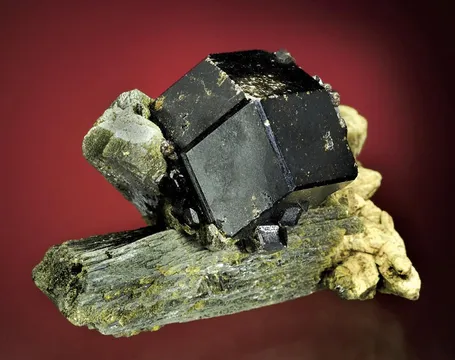
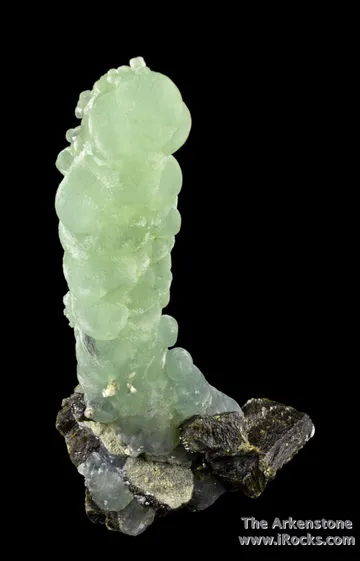
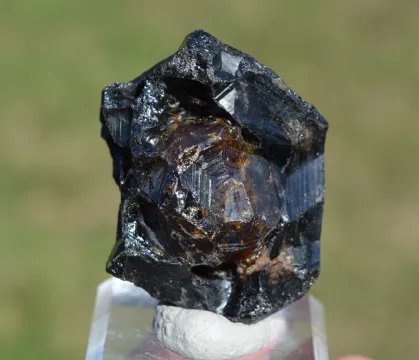
The best Kayes prehnites are not simply botryoidal coatings. They form discrete balls, hemispheres, and crusts with glistening microcrystalline surfaces; in aesthetic specimens these sit like pale green fruit among dark epidote stems. The garnets are equally distinctive: usually dodecahedral, commonly modified by trapezohedral faces, and ranging from honey-yellow and greenish yellow through brown, reddish brown, and nearly black melanite-like material. Much Kayes garnet is compositionally intermediate, so older specimen labels reading “demantoid,” “topazolite,” or “andradite” deserve scrutiny unless supported by analysis.

Photo: Wikimedia Commons / Rob Lavinsky, iRocks.com, CC BY-SA 3.0

Search for specimens: View all specimens from Kayes Region, Mali
Kayes Region is an administrative unit, not a single mine, and collector labels often use it broadly. The classic prehnite-epidote specimens come mainly from small diggings in the Diakon Commune and adjacent parts of Bafoulabé Cercle, especially the Djouga diggings near Bendougou, Baga and Baga West, Diamonkara, Bosomine, and related workings. Garnets have been recorded from Diakon, Sibinndi, Koukouri at Trantimou, Damandi Firman, Kembelé, Angola 1 in the Sangafé area, Mendié Kossa, Keniéba Kasso, Sandaré, and other points in the broader skarn belt. Because parcels were traded through Bamako, Kayes, Sandaré, and international dealers, many older labels are deliberately broad: “Kayes Region,” “Nioro du Sahel,” “Sandaré,” or simply “Mali.”
The specimen deposits are contact-metamorphic and metasomatic. Regional carbonate rocks, sandstones, and calcareous sedimentary sequences were intruded by Jurassic diabase/dolerite bodies and related mafic rocks. Along those contacts, heat, fluids, and chemical exchange converted carbonate-rich rocks into localized skarns rich in calcium silicates. In the most productive specimen zones, epidote, prehnite, garnet, vesuvianite, chlorite, magnetite, quartz, chalcedony, fluorite, pyrite, and minor amphiboles developed in brecciated calc-silicate rock and in veins or cavities opened by later weathering and fracturing.
The Djouga area, a hill near Bendougou village, is the best documented source for the modern prehnite-epidote style. It lies roughly 7 km northeast of Bendougou, east of the track to Diabé, and has also been referred to as Djouga-Kolon or, incorrectly and more generally, as “Nioro du Sahel.” Its production is known for abundant botryoidal prehnite on large, commonly doubly terminated epidote crystals. Field observations from the mid-2000s described simple hand mining following prehnite-bearing veins underground, with shafts reaching about 24 m. The workings were small, numerous, and individually operated rather than industrial; miners dug until they struck prehnite-bearing rock, then followed the productive zones outward with short tunnels.
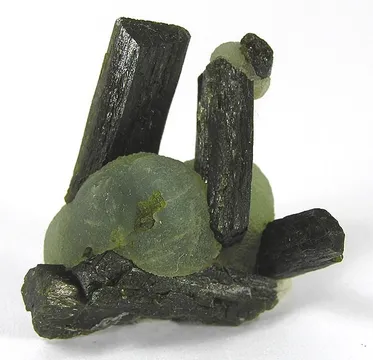
The ore bodies at Djouga and nearby sites are modest in surface footprint but specimen-rich. Prehnite occurs as crusts, balls, hemispheres, and intergrown spherical clusters. Individual prehnite balls are commonly in the 2–3 cm range and may reach about 5 cm; crusts can be several centimeters thick and, exceptionally, much thicker. Some crusts have flat undersides, suggesting growth on earlier soluble crystals, possibly anhydrite, later removed by dissolution. The most desirable pockets combined translucent gray-green, blue-green, or yellow-green prehnite with stout dark epidote prisms. Pieces from Djouga that preserve complete isolated balls on sharp epidote, with minimal iron staining and no sawed-looking base, are the collector standard.
Baga, another Bendougou-area locality, produced paler gray to grayish green prehnite crusts, including very large pieces, but the locality is better remembered by collectors for fine epidote and yellow-brown garnets. Reports note epidote crystals to around 10 cm from Baga and abundant small rhombic dodecahedral garnets, some associated with epidote. Baga West is documented for epidote, prehnite, stilbite-subgroup minerals, and andradite-grossular series garnet. Diamonkara is documented for epidote, prehnite, stilbite-subgroup material, and possible stellerite.
The garnet history begins earlier. Garnets from western Mali were known in the early twentieth century, but the commercial gem and specimen rush took shape in the 1990s after transparent yellow-green to brown grossular-andradite material reached the international market. The deposits near Diakon and in the Zone of Sangafé yielded crystals, waterworn nodules, and broken fragments. Alluvial recovery appears to have played an important role early on, because rounded nodules with gemmy cores were more useful to cutters than large but internally fractured euhedral crystals. Large rough crystals were recorded, but the facetable yield was tiny; for collectors this is precisely why intact, well-formed garnet crystals are more interesting than their abundance in the rough trade might suggest.
Mining at the specimen localities has been artisanal and highly seasonal. In the mid-1990s thousands of people reportedly worked the Diakon garnet zone during the rush, extracting many tonnes of garnet. By the mid-2000s, prehnite mining around Bendougou had become a local dry-season income source, with dozens of miners seen during active visits and a larger workforce possible when agricultural work slowed. Material was hand sorted at the pits and moved into trade channels through local buyers, Bamako markets, and foreign importers. Much prehnite went to bead and lapidary factories, while the most aesthetic combinations were reserved for mineral dealers.
Kayes Region also contains major gold and polymetallic deposits that matter mineralogically but are not the usual source of the green collector specimens. Sadiola Hill, Yatela, Alamoutala, Loulo-Gounkoto, and Falea belong to the larger mineral story of western Mali. Sadiola is a world-class carbonate-hosted gold deposit in the Kédougou-Kéniéba inlier, with gold associated with arsenic-antimony and a broader Au-As-Sb-Cu-Fe-W-Mo-Ag-Bi-Zn-Pb-Te suite. Falea is an unconformity-associated uranium-silver-copper deposit with uraninite, coffinite, brannerite, native silver, acanthite, chalcopyrite, tennantite-subgroup minerals, galena, sphalerite, cobaltite, arsenopyrite, and related gangue minerals. These mines and projects are industrial or exploration localities, and they should not be confused with the accessible-looking but still legally controlled artisanal skarn diggings that supplied the prehnite, epidote, and garnet specimens.
Collecting access today should be treated as closed unless arranged through legitimate local titleholders, community authorities, and professional in-country contacts. Mali’s mining system distinguishes prospecting, exploration, exploitation, small-mine, and artisanal authorizations; casual foreign collecting is not a free-for-all. Security conditions are also a decisive practical barrier. Current official travel advisories from the United States and the United Kingdom advise against travel to Mali, and mineral collectors should not attempt field visits based on old locality descriptions. For serious collectors, the safe path is provenance: buy from established dealers who can distinguish Djouga, Diakon, Sibinndi, Baga, and generic “Kayes Region” material honestly.
Grossular from Kayes Region is best known as the yellow-green to brown “Mali garnet” material from the Diakon-Sangafé skarn belt, especially around Sibinndi, Diakon, Bendougou, Kembelé, and related diggings, where garnet formed at diabase-carbonate contacts with epidote, prehnite, vesuvianite, magnetite, quartz/chalcedony, and other calc-silicates. Specimen crystals are typically dodecahedral, sometimes modified by trapezohedral faces, and can range from thumbnail crystals to large cabinet-size groups; documented individual crystals reached kilogram scale, though clean facetable cores were far smaller. The most attractive collector pieces are lustrous, well-shaped, translucent greenish yellow to honey-green crystals with sharp faces and pleasing isolation, while ordinary pieces tend to be opaque, fractured, dull, or compositionally ambiguous dark grandite. The best labels distinguish true grossular-dominant material from broader andradite-grossular series garnet, because many Kayes garnets sit along the grandite join rather than at a pure end member.
Prehnite is the signature display mineral of the Bendougou-Djouga area, where it occurs as translucent gray-green, apple-green, blue-green, yellow-green, and water-green balls, hemispheres, botryoidal crusts, and intergrown spherical aggregates in brecciated calc-silicate rocks adjacent to diabase intrusions. The most collected pieces show discrete prehnite spheres from a few millimeters to several centimeters across, commonly perched on or intergrown with dark prismatic epidote; crusts several centimeters thick were mined as lapidary material, but the fine specimens are those that retained three-dimensional form and open spaces. Djouga produced the classic combinations, while Baga and other Bendougou-area workings yielded paler crusts and associated epidote. Superior pieces have saturated clean green color, translucency, complete undamaged balls, visible sparkling micro-terminations, and strong contrast with epidote; lesser examples are massive, iron-stained, oiled, bruised, or broken from bead-grade rough.
Epidote from Kayes Region is the dark structural partner that gives the prehnite specimens their drama: stout black-green to olive-green prismatic crystals, commonly lustrous and in good examples sharply terminated, embedded in or supporting pale green prehnite. Djouga produced many of the recognizable prehnite-on-epidote combinations, including pieces with doubly terminated epidote crystals; Baga is noted for especially fine epidote specimens, with crystals reported to about 10 cm. Epidote also occurs throughout the Diakon and Bendougou skarn assemblages with garnet, prehnite, stilbite-subgroup minerals, chlorite, quartz, and occasional pyrite. The best specimens show exposed, undamaged terminations and a balanced ratio of dark epidote to translucent prehnite, rather than epidote completely swallowed by prehnite or reduced to broken dark rods in a green mass.
Andradite from Kayes Region is mostly encountered by collectors as dark brown to black garnet, including melanite-style material, from Diakon Commune, Trantimou, Fatoumanéné, Damandi Firman, Baga, Sandaré, and related skarn diggings; it sits in the same geological family as the grossular-dominant Mali garnets but represents the more iron-rich side of the assemblage. Crystals are generally dodecahedral to modified dodecahedral, sometimes associated with prehnite and epidote, and the darkest stones have often been called melanite, though titanium-rich composition should not be assumed without analysis. Good andradite pieces from Kayes have sharp geometry, glossy faces, strong black-to-brown color, and attractive contrast with pale prehnite or green epidote; ordinary examples are worn alluvial nodules, granular skarn fragments, or over-broad “andradite” labels applied to unanalyzed grandite. For specimen value, accuracy of identification matters as much as aesthetics, because many greenish and yellowish Kayes garnets tested to date fall on the grossular side of the grossular-andradite series.
Other documented minerals from Kayes Region broaden the locality far beyond the four showcase species. Vesuvianite, clinochlore, stilbite-Ca and other stilbite-subgroup minerals, possible stellerite, laumontite, quartz including chalcedony and prase, pargasite, actinolite, pyrite, magnetite, fluorite, and minor amphiboles belong to the skarn and low-grade metamorphic collector assemblage. The gold districts add native gold, electrum, arsenopyrite, stibnite, berthierite, gudmundite, jamesonite, scheelite, molybdenite, tellurobismuthite, hessite, petzite, calaverite, maldonite, and tourmaline species including dravite, oxy-dravite, schorl, and povondraite. Falea contributes an entirely different uranium-silver-copper suite with uraninite, pitchblende, coffinite, brannerite, native silver, acanthite, bornite, chalcopyrite, covellite, galena, sphalerite, cobaltite, tennantite-subgroup minerals, and riebeckite. These rarities are important mineralogical records, but they are generally not the same kind of cabinet-specimen production as the Djouga-Diakon prehnite, epidote, and garnet finds.
The most common Kayes Region problem is not outright fakery but imprecise locality and species labeling. “Kayes Region” may be perfectly honest for older parcels, yet it hides important differences between Djouga prehnite-epidote, Sibinndi grossular, Baga epidote, Diakon grandite, and Sadiola or Falea ore-mineral records. “Nioro du Sahel” and “Sandaré” labels have often been used as trading localities for material more precisely attributable to the Bendougou-Djouga or Diakon areas. Conversely, some labels over-specify a famous name without evidence. Treat unusually precise old labels with healthy skepticism unless they carry provenance from a dealer or collector who was active in Mali material at the time.
Species naming requires equal care. Much yellow-green “Mali garnet” is grossular-dominant, not demantoid. Dark black garnets may be andradite or melanite-like andradite, but “melanite” implies titanium-rich andradite and should not be used casually on appearance alone. The safest labels for unanalyzed intermediate material are “grossular-andradite series,” “grandite garnet,” or “grossular, var. Mali garnet” only where composition supports it. Older market names such as “topazolite,” “demantoid,” and “green andradite” were part of the early confusion and should be corrected when analytical or reputable published information is available.
Prehnite condition should be examined under magnification. The balls are tougher than many zeolites but still bruise at high points, and the sparkling micro-terminated surfaces can be abraded by poor packing. Look for flattened or contacted backs, broken epidote terminations, iron staining, and mismatched resin at repair points. Some specimens are mounted, which is normal and acceptable if disclosed, because the best miniatures are often sculptural floaters with awkward balance.
Treatment is specifically relevant for Kayes prehnite. Published gemological reporting on Mali prehnite noted that much rough was oiled to improve appearance. On specimens, oiling may deepen color, mask dryness, or reduce the visual effect of small surface bruises and iron staining. It is not always obvious, and it does not necessarily make a piece undesirable, but disclosure matters. Avoid aggressive solvents unless you are prepared for the possibility that the specimen will look paler or more matte afterward.
Fluorescence is not a collecting feature for the classic prehnite: tested Mali prehnite was inert to both long-wave and short-wave ultraviolet radiation. The main handling issue is mechanical, not optical. Keep prehnite-epidote combinations out of rattling flats; epidote prisms can act like levers and break away from the prehnite balls. Avoid acids on mixed specimens unless tested carefully, because iron oxides, carbonate remnants, chlorite, and possible zeolite-group associates respond differently, and acid can create unnatural-looking cleaned surfaces.
Market availability remains good for prehnite-epidote, especially small cabinet and miniature specimens, because the early-2000s production was abundant and parcels continue to circulate. Truly fine examples with complete, isolated balls on sharp epidote are much scarcer than ordinary green clusters. Grossular-dominant Mali garnet crystals are available but good lustrous, translucent, undamaged, well-labeled pieces have become more selective. Dark andradite/melanite-style specimens are less commonly offered than prehnite and should be judged by identification confidence and crystal quality rather than by the label alone.
The Mali garnet rush had the flavor of a frontier gem strike. In the mid-1990s, yellow-green and brown garnets from the Diakon-Sangafé area began moving through the trade, and the route from pit to cutting center was anything but elegant. Kayes could be reached by rail from Bamako or Dakar, but the garnet ground still lay beyond partially paved roads and another stretch of unpaved travel around Sandaré, Sibinndi, and Diakon. Rough traveled in flour and rice sacks, passed from hand to vehicle to railway. Demand grew so quickly that extra railroad cars were reportedly added to trains heading toward Kayes. For a brief moment, a remote skarn belt in western Mali was plugged directly into the gem centers of Idar-Oberstein, New York, Tucson, and beyond.
The early garnet story also produced one of those trade confusions that collectors still inherit on old labels. Some green stones were first thought by locals and traders to be emeralds; once garnet was recognized, the pendulum swung toward names like demantoid, topazolite, and andradite. Laboratory work later showed the important gem material to be mostly grossular-dominant, intermediate toward andradite, with iron and chromium contributing color. The result was a commercial name that stuck better than the early guesses: “Mali garnet.” For specimen collectors, the lesson remains practical: the color is seductive, but the chemistry is the truth.
The numbers behind the faceted-stone trade explain why intact specimen crystals are not as common as one might expect. One study calculated that a 200 kg parcel of 400–500 crystals might yield only 160 grams of nodules, and from those just 60 grams would be facet-grade rough. After cutting, perhaps 150 carats of finished gems would result—a yield of about 0.015%. That arithmetic encouraged miners and dealers to break large crystals for their gemmy cores, leaving relatively few euhedral crystals for crystallographic study or high-end mineral cabinets. The cutter saw potential brilliance; the collector sees what was lost.
Then, in the early 2000s, attention shifted to prehnite. Around Bendougou, especially at Djouga, miners were no longer chasing only garnet cores but green crusts and balls that could be sorted by hand. Visitors in December 2005 saw more than meter-high piles of rough apple-green prehnite in Bamako. Some of it was iron-stained or weathered; much was destined for 120 kg bags shipped to Asian lapidary factories, mostly for beads. Yet from that same production came delicate small cabinet specimens: pale green spheres nestled among black epidote crystals, the kind of pieces that made collectors suddenly care about a mineral many had previously treated as a secondary zeolite-companion.
At Djouga the work was intimate, physical, and improvised. The active ground covered roughly 200 by 100 m and contained about 120 shafts. Miners dug down until they hit the right rock, then chased the veins laterally. The shafts reached about 24 m at most, and tunnels radiated outward from them. During one visit, 50–75 independent miners were seen working, but the workforce could swell to several hundred near the end of the dry season when farming loosened its grip on daily life. In the right pocket, the reward was not ore in the industrial sense but a natural composition: translucent green prehnite balls, sometimes 2–3 cm and occasionally larger, sitting on stout dark epidote prisms.
Baga tells the other side of specimen mining. It produced prehnite crusts so large that pieces of at least 100 kg were reported, but size did not equal desirability. The color ran gray to grayish green, and prehnite mining there reportedly stopped because the material was not attractive enough. The same area, however, yielded fine epidote crystals to about 10 cm and small yellow-brown dodecahedral garnets, a reminder that each hill and contact zone in Kayes has its own personality. In this district, a poor prehnite locality can still be an excellent epidote locality, and a bead-grade pile can still hide a future classic miniature.