






Bafoulabé Cercle, Mali locality guide highlighting sculptural prehnite-epidote specimens and Mali garnet gems; rare apple-green prehnite balls on epidote.
Key facts
Bafoulabé Cercle, in the Kayes Region of western Mali, is one of the great modern localities for sculptural prehnite-epidote specimens and for the “Mali garnet” suite of grossular-andradite and andradite-related garnets. Its best-known mineral occurrences lie around Diakon and Bendougou, especially the Djouga diggings north of Bendougou village, where small-scale miners followed prehnite-bearing veins and calc-silicate bodies underground. The geological engine is a belt of contact-metamorphic to hydrothermal calc-silicate mineralization: diabase intrusions cutting Neoproterozoic sandstones and calcareous rocks on the western margin of the Taoudeni Basin. That setting produced the locality’s distinctive triad—apple- to water-green prehnite, blackish green epidote, and brown to yellow-green garnet—along with vesuvianite, clinochlore, titanite, stilbite-group minerals, amphiboles, magnetite, hematite, pyrite, quartz, and a scattering of rarities.
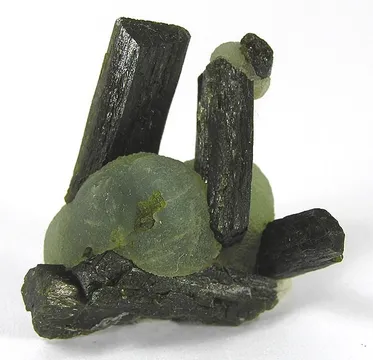
Historically, collectors first knew western Mali for gem garnets reported from the Sangafé/Diakon area in the 1990s, when yellow-green to brown grossular-andradite gems entered the trade as “Mali garnet.” The specimen market followed with dramatic epidote, prehnite, and garnet groups, especially from Bendougou, Djouga, Baga, Kembelé, Trantimou, Sibinndi, and nearby workings. The finest specimens have a look that is instantly recognizable on a bourse table: translucent spherical or hemispherical prehnite “balls,” often 2–5 cm across in the best groups, glowing pale green to rich apple-green, perched on dark, stout, prismatic epidote crystals; or lustrous, dodecahedral brown to honey andradite/grossular-andradite garnets on calc-silicate matrix. Good pieces are not merely pretty—they are three-dimensional, architectural, and unmistakably Malian.
Regional View
Country View
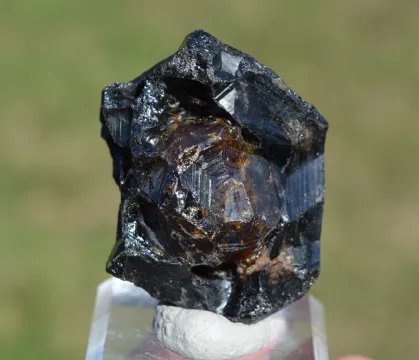
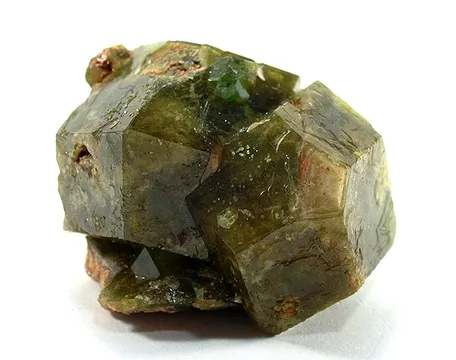
The classic display contrast is pale translucent prehnite against near-black epidote. In hand, the prehnite can appear almost waxy or misty, but under strong light the best spheres show an inner green glow and a very fine bladed or granular surface texture. Epidote may appear black at first glance, yet broken edges and thin crystal margins usually reveal deep olive to pistachio green. Garnet specimens from the same broad district range from opaque melanite-like black-brown groups to translucent honey, orange, yellow-brown, greenish yellow, and olive-green grossular-andradite crystals, commonly dodecahedral with trapezohedral modifications and stepped growth features.

Search for specimens: View all specimens from Bafoulabé Cercle, Mali
The mineral localities marketed under Bafoulabé Cercle are not one single mine but a cluster of small diggings and village-area occurrences, most famously around Diakon Commune and Bendougou village. Important names encountered on labels include Djouga diggings, Bendougou, Damandi Firman diggings, Diakon 1–5, Diaboukara, Guedigui, Angola 1 diggings at Sangafé, Baga and Baga West, Kembelé, Doualé, Sibinndi in the Sangafé area, Trantimou and its Koukouri diggings, Kolon diggings, Sougounikoura, Damandi, and Mendié Kossa. Older labels often say “Sandaré,” “Diakon, Nioro du Sahel,” or simply “Kayes, Mali.” Those labels are not always wrong historically as trade labels, but many of the most recognizable prehnite-on-epidote specimens were collected south of the Sandaré market stop, in what is now best described as the Bendougou–Diakon area of Bafoulabé Cercle.
Geologically, the deposits are skarn-like calc-silicate and hydrothermal occurrences associated with diabase intrusions in western Mali. Regional work on Mali garnets describes the area as part of the Precambrian West African Craton, warped into the broad Taoudeni Basin, with sedimentary sequences including sandstones and calcareous rocks intruded by diabase bodies. The collector minerals formed where these intrusions interacted with limestones, dolomitic limestones, and other calcareous rocks, producing garnet, epidote, prehnite, vesuvianite, magnetite, amphibole, and associated silicates. In the Bendougou area the prehnite-epidote-garnet-vesuvianite assemblage occurs in brecciated calc-silicate rocks adjacent to localized diabase intrusions; the most specimen-rich zones are not massive industrial ore bodies but discontinuous pockets, seams, veins, and altered blocks worked by hand.
Djouga is the prehnite locality collectors know best. It lies roughly 5 km north of Bendougou village and became the most active prehnite-producing area observed by Rock Currier and Demetrius Pohl during their December 2005 visit. There, shafts were sunk into a small mineralized area and miners followed productive veins laterally underground. The workings were hand-dug and hand-sorted, with shafts reported to reach about 24 m deep. The most distinctive production consisted of crusts, individual balls, and intergrown clusters of translucent gray-green, blue-green, yellow-green, and apple-green prehnite, commonly with stout black epidote prisms. Many crusts have flat undersides and are interpreted as having grown on earlier crystals—probably anhydrite—that later dissolved, leaving prehnite epimorphs or perimorphic shells.
Baga, another Bendougou-area locality, is remembered less for gemmy prehnite color and more for large crusts and very fine epidote. Reports from the locality describe gray to grayish green prehnite crusts and very large specimen masses, including pieces of at least 100 kg, but the poor color made Baga prehnite less desirable for continued mining. Baga is much more important to collectors for dark, lustrous epidote crystals, with some reported to about 10 cm, as well as small yellow-brown dodecahedral garnets, some associated with epidote.
The garnet story is older and broader. Gem-quality grossular-andradite garnets from the Sangafé/Diakon area were known to the gem trade by 1994–1995, and the first rush focused on alluvial and then bedrock material. Garnet crystals and nodules from the region produced yellow-green, green, orangy brown, and brown gems, most commonly small faceted stones but with some remarkable large examples. The garnets formed in the same family of contact-metamorphic environments that yielded epidote, prehnite, vesuvianite, and magnetite. Kembelé is one of the best-documented specimen localities for andradite-grossular series garnets, with associated clinochlore and vesuvianite. Koukouri diggings near Trantimou produced notable 2023 garnet material—sharp orange to honey grossular and related garnet on chlorite-bearing matrix—while Sibinndi and Bendougou labels occur on older and newer garnet specimens ranging from dark brown andradite to translucent, zoned grossular-andradite.
Mining has been small-scale, decentralized, and seasonal rather than a continuous industrial operation. At Djouga, the workforce observed in 2005 fluctuated with agricultural priorities: dozens of independent miners could be active during one visit, while several hundred might appear near the end of the dry season. Production was sorted on-site, moved through Bamako and other trading channels, and in many cases cobbed for either mineral specimens or lapidary rough. A large share of prehnite was shipped in heavy bags to Asian lapidary factories for beads and small carved objects; the finest sculptural groups were diverted into the specimen trade by exporters and dealers who recognized the exceptional prehnite-epidote aesthetics.
Collecting access today should be approached realistically. These are local, hand-worked diggings in rural Mali, not open public collecting sites in the North American sense. Productive ground is worked by local miners and intermediaries; export-quality specimens normally reach collectors through established dealers, older collections, or parcels purchased in Bamako and international mineral shows. Field access requires local permission, current security awareness, language and logistical support, and respect for village land use. For most collectors, the practical “access” to Bafoulabé is through well-labeled specimens with precise sublocality data—Djouga, Baga, Kembelé, Koukouri, Sibinndi, Damandi Firman—rather than through personal digging.
Bafoulabé epidote is typically dark olive-green to greenish black in stout prismatic crystals, commonly doubly terminated, with a vitreous luster that can be superb when the crystal faces are not etched or dusted by later coatings. At Djouga and Bendougou it most often serves as the dramatic dark scaffold for translucent prehnite spheres, but pure epidote clusters are scarcer and highly desirable; good examples form open, three-dimensional sprays or jackstraw clusters rather than flat masses. Baga is especially noted for large, fine epidote, with crystals reported to around 10 cm, while Diakon-area specimens may also carry stilbite-Ca, apatite, prehnite, garnet, or minor pyrite. The best pieces show sharp terminations, visible green translucency on edges, minimal bruising on prism corners, and balanced contrast with prehnite when present; ordinary pieces are massive, overly black, broken-ended, or hidden beneath mediocre prehnite crust.
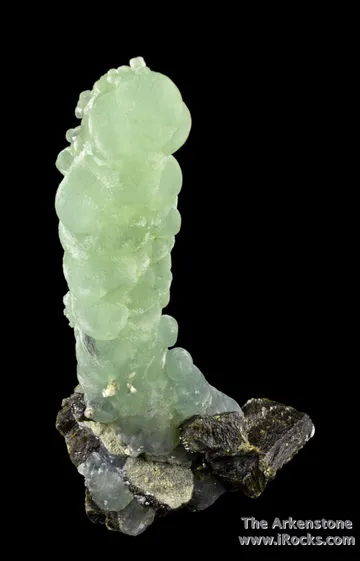
Prehnite is the signature display mineral of the Bendougou–Djouga area: translucent pale green to apple-green balls, hemispheres, crusts, and intergrown spherical clusters, commonly 2–3 cm across and locally to about 5 cm for individual rounded forms, with crusts that may reach several centimeters thick and occasionally much larger in mass. Djouga produced the classic “water-green” spheres on dark epidote, as well as crusts with flat undersides that preserve the form of vanished precursor crystals, probably anhydrite; Baga produced larger gray to gray-green crust material that was less valued for color. Good Bafoulabé prehnite has a glowing interior, a clean unbruised spherical outline, fine sparkling microtexture, and sculptural attachment to epidote; lesser pieces are iron-stained, chalky, oiled to compensate for dullness, broken along the edges, or too massive and gray to display the locality’s famous inner light.
Andradite from Bafoulabé Cercle overlaps visually and chemically with the famous Mali grossular-andradite suite, so careful labels matter: true andradite and melanite occur with the broader garnet assemblage, while many yellow-green to honey “Mali garnets” are better described as grossular-andradite series or ferrian grossular unless analyzed. Collector specimens from Bendougou, Sibinndi, Damandi Firman, Kembelé, and Koukouri/Trantimou commonly show rhombic dodecahedral crystals, often beveled by trapezohedron faces, in dark brown, reddish brown, blackish melanite, honey-orange, or yellow-brown colors; individual crystals on good specimens range from small drusy crystals to cabinet-scale crystals of several centimeters. The strongest pieces have lustrous, sharply bounded faces, visible translucency or color zoning, undamaged dodecahedral form, and attractive matrix associations with clinochlore, epidote, vesuvianite, or prehnite; ordinary pieces are opaque, granular, chipped, or sold under vague “Mali garnet” labels without a sublocality or species distinction.
Beyond the headline trio, Bafoulabé Cercle has a compact but interesting calc-silicate suite. Mindat lists actinolite, albite, almandine, amphibole-group minerals including uralite labels, apatite, apophyllite-group minerals, azurite, clinochlore, diopside, grossular, hematite, magnetite, malachite, native iron, pargasite, pyrite, quartz including chalcedony, stilbite-Ca, possible stellerite, titanite, and vesuvianite from the cercle and its sublocalities. Clinochlore rosettes on garnet, vesuvianite with andradite-grossular, titanite at Kembelé and Koukouri, and native iron from Damandi Firman are especially interesting to systematic collectors. This is not a locality famous for type minerals; its importance is specimen quality, gemological relevance, and the unusual abundance of attractive skarn-related prehnite-epidote-garnet combinations.
The most important authenticity issue for Bafoulabé material is locality precision. Many older labels say “Sandaré,” “Kayes,” “Diakon,” “Nioro du Sahel,” or “Bendoukou, Sandaré district.” Sandaré was a trading and road point, and some specimens sold under that name almost certainly came from Bendougou–Diakon localities farther south in Bafoulabé Cercle. Serious collectors should preserve every old label but, when possible, refine the locality to Djouga diggings, Baga, Kembelé, Koukouri, Sibinndi, Damandi Firman, or another documented sublocality.
Prehnite treatments are real and locality-specific: GIA reported that much of the Mali prehnite observed in the trade was oiled to improve appearance. Oil can deepen color, hide fine surface bruises, and reduce the chalky look of weathered material; it may also attract dust over time or create a slightly greasy feel. On a specimen, look into recesses and broken edges for uneven luster, darker seep lines, and dull un-oiled areas. Oiling does not make a specimen fake, but it affects value, and it should be disclosed.
The principal misidentification problem is not synthetic material but naming. Pale green Mali prehnite entered the gem and jewelry trade under erroneous descriptions such as “garnet with tourmaline inclusions,” even though XRD and EDS work identified the host as prehnite and many inclusions as epidote and amphibole. In specimen form, dark inclusions or rods in prehnite are usually epidote or amphibole, not tourmaline. Garnets are also loosely sold as “Mali garnet,” “grandite,” “grossular,” “andradite,” or “melanite.” Without analysis, yellow-green to brown material near the grossular-andradite join should be treated as a garnet-series specimen rather than forced into a single species name.
Condition is central. Prehnite spheres bruise, chip, and cleave from the matrix along their contact zones; edge damage on balls is common, especially on older lots that were transported in bulk. Epidote prisms are tougher-looking than they are: terminations and prism edges chip readily, and doubly terminated crystals may have hidden contacts where they detached from a pocket wall. Garnet crystals may show natural etching, stepped growth, or rough growth faces, but impact bruises on high points and broken dodecahedral corners are value killers.
Fluorescence is not a useful selling point for the classic green prehnite: GIA’s tested polished Mali prehnites were inert to both long-wave and short-wave ultraviolet. Handling is straightforward—avoid acids, oils, heat, and ultrasonic cleaning, especially on prehnite-on-epidote combinations with many small contact points. Dust removal is best done with a hand blower and soft brush; water can be used sparingly, but soaked specimens should be dried thoroughly to avoid mobilizing old oil or dirt trapped between prehnite spheres.
Market availability remains better than for many modern African classics because production was substantial and large quantities entered the trade in the 2000s and later. However, the best Djouga-style pieces—undamaged, sculptural, translucent green prehnite on sharp epidote—are no longer ordinary bulk material. Pure epidote clusters from Djouga or Baga, precise-sub-locality garnets, older ex Rock Currier or Demetrius Pohl pieces, and 2023 Koukouri garnet specimens with strong documentation are notably more desirable than generic “Mali prehnite” flats.
The most vivid chapter in Bafoulabé mineral collecting reads like a desert-rim prospecting rush. In the mid-1990s, the gem trade learned that western Mali was producing something new: yellow-green to brown grossular-andradite garnets, with rare intense green stones, from contact-metamorphic deposits around the Zone of Sangafé near Diakon. Access was not simple. Kayes could be reached by train from Bamako or Dakar; from Kayes, travelers still had roughly 170 km to Sandaré, then another 20–30 km on unpaved roads toward the mining areas around Sibinndi and Diakon. The rush was strong enough that extra railroad cars were reportedly added to trains going toward Kayes, while rough garnet moved in flour or rice sacks by whatever vehicle could reach the station.
The gem yield was almost absurdly small. Johnson and coauthors described parcels where hundreds of crystals—400 to 500 crystals weighing about 200 kg—might yield only 160 g of nodules, and only 60 g of facet-grade rough. From that, perhaps 150 carats of cut gems resulted: an estimated total yield of 0.015%. The numbers explain why so many large garnet crystals were broken for their gemmy cores and why good euhedral crystals became far scarcer than the amount of rough might suggest. One reported crystal exceeded 5.5 kg, yet the facetable portion of such stones was typically only a small internal zone.
A decade later, the collector story shifted from garnet to prehnite. In December 2005, Rock Currier and Demetrius Pohl visited the Bendougou–Diakon area and observed prehnite mining in progress. In Bamako they saw piles more than a meter high of rough “apple” green prehnite, not showroom-clean specimens but field material—some weathered, some iron-stained, much of it destined to be cobbed and packed into 120 kg bags for Asian bead factories. The mineral specimen trade was competing with the lapidary trade from the beginning; every fine undamaged prehnite-on-epidote group that survived as a specimen did so because someone chose not to cut, tumble, bead, or break it.
At Djouga, the workings were concentrated in a surprisingly small patch of ground. About 120 shafts had been dug in an area roughly 200 by 100 m, with tunnels radiating outward once miners hit prehnite-bearing rock. The shafts could reach about 24 m deep, and the work was done by simple hand methods. During the visit, 50–75 independent miners were active, but the labor force changed with farming needs and could swell to several hundred near the end of the dry season. The locality was not an industrial mine with benches and haul roads; it was a field of individual shafts, local miners, hand sorting, and the constant practical question of whether a piece was bead rough, specimen rough, or something exceptional.
Some of the most memorable finds are odd rather than merely beautiful. Flat-bottomed prehnite crusts from Bendougou preserve the ghost geometry of something that vanished, probably anhydrite crystals dissolved away after prehnite grew around them. A Heritage Auctions catalog preserved Rock Currier’s note on a Sougounikoura specimen: a 17 cm “finger” of prehnite with a black amphibole core visible when held to the light, plus a tiny bit of epidote—acquired when Currier bought a large lot of prehnite from Demetrius Pohl. Such pieces remind collectors that the locality is not just a factory for green balls on black sticks; it is a chemically restless calc-silicate system that grew prehnite around, over, and through earlier minerals.
_1.jpg)