Riemvasmaak, South Africa - a remote Northern Cape locality famous for emerald to lime green octahedral fluorite on quartz, prized by collectors for color, siz…
Key facts
Riemvasmaak is one of the great modern fluorite names: a remote Northern Cape occurrence where granitic desert country, quartz veins, and pegmatites have produced the electric green octahedral fluorites that collectors now recognize at a glance. The occurrence lies in the Orange River region north-west of Kakamas, close to the Namibian border, in the Kakamas Terrane of the Namaqua-Natal Province. It is not famous as an industrial fluorspar mine. Its importance is almost entirely specimen mineralogical: small pockets and near-surface workings have yielded transparent to translucent fluorite crystals, usually octahedral or modified cuboctahedral, commonly perched on white quartz or partly mantled by a sugary druse of secondary quartz.
The best Riemvasmaak pieces have a drama that few fluorites can match. The fluorite is typically saturated emerald, lime, or “neon” green, with crisp triangular faces and sharp, glassy edges; some crystals show violet cores, centered inclusions, or colour zoning. Matrix specimens are especially prized when the green fluorite sits naturally among bright milky-white quartz points, creating the now-classic green-and-white Riemvasmaak contrast. Large cabinet plates are known, and published accounts record octahedral and modified cuboctahedral crystals reaching exceptionally large sizes, but the collector’s sweet spot is often a thumbnail to small-cabinet group with undamaged crystals, bright transparency, and enough quartz matrix to prove the geologic context.
Regional View
Country View
Although Riemvasmaak specimens surged into the international market in the mid-2000s, the occurrence was not wholly unknown before that. Similar fluorite was already represented in South African institutional collections from earlier decades, but the 2007–2008 pockets transformed the locality from a regional curiosity into a world-class specimen source. Those finds were dug largely by local artisanal workers rather than by a formal mining company, and the resulting material quickly became a contemporary classic at major shows.
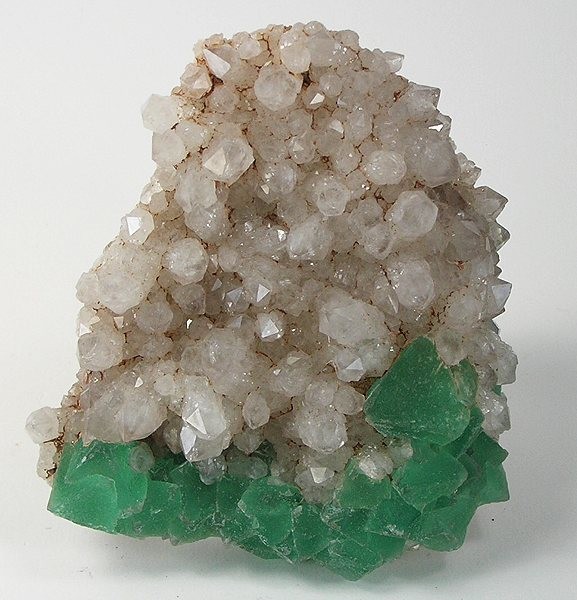
Photo: Rob Lavinsky, iRocks.com / Wikimedia Commons
Search for specimens: View all specimens from Riemvasmaak, South Africa
The mineral occurrence is generally given as the Riemvasmaak fluorite occurrences, near Riemvasmaak village, Kakamas, Kai !Garib Local Municipality, ZF Mgcawu District Municipality, Northern Cape Province. The collecting area is a small group of occurrences rather than a single named mine shaft. Published locality data place the occurrence roughly 3 km north of Riemvasmaak village, in desert terrain where small workings and spoil piles are visible in the hills.
Geologically, the specimens come from a granitic and pegmatitic district within the Namaqua-Natal Province, especially the Kakamas Terrane and associated Riemvasmaak Gneiss country. The broader Orange River pegmatite belt extends through the Kenhardt and Gordonia districts and into the Richtersveld region; around Riemvasmaak, quartz veins and pegmatites are common, and the fluorite-bearing pockets belong to this granite-related vein-pegmatite environment. For collectors, the important point is that fluorite formed in open spaces where octahedral crystals could develop, then in many cases received a later coating of white drusy quartz. The quartz crust is distinctive because it tends to coat the fluorite rather than the surrounding quartz matrix in the same way, a feature that has influenced both the look of natural pieces and the way specimens are prepared for sale.
There is no well-documented history of a large formal fluorspar operation at Riemvasmaak comparable to the major South African industrial fluorite mines. The occurrence is a specimen producer, worked in small pockets and shallow surface excavations. Fluorite specimens from the region were known by the 1970s, but the locality’s collecting history changed dramatically when high-quality green fluorites appeared on the international market around 2004 and then in larger, better batches from 2007 and 2008. Those later finds included thumbnail, miniature, cabinet, and large-cabinet specimens, many dug with hand tools from small pockets rather than from mechanized mining.
The best-publicized commercial wave came just before the 2008 Denver Show, when Collector’s Edge obtained a notable lot of Riemvasmaak fluorites that were described at the time as the finest seen up to that point. Later pieces continued to appear, including specimens dated 2008, about 2005, and January 2010 in dealer and collection records. Fabre Minerals, The Arkenstone, Crystal Classics, iRocks, and other fine-mineral dealers have all handled Riemvasmaak material, and the locality is now firmly represented in private and museum-level collections.
Collecting access today should be understood in the context of Riemvasmaak’s community-owned land and tourism landscape. The wider Riemvasmaak area is a community conservancy and wilderness, historically returned through land restitution after its use as a military testing and training area. Visitors come for the hot springs, 4×4 routes, hiking, and rugged granite-canyon scenery, but that does not make mineral collecting an open public activity. Serious collectors should treat the occurrence as controlled community land and rely on legitimate specimen channels unless they have explicit local permission, guidance, and safety clearance.
Riemvasmaak’s notable pocket history is not a series of named underground chambers, as at some classic mines, but rather a succession of small near-surface finds. The great pockets produced sharp green octahedra and cuboctahedra, some partly encased in white drusy quartz, some as single crystals, and others as groups on quartz matrix. Specimens labelled more broadly as “Orange River” may come from related but unnamed occurrences in the region; these can be excellent, but the stricter Riemvasmaak label is best reserved for pieces with reliable provenance to the Riemvasmaak fluorite occurrences.
Riemvasmaak fluorite is celebrated for transparent to translucent octahedra and modified cuboctahedra of CaF2, most famously in vivid emerald, lime, and apple-green colours, though yellow, yellow-green, purple, pale green, colourless, and phantom crystals are also documented. The classic association is white quartz: either as a matrix of milky to colourless crystals beneath the fluorite or as a thin sugary druse coating the fluorite itself. Fine specimens range from thumbnails with a single sharp octahedron to large cabinet pieces; individual crystals of several centimetres are well known, with exceptional published crystals far larger. The best pieces combine undamaged triangular faces, high transparency, intense uniform colour or attractive violet-green zoning, and a natural quartz setting; ordinary pieces tend to be loose, abraded, over-etched, heavily contacted, or lacking the crisp green-and-white contrast that defines the locality.
Quartz from Riemvasmaak is inseparable from the fluorite story: it forms the bright milky to colourless matrix crystals, the sugary drusy coatings, and in some cases the sculptural ridges that make the green fluorite stand proud. The finest quartz associations show clean, lustrous points that frame the fluorite without burying it, while natural drusy crusts can give unprepared pieces a snowy, frosted appearance. Sceptre quartz and amethyst are documented from the occurrence, and red or hematite-included quartz is noted from related Orange River material. For collectors, quartz is most valuable here when it is not merely background but an aesthetic counterpoint: sharp, sparkling, and intact enough to make the fluorite look brighter rather than visually crowded.
The verified mineral list for the Riemvasmaak fluorite occurrences is compact but interesting: fluorite and quartz dominate, with hematite, allanite-(Ce), amethyst, and sceptre quartz documented in standard locality records and publications. Allanite-(Ce) is a notable rare-earth-bearing accessory consistent with the broader pegmatitic and REE-enriched character of the district, while hematite is important both as a mineral in its own right and as an inclusion or staining agent in quartz and some regional fluorite-quartz material. No type-locality mineral species is securely tied to Riemvasmaak in the standard published locality record; the locality’s significance rests instead on specimen quality, colour, and modern collecting history.
Riemvasmaak fluorite has one locality-specific preparation issue every buyer should understand: many natural specimens were partly covered by a white drusy quartz coating, and much market material has been cleaned with hydrofluoric acid to reveal the green fluorite. This is not automatically a defect; it is part of the collecting history of the locality. However, over-cleaning can leave etched quartz, dulled surfaces, unnatural-looking recesses, or a too-stripped appearance. The most desirable prepared pieces preserve the contrast between bright fluorite and healthy quartz matrix, while unprepared or minimally prepared specimens showing intact quartz frost can have documentary and aesthetic value of their own.
The second authenticity concern is artificial shaping. Because fluorite has perfect octahedral cleavage, some loose Riemvasmaak material has been hand-cleaved or “improved” into more perfect octahedra. Natural pocket-grown octahedra generally show appropriate growth surfaces, subtle modifications, contact points, or matrix relationships; cleaved pieces may look too geometrically perfect, show broad flat cleavage faces without growth texture, or lack convincing provenance. This matters especially for loose single crystals sold as natural octahedra. Matrix specimens with a coherent quartz setting are usually more reassuring, though they still deserve close inspection.
Mislabelling also occurs. Related green fluorites from the broader Orange River region are sometimes labelled Riemvasmaak, and specimens from other green fluorite localities can be described loosely as “Riemvasmaak-type.” A good label should name Riemvasmaak, Kakamas, Northern Cape, South Africa, or the Riemvasmaak fluorite occurrences, and older dealer labels from recognized handlers add confidence. Conversely, an “Orange River” label may be honest but less specific.
Condition is crucial. Fluorite octahedra chip easily along edges and corners, and the glassy green material makes bruises conspicuous under strong light. Check apexes, triangular face edges, contact points, and the underside where crystals detached from the pocket. Quartz points on matrix are also commonly nicked, and acid preparation may leave them etched or softened. Strong pieces often fluoresce blue under longwave ultraviolet, and some published and dealer records note response under both longwave and shortwave UV, but fluorescence should be treated as a bonus rather than a sole proof of origin.
Riemvasmaak remains available on the market, but the supply is uneven. Small loose octahedra and modest clusters appear regularly, while fine matrix pieces with intense colour, transparency, good quartz, and minimal damage are significantly scarcer. Large cabinet specimens, crystals over several centimetres, and pieces from the best 2007–2010-era finds command strong premiums, especially when accompanied by old labels, collection history, or publication-quality aesthetics.
The Riemvasmaak story begins, fittingly, with straps. One well-known explanation of the name says that stock thieves were once caught near the Molopo River and tied to a large rock with rawhide thongs, rieme in Afrikaans. By morning, the captives were gone and only the straps remained. Another version ties the name to ox wagons and the tightening of leather thongs before climbing the hard country. Either way, the name stuck to a place of hard rock, dry riverbeds, and long memory.
The human history of the area is as striking as the minerals. Riemvasmaak was settled by a mixed community that included Xhosa-speaking people, Damara, Herero, Nama, and Coloured pastoralists. In the 1970s, under apartheid “black spot” removals, the community was forced off roughly 74,000 to 75,000 hectares north of the Orange River. People were divided by imposed ethnic classifications: some were sent to the Eastern Cape, some to towns in the Northern Cape, and Nama or Damara families to Namibia. The emptied land became a South African Defence Force training and weapons-testing area. Families began returning after the democratic transition, and Riemvasmaak became one of the emblematic early land-restitution cases of post-apartheid South Africa. Today the same broader landscape is known to visitors for hot springs, granite canyons, 4×4 tracks, and community-run tourism.
Against that background, the mineral discovery has an unusual character. This was not a famous old mine reopened by a corporate operator. It was a sparsely populated, rugged desert locality where local diggers found small pockets of startling green fluorite in quartz-bearing ground. By the time the best specimens reached the market in 2007 and 2008, the fine-mineral world was ready for them: sharp octahedra, vivid colour, and white quartz matrix made an instantly memorable combination.
In August 2008, Thomas P. Moore wrote that a “major new fluorite discovery in South Africa” was about to make a splash. Collector’s Edge had acquired a strong batch for the Denver Show, and the mineral world was told to expect a “neon-green spectacle.” The phrase was not exaggerated. The fluorites ranged from thumbnail to large cabinet size, many dug from small surface pockets with hand tools, and individual crystals were reported up to 12 cm on edge in that early market account. Later summaries pushed the known exceptional size even higher, recording octahedral and modified cuboctahedral crystals up to 15 cm on edge.
One of the most memorable practical details is the preparation method. Many Riemvasmaak fluorites came out under a thin white drusy quartz jacket. To reveal the green fluorite, preparators used hydrofluoric acid, an extremely dangerous process. A later South African account described quartz crystals being coated with wax to protect them while the unwanted quartz film on the fluorite was removed. That detail explains why some specimens look brilliantly exposed while others retain a sugary “snow” of quartz: the modern Riemvasmaak aesthetic is partly geology and partly very deliberate preparation.