Ras Koh Mountains, Pakistan - remote locality famed for brookite from Zard Mountain and Maldin Koh epidote, prized for sharp crystals and magnetic inclusions.
Key facts
The Ras Koh Mountains of Balochistan occupy a rugged desert sector of western Pakistan where the collector’s story is tied less to large-scale ore mining than to small, highly productive crystal pockets. For mineral collectors, the name now chiefly means the Zard Mountain–Thurdook brookite field and the Maldin Koh epidote occurrence: two modern Pakistani discoveries that put a remote part of Kharan District into serious worldwide collections. The geological background is the Chagai–Raskoh arc and its complicated mix of ophiolitic, volcanic, plutonic, and contact-metasomatic rocks, but the specimen-level importance is more intimate—open pockets and veins that allowed titanium oxides, quartz, epidote, feldspar, chlorite, magnetite, titanite, and related minerals to grow with sharp faces and display-quality aesthetics.
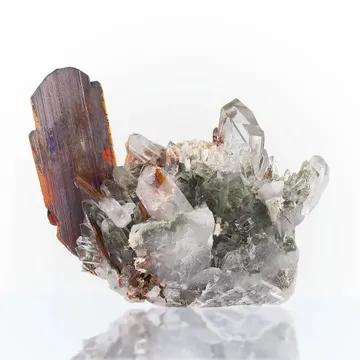
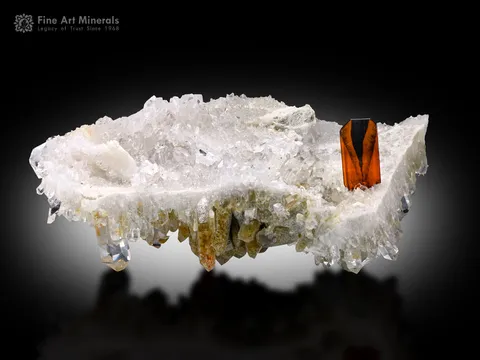
The best Ras Koh brookites have become modern classics: thin, lustrous, red-brown to orange TiO2 blades, commonly on quartz, sometimes with black internal phantoms that flash dramatically when backlit. The best epidotes are just as locality-specific in their own way: flattened pseudohexagonal, pseudo-octahedral, and tabular green crystals from Maldin Koh, some slightly magnetic because of magnetite inclusions in a skarn-like igneous core. Together these two minerals give Ras Koh an unusual collecting identity—one locality group famous for both gemmy, fiery titanium oxides and heavy, sculptural, magnetic epidote habits.
Regional View
Country View
In the market, “Kharan District” has often been used as a broad label for material from this area, especially on older brookite specimens. More specific labels may read Zard Mountain, Mount Zard, Ras Koh Range, Thurdook or Thurdok, Nausherwani mine, Maldin Koh, or Maldeen/Maldin. That label history matters: the minerals were extracted in remote country, moved through local traders and Pakistani mineral networks, and often reached international dealers with simplified or generalized locality names. Serious collectors should treat Ras Koh labels as part of the specimen’s evidence, not merely decoration.

Photo: Rob Lavinsky / iRocks.com via Wikimedia Commons
Search for specimens: View all specimens from Ras Koh Mountains, Pakistan
The Ras Koh Mountains lie in Kharan District and Chagai District, Balochistan, and the collector localities most often attached to fine specimens are in the Kharan portion of the range. Mindat places the Ras Koh Mountains regional locality at about 28°49′43″N, 65°11′42″E, while Zard Mountain, the best-known brookite area, is listed west of Kharan with sublocalities including Thurdook and the Nausherwani mine. Maldin Koh, the epidote ridge, is a nearby Ras Koh locality and is listed roughly 5.7 km from Zard Mountain in locality data.
The broader geological setting is a segment of the Chagai–Raskoh magmatic arc and associated ophiolitic terranes. Published work on the Ras Koh ophiolites describes serpentinized peridotites and a preserved metamorphic sole emplaced over a Jurassic–Cretaceous island-arc sequence, later intruded by calc-alkaline to subalkaline tonalite, diorite, and gabbro related to north-directed subduction magmatism. Another petrogenetic study of Raskoh volcanic rocks interprets the Late Cretaceous volcanic suite as an oceanic island-arc product developed in the Ceno-Tethyan convergence system. For the specimen collector, the important translation is this: Ras Koh is not a simple pegmatite district, but a structurally and thermally complicated arc terrane where igneous rocks, skarn-like alteration, fissures, and small hydrothermal pockets produced localized crystal assemblages.
The brookite occurrences are specimen workings rather than titanium ore deposits. Thurdook is described as a digging area at Zard Mountain that produced high-quality brookite specimens, with the exact location unrevealed and coordinates commonly tied only to the Zard Mountain summit. Nausherwani mine labels also occur, but collectors should note that Nausherwani-related names have been used for more than one Kharan District occurrence, including Zard-area brookite material and a separate Char Kohan quartz mine outside the strict Ras Koh locality. The most defensible Ras Koh brookite labels are those that retain the Zard Mountain or Thurdook connection and are backed by old dealer labels, photographs, collection history, or a credible Pakistani source.
Brookite and anatase from Kharan surged onto the international market in 2004, and that influx changed the collector hierarchy for brookite. Earlier classic localities in the Alps and elsewhere had long supplied beautiful crystals, but Kharan material brought a combination of relatively large blade size, red-orange transmitted color, lustrous faces, black phantoms, and quartz-matrix presentation that was unusually strong for the species. Fabre Minerals documented Mount Zard brookites from 2004 and 2005, including flattened crystals on quartz and specimens with albite. Later appearances continued, but the early flood diminished; high-end pieces are now more selective, and genuinely undamaged large blades are no longer casually available.
Maldin Koh’s epidote story is later and mineralogically distinct. Specimens began circulating with confused labels such as Quetta, Dalbandin, Zard Mountain, Nausherwani mine, or simply Balochistan before the Maldin Koh attribution became accepted for the pseudohexagonal and pseudo-octahedral magnetic epidotes. The occurrence is best understood as pockets within weathered igneous rock or a skarn-like deposit. The USGS-hosted Mindat article by Brownfield, Lowers, and Betterton studied two unusual crystals supplied by Rock Currier and documented magnetite, titanite, quartz, albite, biotite, actinolite, and chamosite in the core material. Their conclusion explains the apparent paradox collectors noticed immediately: the crystals are epidote, not magnetite pseudomorphs, yet some attract a magnet because magnetite inclusions are present.
There is no public, collector-friendly access model for Ras Koh comparable to a regulated fee quarry or club collecting site. These are remote Balochistan workings, the precise pocket localities are partly protected by miners and dealers, and security, land rights, mineral rights, and travel permissions are serious practical issues. Field collecting should not be attempted without explicit permission from the claim holders or local authorities, appropriate regional guidance, and a clear understanding that the published coordinates for some sublocalities may represent a summit or generalized locality rather than a safe or exact collecting point.
The notable finds are best treated in two groups. At Zard Mountain and Thurdook, pockets produced brookite with quartz, anatase, albite, chlorite, and locally faden or smoky-looking quartz associations. At Maldin Koh, pockets and veins yielded heavy green epidote crystals and clusters, including flattened tabular forms, pseudohexagonal crystals, and pseudo-octahedral forms whose magnetism led to early debate. These two specimen populations are close enough to belong in the Ras Koh collector story, but different enough that a good label should not collapse them into a single vague “Kharan” occurrence when better provenance is available.
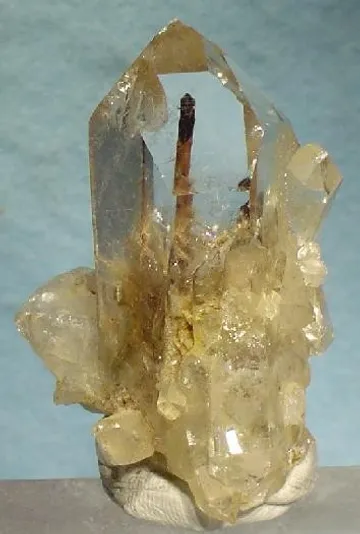
Ras Koh brookite is the locality’s prestige mineral, especially from Zard Mountain, Thurdook/Thurdok, and Nausherwani-labelled material in the Zard area. Crystals are typically flattened, lustrous, striated blades or tabular prisms of TiO2, ranging from small sharp crystals on quartz to major cabinet specimens with crystals several centimeters across; museum and dealer records document exceptional Thurdook examples with very large main crystals, while most market pieces are far smaller. Color is the essential character: in reflected light the crystals may look dark brown, root-beer, reddish brown, or nearly black, but strong backlighting can reveal orange, red-orange, amber, and brown transparency, often with dramatic black phantom patterns. The common matrix is quartz, sometimes with albite or anatase; the best pieces have upright, undamaged blades, glassy luster, crisp terminations, visible translucency, and an uncluttered quartz setting, while ordinary pieces tend to be contacted, edge-chipped, opaque-looking, or crowded into less aesthetic matrix.
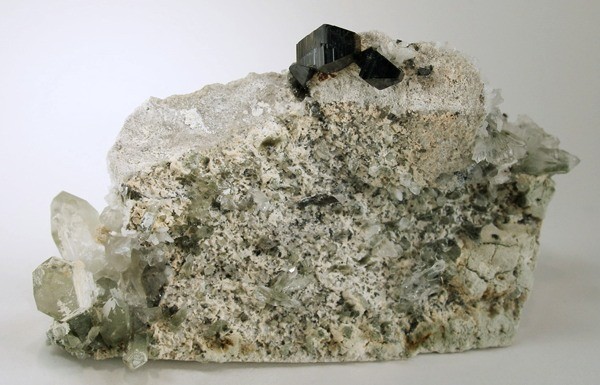
Ras Koh epidote is most characteristic from Maldin Koh, where the famous crystals are not the long, needlelike or prismatic epidotes collectors may expect, but flattened tabular, pseudohexagonal, and pseudo-octahedral green crystals with unusually heavy, sculptural forms. The better-documented studied crystals measured about 5.5 to 6.5 cm and were slightly magnetic; larger market and auction examples include palm-sized clusters with a saturated olive to pistachio-green color, lustrous microcrystalline coatings, and areas of smoother, gemmier surface. The assemblage documented in the core and associated material includes magnetite, titanite, quartz, albite, biotite, actinolite, and chamosite, tying the specimens to weathered igneous or skarn-like pockets rather than a simple alpine fissure. Good Ras Koh epidote is judged by completeness, bold pseudohexagonal or pseudo-octahedral form, clean crystal definition, deep even color, attractive cluster architecture, and minimal pocket contact; ordinary examples can be massive-looking, heavily coated, broken at the base, or too dark and crude to show the unusual habit clearly.
Other documented Ras Koh minerals include anatase, albite, actinolite, biotite, calcite, chamosite, chlorite-group minerals, magnetite, quartz, amethyst, sceptre quartz, and titanite. Anatase is the most important companion species for brookite collectors, occurring as lustrous dipyramidal crystals on quartz and albite and sometimes sharing matrix with brookite; titanite and magnetite are especially important in understanding the Maldin Koh epidote material. Ras Koh is not chiefly known as a type-locality district for new species, but as a locality where familiar species—especially brookite and epidote—take on unusually collectible forms.
The principal authenticity issue is not synthetic material; it is locality precision. Genuine brookite from Balochistan has been sold under broad and sometimes conflicting labels: Kharan District, Zard Mountain, Ras Koh Mountains, Rashkoh Mountains, Thurdook, Thurdok, Ghad mine, Nausherwani mine, Dalbandin, Taftan, and even Quetta. Some of those names refer to real districts or separate Balochistan occurrences, while others may be generalized trade labels or errors. A “Kharan District” label is not automatically bad, especially for early material, but a high-value specimen should have a provenance trail that supports any more exact Ras Koh attribution.
For brookite, condition is everything. The crystals are thin, brittle, and commonly exposed on quartz, so look carefully for chipped terminations, abraded vertical edges, glued bases, repaired blades, detached reattached crystals, and quartz points broken around the main crystal. Some dealers have shipped fragile Kharan brookites in water-soluble protective resin; that is best understood as a shipping protection method rather than a treatment, but buyers should ask whether all residue has been removed and whether any consolidant remains.
For epidote, beware the old “epidote after magnetite” or “magnetic pseudomorph” interpretation. The magnetic Ras Koh material is epidote with magnetite inclusions, not a simple epidote pseudomorph after magnetite. A magnet can be a useful curiosity test, but it is not a standalone identification method. The best Maldin Koh examples show epidote crystal morphology clearly; crude dark masses that merely attract a magnet should be treated cautiously unless the provenance and morphology are convincing.
Fluorescence is not a major buying criterion for the Ras Koh suite. Brookite is generally not sought for fluorescence, and epidote is valued here for form, color, magnetite-bearing composition, and locality significance. Handling should be conservative: keep brookite away from ultrasonic cleaning, avoid pressure on free-standing blades, and store crystals so that quartz points or neighboring specimens cannot strike the edges. Epidote is mechanically tougher in hand, but pocket contacts and thin projecting corners can still bruise.
Market availability is uneven. Small brookites and ordinary quartz-matrix specimens continue to appear, as do Maldin Koh epidotes, but the finest Ras Koh pieces are no longer plentiful. Top brookites are those with large, transparent, fiery blades on attractive quartz; strong phantoms and damage-free terminations command serious attention. Top epidotes are bold, complete, pseudohexagonal or pseudo-octahedral clusters with saturated color and minimal contact. The locality rewards patient buying: there is enough material in circulation that one need not settle for a damaged example, but the truly exceptional pieces are scarce enough that provenance and condition should be assessed quickly when they appear.
The Ras Koh brookite story entered the modern collecting world suddenly. Around 2004, Kharan District produced what Thomas P. Moore later described as a “mighty surge” of thousands of brookite and anatase specimens. For collectors who had been used to modest Alpine brookites, the Pakistani material seemed almost improbable: lustrous red-orange blades, transparent under strong light, perched on clean quartz, and marked by black hourglass phantoms. Within a few years the flood had slowed, and by 2019 Moore was already writing that the brookites were still not rare, but were “considerably less common” and more expensive than before.
One 2019 market episode captured the shift perfectly. Brian Kosnar of Mineral Classics posted 30 Kharan District brookite specimens at once—an unusually large group by then. The range was broad: small thumbnails with brookite blades on transparent quartz, and cabinet-size matrix pieces carrying dozens of crystals rising from crannies. In that group, the largest individual brookite blade was 3.2 cm on a 7.7 cm matrix specimen priced at $1,300, while a 2.2 cm thumbnail was priced at $900. Those figures tell a compact market history: what had arrived in quantity in 2004 had become, fifteen years later, a competitive modern classic.
The Nausherwani family story gives the locality a human thread. In a Mindat discussion in 2011, Nauroz Nausherwani wrote that he was 12 when his elder brother Faisal returned from Germany after completing his studies. Faisal saw brookite and anatase from Kharan, and because he belonged to Kharan, he became curious about the minerals. He brought specimens home and showed them to Nauroz, who wrote that he was “really attracted to the natural beauty of minerals.” That small family moment sits behind a much larger international trade story: local curiosity, remote Balochistan pockets, and specimens that eventually reached collections around the world.
The label confusion around Ras Koh is almost a field note in itself. In another Mindat exchange, Rock Currier explained that his supplier in Peshawar, an experienced mineral dealer, was confident that the unusual epidotes came from Zard Mountain, and that similar specimens came from more than one locality in the area. Collectors immediately wrestled with Quetta, Kharan, Zard Mountain, Maldeen, and Maldin Koh. Karel Bal added the practical explanation that Quetta was likely where early specimens were traded rather than where they were found, and that Zard-Koh in the Ras Koh Range should not be confused with the famous Zard Kuh in Iran’s Zagros Range. The debate is a reminder that in remote mineral districts, the first label is often a trade route, not a GPS point.
The Maldin Koh epidotes also generated a mineralogical detective story. Their pseudo-octahedral shapes and magnetic response encouraged early talk of epidote pseudomorphs after magnetite. The later study by Brownfield, Lowers, and Betterton gave collectors a better answer: the crystals were epidote with magnetite inclusions in a weathered igneous or skarn-like core. The shape was unusual, the magnetism was real, but the simple pseudomorph story was not. That is exactly the kind of correction serious collectors value, because it turns an oddity into a documented locality signature.
Michael E. Brownfield, Heather Lowers, and William K. Betterton, “Epidote from the Zard Mountains, Kharan, Balochistan, Pakistan,” Mindat.org article listed by the U.S. Geological Survey, 2013. This is the key modern mineralogical note on the magnetic pseudohexagonal and pseudo-octahedral epidotes, including the magnetite-bearing core assemblage. USGS publication page
Michael E. Brownfield, Heather Lowers, and William K. Betterton, “Epidote from the Zard Mountains, Kharan, Balochistan, Pakistan,” Mindat article page. The article’s summary records the slightly magnetic epidote crystals, magnetite inclusions, titanite, quartz, albite, biotite, actinolite, chamosite, and weathered igneous/skarn-like pocket setting. Mindat article
Edwin Gnos, Mehrab Khan, Khalid Mahmood, Abdul Salam Khan, and Igor Maria Villa, “Age and tectonic setting of the Ras Koh ophiolites, Pakistan,” Acta Mineralogica Pakistanica, volume 11, issue 1, pages 105–118, 2000. This paper provides the geological framework for Ras Koh ophiolites, metamorphic soles, emplacement, and later arc-related intrusions. PASTIC record
M. Khan and coauthors, “Petrogenesis of Late Cretaceous lava flows from a Ceno-Tethyan island arc: The Raskoh arc, Balochistan, Pakistan,” Journal of Asian Earth Sciences, 2013. This study places the Raskoh volcanic rocks in an oceanic island-arc and Ceno-Tethyan convergence context. ScienceDirect abstract
Thomas P. Moore, “What’s New in the Mineral World,” Report #52, The Mineralogical Record, April 15, 2019. Moore’s online report gives a collector-market snapshot of Kharan brookite, including the 2004 surge, later scarcity, locality-name confusion, and 2019 Mineral Classics offering. Mineralogical Record PDF
Heritage Auctions, lot 72099, “Epidote, Maldin Koh, Ras Koh Mountains, Kharan District, Balochistan, Pakistan,” 2024. A notable market record for an 8.7 × 7.7 × 7.6 cm pseudohexagonal epidote floater cluster, useful for documenting specimen scale and market presentation. Heritage Auctions lot
mim Museum / Mineralogia.es online album entries for Ras Koh brookite. These document several museum-held Thurdook and Zard Mountain brookites, including very large main crystals and brookite with quartz, anatase, faden quartz, and feldspar-group associations. Mineralogia.es album
Mindat: Ras Koh Mountains, Kharan District, Balochistan, Pakistan — Core regional locality page with coordinates, hierarchy, and documented mineral list for the Ras Koh Mountains.
Mindat: Zard Mountain, Ras Koh Mountains, Kharan District, Balochistan, Pakistan — Essential sublocality page for Zard Mountain, including brookite, quartz, epidote, magnetite, titanite, and related species.
Mindat: Thurdook, Zard Mountain, Ras Koh Mountains, Kharan District, Balochistan, Pakistan — Named digging area tied to high-quality brookite specimens and alternate spelling Thurdok.
Mindat: Maldin Koh, Ras Koh Mountains, Kharan District, Balochistan, Pakistan — Key locality page for the magnetic pseudohexagonal and pseudo-octahedral epidotes.
USGS: Epidote from the Zard Mountains, Kharan, Balochistan, Pakistan — Publication record for the Brownfield, Lowers, and Betterton study of the unusual epidotes.
Mindat discussion: Magnetic epidote from Pakistan — Valuable collector discussion documenting the Quetta/Zard/Maldin Koh label correction and early interpretation of the magnetic epidotes.
Mindat discussion: Pakistan epidote psd. after magnetite? — Useful background on the pseudomorph question and why the Maldin Koh epidotes are now understood differently.
Fabre Minerals reference specimens: Mount Zard brookite and Ras Koh epidote — Dealer-archived reference examples documenting 2004 Mount Zard brookites and Ras Koh epidote with quartz.
The Mineralogical Record: What’s New in the Mineral World, Report #52 — Collector-market context for the 2004 Kharan brookite surge, 2019 availability, prices, and diagnostic aesthetics.
Wikimedia Commons: Minerals of Kharan — Freely licensed photographs of Kharan brookite, anatase, quartz, and related minerals useful for visual comparison.
mim Museum / Mineralogia.es album page — Museum-oriented image records of Thurdook, Zard Mountain, and related Balochistan brookite specimens.