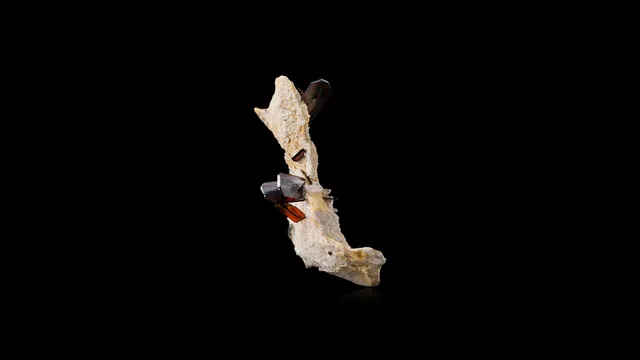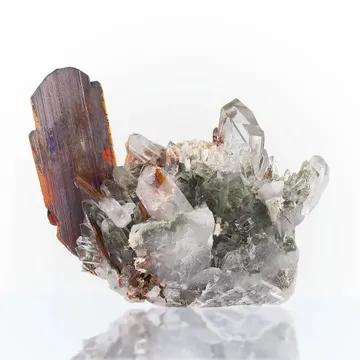
Kharan District, Pakistan — brookite on quartz with red-brown to fiery orange blades, phantom zoning, and large Alpine-style crystals prized by collectors.
Key facts
Kharan District, in western Balochistan, is one of the few modern localities that genuinely changed collector expectations for a classic species. Its reputation rests first on brookite: red-brown to fiery orange TiO2 blades, commonly perched on quartz, with the black internal phantom zoning that has become almost a signature of the district. The important specimen ground lies in the Ras Koh Mountains, especially around Zard Mountain, west of Kharan town, where labels such as Zard Mountain, Mount Zard, Ras Koh Range, Nausherwani mine, Thurdook or Thurdok, and the broader “Kharan District” all appear in the market record.
The locality’s geological personality is not that of the famous northern Pakistani pegmatite districts. Kharan belongs to the arid, rugged Chagai–Ras Koh arc country of Balochistan, a terrain of volcanic, intrusive, and locally skarn-influenced rocks. For collectors, the critical feature is open-space pocket growth. Brookite, anatase, quartz, albite, epidote, rutile, magnetite, titanite, and related minerals formed in clefts and cavities where crystals could develop freely, giving many pieces a poised, Alpine-style look: sharply terminated oxides on bright quartz, rather than massive ore specimens.
Kharan’s historical significance is unusually clear. In the early 2000s, and especially during the 2004–2005 market surge, thousands of brookite and anatase specimens from Balochistan reached dealers and shows. Suddenly, brookite was no longer represented mainly by elegant but small European Alpine blades or scattered classic thumbnails. Kharan offered larger crystals, stronger red-orange transmitted color, dramatic phantoms, and attractive quartz matrix. The best pieces are now modern classics: dark root-beer blades in reflected light that ignite amber, orange, or Bengal-red when backlit.
Regional View
Country View

Photo: Wikimedia Commons
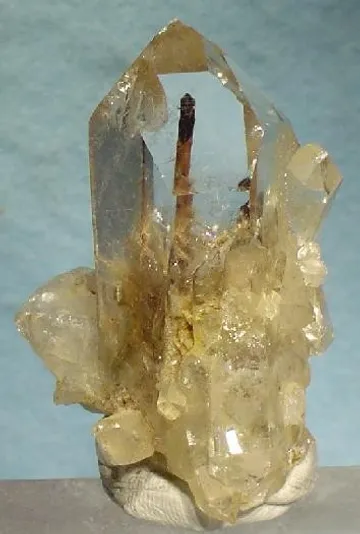
A fine Kharan brookite is best judged both normally and with light behind it. From the front it may read as dark brown, blackish brown, or smoky red; against a strong light it can become transparent orange-red, revealing phantoms, internal growth zones, and slender “tiger-stripe” shadows. Matrix matters too. White quartz, colorless quartz, faden quartz, albite, or a clean pocket wall can elevate an otherwise good blade into a display specimen with real visual drama.
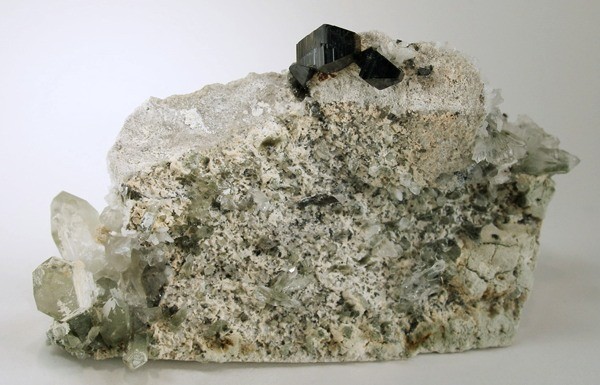
Photo: Wikimedia Commons
Search for specimens: View all specimens from Kharan District, Pakistan
Kharan District is an administrative region in Balochistan, but the specimen locality name is usually an umbrella for a small suite of workings and pocket zones in the Ras Koh Mountains. Zard Mountain is the most important name to know. It lies west of Kharan town, and Mindat treats it as the most precise name for much of the brookite and anatase once sold simply as “Kharan.” The Zard Mountain coordinate commonly cited for the locality corresponds to the summit, about 1,650 m elevation, rather than to every individual pocket.
The deposit style is best understood as Alpine-type cleft and pocket mineralization in a volcanic-intrusive to skarn-influenced mountain setting. The regional Chagai–Ras Koh arc includes Cretaceous to Cenozoic volcanic and intrusive rocks, with the Ras Koh Range recording a complex history of accretionary, volcanic, sedimentary, and intrusive units. The collector specimens are not products of a large commercial titanium ore body; they are pocket minerals from small openings where quartz, albite, TiO2 polymorphs, and calc-silicate minerals crystallized freely.
The titanium-oxide assemblage is the heart of the locality: brookite, anatase, and rutile all occur, commonly with quartz and albite. The classic pocket look is brookite on quartz, but matrix specimens with anatase, quartz, feldspar, and small brookite blades are equally important for understanding the locality. Rutile appears both as individual associated material and as inclusions in quartz. Quartz itself can be clear, milky, tabular, drusy, doubly terminated, faden, or included with chlorite, brookite, or rutile.
Several named localities help refine Kharan labels. The Nausherwani quartz mine at Char Kohan is a distinct mine and should not be confused with the Nausherwani mine near Zard. The Char Kohan Nausherwani quartz mine is documented for anatase, axinite-(Fe), brookite, chromite, and quartz. The Zard-associated Nausherwani mine is tied to brookite, anatase, and faden quartz labels in the collector trade. Thurdook, also rendered Thurdok, is a named digging area at Zard Mountain and is recorded for brookite on quartz. Rayo Mine, elsewhere in Kharan District, is important for andradite and sits within a broader chromite-bearing Ras Koh context rather than the main brookite-quartz pocket narrative.
Mining history here is specimen-led and locally controlled. There is no long, well-documented history of industrial production comparable to a classic European ore mine. Instead, the record begins to matter to mineral collectors when brookite from Kharan began reaching Western markets around 2003, followed by the dramatic 2004 surge and continued 2005 production documented by dealers. Early material was often labeled broadly, sometimes with confusing or overlapping terms such as Kharan, Kharan Mountains, Mount Zard, Ras Koh, Nausherwani, Thurdok, Dalbandin, or Taftan. That label problem remains part of the locality’s identity.
The best-known production includes miniature to cabinet specimens with lustrous brookite blades on quartz, some with main crystals in the 1–3 cm range and rare larger examples. Fabre Minerals documented Mount Zard pieces from 2004 and 2005, including brookite with quartz, brookite with albite, and specimens with sharply formed main crystals over 2 cm. The Mineralogical Record’s 2019 market report noted that Kharan brookites were still obtainable but less common and more expensive than during the early abundance, and that a 2019 Mineral Classics offering contained 30 Kharan specimens ranging from elegant thumbnails to cabinet pieces with numerous blades.
Collecting access should not be treated as casual rockhounding. These are remote desert-mountain workings, not a public fee-dig locality. Published locality pages warn that no one should attempt to visit without permission from land and mineral-rights holders and without appropriate safety precautions. In practical collector terms, Kharan specimens reach the market through Pakistani miners and dealers, then through international dealers and auctions. For a buyer, the realistic work is not arranging a field trip; it is reading labels carefully, comparing habits and associations, and buying from sources that understand the difference between Zard Mountain, Nausherwani, Char Kohan, Thurdook, Rayo, and the district-level label.
Brookite is the mineral that made Kharan famous: flattened prismatic to thin tabular TiO2 crystals, commonly red-brown, dark brown, or nearly black in reflected light, but orange, amber, or fiery red-orange when backlit. The best examples come from the Zard Mountain–Ras Koh pocket system and related Kharan labels, especially pieces from the 2004–2005 production, where blades are perched on clear to milky quartz, albite, or faden quartz. Typical desirable specimens have 1–2 cm blades; better pieces carry sharper, cleaner, more transparent crystals approaching or exceeding 3 cm, and major examples are valued for complete terminations, bright luster, strong red transmitted color, and black internal phantom zoning. Ordinary Kharan brookite may be just a dark chipped blade or a crowded matrix fragment; a superior one stands upright, has crisp edges, shows a dramatic phantom, and remains undamaged at the thin termination.
Quartz from Kharan is rarely the headline species, but it is the stage on which the locality’s best specimens perform. It occurs as bright drusy coatings, colorless to milky crystals, doubly terminated crystals, tabular crystals, faden quartz, and included crystals containing rutile, brookite, chlorite, or dark phantom material. In the Zard Mountain and Nausherwani-associated material, quartz may form clean white or transparent clusters that contrast beautifully with red-brown brookite, or it may host anatase and albite on feldspar-rich matrix. Good quartz pieces from Kharan are not judged only by quartz perfection; collectors look for sharp, undamaged quartz that aesthetically supports brookite or anatase, shows interesting inclusions, or preserves the open-cleft pocket character of the deposit.
Anatase from Kharan belongs to the same TiO2 pocket suite as brookite and rutile, and good pieces show sharp bipyramidal crystals in dark blue, black, brown, or blue-brown tones on quartz, albite, feldspar-rich matrix, and occasional brookite. Zard Mountain and broader Ras Koh labels dominate the collector record, while the Nausherwani quartz mine at Char Kohan is also documented for anatase. Many Kharan anatases are around thumbnail scale, but the locality is notable for matrix specimens with numerous sharp crystals averaging around 1 cm and, in select reports, larger crystals that helped challenge the idea of anatase as mainly a micro or thumbnail species. The best pieces have bright luster, clean bipyramidal form, strong contrast on pale albite or quartz, and an intact association with brookite or quartz rather than isolated, damaged dark grains.
Epidote from Kharan is a separate but important Ras Koh story, especially the unusual material from Maldin Koh and Zard Mountain-area labels. Specimens range from pistachio-green fan sprays on quartz to dark green, pseudohexagonal or pseudo-octahedral crystals, some large enough to be cabinet-worthy and some slightly magnetic because of microscopic magnetite inclusions. A USGS-linked study of unusual Zard Mountain epidote examined crystals roughly 5.5–6.5 cm across and interpreted the material as having formed in pockets within weathered igneous or skarn-like rock containing magnetite, titanite, quartz, albite, biotite, actinolite, and chamosite. The best Kharan epidotes are sharp, lustrous, sculptural, and distinctive in form; ordinary pieces are darker, bruised, or visually heavy without the crisp sprays, magnetic curiosity, or quartz contrast that make the locality memorable.
Andradite is much scarcer on the Kharan market than brookite, quartz, anatase, or epidote, and the documented district occurrence is tied to the Rayo Mine. Dealer records describe Kharan andradite as brown to deep brown or orange-brown crystals, including sharp dodecahedral groups and very acute dipyramidal-looking crystals, commonly on albite and associated with epidote, titanite, and additional small andradite. The known specimen style is calc-silicate rather than gem demantoid: compact, lustrous, dark garnet groups with pale albite contrast and occasional green epidote. Good pieces here are judged by sharp crystal faces, contrast, transparency or translucency in smaller orange crystals, and a credible Rayo or Kharan District provenance; ordinary pieces can look like undifferentiated brown garnet crust unless the form and associations are clear.
Other documented Kharan District minerals include albite, rutile, axinite-(Fe), chromite, calcite, magnetite, titanite, actinolite, chamosite, clinochlore, chrysotile, fluorite, prehnite, K-feldspar/adularia, schorl, spessartine, amethyst, and sceptre quartz. No well-established IMA type-locality mineral appears to define Kharan’s collector importance; its distinction is instead assemblage and quality. The rarities that matter most to collectors are not new species but locality-specific forms: brookite with black phantoms, brookite and rutile inclusions in quartz, Kharan anatase on albite-rich matrix, slightly magnetic epidote, and the far less common axinite-(Fe), andradite, prehnite, spessartine, and titanite occurrences attached to specific Kharan sublocalities.
The main authenticity concern with Kharan specimens is assembly and repair, not synthetic production. Brookite blades are thin, brittle, and highly valuable when well placed on quartz, which makes them tempting candidates for gluing, reattachment, or undisclosed reconstruction. Examine the base of each important crystal under magnification. Warning signs include glossy adhesive, crushed matrix powder packed around the contact, a blade that sits on quartz without any natural pocket texture, mismatched color or dirt at the contact, or a “perfect” central crystal with no smaller associated brookites where the rest of the pocket surface suggests there should be some.
Repairs are not unusual on fine brookite, because the crystals are thin and edge-sensitive. A disclosed reattachment may still be acceptable for a display specimen if the visual quality is high and the price reflects it. Undisclosed repair, however, is a major value issue. Termination chips, bruised edges, broken side crystals, contacted backs, and sawn or trimmed matrix are common condition problems. Since many Kharan brookites are visually dominated by a single blade, even a small chip can matter.
Some recent dealer descriptions mention shipping fragile Kharan brookites in temporary water-soluble protective resin. That is a packing method rather than a mineralogical treatment, but buyers should still ask whether any coating, consolidant, or residue remains on the specimen. Cleaning should be conservative: brookite is brittle, quartz points can be loose, and pocket clay may hide supporting contacts. Ultrasonic cleaning is a poor idea for most brookite-on-quartz pieces.
Locality precision affects desirability. “Kharan District” is common and often legitimate for older specimens, especially those from the early wave, but it is broad. “Zard Mountain, Ras Koh Mountains” is better when supported by a reputable old label. “Nausherwani” requires care because the district has both a Nausherwani quartz mine at Char Kohan and Nausherwani-labeled Zard material. “Thurdook” or “Thurdok” points to a named Zard digging area. “Rayo Mine” is most relevant to andradite rather than the classic brookite-on-quartz suite.
Fluorescence is not a central diagnostic feature for the main Kharan suite. Brookite, anatase, rutile, and ordinary quartz should not be bought on fluorescence claims. Backlighting, however, is essential for brookite. A crystal that looks opaque brown in the case may reveal superb orange-red transparency and black phantoms with a small light behind it.
Market availability is active but tiered. Modest brookite thumbnails and small matrix pieces still appear through online auctions, Pakistani dealers, and fine-mineral websites. Good undamaged matrix examples with transparent, lustrous, phantom-bearing crystals are much scarcer. Large blades, strong phantoms, faden quartz associations, and balanced cabinet pieces are now serious collector material. Anatase and epidote from Kharan are less constantly available than brookite, and andradite from Rayo Mine is distinctly uncommon.
The Kharan story begins, for most collectors, as a market shock. Around 2003 and 2004, specimens from Balochistan began appearing in numbers that did not fit the old brookite script. Brookite had long been a connoisseur’s species: admired for elegance, crystal form, and rarity in good display pieces, but often small. Then Kharan produced sharp red-brown blades on quartz, many large enough to dominate a thumbnail or miniature, and some with black phantom structures that made the crystals look alive when backlit.
By 2019, Thomas P. Moore could already write about the early production as history. His Mineralogical Record report described “a mighty surge” in 2004 that brought thousands of brookite and anatase specimens from Kharan onto the scene. The same passage noted the inevitable aftermath: the surge declined, and good brookites became less common and more expensive. That is exactly how the locality entered collector memory: first as a flood of unexpectedly fine Pakistani brookite, then as a tightening supply of increasingly selective specimens.
The labels tell another story. Moore listed the kinds of names attached to the material: Ghad mine, Thurdok mine, Dalbundi, Taftan, Zard Mountain, Rashkoh Mountains, and broad Kharan District labels. Some of those names are sublocality clues; others reflect the messy path from remote pocket to dealer tray. Kharan specimens passed through miners, local buyers, exporters, show dealers, and collectors, and the label often became more generalized at each step. Serious collectors now treat the label history as part of the specimen’s value.
One vivid 2019 market moment involved Brian Kosnar of Mineral Classics posting 30 Kharan District brookites at once. The range itself was the story: small elegant thumbnails with blades on transparent quartz at one end, cabinet-size matrix pieces with dozens of brookites rising from crannies at the other. In that offering, a 7.7 cm matrix piece carried a 3.2 cm brookite blade and was priced at $1,300, while a 2.2 cm thumbnail was priced at $900. Those numbers say a great deal about the locality’s arc. Kharan brookite was still available, but the best crystals had moved firmly into the world-class specimen market.
The epidote story is quieter but wonderfully strange. In 2012, two unusual Kharan epidote crystals reached Rock Currier of Jewel Tunnel Imports and were studied by Michael E. Brownfield, Heather Lowers, and William K. Betterton. The crystals were large, flat, tabular, and pseudohexagonal—an odd look for a monoclinic mineral—and they were slightly magnetic. The explanation was not magic but inclusions: magnetite in the core material, with titanite, quartz, albite, biotite, actinolite, and chamosite in a weathered igneous to skarn-like matrix. Kharan, already famous for photogenic titanium oxides, had produced an epidote that could literally respond to a magnet.
Even the brief field-photo captions are memorable. Locality pages preserve phrases such as “Brookite man walking towards Brookite pockets,” “Towards Brookite Pockets,” “Quartz Pocket at Char Kohan, Kharan,” and “Lala Riaz Nausherwani.” They are small fragments, but they return the specimens to a real landscape: a dry Ras Koh mountain slope, pocket workings, quartz piles, and named local people rather than anonymous mineral-show labels. The best Kharan specimens look Alpine in the showcase, but their story belongs to the desert mountains of Balochistan.