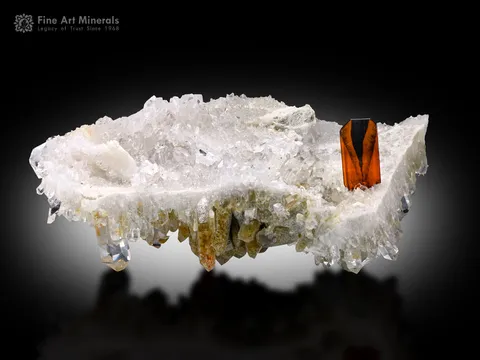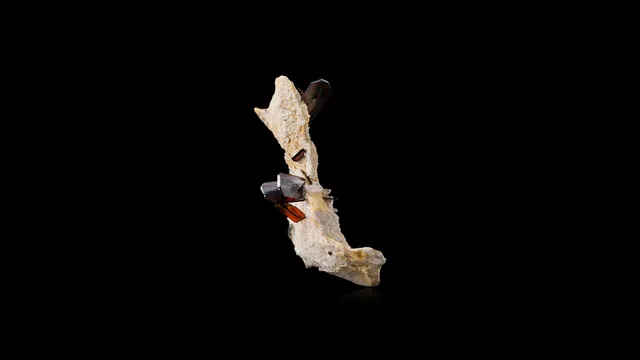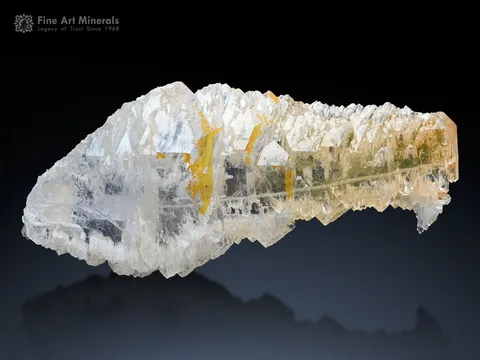
Brookite from Kharan District, Pakistan — sharply formed TiO2 blades with red-orange transparency, dramatic black phantoms on quartz, a standout Alpine classic.
Key facts
Brookite from Kharan District is one of the modern classics of the titanium-oxide world: sharply formed, lustrous, blade-like TiO2 crystals in red-brown to glowing orange tones, commonly standing on bright quartz. The best pieces have a look that immediately recalls Alpine fissure minerals—clear quartz, freestanding crystals, clean geometry, and pocket-grown freshness—but with a Pakistani personality: stronger red-orange transmitted color, larger-than-usual brookite blades, and dramatic black internal phantoms that can look like hourglasses, smoke, or tiger stripes suspended inside the crystal.

Photo: Wikimedia Commons
The locality name “Kharan District” is often a practical umbrella rather than a mine-precise label. The most important named area is Zard Mountain in the Ras Koh Mountains, west of Kharan, with additional labels in circulation such as Nausherwani mine and Thurdook/Thurdok. The Ras Koh setting belongs to the broader Chagai–Raskoh magmatic arc terrain of western Pakistan, a rugged desert mountain belt where specimen pockets have yielded brookite, anatase, quartz, albite, and related minerals. Dealers and locality compilers commonly describe the brookite occurrences as Alpine-type clefts: open cavities where crystals had room to grow as sharp, isolated forms rather than massive aggregates.
The historical importance of Kharan brookite rests on the early-2000s finds, especially the 2004–2005 production that suddenly put large, colorful Pakistani brookite into the international specimen market. Before these finds, good brookite was widely admired but usually small; classic European Alpine examples had elegance and history, but Kharan material brought an unusual combination of size, luster, red-orange transparency, black phantoms, and quartz-matrix display. For many collectors, the best Kharan pieces now define the “large, gemmy, phantom brookite on quartz” style.
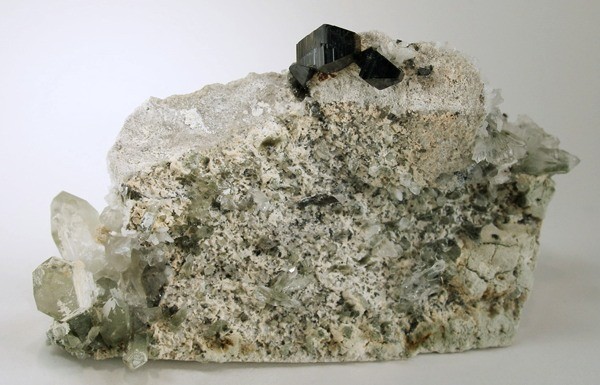
Photo: Wikimedia Commons
Collectors look first for undamaged, upright blades with crisp terminations, bright luster, and the strongest transmitted color. A top specimen should reward both ordinary viewing and backlighting: from the front it may appear dark root-beer brown or nearly black; from behind it can ignite into orange, red-brown, amber, or Bengal-orange. Black internal phantoms, especially those with hourglass or mirror-like symmetry, are not a defect here—they are a defining feature of the locality’s appeal.
Search for specimens: View all brookite specimens from Kharan District, Pakistan
Kharan District lies in Balochistan, southwestern Pakistan. The brookite localities most often tied to fine specimens are in the Ras Koh Mountains, particularly around Zard Mountain. Mindat places Zard Mountain at roughly 28°45′52″N, 65°05′00″E, with the coordinate point corresponding to the summit, and notes that the summit reaches about 1,650 meters. The name “Zard” is reported as a Balochi word for yellow, a memorable detail for a mountain that became known internationally for red-brown titanium-oxide crystals.
The geological setting is best understood as pocket mineralization in a rugged igneous to skarn-influenced mountain environment within the Chagai–Raskoh arc region. For collectors, the important practical point is the open-space growth: brookite blades, anatase crystals, quartz, albite, and related minerals developed in cavities or clefts where crystal faces remained sharp and lustrous. That is why Kharan specimens can have the poised, crystallized-on-quartz appearance associated with Alpine fissures rather than the broken or embedded look of many oxide occurrences.
The mining history is specimen-driven rather than ore-driven. Brookite is a titanium dioxide mineral, but the Kharan occurrence is valued for crystals, not industrial titanium. A major wave of material reached the market in 2004, with thousands of brookite and anatase specimens reported from the district. Fabre Minerals documented Kharan and Mount Zard brookites from 2004–2005, including large flattened crystals on quartz and brookite with albite. Later market appearances continued, but the early surge diminished; good specimens remained obtainable, yet finer pieces became less common and more expensive.
Locality labels require careful reading. “Kharan District” is common and acceptable for older specimens, but more specific labels may say Zard Mountain, Ras Koh Mountains, Nausherwani mine, Thurdook, or Thurdok. Some historic labels also used broader or confusing place names from Balochistan. Thurdook is described by Mindat as an actual mining area at Zard producing high-quality brookite specimens, while the Nausherwani mine page notes fine brookite, anatase, and faden quartz but keeps the exact location unrevealed, with coordinates corresponding to the Zard Mountain summit rather than the precise mine.
Collecting access should not be treated as casual rockhounding. The sites are remote, dry, mountainous, and locally controlled, and published locality pages explicitly warn against visiting without permission from land and mineral-rights holders and without appropriate safety precautions. In practice, the collector market is supplied through Pakistani miners, local mineral dealers, and international specimen dealers rather than by visiting collectors.
Notable finds include matrix pieces with numerous brookite blades, thumbnails with one or two superb crystals perched on quartz, and larger cabinet pieces from early production. Fine examples include 2–3 cm blades on quartz, clusters with multiple transparent crystals, and rare larger crystals or plates that moved into high-end collections. Associated anatase is especially important in some Kharan pieces: lustrous black anatase crystals can sit on feldspar- and quartz-rich matrix with smaller brookite blades, making a complete titanium-oxide association.
Kharan brookite is typically bladed, flattened prismatic, or thin tabular. The crystals are often vertically striated and can show beveled edges, sharp wedge-like terminations, and parallel growth. Doubly terminated crystals occur, and some of the most attractive specimens show one or more brookite blades attached to or partly enclosed by quartz.
Color is one of the great attractions. In reflected light, crystals may appear dark brown, reddish brown, blackish brown, or root-beer brown. With transmitted light, the better crystals glow orange, amber, red-orange, or fiery reddish brown. This locality’s finest examples are prized precisely because they change character under backlighting: what looks like a dark blade on the shelf may become a transparent red-orange window when lit from behind.
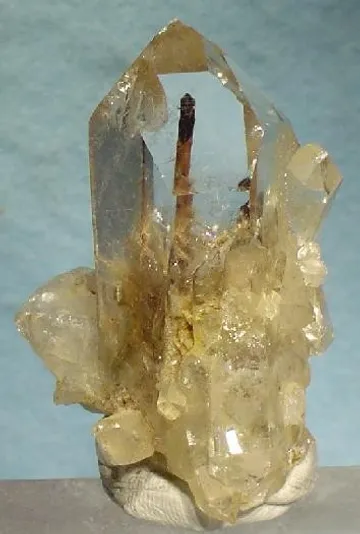
Internal phantoms are a signature feature. The best crystals show black to nearly opaque internal growth zones, commonly described as hourglass phantoms, black phantoms, tiger-stripe patterns, or dark shadows. These can run along the length of the crystal, mirror one another imperfectly, or create a strong central contrast against the glowing orange body. For Kharan material, a well-placed dark phantom can increase desirability rather than reduce it.
Quartz is the classic matrix. It may be colorless, white, milky, transparent, or sparkling; individual quartz crystals can be doubly terminated, tabular, or jumbled into drusy cleft fillings. Albite occurs on some specimens as small white crystals, and anatase is a documented associate, sometimes as metallic black crystals on the same matrix. At the Nausherwani mine, faden quartz is also noted, reinforcing the Alpine-cleft character of the occurrence.
Typical collector specimens range from thumbnails with 1 cm blades to miniatures and small-cabinet specimens carrying 1.5–3 cm main crystals. Early dealer descriptions from Mount Zard include main brookite crystals around 2.9 × 2.2 cm on quartz, and market reports have described individual blades exceeding 3 cm in high-quality lots. Larger crystals and clusters are known but command much more attention, especially when the crystal remains sharp, lustrous, transparent, and undamaged.
Quality depends on a balance of several traits:
The main authenticity issue is not synthetic brookite; it is assembly, repair, and vague locality attribution. Brookite blades are thin, brittle, and visually dramatic, which makes them tempting candidates for gluing onto quartz matrix or reattaching after breakage. A careful buyer should examine the base of each major crystal under magnification, looking for glue shine, unnatural gaps, crushed quartz powder, mismatched matrix texture, or a contact that does not make crystallographic sense. Repaired crystals can still be collectible if disclosed, but undisclosed repair is a serious value issue.
Documented general warnings in collector literature specifically mention faked specimens with brookite crystals glued onto matrix. That caution is particularly relevant for Pakistani brookite because the aesthetic ideal—a sharp blade rising from quartz—is exactly the look an assembler might try to imitate. Natural Kharan specimens commonly have small associated brookite crystals scattered on the matrix, quartz overgrowths, partial embedding, or pocket texture around the attachment; an isolated “perfect” blade on a suspiciously blank quartz base deserves extra scrutiny.
Condition is often the deciding factor. Common problems include chipped terminations, abraded vertical edges, broken side crystals, contacted backs, detached fragments, and repairs at the base of the main blade. Some dealers ship fragile freestanding brookite in temporary water-soluble protective resin, which is a shipping measure rather than a treatment, but buyers should know whether any coating, consolidant, or residue remains on the specimen.
Locality precision is another concern. “Kharan District” is often legitimate but broad. “Zard Mountain, Ras Koh Mountains” is more informative when supported by old labels or reputable dealer provenance. Nausherwani labels can be confusing because more than one Nausherwani-named mine has been referenced in Kharan District, including a quartz mine near Char Kohan and a brookite-producing mine associated with Zard Mountain. Thurdook/Thurdok labels point to a named digging area at Zard. For high-value specimens, provenance from an established dealer or collection is important.
Rarity is tiered. Small single crystals and modest matrix pieces are not rare in the way classic one-pocket minerals are; Kharan material appears regularly enough that patient collectors can choose. Fine, undamaged, transparent crystals on attractive quartz are much scarcer. Large blades above about 3 cm, dramatic phantom crystals, and balanced cabinet specimens with multiple sharp crystals are genuinely competitive and can move quickly when priced fairly.
Market availability remains active but uneven. Lower-end thumbnails and small cabinet pieces appear through online dealers, auctions, and Pakistani sellers, while elite examples are more often handled by fine-mineral dealers. Recent offerings show a broad spread: modest pieces can trade in the low hundreds, attractive thumbnails and miniatures can reach several hundred dollars, and major matrix or large-crystal specimens may be priced in the low to high thousands depending on size, color, damage, and repair status.
The story of Kharan brookite begins, for most collectors, as a market shock. Around 2004, specimens from Balochistan began appearing in quantity: not just a few isolated crystals, but a surge of brookite and anatase that changed expectations for the species. Brookite had long been a connoisseur’s mineral—small, sharp, elegant, often European or Arkansan in classic collections—but suddenly Pakistani pieces were arriving with broad red-brown blades, quartz matrix, transparency, and black phantoms. The best were not merely larger; they were theatrical.
By the time Thomas P. Moore wrote about the material in a 2019 Mineralogical Record online report, the early abundance had already become part of specimen-market history. He described the 2004 wave as “a mighty surge” that brought thousands of Kharan brookite and anatase specimens onto the scene, followed by a decline that made good pieces less common and more expensive. That is exactly how many collectors experienced the locality: first as a flood of surprisingly affordable, world-class brookite, then as a slow tightening of supply.
Moore’s report also captured the problem of locality names. Specimens were being sold with labels such as Ghad mine, Thurdok mine, Dalbundi, Taftan, Zard Mountain, and Rashkoh Mountains, yet many dealers settled on the broader “Kharan District.” That jumble of names is not just a paperwork nuisance; it reflects the reality of mineral specimens moving from remote pockets through local miners, traders, exporters, and international dealers before finally receiving a polished label in a showcase.
One particularly vivid 2019 market moment involved Brian Kosnar of Mineral Classics, who posted 30 Kharan District brookite specimens at once. The group ranged from elegant thumbnails with brookite blades on transparent quartz to cabinet-size matrix pieces carrying dozens of brookites rising from crannies. The largest individual crystal in that lot was a 3.2 cm blade on a 7.7 cm matrix specimen priced at $1,300, while a 2.2 cm thumbnail was priced at $900. Those numbers tell a compact story: the material was still available, but the finest pieces had crossed fully into serious collector territory.
The field photographs preserved on locality pages add a different kind of texture. Captions such as “Towards Brookite Pockets,” “Brookite Man,” and “Faisal Nausherwani at Nausherwani mine, Zard mountains, Kharan” are brief, but they place the specimens back into a real landscape: desert mountains, pocket workings, and named local miners rather than anonymous supply chains. Zard Mountain is not an abstract label; it is a remote place in the Ras Koh Mountains where people walked toward pockets and extracted crystals delicate enough that, years later, dealers sometimes protect them in soluble resin just to survive shipping.