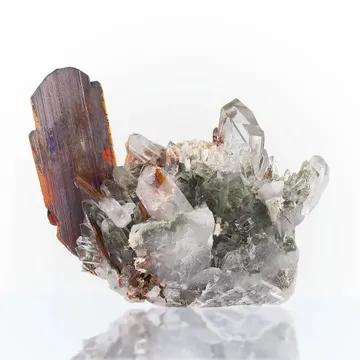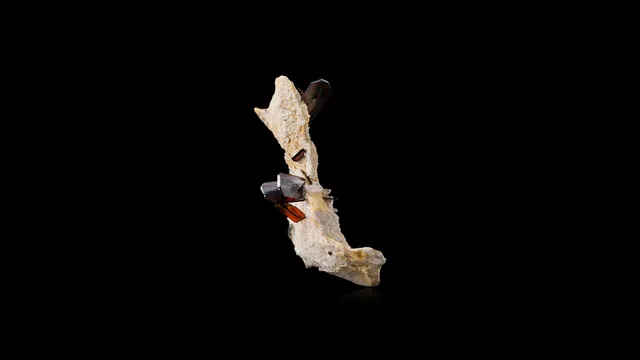
Chagai District, Pakistan - Taftan brookite-quartz specimens prized by collectors for crisp, delicate TiO2 blades with rutile and the locality rarity.
Key facts
Chagai District occupies the far northwestern corner of Balochistan, where Pakistan meets Iran and Afghanistan, and for collectors it has two quite different identities. In economic geology, it is one of the great porphyry-copper provinces of the Tethyan metallogenic belt: the Chagai-Raskoh magmatic arc hosts Saindak, Reko Diq, Siahdik, Dasht-e-Kain, Tanjeel, and related copper-gold-molybdenum systems formed around diorite to quartz-diorite and granodiorite intrusions. In the cabinet, however, Chagai is best known for a more delicate treasure: Alpine-style brookite with quartz, especially the Taftan material that put superb clove-brown to amber TiO2 blades, rutile needles, anatase, and transparent quartz crystals into advanced collections.
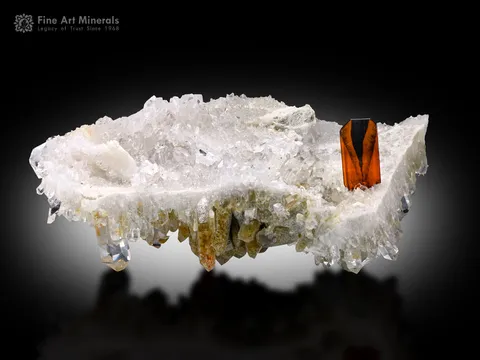
The best Chagai specimens have the look that made Pakistani brookite a modern classic: thin, lustrous, sharply edged brookite plates standing on or suspended inside colorless quartz, sometimes with golden-brown rutile sprays and pale green chloritic ghosts. The finest pieces are not ore-mine curiosities from Saindak or Reko Diq; they are aesthetic fissure-pocket specimens from the Taftan-Dalbandin collecting sphere, where clear quartz could grow over and around earlier TiO2 crystals. Good examples are airy and architectural. Exceptional ones show undamaged brookite blades large enough to read from across a case, transparent enough at the edges to burn orange in transmitted light, and set naturally among clean quartz points rather than buried in cloudy, fractured rock.
Regional View
Country View
For the collector, the important geographic names to keep straight are Chagai District as the broad administrative locality, Taftan as the classic brookite-quartz source, and Dalbandin as another Chagai locality represented by quartz, amethyst, sceptre quartz, rutile, and brookite-bearing specimens. Older labels may simply say “Balochistan,” “Baluchistan,” “Taftan,” “Dalbandin,” “Kharan Mountains,” or even mix Chagai and Kharan names; that label history matters because excellent brookite also occurs in neighboring Kharan District, and the two districts are routinely blurred in trade descriptions.

Photo: Wikimedia Commons

Photo: Wikimedia Commons
Search for specimens: View all specimens from Chagai District, Pakistan
Chagai District belongs to the Chagai-Raskoh magmatic arc, a long east-west belt of calc-alkaline volcanic, plutonic, and sedimentary rocks developed along the northern margin of the Arabian Sea region. The district’s bedrock includes Cretaceous volcanic and volcaniclastic successions, Paleogene to Neogene sedimentary units, and a series of intrusive bodies ranging from gabbro and diorite through quartz diorite, tonalite, granodiorite, granite, and related porphyries. This is the geologic framework behind Chagai’s economic importance: hydrothermal systems centered on porphyritic intrusions introduced copper, gold, molybdenum, iron oxides, sulfides, quartz stockworks, and broad alteration shells.
The Saindak district was the first great proving ground. Early geological work described copper-bearing quartz diorite stocks intruded into folded sedimentary and volcanic rocks, with disseminated copper sulfides, contact-metasomatic pyrite, pyrrhotite, and hematite replacements, and smaller hydrothermal veins carrying quartz, calcite, galena, chalcopyrite, and oxidized copper minerals. Later development divided the Saindak copper-gold system into south, north, and east ore bodies. The operating mine has been worked as an open-pit copper-gold project, producing ore from hydrothermally altered intrusive and wall-rock assemblages rather than from the fine brookite-quartz pockets collectors prize.
Reko Diq lies to the east in the same broad Chagai metallogenic belt and is a much larger porphyry copper-gold complex. The H13, H14, and H15 systems are associated with Miocene quartz diorite to granodiorite porphyries, potassic alteration rich in biotite, K-feldspar, magnetite, and quartz, and hypogene sulfide assemblages dominated by chalcopyrite, bornite, and pyrite. Tanjeel, another part of the complex, is known for supergene chalcocite enrichment. Modern technical descriptions treat Reko Diq as one of the world’s largest undeveloped copper-gold projects, planned as a long-life, open-pit operation producing copper-gold concentrate rather than specimen minerals for the collector trade.
The district’s specimen story is smaller in tonnage but finer in crystallography. Taftan has supplied the best-known Chagai brookite-quartz pieces: transparent quartz crystals and clusters, some doubly terminated, enclosing or carrying lustrous brookite blades and, in rarer examples, rutile sprays. Mindat photo data for Taftan records a strong brookite-quartz-anatase-rutile association, with albite, chlorite-group material, and rare axinite-(Fe) also represented. Dalbandin specimens are broadly similar but are better known in the specimen record for quartz, including amethyst and sceptre quartz, with brookite and rutile as important associates.
Production of specimen material appears to have been episodic rather than continuous. Dealer and museum-style records point to a significant early-2000s influx of “Alpine-type” brookite and anatase specimens from the Chagai area, followed by later pockets and dispersed market appearances. Several well-documented Taftan specimens are dated to around 2010–2013 in collection and dealer records, and later EarthWonders and auction examples show that the locality has continued to circulate through the market as older finds are dispersed or small new parcels appear.
Collecting access today should be treated as difficult. Chagai is remote, arid, sparsely populated, and sensitive because of its border position and large strategic mining projects. The operating and developing copper-gold projects are industrial sites, not casual collecting localities, and the specimen-producing brookite-quartz material that reaches Western collections generally travels through Pakistani dealers, export channels, and secondary-market dispersals rather than through collector field trips. For serious collectors, the practical “access” is usually provenance work: separating genuine Taftan or Dalbandin Chagai pieces from broader Balochistan or neighboring Kharan material, preserving old dealer labels, and recording whether the specimen was acquired from an early-2000s find, a 2010–2013 Taftan parcel, or a later market release.
Chagai brookite is the district’s signature collector mineral, especially from Taftan, where lustrous, thin, tabular to bladed crystals occur on and in quartz; colors range from clove-brown and smoky bronze to reddish amber, with fiery orange edges visible in strong transmitted light on the best crystals. Most cabinet-quality pieces are thumbnail to miniature specimens with brookite crystals around the centimeter scale, but documented Taftan examples include single blades over 2 cm and exceptional Chagai-area reports reaching roughly 4 cm; the finest are sharp, undamaged, well isolated, and naturally framed by transparent quartz rather than partly hidden in cloudy matrix. Rutile needles, anatase crystals, albite, and chloritic inclusions are important companions, and the most desirable pieces show the full TiO2 story at once: brookite blades, rutile sprays, and clear quartz grown in a sequence that leaves the inclusions visible from several angles.
Chagai quartz is prized less as a stand-alone species than as the transparent stage on which brookite, rutile, and anatase are displayed. Taftan pieces include colorless, sharply terminated crystals and small clusters, some doubly terminated, with internal rutile “forests” and brown brookite blades partly or wholly enclosed; the best examples are water-clear enough to make inclusions legible, bright enough to avoid the dead look of rehealed or weathered quartz, and balanced enough that the included minerals are not lost in fractures. Dalbandin broadens the district’s quartz suite with amethyst and sceptre quartz, and its brookite-rutile associations overlap visually with Taftan material, so label precision, clarity, termination quality, and undamaged quartz tips all matter when judging Chagai quartz specimens.
Other documented Chagai minerals fall into two overlapping worlds: Alpine-style specimen minerals from Taftan and Dalbandin, and ore-mineral assemblages from the porphyry systems. The specimen suite includes anatase, rutile, albite, chlorite-group material, hematite, and rare axinite-(Fe). The porphyry and copper-oxidation suite is much broader, with chalcopyrite, bornite, pyrite, chalcocite, covellite, molybdenite, magnetite, malachite, chrysocolla, cuprite, galena, wulfenite, native gold, molybdite, and joséite recorded from Saindak, Reko Diq, Siahdik, or related Chagai deposits. These ore species are important for the district’s geology, but very few appear in the market as aesthetic crystallized specimens comparable to the brookite-quartz material.
The biggest authenticity issue with Chagai specimens is not laboratory fakery but locality discipline. Pakistani brookite-quartz specimens from Chagai District and neighboring Kharan District can be extremely similar, and labels in the trade have not always been careful. “Balochistan,” “Baluchistan,” “Kharan Mountains,” “Taftan,” “Dalbandin,” and “Chagai” have all appeared in ways that require scrutiny. A good Chagai label should ideally specify Taftan or Dalbandin, preserve the dealer or collection history, and avoid vague regional claims when a more precise locality is known.
Brookite itself is hard enough to be durable in a display case, but Chagai crystals are commonly wafer-thin and exposed on quartz. Edge chipping, bruised terminations, and contacts on smaller subsidiary blades are common. In included-quartz pieces, the quartz may be naturally fractured, rehealed, or internally veiled; that does not make the piece bad, but high-end examples need enough transparency for the included brookite and rutile to be clearly visible. Check quartz terminations under magnification, because small tip bruises dramatically reduce the aesthetics of otherwise fine Taftan pieces.
Polished included-quartz specimens from Taftan have appeared in the trade. They can be legitimate collector objects, especially where polishing reveals a brookite blade or rutile spray that would otherwise be obscured, but they should be sold as polished, not as natural complete crystals. For natural-crystal collectors, polishing reduces the mineralogical and aesthetic premium unless the inclusion is extraordinary.
No consistent, locality-specific treatment problem comparable to dyed agate or heated amethyst is well documented for Chagai brookite-quartz. The more realistic concerns are repaired quartz tips, glued loose brookite blades, composite mounts, and over-optimistic labels that move a generic Balochistan specimen into Taftan or Chagai for market appeal. Good brookite should show natural attachment or convincing natural enclosure in quartz, with no suspicious adhesive meniscus at the contact.
Fine Chagai brookite is not common, but it is not unobtainable. Small brookite-on-quartz pieces and included-quartz miniatures appear periodically from older dealer stock, auctions, and collection dispersals. Large, sharp, undamaged brookite blades in aesthetic association with clear quartz are significantly rarer and should be judged against the best early-2000s to early-2010s material rather than against ordinary brown TiO2 blades on cloudy matrix.
In the 1970s, Chagai became an early proving ground for a new way of looking for ore. Saindak was used as the control area for computer processing of Landsat-1 multispectral scanner data, then still new enough to be called ERTS-1. The method was crude by modern remote-sensing standards: apparent reflectance limits were chosen for four spectral bands, and when a pixel fit the limits for a presumed rock type, a symbol was printed on a computer-generated map. Yet the result was remarkably useful. Twenty-three prospecting targets were selected in Chagai District, and five turned out to be large areas of hydrothermally altered porphyry containing pyrite. The system even outlined drainage channels, mineralized quartz diorite, pyrite-rich rock, and the approximate limit of propylitic alteration. For a district of desert, low mountains, and vast distances, the satellite view helped turn alteration color into exploration strategy.
The collector story has a different scale: a pocket-scale world of clear quartz and TiO2 crystals. The Taftan specimens that entered the market in the early 2000s surprised collectors because they did not look like what many expected from Balochistan. They looked Alpine. Sharp, flat brookite blades sat on quartz as if they had come from European clefts, and some were sealed inside quartz points with rutile needles fanning through the host crystal. Dealers compared the quality to classic Italian and Swiss Alpine brookites: sharp, lustrous, gemmy at the edges, and far more sculptural than the massive or opaque brookite most collectors knew from older localities.
One Taftan piece later published on Wikimedia Commons captured the appeal perfectly: a 7.6 x 5.4 x 3.6 cm quartz crystal enclosing star-shaped to jackstraw rutile needles and partly enclosing a clove-brown brookite blade. Another, a 5.3 x 4.3 x 1.6 cm doubly terminated quartz, was described by its photographer as loaded with both brookite and rutile. The point is not just rarity. It is timing. The quartz had to remain transparent enough to act like a window, while earlier brookite and rutile crystals survived inside it without being completely swallowed by fractures, clay, or chlorite. When everything worked, the result was a natural display case: quartz as the vitrine, brookite and rutile as the exhibit.
Reko Diq has supplied a larger, more public story. The porphyry complex covers roughly 10 x 10 km and contains multiple porphyry copper deposits, with H13, H14, and H15 forming the principal copper-gold resource in the best-known geological accounts. What collectors see as a dot on a locality map is, to mine geologists, a cluster of intrusions, magnetic highs, potassic alteration, sulfide zoning, and years of drilling in desert terrain. The project’s modern history became famous well beyond mineral circles because development stalled in legal and political conflict before being reconstituted in December 2022. The current plan puts Barrick and Pakistani stakeholders into an equal partnership structure, with first production targeted for the end of 2028, making Chagai one of the few mineral districts whose name appears both on thumbnail brookite labels and in global copper-supply discussions.