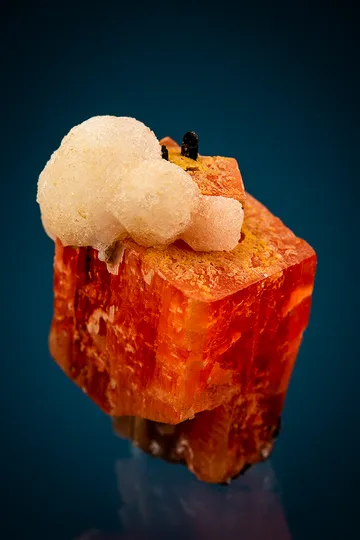
Poudrette Quarry, Canada — Mont Saint-Hilaire locality famed for diverse rare minerals (serandite, carletonite, analcime) from pegmatites, prized by collectors.
Key facts
Poudrette Quarry is the collector’s face of Mont Saint-Hilaire, the extraordinary alkaline intrusive complex rising from the St. Lawrence Lowlands east of Montréal. In specimen terms, it is one of those rare localities whose name is not merely geographic but cultural: a shorthand for salmon-orange serandite, royal-blue carletonite, pseudohexagonal catapleiite, snowy analcime, black spear-like aegirine, fluorescent sodalite, and an almost implausible suite of rare sodium-, zirconium-, titanium-, beryllium-, niobium-, carbonate-, and rare-earth minerals. The quarry is not an ore mine in the usual sense. It is an aggregate quarry cut into the East Hill suite of Mont Saint-Hilaire, where quarrying exposed nepheline syenite, sodalite syenite, alkaline pegmatites, hydrothermal veins, igneous breccias, hornfels, marble xenoliths, and the tiny chemical worlds at their boundaries.
Its fame rests on mineral diversity at a scale few single localities can approach. The quarry’s agpaitic and peralkaline rocks concentrated sodium, volatiles, incompatible elements, manganese, zirconium, titanium, niobium, beryllium, rare earths, fluorine, chlorine, and carbonates into a patchwork of mineral-forming environments. The result is a locality where cabinet classics and microscope rarities come from the same industrial hole in the mountain. Many of the most important specimens came from pegmatitic pockets: open spaces lined with albite, microcline, aegirine, analcime, natrolite, catapleiite, serandite, rhodochrosite, polylithionite, eudialyte-group minerals, and rare accessory species. Other species belong to marble xenoliths, hornfels fissures, sodalite xenoliths, or small cavities in breccia.
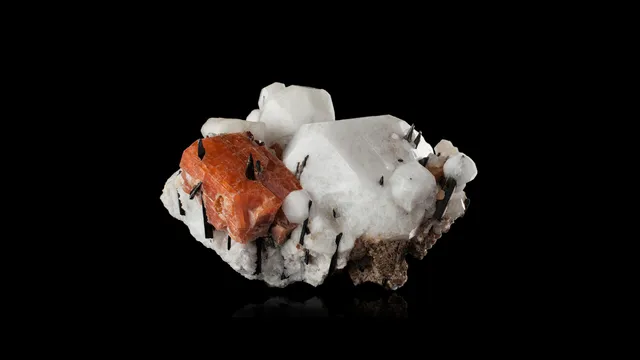
The best Poudrette pieces have a look that is unmistakable. Serandite is the emblem: fleshy pink to salmon-orange triclinic crystals, sometimes blocky and lustrous, sometimes bladed or radiating, set against white analcime, snowy natrolite, black aegirine, pale albite, silvery polylithionite, or red-brown rhodochrosite. The quarry’s finest combinations are architectural, not merely colorful: black pyroxene blades thrusting from pale zeolites; orange serandite rising against white trapezohedra; blue carletonite perched in altered xenolithic matrix; catapleiite plates stacked like coins or rosettes. Even modest thumbnails can look like miniature alkaline landscapes.
Regional View
Country View
Historically, the name “Poudrette Quarry” also covers a shifting practical reality. Older labels may say Poudrette, De-Mix, Demix, Uni-Mix, Desourdy, Carrière de Poudrette, Carrière Mont Saint-Hilaire, Rouville County, or simply “MSH.” These names reflect quarry ownership, adjoining excavations, and the gradual incorporation of older workings into a larger operation. For collectors, that label history matters: the best old pieces often predate the present ownership and may carry a name that was correct when the pocket was opened.


Search for specimens: View all specimens from Poudrette Quarry, Canada
Poudrette Quarry lies on the northern to northeastern side of Mont Saint-Hilaire, in La Vallée-du-Richelieu RCM, Montérégie, Québec. Mont Saint-Hilaire is one of the Monteregian Hills, a Lower Cretaceous alkaline intrusive province that cuts the older sedimentary rocks of the St. Lawrence Lowlands. The mountain itself is a composite intrusion: gabbroic rocks dominate the western half, while the eastern half contains the younger peralkaline syenitic rocks of the East Hill suite. The quarry cuts into this eastern sector, which is why the mineralogy is so rich.
The deposit type is best described as an alkaline intrusive and pegmatitic–hydrothermal rare-mineral locality exposed by quarrying. The principal quarried rock is nepheline syenite, with abundant alkali feldspar and albite, nepheline, sodalite, and aegirine. Accessory and late minerals carry the collector interest: eudialyte-group species, zirconosilicates, titanosilicates, rare-earth carbonates, beryllium silicates, zeolites, feldspathoids, sulphides, fluorides, and manganese-rich silicates and carbonates. Mineralization is not a single ore body but a mosaic of pockets, veins, xenoliths, fissures, and altered zones.
Syenitic pegmatites and hydrothermalites are the classic specimen producers. They occur as veins from a few centimeters thick to dike-like bodies several meters thick, as irregular ovoid or pipe-like bodies, and as pegmatitic segregations. Many are internally zoned: fine aegirine–microcline selvages, coarser intermediate zones, and open central pockets or cores lined by large aegirine, microcline, analcime, albite, catapleiite, serandite, natrolite, rhodochrosite, polylithionite, and rarities. The largest and most famous pegmatitic body is the Poudrette pegmatite, a named body in which an aplitic line-rock band replaces the ordinary chilled margin. Several type species and rare late-stage minerals are tied to that pegmatite and its hydrothermally altered zones.
Carbonate-rich pegmatites are less common and occur mainly in the eastern part of the quarry, commonly near sodalite syenite. Their assemblage is different: microcline, albite, calcite, siderite, rutile, zircon, quartz, synchysite-(Ce), pyrite, sphalerite, and related carbonate-rich species, with little evidence for the aegirine-rich pyroxene assemblage typical of many syenitic pegmatites. These pockets are important for siderite, calcite, sulphides, and rare carbonate species.
Miarolitic cavities in porphyritic nepheline syenite form another major environment. These cavities are generally small, often only a few centimeters across, but some are lined with analcime, calcite, feldspar, mica, natrolite, or altered zeolites, and then sprinkled with millimeter-sized aegirine, zircon, pyrophanite, fluorapatite, donnayite-(Y), burbankite, sodalite, ewaldite, and uncommon or type-locality minerals. Some cavities reportedly released pressurized fluid with a pop when opened, a reminder that even the smallest openings at Mont Saint-Hilaire can preserve late-stage histories.
Sodalite xenoliths are among the quarry’s most unusual environments. These angular bodies, from centimeters to roughly two meters across, are concentrated in the southern part of the quarry near the huge hornfels block and were especially encountered during quarrying from the early 1980s into the early 1990s. They are intensely alkaline, rich in coarse sodalite with analcime and microcline, and host minerals such as villiaumite, sodalite, eudialyte-group minerals, steenstrupine-(Ce), serandite, vuonnemite, lovozerite-group minerals, and several exceedingly rare sodium-rich species. Their sodalite is famous for intense orange fluorescence under ultraviolet light and for photochromism: fresh violet fracture surfaces can fade rapidly in sunlight.
The marble and hornfels xenoliths are equally important. Large white to pale green marble blocks, sometimes up to several meters across, occur in the eastern quarry in nepheline syenite, sodalite syenite, and breccia near the hornfels block. Marble xenoliths are the setting for unusual calcium-rich and beryllium-bearing species, and poudretteite itself was found in a marble xenolith enclosed in nepheline syenite. Hornfels fissures and metasomatized greenish hornfels fragments yielded another family of specimens: quartz, calcite, siderite, strontianite, gmelinite-Na, sulphides, epididymite, eudidymite, beryllonite, cordylite-(Ce), narsarsukite, lorenzenite, carletonite, leucosphenite, and rare barium–rare-earth carbonates.
Mining began as industrial quarrying for aggregate, not as a mineral-collecting venture. The Poudrette operation became active in the mid-twentieth century, and the adjacent Demix workings incorporated still older Desourdy and Uni-Mix areas. Demix ceased operations and was acquired by the Poudrette family in 1994, after which those central and western workings became part of the Poudrette Quarry footprint. In late 2007, the Poudrette family was no longer involved, and the quarry has since been operated under the name Carrière Mont Saint-Hilaire.
Collecting access has changed dramatically. The older Poudrette and Demix periods are remembered with unusual affection by collectors because access was possible for many years and scientifically important material was recovered rather than crushed. Today the quarry is an active industrial site and collecting is tightly controlled. Modern access is not casual rockhounding; it has been restricted to limited, organized field trips for small groups, typically associated with the Club de Minéralogie de Montréal and conducted under strict rules. Most specimens on the market are therefore older recoveries, old dealer stock, estate material, or pieces collected before the 2007 ownership change.
The notable finds are often remembered by environment or by pocket rather than by bench number. The great serandite recoveries of 1973, 1981, and 1988 produced the locality’s signature aesthetic crystals. The 1980s and early 1990s sodalite xenolith exposures opened a hyperalkaline world of fluorescent sodalite, villiaumite, rare phosphates, carbonates, and sodium-rich species. The late 1990s carletonite material produced some of the most desirable blue specimens from the locality. The Poudrette pegmatite, altered pegmatite pockets, and xenolithic zones continued to yield type minerals and rarities long after the quarry had already become famous.
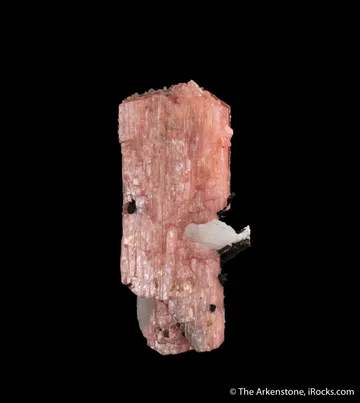
Serandite is the signature mineral of Poudrette Quarry: pale pink, salmon, orange, rose-red, brownish, or rarely darker triclinic crystals occurring as blocky prisms, tabular blades, radiating groups, and sculptural combinations with analcime, aegirine, albite, natrolite, catapleiite, rhodochrosite, polylithionite, leucophanite, ancylite-(Ce), and pyrochlore. The famous collector pieces came chiefly from alkaline pegmatitic pocket environments, with three major finds in 1973, 1981, and 1988 producing aesthetic specimens and crystals reportedly up to about 20 cm. Good Poudrette serandite is judged by saturated salmon-orange color, clean terminations, sharp faces, freedom from bruising along its perfect cleavages, and strong contrast against white analcime or natrolite and black aegirine; ordinary pieces are dull, cleaved, partly altered, or lost in matrix without a clear crystal architecture.
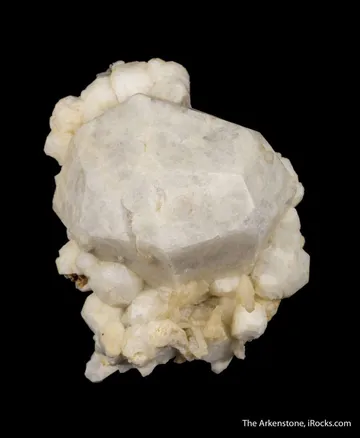
Analcime is abundant at Poudrette Quarry and forms some of the locality’s most important visual architecture: colorless to white or gray trapezohedra, distorted trapezohedra, large individual crystals, and crystalline masses lining cavities in nepheline syenite, sodalite syenite, pegmatites, and miarolitic pockets. The finest pieces are not merely “white zeolite” specimens but clean, lustrous, well-positioned crystals that frame serandite, rhodochrosite, aegirine, catapleiite, natrolite, leifite, and rare accessories. Crystals can be very large for the species, with Mont Saint-Hilaire noted for exceptional analcime up to decimeter scale; collector-grade examples from Poudrette are valued for sharp trapezohedral form, porcelain-to-vitreous luster, minimal bruising, and the way the pale analcime serves as a stage for the quarry’s colored rare minerals.
Rhodochrosite at Poudrette Quarry is a common late-stage pegmatite and altered-pegmatite mineral, but the best pieces are distinct from the banded or scalenohedral classics of other districts. Here it occurs as pale to deep pink, red, orange-red, brownish red, orange-brown, or darkened crystals, commonly as rhombohedra, curved druses, balls, rosettes, thin plates, and small sparkling aggregates with aegirine, albite, analcime, catapleiite, microcline, natrolite, polylithionite, pyrochlore, serandite, siderite, zircon, and rare zirconosilicates. Large crystals up to about 10 cm have been reported, though those tend to be less attractive in color and transparency; the best collector pieces are smaller, well-colored, lustrous, damage-free rhombohedra or rosettes integrated into multi-species Poudrette combinations rather than isolated brown masses partly altered to manganese oxides.
Aegirine is one of the dominant visual and rock-forming minerals of the Poudrette assemblage, present in nepheline syenite, syenitic pegmatites, miarolitic cavities, sodalite xenoliths, breccia cavities, and many altered zones. It ranges from tiny acicular green, yellowish, brownish, or reddish sprays to large black prismatic crystals, with the best quarry specimens showing lustrous, well-terminated blades or spears to impressive cabinet size. In syenitic pegmatites aegirine commonly forms selvages and inward-growing crystals that project into pockets, often with microcline, albite, analcime, natrolite, serandite, catapleiite, rhodochrosite, eudialyte-group minerals, and polylithionite. Good Poudrette aegirine needs sharpness and luster, intact terminations, and contrast with pale zeolites or feldspar; ordinary material is abundant, splintered, embedded, or simply too massive to carry aesthetic weight.
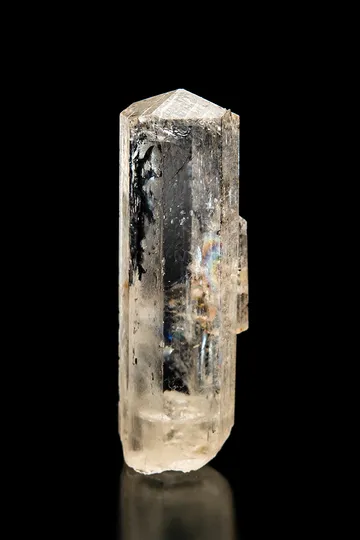
Carletonite is one of the great Poudrette Quarry rarities and one of the locality’s most desirable visual species, because Mont Saint-Hilaire is its type locality and effectively its classic collecting source. It occurs as pale to deep blue, pinkish, colorless, or white tetragonal prisms and crystalline masses, characteristically color-zoned; smaller transparent blue crystals may show darker blue cores, pale outer zones, and phantoms. Its best specimens are associated with altered hornfels or siliceous marble xenolith environments and with species such as quartz, narsarsukite, calcite, fluorite, leucosphenite, lorenzenite, albite, pectolite, microcline, and arfvedsonite. The finest Poudrette carletonites have saturated blue color, visible zoning, undamaged prism faces, and three-dimensional presentation; lesser examples are pale, massive, etched, cleaved, or represented only by small patches in matrix.
Catapleiite is a Poudrette specialty of global rank, with Mont Saint-Hilaire credited with producing some of the largest and finest crystallized specimens of the species. It occurs in altered pegmatites and related alkaline pocket environments as tan, beige, gray, brown, colorless, and rarely pale yellow, orange, pink, or bluish pseudohexagonal plates, stacked groups, rosettes, and twins. It is commonly associated with aegirine, albite, analcime, amphiboles, ancylite-(Ce), calcite, natrolite, polylithionite, pyrochlore, rhodochrosite, siderite, sphalerite, and serandite, and it can also appear as replacements or pseudomorphs in hydrothermally altered pegmatites. Fine Poudrette catapleiite is crisp, lustrous, well-separated, and three-dimensional; ordinary examples are dull from surface films, partly replaced, broken along perfect cleavage, or reduced to drab plates without an aesthetic setting.
Albite is one of the quarry’s common framework minerals and a frequent supporting actor in Poudrette specimens, occurring as colorless, white, and rarely pink sharp bladed, tabular, or platy crystals from millimeter size to several centimeters. It appears in syenitic pegmatites, hydrothermal alteration zones, breccia cavities, and as a second-generation mineral that may coat, replace, or accompany earlier pocket species. Poudrette albite is especially important as a pale matrix for rhodochrosite, elpidite, aegirine, siderite, synchysite, pyrite, pyrrhotite, and rare zirconosilicates; some pink albite is known to fade somewhat after extended exposure to natural light. The collector premium goes to sharp, bright, well-placed blades that enhance a combination, not to massive white feldspar or altered coatings that obscure the rarer species.
Siderite is common at Poudrette Quarry, especially in pegmatites and carbonate-rich pegmatites, where it occurs as tan, beige, orange-yellow, brown, grayish brown, rhombohedral, modified rhombohedral, tabular, and curved aggregate crystals. Although most crystals are only a few millimeters, quarry specimens have included very large crystals up to about 25 cm on edge, a size range that gives Poudrette siderite more stature than collectors sometimes expect from this locality. Its associations include albite, aegirine, calcite, dolomite, microcline, pyrite, pyrrhotite, sphalerite, rutile, rhodochrosite, pyrochlore, synchysite, zircon, and rare late-stage species. The best examples show clean, lustrous, sharply formed rhombohedra or dramatic large crystals with good contrast; ordinary material is common, brown, cleaved, dull, or visually subordinate to more colorful associated minerals.
Natrolite is widespread across Poudrette environments, from syenitic pegmatite pockets to miarolitic cavities, sodalite-related zones, and hydrothermal veins. It occurs as colorless to white, rarely pale pink or very pale bluish gray prisms, pseudotetragonal crystals, fibrous aggregates, sprays, and crystalline masses, sometimes forming pocket fillings with serandite, polylithionite, and other late minerals. In miarolitic cavities, natrolite can carry epitactic overgrowths of paranatrolite that may dehydrate to gonnardite, adding identification complexity. Important associations include aegirine, albite, analcime, ancylite-(Ce), catapleiite, cordylite, elpidite, epididymite, eudialyte, fluorite, gonnardite, rhodochrosite, serandite, siderite, and polylithionite. Fine Poudrette natrolite is lustrous, terminated, clean, and compositionally useful as a white structural contrast; lesser pieces are massive, friable, bruised, or merely fibrous filler.
Elpidite is moderately rare at Poudrette Quarry but can occur in locally significant amounts in hydrothermally altered alkaline pegmatites, where it forms tan, greenish gray, white, or colorless short prismatic crystals, elongated needles, and sprays. It is also known here as a pseudomorph after serandite, commonly with a very fine dark green powdery chlorite-group coating, making careful observation essential when a pale or greenish replacement retains the outline of a former serandite crystal. Associations include aegirine, albite, calcite, chlorite-group minerals, epididymite, fluorapatite, natrolite, pyrochlore, rutile, siderite, and bastnäsite. The best Poudrette elpidites have distinct terminated sprays or a clearly readable replacement story; ordinary examples are earthy, coated, broken, or visually confused with other pale zirconosilicates without analysis.
Narsarsukite is relatively common for a rare alkaline-complex mineral at Mont Saint-Hilaire, and Poudrette material is prized because the locality has produced some of the finest and largest specimens known for the species. It occurs as pale to dark yellow, greenish yellow, dark green, grayish brown, brown, colorless, pale pink, lemon-yellow, or orange-yellow tabular and lath-shaped crystals, often in radiating sprays, stacked groups, or aggregates. Its best Poudrette setting is the hornfels and metasomatized xenolith suite, including greenish hornfels fragments and quartz veinlets with carletonite, lorenzenite, leucosphenite, microcline, albite, calcite, natrolite, aegirine, and amphiboles. The finest pieces have gemmy yellow to greenish tabular crystals, sharp lath form, and attractive sprays; ordinary pieces are embedded, dark, cleaved, or too small to show the characteristic habit.
Beyond these collector classics, Poudrette Quarry is one of the world’s great type-locality reservoirs. Minerals first described from Mont Saint-Hilaire and its quarry environments include carletonite, poudretteite, hilairite, gaidonnayite, petarasite, paranatrolite, perraultite, monteregianite-(Y), thornasite, doyleite, reederite-(Y), sheldrickite, petersenite-(Ce), khomyakovite, manganokhomyakovite, ferrokentbrooksite, johnsenite-(Ce), oneillite, nalipoite, abenakiite-(Ce), gaultite, griceite, rouvilleite, silinaite, martinite, adamsite-(Y), micheelsenite, peatite-(Y), ramikite-(Y), and newer rare carbonate species such as bainbridgeite-group minerals. For systematic collectors, the quarry’s “minor” minerals are often anything but minor: leifite, epididymite, eudidymite, nenadkevichite, ancylite-(Ce), bastnäsite-(Ce), synchysite-(Ce), leucosphenite, lorenzenite, labuntsovite-Mn, mangan-neptunite, eudialyte-group minerals, villiaumite, ussingite, sodalite, polylithionite, cryolite, and many others make Poudrette an endless locality rather than a one-species occurrence.
The first collector issue with Poudrette material is locality precision. Labels reading Poudrette, Demix, De-Mix, Uni-Mix, Desourdy, Rouville County, Carrière Mont Saint-Hilaire, and Mont Saint-Hilaire may all refer to material from related or absorbed workings. That does not make the specimen wrong, but it does affect how carefully it should be catalogued. Older labels are often worth preserving, even when modern locality databases consolidate the occurrence under Poudrette Quarry, because the label may preserve the operating name in use when the specimen was collected.
The second issue is identification. Poudrette is famous for look-alike rare species, pseudomorphs, solid-solution series, and tiny accessories. Serandite, pectolite, and schizolite can be visually close; steacyite and turkestanite are notoriously difficult to separate without analysis; eudialyte-group minerals have undergone extensive modern revision; zeolite names around natrolite, paranatrolite, tetranatrolite, and gonnardite can be label-sensitive; and many rare carbonates and zirconosilicates require analytical confirmation. Serious collectors should treat highly specific rare-species labels with respect but not blind faith, especially for micros and old collections.
The third issue is condition. Serandite has perfect cleavages and many crystals are bruised, cleaved, or subtly repaired; check ends and side faces under magnification. Catapleiite has perfect cleavage and may carry dull films or replacement textures. Natrolite sprays and fibrous aggregates break easily. Analcime commonly survives better, but high points on large trapezohedra can be chipped. Aegirine blades may look intact from a distance while the terminations are splintered. Carletonite can be cleaved, etched, or massive; the best pieces deserve careful handling and no aggressive cleaning.
Alteration is part of the locality’s story, not always a defect. Darkened rhodochrosite, elpidite after serandite, albite after natrolite or aegirine, catapleiite after eudialyte, and carbonate or rare-earth pseudomorphs are all documented styles of Poudrette mineralization. The challenge is to decide whether the alteration makes the specimen more interesting or simply less attractive. For rare species, an ugly but analyzed specimen may be more important than a pretty but ambiguous one.
Fluorescence and light sensitivity matter. Sodalite from the sodalite xenoliths can fluoresce intense orange under ultraviolet light, and hackmanitic/photochromic sodalite may fade from violet toward gray or white in sunlight after fresh exposure. Pink albite from the locality has also been noted to fade somewhat under prolonged natural light. Store color-sensitive pieces away from strong daylight, and keep unstable sodium-rich or water-soluble minerals dry. Villiaumite, natrite, thermonatrite, and related soluble or alteration-prone species should never be washed.
Documented manufactured fakes are not the defining problem in the Poudrette market; misidentification, incomplete labels, old quarry-name confusion, repairs, trimming, and overconfident rare-species names are far more common concerns. Be wary of improbable combinations, intensely colored pieces with no old provenance, and rare species offered without analytical history. Conversely, do not dismiss an old, modest, well-labelled micro from Poudrette: many important specimens from this quarry are visually small but mineralogically serious.
Market availability is uneven. Serandite, analcime, aegirine, rhodochrosite, catapleiite, natrolite, albite, and siderite appear regularly from old collections and dealer stocks, but fine aesthetic examples are finite and increasingly valued. Carletonite is far scarcer and commands strong prices when blue, crystallized, and well documented. True type-locality rarities and analytical micros circulate mostly through specialist dealers, collection dispersals, and exchanges among systematic collectors. Since current collecting access is tightly limited, the best pieces on the market should be understood as historical recoveries from a locality whose open-access heyday has passed.
One of the great human stories of Poudrette Quarry is that it became world-famous because industrial quarrying and amateur obsession intersected at exactly the right time. The rock was being crushed for construction, but the pockets inside it held forms no aggregate buyer cared about: orange serandite, blue carletonite, strange sodium minerals, rare carbonates, and microscopic crystals that would become new species. For decades, the quarry’s operators allowed collectors and researchers enough access that scientifically important material could be recognized before it disappeared into the crusher. That generosity shaped the locality’s legacy as much as the geology did.
The Poudrette name also belongs to a family and a period. Collectors still speak of the old quarry days with a kind of practical nostalgia: not romantic wilderness collecting, but hard benches, blasted rock, active machinery, and the need to spot a mineralized block quickly. The quarry was never a gentle field locality. It was a working industrial site where the important rocks appeared because blasting exposed them, and where hesitation could mean a pocket became road metal.
The story of Gilles Haineault gives the locality its most vivid modern arc. Haineault, from Saint-Mathieu-de-Beloeil, became the only full-time professional collector at the Poudrette Quarry in the mid-1980s and continued until 2007. With his wife Liliane, he built what is widely regarded as the finest Mont Saint-Hilaire collection: more than 8,000 specimens, valued at about $4.5 million when acquired by the Canadian Museum of Nature. The collection ranges from palm-sized display pieces to rare crystallizations visible only under the microscope, and it is not merely a trophy accumulation. Haineault made major finds, supplied collectors and institutions, and contributed to the discovery or recognition of new species. His collection became a national scientific resource precisely because it preserved thousands of individual mineralogical events from an active quarry.
There is a particular drama in the way some Mont Saint-Hilaire specimens were saved. In one recollection from the collecting community, the first serandite material appears as a race against the machinery: a collector persuaded an excavator operator to wait while he hurried up and down the hill to rescue as many specimens as possible. That image captures the Poudrette Quarry better than any polished display case: the great classic of the locality, born in a working quarry, with the collector literally negotiating minutes against the excavator.
The most memorable Poudrette specimens often carry stories inside their matrices. A serandite–analcime thumbnail may look composed, almost staged, yet it records a pocket where late alkaline fluids left manganese silicate crystals against white zeolite. A sodalite xenolith may look like a block of pale gray rock until ultraviolet light turns it orange and a fresh fracture briefly blooms violet before fading. A blue carletonite specimen may be the visible remnant of a xenolith boundary where hornfels, marble, silica, carbonate, sodium, and fluorine met under conditions so particular that the mineral became essentially synonymous with this single mountain.