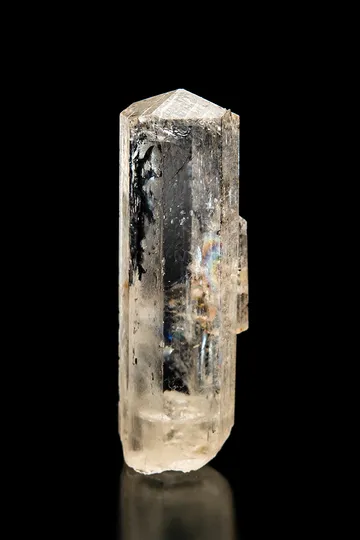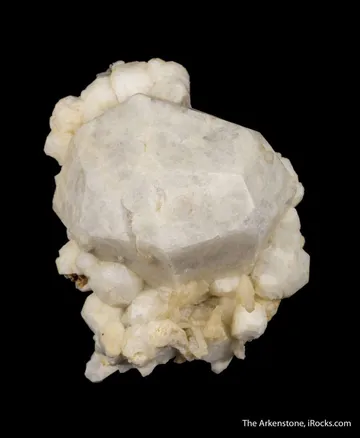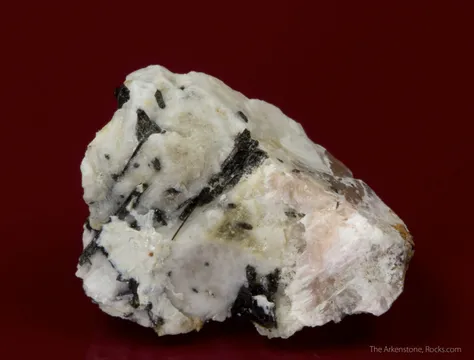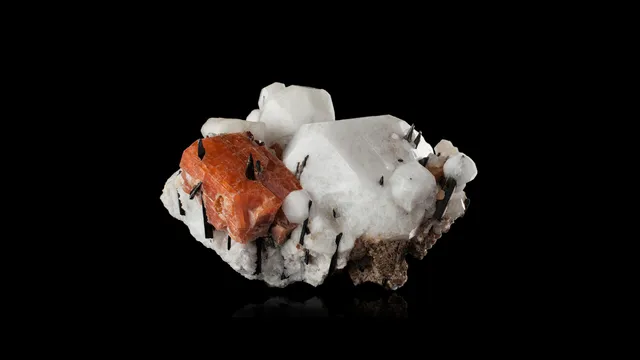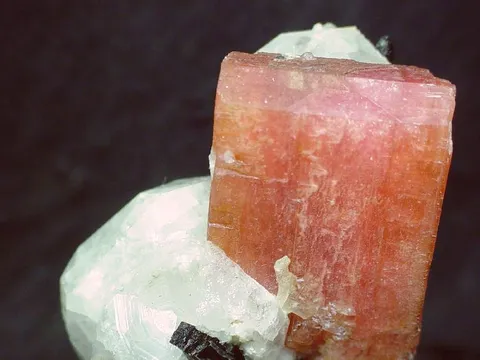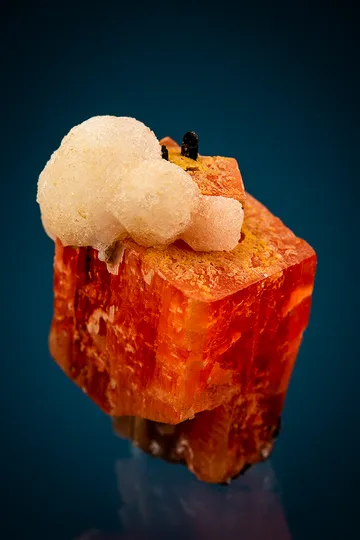
Mont Saint-Hilaire, Canada — a premier collector locality famed for extreme species diversity and display specimens, from serandite blades to carletonite.
Key facts
Mont Saint-Hilaire is one of the defining mineral localities of modern collecting: a single alkaline intrusion in southern Québec whose quarry exposures turned a quiet Monteregian hill into a global reference point for rare-species mineralogy. The collector locality is the former Poudrette quarry, now Carrière Mont Saint-Hilaire, on the northeastern side of the mountain about 40 kilometers east of Montréal. The host is not a vein mine or a metal mine in the usual sense, but an aggregate quarry cut into the East Hill suite of the Mont Saint-Hilaire alkaline complex, where peralkaline nepheline syenites, sodalite syenites, igneous breccias, pegmatites, hydrothermal veins, hornfels, and marble xenoliths created an exceptional array of tiny but chemically extreme mineral environments.
For collectors, Mont Saint-Hilaire matters because it combines two qualities that rarely coexist: extreme species diversity and genuine display appeal. Its best specimens are immediately recognizable—salmon-pink to orange serandite blades with black aegirine and white analcime; deep-blue carletonite in marble-derived assemblages; pale yellow leucophanite plates; silvery polylithionite rosettes; white natrolite sprays; gemmy rhodochrosite rhombohedra; brown-to-tan siderite; green sphalerite; and a dense supporting cast of exotic sodium-, zirconium-, beryllium-, niobium-, titanium-, rare-earth-, carbonate-, and halide-bearing species. Much Mont Saint-Hilaire material is thumbnail or micromount scale, but the great pieces have the visual architecture of cabinet specimens: sharp contrasts, open-pocket growth, clean terminations, and unlikely associations that could only have formed in a highly evolved alkaline system.
Historically, Mont Saint-Hilaire changed Canadian mineralogy. Quarrying began to reveal the intrusion in the mid-20th century, and by the 1960s collectors and researchers were encountering unknown or barely known species in quantity. Serandite, formerly a rare mineral best known from its original African occurrence, became a Canadian classic here. Carletonite, poudretteite, hilairite, monteregianite-(Y), rouvilleite, abenakiite-(Ce), and many others tied their names directly to the mountain, the region, the quarry operators, or the scientists and collectors who studied the material. The locality is now recognized internationally for hundreds of documented species and scores of type-locality minerals; many of its best specimens are held in major public and private collections.
Regional View
Country View
The Mont Saint-Hilaire aesthetic is usually a product of pockets, not bulk rock. A cavity a few centimeters across may carry the whole story: early feldspar and aegirine, later zeolites and pyroxenoids, then delicate beryllium silicates, rare-earth carbonates, zirconosilicates, and final-stage alteration minerals. In larger pegmatitic pockets, crystals can become unexpectedly bold—analcime to fist-sized dimensions, aegirine prisms to tens of centimeters, catapleiite plates of museum scale, and serandite crystals long enough to dominate a cabinet specimen. Yet even a 3 mm crystal from this quarry can be important if the species is rare, correctly identified, and well documented.
Search for specimens: View all specimens from Mont Saint-Hilaire, Canada
The collector locality is the Poudrette quarry complex on the northeastern side of Mont Saint-Hilaire, in La Vallée-du-Richelieu RCM, Montérégie, Québec. Older labels may say Poudrette quarry, Demix quarry, De-Mix quarry, Uni-Mix quarry, Desourdy quarry, Carrière de Poudrette, or simply Mont St-Hilaire; those names reflect adjoining and later merged quarry operations. The established mineralogical name remains “Poudrette quarry” in much of the literature, even though the current operating name is Carrière Mont Saint-Hilaire.
Geologically, the mountain is a small composite alkaline intrusion of Cretaceous age, part of the Monteregian Hills petrographic province. The western side is dominated by earlier gabbroic rocks, while the eastern side—the part exposed by the quarry and most important to collectors—is the East Hill suite, composed of evolved peralkaline syenitic rocks, sodalite-rich syenites, igneous breccias, pegmatites, hydrothermalites, and included blocks of older intrusive and sedimentary rocks. The intrusion cuts Ordovician limestone, shale, and siltstone of the St. Lawrence Lowlands, and quarrying exposed both the igneous rocks and the contact-metamorphosed sedimentary material.
This is not an ore deposit in the usual mining sense. The quarry has been worked for crushed stone and aggregate, not for metals or gem minerals. The “mineralization” prized by collectors occurs chiefly in late-stage pegmatites, altered pegmatites, miarolitic cavities, carbonate-rich pegmatites, hydrothermal veins, breccia cavities, hornfels fissures, sodalite xenoliths, and marble xenoliths. These environments are chemically specialized and spatially small. In syenitic pegmatites, the common framework minerals include microcline, albite, aegirine, nepheline, analcime, and related zeolites, with local concentrations of serandite, catapleiite, rhodochrosite, polylithionite, and kupletskite. Later hydrothermal activity added fibrous aegirine, second-generation albite, rare beryllium silicates such as epididymite and leifite, rare-earth carbonates, zirconosilicates, and replacement assemblages.
Carbonate pegmatites form a separate and important collector environment. They are less common than the syenitic pegmatites and are especially associated with the eastern part of the quarry and sodalite syenite. Their principal minerals include microcline, albite, siderite, calcite, quartz, zircon, rutile, synchysite-(Ce), pyrite, and sphalerite. These assemblages are responsible for some of the locality’s best siderite, sphalerite, sulphide, and quartz combinations, and they look markedly different from the classic serandite-analcime-aegirine pieces.
The marble xenoliths are equally distinctive. Cavities in marble-derived blocks commonly contain pectolite, calcite, vesuvianite, fluorapophyllite, richterite and other sodium amphiboles, feldspars, phlogopite, fluorite, sodalite, quartz, molybdenite, and sphalerite. They also host several of the locality’s rare or type-locality species. Most important for collectors is carletonite, a blue tetragonal silicate-carbonate that occurs exclusively at Mont Saint-Hilaire and is the most spectacular of the marble-xenolith species.
The hornfels block exposed in the southeastern part of the quarry produced another suite of mineralized fissures and contact-related assemblages. In the margins and fractures of the hornfels, hydrothermal fluids introduced carbonates, feldspars, quartz, rutile, anatase, fluorite, fluorapatite, gmelinite-Na, and sulphides including pyrite, pyrrhotite, sphalerite, molybdenite, and chalcopyrite. These fissures are generally not the source of the iconic serandite combinations, but they are important for the locality’s overall species count and for specialized collectors.
The modern collecting story began when quarrying exposed fresh rock and collectors started seeing unknown crystals in the 1960s. A key early moment came in 1963, when local collector Frank Melanson found unusual well-crystallized minerals that were later examined by Guy Perrault at École Polytechnique; among them was serandite. From that point onward, the quarry became a collaborative arena for collectors, universities, museums, and professional mineralogists. The Poudrette family and the Demix operation were long remembered by collectors for permitting access that allowed important specimens to be found and studied.
Access today is highly restricted. The quarry is an active industrial operation, and casual collecting is not permitted. Current access has been reported as limited to a very small number of supervised field trips for registered members of the Club de Minéralogie de Montréal, with participation controlled by lottery and strict rules. Collectors should not attempt to enter the quarry independently, and older material with good provenance is increasingly important because most classic specimens were collected before the 2007 ownership change.
Serandite is the emblem mineral of Mont Saint-Hilaire: pale pink, rose, salmon-red, orange, brownish, or rarely very dark blades and prisms, commonly set with white analcime, black-green aegirine, natrolite, albite, leucophanite, polylithionite, rhodochrosite, manganoneptunite, fluorite, calcite, and other late-stage pegmatite minerals. The important finds of 1973, 1981, and 1988 produced superb display pieces, with crystals reported to 20 cm, and they transformed the species from an obscure pyroxenoid into a classic cabinet mineral. The best Mont Saint-Hilaire examples have lustrous, undamaged, well-terminated tabular or bladed crystals with strong salmon-to-orange color, open composition, and clean contrast against white zeolite or dark aegirine; ordinary pieces are dull, bruised, massive, or color-poor, and the serandite-schizolite-pectolite compositional series means that serious labels sometimes require analytical care.
Aegirine is one of the most abundant and visually important crystallized minerals at Mont Saint-Hilaire, forming everything from tiny acicular sprays and radiating aggregates to glossy, well-terminated black prisms reported to 30 cm in the pegmatites. It is both a rock-forming mineral and a specimen mineral here, occurring across many quarry environments and acting as the dark architectural counterpoint to white analcime and natrolite, salmon serandite, pale feldspar, yellow leucophanite, rhodochrosite, catapleiite, genthelvite, and rare accessory species. The finest pieces show sharp, complete, lustrous crystals with good terminations and balanced associations; poor examples are simply broken black needles in massive syenite, of interest only when the association or provenance is unusually strong.
Rhodochrosite at Mont Saint-Hilaire is a common late-stage pegmatite and altered-pegmatite mineral, occurring as simple rhombohedra, curved rhombohedral druses, balls, rosettes, thin triangular plates, rare scalenohedra, hexagonal plates, and botryoidal aggregates. Colors range from very pale pink through red and orange-red to brownish and blackened tones, the darker brown-to-black surfaces commonly reflecting alteration to birnessite; crystals to about 10 cm have been reported, though large examples are often less attractive in color and transparency than smaller, sharper pieces. The most desirable Mont Saint-Hilaire rhodochrosites are bright, clean, lustrous pink-to-red crystals on contrasting aegirine, analcime, albite, microcline, catapleiite, natrolite, serandite, polylithionite, epididymite, leucophanite, or rare-carbonate assemblages, while dull brown masses and altered, cleaved crystals are far more ordinary.
Analcime is abundant at Mont Saint-Hilaire and is one of the locality’s most important aesthetic minerals, occurring in several environments as colorless, white, or gray crystals, commonly as sharp trapezohedra and modified trapezohedra, with exceptional crystals reported to 25 cm and pseudomorphic masses to about 15 cm. It is the classic white stage on which serandite, aegirine, natrolite, rhodochrosite, siderite, microcline, albite, catapleiite, fluorite, polylithionite, and rare late-stage species are displayed. The best pieces are bright, lustrous, sharp-edged, undamaged crystals in open cavities or in balanced association with high-value species; sheer size alone is less important than surface quality, crisp geometry, and a genuinely Mont Saint-Hilaire association.
Epididymite is fairly abundant for such a rare beryllium silicate at Mont Saint-Hilaire, especially in pegmatitic and late hydrothermal assemblages, and the locality is noted for superb trillings to about 1 cm. It occurs as colorless single crystals, white twins, fibrous to acicular aggregates, bladed to long-prismatic forms, blocky and equant prisms, spherical or barrel-shaped twinned groups, and pseudohexagonal trillings. Good examples are sharply crystallized, lustrous, and visibly twinned, often with aegirine, albite, analcime, catapleiite, elpidite, fluorite, genthelvite, leucophanite, natrolite, rhodochrosite, serandite, siderite, sphalerite, or yofortierite; lesser pieces look like anonymous white crusts unless magnification reveals the twinning and form.
Polylithionite is one of the most attractive mica-group minerals from Mont Saint-Hilaire, forming pearly, silvery to colorless, pale brown, or pale yellow-brown pseudohexagonal books and delicate rosettes of thin lamellae, especially in syenitic pegmatite assemblages. It is locally associated with serandite, analcime, aegirine, natrolite, microcline, albite, rhodochrosite, catapleiite, genthelvite, and other late-stage species, and its bright lemon-yellow shortwave fluorescence is a useful separating feature from closely related tainiolite. The best specimens show intact rosettes with clean pearly luster and attractive placement on contrasting matrix; crushed books, oxidized flakes, and untested mica aggregates are much less convincing.
Carletonite is a Mont Saint-Hilaire signature in the strongest possible sense: the quarry is its type locality and the only locality for the species. It is a marble-xenolith mineral, appearing as pale to deep blue, colorless, white, and rarely pink tetragonal prisms or crystalline masses, often with color zoning, sharp-to-irregular blue phantoms, and etched surfaces; smaller transparent blue crystals can show a darker blue core beneath a paler rim. Top pieces are intensely blue, sharply crystallized, translucent to transparent, and well isolated on contrasting marble-associated matrix; pale, etched, cleaved, or massive examples remain important scientifically but lack the magnetic appeal of the best crystal specimens.
Leifite from Mont Saint-Hilaire is a late-stage beryllium-bearing silicate of the syenitic pegmatite environment, valued less for size than for its distinctive habits and associations. It commonly appears as white to colorless or pale crystals, sometimes in barrel-like, tapered, or cone-like forms and sprays, and it is most memorable when perched directly on serandite or set among aegirine, albite, analcime, natrolite, rhodochrosite, leucophanite, catapleiite, genthelvite, epididymite, and rare sodium-zirconium assemblages. A good specimen has discrete, identifiable leifite crystals with clean terminations and a meaningful association; a routine one is a tiny white aggregate that needs magnification, careful labeling, and often analysis to stand apart from the many pale late-stage silicates of the quarry.
Leucophanite is moderately common at Mont Saint-Hilaire, and the quarry produced some of the finest and largest known crystals for the species. It occurs in pale to lemon-yellow, white, beige, yellow-green, and pale green forms, including sharp pseudocubic crystals to about 5 mm, twinned elongated crystals to about 12 mm, superb twinned square tabular crystals to about 4 cm, small rounded flakes, and rosettes. The best pieces are yellow, sharp, lustrous, and visually separated from the matrix, ideally with aegirine, albite, analcime, catapleiite, epididymite, fluorite, genthelvite, microcline, natrolite, rhodochrosite, or serandite; dull pale crusts and indistinct plates are far less desirable unless they carry unusual paragenetic value.
Natrolite is widespread at Mont Saint-Hilaire and occurs in nearly every major rock environment, usually as colorless or white crystals and fibrous aggregates, rarely with pale pink or very pale bluish-gray tones. It forms pseudotetragonal prisms, fibrous sprays to about 10 cm, and crystalline masses, and it is a key textural element in many pegmatite pockets with aegirine, albite, analcime, catapleiite, elpidite, epididymite, eudialyte, fluorite, gonnardite, manganoneptunite, polylithionite, rhodochrosite, serandite, and siderite. The best specimens have clean, open sprays or sharp prismatic groups that add height and delicacy to a complex association; compact chalky masses and matted fibers are common and usually secondary in collector importance.
Albite at Mont Saint-Hilaire is both a rock-forming feldspar and a collector mineral, especially in the syenitic pegmatites where it forms white to pale, blocky, platy, and twinned crystals associated with aegirine, analcime, serandite, natrolite, microcline, catapleiite, rhodochrosite, sphalerite, siderite, genthelvite, and rare late-stage species. One particularly important line of study involved baveno-twinned albite from the Poudrette quarry, demonstrating that even “common” feldspar at this locality can carry crystallographic significance. Good collector pieces show sharp, lustrous, well-separated albite crystals or attractive twins that frame more colorful species; ordinary material is massive white feldspar matrix, useful mainly for context and association.
Genthelvite from Mont Saint-Hilaire is rare but world-class for the species, occurring in pegmatites as tetrahedral crystals from a few millimeters to as much as about 5 cm across. Colors include colorless, white, pale to lemon-yellow, and apple-green, and the classic associations include aegirine, albite, catapleiite, microcline, polylithionite, rhodochrosite, analcime, natrolite, kupletskite, pyrochlore-group minerals, calcite, gaidonnayite, serandite, and fluorite. The best genthelvites are sharp, lustrous, translucent, and strongly colored, with clean tetrahedral form and minimal damage; small yellow crystals are still desirable when crisp, while rounded, granular, or embedded grains need careful documentation to command serious interest.
Catapleiite is one of Mont Saint-Hilaire’s great display species, and the quarry has produced the largest crystallized specimens known for the mineral. It occurs as tan, beige, pale gray, brown, colorless, and rarely pale yellow, orange, pink, or very pale blue pseudohexagonal plates, often in stacked rosettes, with multiple twin laws and occasional thin coatings that can dull the luster or create iridescence. The finest specimens show broad, sharp, rosette-like plates or “donut”-like aggregates with attractive placement on aegirine, albite, analcime, natrolite, polylithionite, rhodochrosite, siderite, sphalerite, fluorite, or rare accessories; mediocre pieces are flat, dull, coated plates with little separation or contrast.
Elpidite is moderately rare at Mont Saint-Hilaire but can occur in locally abundant groups, sometimes as tan, greenish-gray, white, or colorless short prismatic crystals and needle-like sprays. The locality is particularly interesting for elpidite after serandite, where the pseudomorph may be coated by a very fine dark green powdery chlorite-group mineral, preserving the older crystal habit while recording late-stage alteration. Good specimens show clean sprays or recognizable pseudomorphs with albite, aegirine, calcite, natrolite, epididymite, fluorapatite, rutile, pyrochlore, bastnäsite, chlorite-group minerals, or siderite; poor pieces are powdery gray-green crusts that require experience to interpret.
Graphite is a true rarity at Mont Saint-Hilaire, not a common accessory, and has been documented as small flakes under 1 mm embedded in sodalite from a sodalite xenolith. It is associated with eudialyte, ussingite, and villiaumite, placing it in one of the quarry’s more specialized reduced, sodalite-rich microenvironments rather than in the familiar serandite-bearing pegmatites. A worthwhile specimen is one with confirmed identification, visible flakes under magnification, and intact sodalite-xenolith context; without that context, tiny black flakes from Mont Saint-Hilaire are too easily confused with other opaque minerals.
Donnayite-(Y) is a Mont Saint-Hilaire type-locality rare-earth carbonate and a very late-stage mineral in the quarry’s pegmatite and cavity assemblages. It occurs as small yellow, brown, white, or gray tabular, platy, barrel-shaped, saucer-shaped, and rosette-like crystals, and it is commonly discussed with other mckelveyite-group and rare carbonate species in the late hydrothermal paragenesis. The best pieces show discrete, sharp, well-formed crystals or attractive caps on related carbonates, with associations such as analcime, albite, calcite, rhodochrosite, siderite, pyrite, and rare-earth carbonates; ordinary pieces are micromount material whose value depends heavily on analysis, provenance, and whether the species has been separated from visually similar ewaldite or mckelveyite-group minerals.
Sphalerite is common across Mont Saint-Hilaire’s rock environments and is a major collector surprise from an alkaline quarry better known for silicates and carbonates. It occurs in yellow, green, brown, red, orange, black, and colorless forms, with tetrahedral, pseudo-octahedral, dodecahedral, modified dodecahedral, and flattened twinned pseudohexagonal crystals; crystals to about 7 cm are documented, and large gemstones have been cut from quarry material. The best specimens are gemmy green, yellow, or reddish crystals with adamantine luster, sharp tetrahedral form, and associations such as albite, calcite, siderite, analcime, aegirine, pyrite, microcline, fluorite, or carbonate-pegmatite minerals; black, dull, cleaved, or massive sphalerite is far less compelling unless it came from a notable pocket.
Kupletskite, an astrophyllite-group mineral, is uncommon at Mont Saint-Hilaire and cannot be reliably distinguished visually from astrophyllite without appropriate work. It appears as bronze-yellow tabular crystals to about 3 mm, acicular crystals, micaceous masses, and fibrous aggregates, with common associations including aegirine, albite, ancylite, arfvedsonite, calcite, eudialyte, fluorite, microcline, and natrolite. Good specimens are lustrous, well-crystallized bronze sprays or plates in clean pegmatite cavities with reliable identification; unattributed “astrophyllite/kupletskite” blades are common enough in old collections that serious buyers should prefer analyzed or well-provenanced pieces.
Microcline is one of the most common minerals at Mont Saint-Hilaire and appears in virtually all associations, but the quarry also produced collector-quality feldspar crystals, including white, tan, gray, and rarely pale pink blocky, tabular, or prismatic crystals reported to 30 cm and baveno twins to about 15 cm. In syenitic pegmatites it provides the structural matrix for aegirine, analcime, albite, serandite, catapleiite, rhodochrosite, natrolite, genthelvite, kupletskite, fluorite, siderite, and many rarities. The best microcline specimens are sharp, aesthetic crystals or twins with meaningful associated species; most massive feldspar matrix is valuable only because it preserves the pocket setting for rarer minerals.
Fluorite is very common at Mont Saint-Hilaire and occurs in many environments, with colors ranging from pale to dark purple, pale to intense green, pink, pale blue, pale to lemon yellow, white, and colorless. It forms cubic, octahedral, dodecahedral, and massive material, and appears with aegirine, albite, amphiboles, analcime, ancylite-(Ce), astrophyllite, calcite, catapleiite, cordylite, elpidite, fluorapatite, microcline, natrolite, nenadkevichite, pectolite, polylithionite, pyrite, pyrophanite, rhodochrosite, siderite, sphalerite, and synchysite. The best pieces have sharp, transparent, strongly colored crystals in association with locality-signature minerals; common colorless or massive fluorite is secondary unless it carries rare species or a notable assemblage.
Narsarsukite is relatively common at Mont Saint-Hilaire, where the quarry and weathered hornfels outcrops on the north flank of the mountain produced some of the finest and largest specimens of the species. It occurs in pale to dark yellow, greenish yellow, dark green, grayish brown, dark brown, colorless, pale pink, lemon-yellow, and orange-yellow crystals, commonly as sharp tabular or lath-shaped forms, radiating sprays, stacked groups, and aggregates. Strong specimens show lustrous, well-developed tabular crystals with good color and associations such as aegirine, albite, amphiboles, calcite, carletonite, leucosphenite, lorenzenite, microcline, natrolite, and quartz; dull brown laths in altered rock are much less appealing.
Siderite is very common at Mont Saint-Hilaire, especially in pegmatites and carbonate-rich environments, and has been found in crystals to about 25 cm on edge, though most crystals are only a few millimeters. It ranges from tan, beige, and orange-yellow in small crystals to brown and grayish brown in larger ones, forming simple and modified rhombohedra, flat tabular crystals, and curved aggregates. Top specimens have sharp, lustrous, well-formed rhombohedra with attractive contrast against albite, analcime, aegirine, calcite, fluorite, microcline, pyrite, pyrrhotite, rhodochrosite, rutile, sphalerite, synchysite, or zircon; ordinary siderite is abundant and often dull or massive.
Pyrite is by far the most abundant sulphide at Mont Saint-Hilaire and occurs in virtually every major mineral association, especially in hornfels and altered pegmatites. It forms brass-yellow cubes to about 5 cm on edge, pyritohedra, masses mixed with other sulphides, and filiform pyrite to about 10 mm, with common associations including albite, analcime, calcite, dolomite, natrolite, nepheline, rutile, siderite, and zircon. Fine collector pieces have sharp, bright crystals, unusual filiform habit, or attractive placement on carbonate or zeolite matrix; tarnished masses and broken cubes are commonplace unless tied to a rare assemblage.
Beyond the headline species, Mont Saint-Hilaire is a systematic collector’s paradise. Its type-locality minerals include abenakiite-(Ce), adamsite-(Y), bainbridgeite-(YCe), bobtraillite, carletonite, donnayite-(Y), doyleite, ferrokentbrooksite, gaidonnayite, gaultite, haineaultite, hilairite, horváthite-(Y), johnsenite-(Ce), khomyakovite, manganokhomyakovite, manganokukisvumite, monteregianite-(Y), nalipoite, natrolemoynite, oneillite, perraultite, petersenite-(Ce), poudretteite, quintinite polytypes, reederite-(Y), rouvilleite, sheldrickite, thomasclarkite-(Y), and others documented in the literature. Many are micromount minerals, and some are known from only a handful of specimens, but together they make the quarry one of the world’s essential localities for alkaline-complex mineralogy.
The main authenticity issue with Mont Saint-Hilaire specimens is not widespread artificial treatment but precision of identification and labeling. The quarry produced hundreds of species, many of them pale, tiny, visually similar, chemically variable, or known in solid-solution series. Labels reading only “Mont St-Hilaire” are common and acceptable for older material, but stronger labels specify Poudrette quarry, Demix quarry, Uni-Mix quarry, Desourdy quarry, or Carrière Mont Saint-Hilaire when that information is known. Because quarry names changed and operations merged, old labels are not automatically wrong; they simply need to be interpreted historically.
Species mislabeling is a real concern. Serandite, schizolite, and pectolite form a compositional series, and orange-pink pyroxenoid specimens have not always been analytically separated. Kupletskite and astrophyllite are visually difficult to distinguish. Donnayite-(Y), ewaldite, mckelveyite-group minerals, and related rare carbonates require care. Rare-earth carbonates and pseudomorphs are often sold under traditional names that may have been revised by later study. Serious buyers should favor analyzed material, collection labels from known Mont Saint-Hilaire specialists, or specimens that match well-documented habits and associations.
Condition matters greatly. Serandite has perfect cleavages and commonly suffers bruised edges, broken terminations, and dull or altered surfaces. Rhodochrosite is soft and cleavable, and darkened surfaces may reflect alteration. Analcime can be large but unattractive if granular, opaque, or scuffed. Natrolite sprays crush easily. Polylithionite books split and flake. Catapleiite plates may be coated or dulled. Carletonite cleaves and may be etched. Sphalerite has perfect cleavage and should be inspected for repaired breaks or contact damage. As with many quarry specimens, one must distinguish natural pocket contacts and extraction bruises from later handling damage.
Fluorescence is useful but should not replace identification. Polylithionite is noted for bright lemon-yellow shortwave fluorescence; helvite fluoresces deep red under longwave and shortwave ultraviolet; monteregianite-(Y) can show intense green shortwave fluorescence; and hackmanite-bearing sodalite from the locality is well known among UV collectors. Many important Mont Saint-Hilaire minerals, however, are weakly fluorescent or nonfluorescent, so ultraviolet response is best used as a supporting observation.
Market availability is strongly tied to old collections. Common matrix minerals, analcime, aegirine, natrolite, microcline, siderite, fluorite, pyrite, and some rhodochrosite appear regularly, but top-quality serandite, carletonite, catapleiite, leucophanite, genthelvite, and well-documented rarities are much scarcer. Since public collecting access is now very limited, fresh classic material is not entering the market at the rate it once did. Provenance to collectors such as Gilles Haineault, Peter Tarassoff, László Horváth, Quintin Wight, or other recognized Mont Saint-Hilaire specialists adds real confidence and, for rare species, can be as important as aesthetics.
The Mont Saint-Hilaire story begins, in collector terms, with a moment that sounds almost too modest for what followed. In 1963, local collector Frank Melanson visited the quarry and found unfamiliar, well-crystallized minerals. They were not showy ore minerals, nor the sort of instantly recognizable species that would make a mining company pause. They were strange pocket crystals from an alkaline rock that few collectors then understood. Guy Perrault at École Polytechnique examined material from that early lot, and one of the identifications was serandite—a rare silicate then known from a remote West African occurrence. That recognition helped turn a working crushed-stone quarry into one of the most studied mineral localities in Canada.
For decades afterward, Mont Saint-Hilaire collecting depended on timing. A blast might expose nothing but hard syenite and broken rock; another might open a pocket that existed only until the loader reached it. Gilles Haineault became one of the great figures of that era because he kept returning. Sources describing his collecting emphasize the patience required: sometimes he found nothing worthwhile for months, depending on where the quarrymen blasted and whether the rock had already been hauled away. Over more than 30 years, his persistence produced a collection of more than 8,000 Mont Saint-Hilaire specimens, eventually acquired by the Canadian Museum of Nature. The museum later recognized 1,160 of the best pieces as Canadian cultural property, keeping them in Canada as research and heritage material.
The Haineault collection includes specimens that define what “best of locality” means at Mont Saint-Hilaire. One catapleiite specimen, described by the Canadian Museum of Nature as arguably the centerpiece of the collection, measures 26 x 16 cm overall, with catapleiite crystals reported at 15 x 9 cm. That scale is startling for a species many collectors know only from small plates and micromounts. The same collection includes carletonite, rare-earth carbonates, hackmanite, leucophanite with aegirine, serandite with analcime, and a pseudomorph of birnessite after serandite—an object that preserves the shape of one of the quarry’s most famous species while replacing its substance with a later manganese oxide.
One of the most vivid individual pocket stories attached to the quarry concerns Jean-Yves Lamoureux and an October 1996 analcime pocket. The specimen later photographed by Modris Baum shows white analcime on microcline, with the largest analcime only 1.3 cm across, but the story behind it is pure Mont Saint-Hilaire. Lamoureux recalled that the cavity was already visible low in the wall of a road descending into the quarry. To reach it, he had to crawl downward and leftward at a 45-degree angle, without even a T-shirt, and he had to empty his lungs to squeeze into the slanted chimney. That is the unseen labor behind many small “expensive” Mont Saint-Hilaire specimens: not just rarity, but awkward, risky, fleeting access to a pocket before it vanished.
Another field account from the Poudrette quarry tells of a pocket that began with skepticism. Collectors at the site saw little reason to expect anything important, yet the cavity went on to yield smoky quartz, microcline plates, and sphalerite. The first thrill was a large smoky quartz crystal; the finder reportedly kept it out of the hot sun, wrapping it in newspaper and placing it under a truck seat. Then came more quartz—single crystals, twins, skeleton-like and cathedral-like pieces, and a 24 cm specimen built as a triangular cluster of three quartz groups around microcline. Still deeper in the pocket were large microcline plates, some about 13 x 13 cm, and a dark heavy object that proved, in daylight, to be a damage-free gem-quality green sphalerite crystal. Among the sphalerites from the same pocket was a tetrahedral crystal about 9 x 9 x 8 cm. At a locality famous for tiny rare species, that pocket is a reminder that Mont Saint-Hilaire could also produce bold, cabinet-scale mineral drama.
Horváth, László; Gault, Robert A.; Pfenninger-Horváth, Elsa; and Poirier, Glenn. Mont Saint-Hilaire: History, Geology, Mineralogy. The Canadian Mineralogist, Special Publication 14, Mineralogical Association of Canada, 2019. The major modern monograph on the locality, with history, geology, species data, and collector context.
Normand, Charles, and Tarassoff, Peter. “Mineralogy and Geology of the Poudrette Quarry, Mont Saint-Hilaire, Québec.” Geological Association of Canada–Mineralogical Association of Canada 2006 Joint Annual Meeting, Field Trip 4A Guidebook. A concise field guide to the quarry geology, mineral environments, and specimen-producing settings.
Horváth, László, and Gault, Robert A. “The Mineralogy of Mont Saint-Hilaire, Quebec.” The Mineralogical Record, 21(4), 281–359, 1990. The landmark published treatment that established much of the modern collector framework for the locality.
Mandarino, Joseph A., and Anderson, Violet. Monteregian Treasures: The Minerals of Mont Saint-Hilaire, Quebec. Cambridge University Press, 1989. A classic book-length treatment of Mont Saint-Hilaire minerals, especially valuable for species descriptions and historical collecting context.
Currie, K. L.; Eby, G. N.; and Gittins, J. “The petrology of the Mont Saint-Hilaire complex, southern Quebec: An alkaline gabbro-peralkaline syenite association.” Lithos, 19(1), 65–81, 1986. Foundational petrology paper for the alkaline complex.
Foland, K. A.; Gilbert, L. A.; Sebring, C. A.; and Chen, J.-F. “40Ar/39Ar ages for plutons of the Monteregian Hills, Quebec: Evidence for a single episode of Cretaceous magmatism.” GSA Bulletin, 97(8), 966–974, 1986. Important dating work for the Monteregian Hills intrusive suite.
Chao, George Y. “Carletonite, KNa4Ca4Si8O18(CO3)4(F,OH)·H2O, a new mineral from Mount St. Hilaire, Quebec.” American Mineralogist, 56, 1855–1866, 1971. Original description of one of Mont Saint-Hilaire’s most iconic type-locality species.
Chao, George Y.; Mainwaring, P. R.; and Baker, J. “Donnayite, NaCaSr3Y(CO3)6·3H2O, a new mineral from Mont St-Hilaire, Québec.” The Canadian Mineralogist, 16, 335–340, 1978. Original description of donnayite-(Y), an important rare carbonate from the locality.
Grice, Joel D.; Ercit, T. Scott; Van Velthuizen, Jerry; and Dunn, Pete J. “Poudretteite, KNa2B3Si12O30, a new member of the osumilite group from Mont Saint-Hilaire, Quebec, and its crystal structure.” The Canadian Mineralogist, 25, 763–766, 1987. Original description of poudretteite, named for the quarry-operating Poudrette family.
Tait, Kim T.; Chao, George Y.; Grice, Joel D.; and Gault, Robert A. “Baveno-twinned albite from Mont Saint-Hilaire, Quebec.” The Canadian Mineralogist, 30, 207–217, 1992. A focused crystallographic study showing the importance of even feldspar specimens from the quarry.
Lykova, Inna; Rowe, Ralph; Poirier, Glenn; Friis, Henrik; and Helwig, Kate. “Mckelveyite group minerals – Part 3: Bainbridgeite-(YCe), Na2Ba2YCe(CO3)6·3H2O, a new species from Mont Saint-Hilaire, Canada.” European Journal of Mineralogy, 36, 183–194, 2024. A recent example of continued species-level research on Mont Saint-Hilaire rare carbonates.
Canadian Museum of Nature: The Haineault Mont Saint-Hilaire Collection. Museum documentation of one of the most important Mont Saint-Hilaire collections assembled.
Canadian Museum of Nature: “Mont Saint-Hilaire at CMN: At the Heart of Canada’s Mineral Collection.” Museum article on the acquisition and significance of the Gilles Haineault collection.
“Mont Saint-Hilaire—A Canadian Mineral Hotspot” — Canadian Museum of Nature — Museum video introducing the locality’s mineral diversity and the importance of Mont Saint-Hilaire specimens in the national collection.
“Minerals of Mont Saint-Hilaire” — Canadian Museum of Nature — Media release for the museum’s Mont Saint-Hilaire exhibit, useful for understanding how the locality is being presented to the public.
“Quarry and minerals” — Mont Saint-Hilaire Biosphere Reserve Virtual Museum — Public-facing media page connecting the quarry, the mountain, and the mineral discoveries.
Mindat: Poudrette quarry / Carrière Mont Saint-Hilaire locality page — Essential online locality reference for quarry names, access notes, references, and the full mineral list.
Mindat: Type Locality Report for Poudrette quarry — Convenient list of type-locality species tied to the quarry.
IUGS: Mineral site of Mont Saint-Hilaire — International geological-heritage summary of the locality’s importance.
Gault Nature Reserve: Natural History — Clear background on the mountain, the quarry, mineral diversity, and links between geology and conservation.
Saint-Hilaire.ca: MSH Mineral Descriptions — Collector-oriented species descriptions and photo references for Mont Saint-Hilaire minerals.
Normand and Tarassoff 2006 Poudrette quarry field-trip guidebook — Practical summary of the quarry geology and mineral-forming environments.
Canadian Museum of Nature: Mont Saint-Hilaire at CMN — Museum article on Mont Saint-Hilaire specimens and the Haineault collection.
Canadian Museum of Nature: The Haineault Mont Saint-Hilaire Collection — Background on the 8,000-plus-piece collection now held by the museum.
Mineralogical Association of Canada: Mont Saint-Hilaire: History, Geology, Mineralogy — Publisher page for the definitive modern monograph.
Library and Archives Canada: History of Quarries — Historical public-education page on the quarry operations and mineral discoveries.
Québec geological heritage proceedings: Mont Saint-Hilaire quarry history — Useful historical source for the early quarry operations and the 1963 Frank Melanson discovery.
McDougall Minerals: Frank and Wendy Melanson — Collector-history article touching on early Mont Saint-Hilaire collecting.
Wikimedia Commons: Category Poudrette Quarry — Open image repository for verified specimen photographs from the quarry.