Pederneira mine, Brazil — a lithium-rich tourmaline pegmatite famed for gemmy elbaite pockets, vivid colors, rare sub-localities, and coveted collector pieces.
Key facts
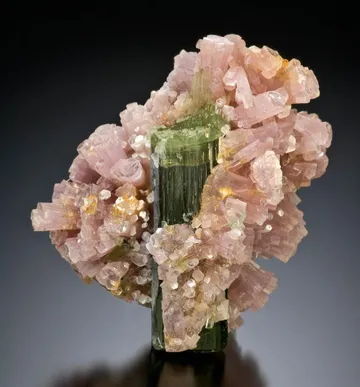
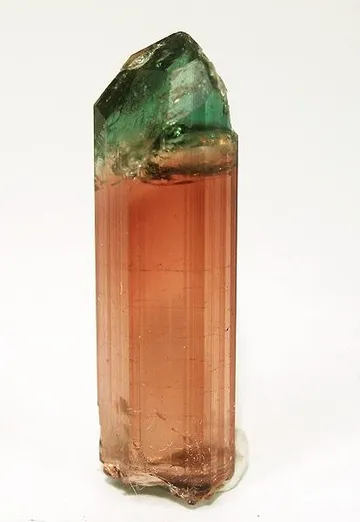
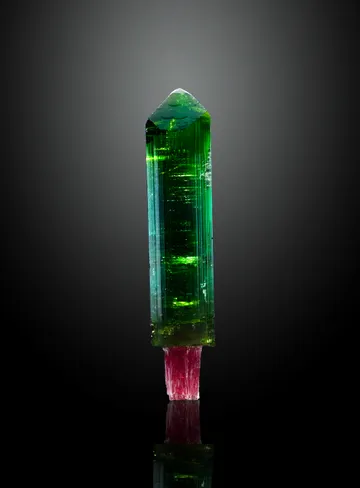
Pederneira is one of the modern world’s defining tourmaline specimen mines: a lithium-rich, boron-bearing pegmatite system in the São José da Safira district of eastern Minas Gerais, worked from steep hillsides above the Córrego da Pederneira. Its reputation rests not on volume alone, but on the repeated emergence of discrete, recognizable pockets whose colors, habits, matrices, and preservation histories are distinct enough that serious collectors speak of them almost as sub-localities: Keké’s, Sharon Stone, Rocket, Afghan, Porcupine, 18%, Grandon, Azul Bien Grande, Bi-Color Steel, Lepidolite and Blue, Blue-Green, Burkhard’s, Violet, Blue Gem, and others. The classic Pederneira specimen is a gemmy, striated elbaite crystal—or a spray of them—rising from snow-white cleavelandite, lavender to hot-pink lepidolite, glassy quartz, and pale feldspar. At its best, the mine produces a kind of controlled exuberance: saturated rubellite cores capped in blue-green, chrome-green crystals on vivid pink mica, pastel Afghan-like zones, true blue indicolite, smoky or pale citrine quartz plates, and improbably elegant matrix pieces that look too sculptural to have survived the violence of a collapsed pegmatite pocket.
Regional View
Country View
Geologically, Pederneira belongs to the Eastern Brazilian Pegmatite Province, in a district that also includes such storied names as Cruzeiro, Aricanga, Golconda, and Jonas. The mine exposes two principal pegmatite bodies, Dilo and Dada, hosted by garnet-bearing mica schists and related metamorphic rocks. Most of the great collector specimens came from highly evolved core-zone cavities along a “pocket plane,” where cleavelandite, lepidolite, quartz, feldspar, beryl, phosphates, and tourmaline crystallized in open spaces. The mine is also a textbook example of why pegmatite specimens often carry complicated histories: many pockets were partly collapsed, water-filled, mud-filled, or shaken by mining, so preservation depended on careful collection, reconstruction, trimming, and documentation.
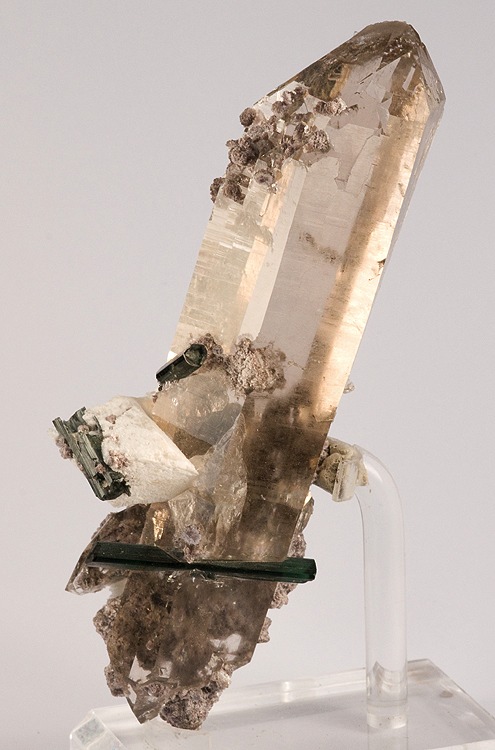
Photo: Wikimedia Commons
Historically, Pederneira bridges two collecting eras. The first significant production in the 1980s yielded tons of tourmaline, morganite, quartz, and albite, but much of the finest gem-quality tourmaline was cut and many specimens were poorly documented by modern standards. The second, better-documented era began in 1999 with Dada’s Tunnel and transformed Pederneira into a world locality: pockets were named, photographed, reconstructed, published, and marketed as locality-specific mineral events. By the time the Grandon, Azul Bien Grande, and Bi-Color Steel pockets appeared in 2004, Pederneira had moved from “important Brazilian tourmaline mine” to one of the handful of localities by which contemporary matrix tourmaline specimens are judged.
Search for specimens: View all specimens from Pederneira mine, Brazil
Pederneira is in the municipality of São José da Safira, Minas Gerais, in a rugged pegmatite district reached from Governador Valadares by roads that pass São José da Safira, the Aricanga and Cruzeiro mines, and the village of Cruzeiro before reaching the mine area. The final approach has long been a rough, unpaved route, and historical accounts note an airstrip on the ridge that was once used to move people and valuable specimens more quickly and safely. The mine’s name comes from the small stream at the base of the mountain.
The deposit is a complex rare-element granitic pegmatite system associated with the São José da Safira district of the Eastern Brazilian Pegmatite Province. The Dilo and Dada pegmatites are two sub-parallel tabular bodies separated by a mica-schist septum, broadly concordant with the schistosity of the host rocks. In many places each body is relatively thin, roughly decimeter to meter scale, but in productive columnar sectors the pegmatite swells dramatically; those enlarged, inclined zones supplied most of the gem and specimen production. The country rock is dominantly biotite-quartz-garnet mica schist, with related paragneiss and quartzite in the district.
The internal zoning explains the mine’s collecting character. In flatter, less evolved pegmatite sections, the rock is chiefly quartz and feldspar with biotite, muscovite, black tourmaline, and occasional garnet. In the inclined, swollen columns, biotite drops out and tourmaline, garnet, muscovite, albite, lepidolite, quartz, feldspar, and accessory rare-element minerals become more important. The pocket-bearing core zones contain sugary albite, cleavelandite, granular to crystallized lepidolite, gray to smoky quartz, K-feldspar, and multicolored tourmaline frozen into quartz and albite near the pocket plane. Accessory minerals documented from the pegmatite include beryl, fluorapatite, hydroxylherderite, helvine, cassiterite, Nb-Ta oxides, pyrochlore-group minerals, phosphate masses, rhodochrosite, pyrite, and spodumene, though not all occur as display-quality specimens.
The mine began in the 1940s, when a farmer named Pacheco noticed muscovite after a major storm exposed pegmatite on the hillside. Wartime demand for mica was high, and Pacheco reportedly carried barrels of mica by mule to São José da Safira, where nearby American mica buyers working in the Cruzeiro district purchased it. The Americans examined Pederneira for a larger mica operation, found the potential insufficient, and the mine slipped back into local hands.
After a long dormant interval, Pederneira revived in the 1980s. Geraldo Neves extended the old tunnel without success, but another miner, Natinho, soon intersected a huge pocket of bicolored tourmaline and rubellite after only about two meters of digging. Dilermando Rodrigues Melo and his son Dilermando Rodrigues Filho—“Dilo”—purchased the pocket’s contents, then Dilo and Julio Cipriano leased the mine from landowner José Oliveira Rocha, known as Deca. Their work in what became Dilo’s Tunnel generated a long bonanza through the 1980s and into the early 1990s, including tourmaline, morganite, quartz, albite, cleavelandite, and lepidolite. Documentation from this era is regrettably thin; a significant portion of the finest tourmaline went to the gem market rather than into collections as specimens.
The better-documented modern era began in 1999, when the miner Dada prospected roughly 100 meters above the older workings and opened the adit later known as Dada’s Tunnel. The initial partnership included Dada, Eustacio Neves, and Deca, and later expanded into the M. Pederneira Ltd. partnership involving figures such as Wilson Tomich, José Menezes, Saint-Clair “Keké” Fonseca Jr., Miranda, and Eustacio. Daniel Trinchillo and Fine Minerals International later became central to marketing, preparation, documentation, and international distribution of the specimens. From 1999 to 2006, Dada’s Tunnel produced the pocket succession that made the mine famous. Later work returned attention to Dilo’s Tunnel, supported by geological mapping, underground surveying, and drilling intended to understand the geometry of the pegmatite rather than simply follow miners’ instinct.
Collecting access today should be understood as private-mine access, not recreational field collecting. Pederneira is a working specimen and gem pegmatite with private ownership, professional preparation standards, and specimen recovery driven by mining operations, not casual visits. Provenance is particularly important because named pockets, repair histories, and publication records can add substantial value and interpretive meaning. Specimens in the market are typically from older pocket inventories, partnership releases, museum deaccession or private-collection turnover, and occasional dealer-held material, rather than from open public collecting.
The great finds define the locality. Keké’s Pocket, discovered in late 1999, produced chrome-green tourmaline with hot-pink crystallized lepidolite, a combination that remains among the mine’s most instantly recognizable aesthetics. The Giant Quartz Pocket of 2000 was notable not for tourmaline but for pale citrine to smoky quartz on superb bluish cleavelandite, including a large specimen later displayed at the Colorado School of Mines. The Sharon Stone Pocket produced blue-green, rubellite, and bicolored tourmalines on quartz, feldspar, albite, and lepidolite; one of its important specimens, “Firecracker,” was nearly 23 cm tall and 25 cm across. The Proud Pocket yielded a dramatic, very large matrix piece almost a meter across before trimming, with a main tourmaline approaching 14 cm long and 7 cm in diameter.
The Rocket Pocket of 2001 is celebrated for natural scepter and “rocket” forms created by selective corrosion and preservation of termination caps; it also produced exceptional quartz, rose-like cleavelandite, purple lepidolite stacks, and a rare morganite pierced by green tourmaline. The Afghan Pocket, also 2001, was physically small—described as no larger than a small beach ball—and produced only about a dozen specimens, but its pastel colors and distinctive colorless zones gave it a character unlike any other Pederneira pocket. The Porcupine Pocket produced sprays and clusters, including notable blue-green specimens and matrix pieces. The 18% Pocket of 2002 yielded only six major reconstructed specimens, with blue crystals containing unusually large flawless gem sections.
The 2004 sequence elevated the mine still further. Grandon Pocket, over 2 cubic meters, produced the 75 cm “Grandon,” the largest single specimen recovered from the mine, built on giant citrine quartz and now associated with the Houston Museum of Natural Science. Azul Bien Grande—“Blue, Good ’n’ Big”—followed with large blue tourmalines on cleavelandite, quartz, and lepidolite, including specimens over half a meter across and crystals around 40 cm. The Bi-Color Steel Pocket was smaller, yielding only a handful of specimens and some singles, yet it produced the 28 cm “Bi-Color Steel,” widely treated as the finest specimen from Pederneira. Later pockets such as Lunch Break, Lepidolite and Blue, Green Scepter, Blue-Green, Burkhard’s, Violet, Blue Gem, and the Quartz Finale Pocket added further variety, from true-violet tourmaline to meter-scale quartz crystals reportedly weighing 70 kg or more.
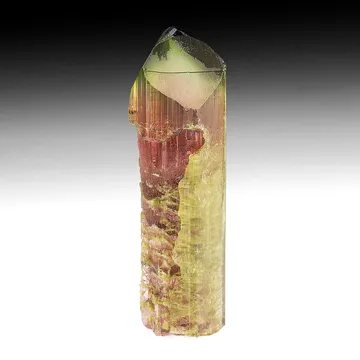
Elbaite is the mineralogical and aesthetic heart of Pederneira: microprobe work on gem-grade material placed the high-quality colored tourmalines largely in the elbaite field, with some pink samples carrying a high rossmanite component and darker green to black portions grading toward foitite. Collector-grade elbaite from the mine occurs as pencil-like, striated, singly and doubly terminated crystals, clusters, sprays, scepters, and matrix groups, with colors ranging through chrome-green, rubellite red, cranberry, purple, blue, blue-green, yellow-green caps, pastel Afghan-like zones, and watermelon or bicolored combinations. Size varies from thumbnail crystals to major cabinet pieces: Rocket crystals are typically shorter, with the longest around 12 cm; Grandon and Azul Bien Grande crystals reached 30 to 40 cm; early Dilo’s Tunnel accounts describe still larger crystals, though many were cut or poorly documented. Fine Pederneira elbaite is judged by transparency, saturation, termination sharpness, color zoning, natural habit, correct matrix position, and the quality of the cleavelandite, lepidolite, quartz, or feldspar setting; ordinary pieces are loose, repaired without clear fit, overly dark, bruised at the termination, or lacking the distinctive pocket character that makes this locality so collectible.
“Tourmaline” is used by collectors for the broader Pederneira suite, and here it is more than a casual label: the mine records elbaite, rossmanite, foitite, schorl, and probably dravite in different parts of the pegmatite system. Black schorl occurs as embedded crystals, aggregates, and graphic quartz-tourmaline textures in intermediate zones, with some crystals or aggregates reaching impressive sizes in the mine walls, while the prized pocket tourmalines are second-generation gem crystals from evolved cavities. The mine’s best tourmaline specimens are inseparable from named-pocket identity: Afghan Pocket crystals with pastel greens and colorless bands; Proud Pocket red cores grading to bluish green caps; Rocket Pocket scepters and corroded “rocket” forms; 18% Pocket blue crystals with red-pink terminal zones; Burkhard’s Pocket red-and-blue crystals with razor-sharp glassy terminations; and Violet Pocket material in an unusually true violet hue. The strongest specimens combine gem transparency, identifiable color architecture, minimal visible restoration, and matrix harmony; commoner tourmalines from Pederneira may still be beautiful but lack the condition, documentation, or sculptural matrix presence that separates locality icons from attractive singles.
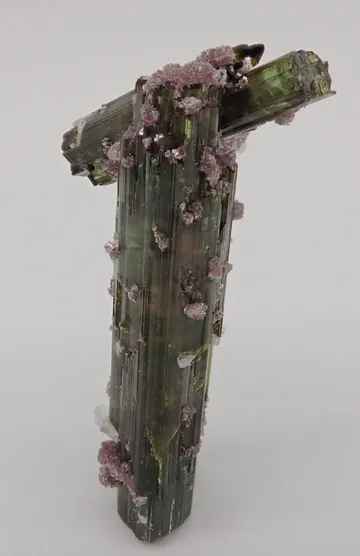
Lepidolite at Pederneira is not merely background mica; in the best pockets it is a primary aesthetic partner to tourmaline. The mine produced fine-grained purple masses in the core zone, granular lavender mica near cavities, crystallized hot-pink plates and stacks, and vivid purple to red-purple matrix coatings that can rival the tourmaline in visual force. Keké’s Pocket is the classic example, with chrome-green elbaite rising from hot-pink lepidolite of exceptional crystallization; the later Lepidolite and Blue Pocket echoed that look with green-to-blue tourmalines set on similarly electric pink mica. Rocket Pocket specimens may carry small purple lepidolite stacks sprinkled among white cleavelandite and glassy quartz, while Bi-Color Steel and Azul Bien Grande specimens use lepidolite as a saturated red-purple stage for gem crystals. Fine lepidolite-rich Pederneira pieces show sharp, lustrous mica crystals, saturated pink to violet color, clean contrast against green or blue elbaite, and balanced coverage; lesser examples are dull, granular, bruised, clay-stained, or so dominant that the tourmaline loses its sculptural clarity.
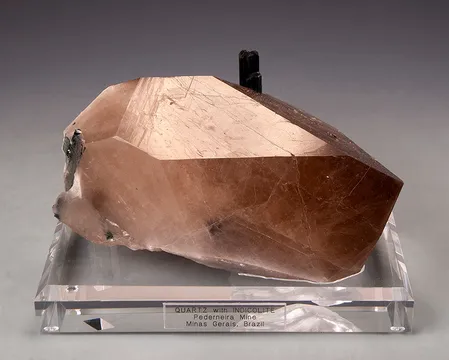
Quartz from Pederneira ranges from milky and smoky core-zone masses to fine transparent pocket crystals, pale citrine, smoky quartz, and large matrix-forming crystals that anchor many of the mine’s best tourmaline specimens. The Giant Quartz Pocket of 2000 produced no major tourmaline specimens but did yield some of Brazil’s finest pale citrine quartz on bluish cleavelandite, including a 60 cm specimen with a roughly 50 cm main quartz crystal and a mass exceeding 40 kg; the Grandon Pocket’s namesake specimen rested on three giant citrine quartz crystals; and the Quartz Finale Pocket reportedly produced quartz crystals approaching a meter tall and weighing 70 kg or more. Quartz is also the stage for many smaller but choice combinations: blue or green tourmaline attached to smoky quartz, quartz with cleavelandite and lepidolite, and doubly terminated quartz with indicolite accents. Superior Pederneira quartz is glassy, lustrous, undamaged at the termination, and compositionally useful to the specimen; average pieces are massive, cloudy, or visually overwhelmed by bruising and repairs.
Albite is fundamental to Pederneira’s pocket mineralogy, occurring as sugary albite masses, pale bluish replacement of K-feldspar, and the bladed cleavelandite variety that provides the snow-white matrix in so many celebrated specimens. In the core-zone setting, albite and cleavelandite mantle pocket walls, fill lower core zones with quartz and lepidolite, and form the attachment surface for gem tourmalines. The best albite-rich specimens from Pederneira are not judged only by whiteness; the finest show clean, crisp bladed texture, subtle translucency, a faint blue cast in some pockets, and a way of cradling tourmaline without visually swallowing it. Burkhard’s Pocket is notable for unusually thick, stark-white albite blades, nearly 6 mm thick and less transparent than typical Pederneira cleavelandite, while Giant Quartz Pocket material showed bluish cleavelandite of especially high quality beneath pale citrine quartz. Ordinary albite is massive, sugary, iron-stained, or broken-looking; top pieces make the matrix feel alive.
Cleavelandite is the signature white architecture of Pederneira specimens, forming rosettes, thick blades, plates, and curled aggregates that set off the saturated tourmalines. The Giant Quartz Pocket demonstrated how important the species can be even without major tourmaline: its pocket was lined with very beautiful cleavelandite crystal groups, including thick-bladed, sharp, glassy crystals with slight translucency and a faint blue tint. In Rocket Pocket matrix, cleavelandite appears as snow-white rose-like forms behind gem green tourmaline and brilliant quartz; in Grandon and Azul Bien Grande pieces it provides a clean structural base for large blue-green and blue crystals; and in Burkhard’s Pocket it becomes heavier and more opaque, forming thick solid-white blades distinct from the mine’s more delicate cleavelandite. Fine Pederneira cleavelandite is fresh, bright, three-dimensional, and undamaged at blade edges; poor examples are chalky, crushed, or visually indistinct from massive albite.
Indicolite is among the most coveted color expressions at Pederneira, appearing as blue, teal-blue, blue-green, grayish blue, and deep blue tourmaline zones or whole crystals within several pockets. The 18% Pocket produced vibrant blue crystals with large flawless sections and red-pink terminal zones; Big Blue and Azul Bien Grande are remembered for bold blue tourmalines on cleavelandite, quartz, and lepidolite; Blue-Green Pocket crystals show alternating blue-to-green-to-blue color shifts ending in greenish yellow; and single smoky-quartz combinations sometimes carry projecting teal-blue indicolite accents. Blue-green to grayish blue and true blue colors are rarer than the mine’s red and green material, so collector attention focuses on hue purity, transparency, and whether the blue is a real body color rather than simply a thin cap or darkened included zone. The finest indicolite pieces retain Pederneira’s matrix elegance while showing saturated blue in well-terminated crystals; lesser examples are dark, included, broken, or attractive only in backlighting.
Smoky quartz at Pederneira belongs to the same evolved pocket environment as the tourmaline and cleavelandite, and it can occur as pale smoky crystals, doubly terminated crystals, and smoky to pale citrine transitional quartz in large cavities. Geological descriptions note quartz turning from milky white toward pale smoky in parts of the quartz-feldspathic band, and collector specimens show smoky quartz supporting or intersected by blue-green tourmaline, feldspar, and lepidolite. The best smoky quartz pieces from the mine are valued when the quartz is glassy and complete, with clean terminations and an attached indicolite, elbaite, cleavelandite, or lepidolite accent that confirms the locality’s pocket signature. Because Pederneira is not primarily a smoky quartz locality, ordinary smoky singles have much less demand than combinations; locality-grade smoky quartz becomes compelling when it participates in the tourmaline story rather than standing as an isolated quartz specimen.
Feldspar at Pederneira includes K-feldspar, orthoclase/perthitic feldspar, microcline-like pocket feldspar, and albite-rich replacement textures, and it forms much of the pegmatite’s massive structure as well as part of the matrix in important specimens. In the upper core zone, giant cream-colored perthitic K-feldspar crystals can reach meter scale and may be partly replaced by bluish sugary albite or cleavelanditic albite. In collector specimens, feldspar commonly appears with cleavelandite, quartz, and lepidolite beneath tourmaline, and the Bi-Color Steel Pocket even produced a small spray of vibrant red tourmalines on the end of a large feldspar crystal section. The best feldspar-bearing Pederneira pieces use feldspar as a pale architectural element—clean, geometric, and not too bulky—while ordinary feldspar matrix is massive, dull, or intrusive. Because the locality is judged by tourmaline aesthetics, feldspar adds value chiefly when it improves composition, provenance, or textural contrast.
Morganite is uncommon but historically important at Pederneira, especially from the earlier Dilo’s Tunnel production and a few later pocket surprises. The first mining era reportedly produced morganite along with tourmaline, quartz, and albite, and published specimen captions document a 25 cm morganite on cleavelandite with quartz from Dilo’s Tunnel. The most memorable later occurrence is from the Rocket Pocket, where one of the few fine morganites known from the mine was pierced by green tourmaline crystals, creating a rare beryl-tourmaline association rather than the usual tourmaline-on-cleavelandite composition. Geological descriptions of the core zone note large tabular orange to pink beryl crystals as present but rather uncommon, matching the market reality: Pederneira morganite is much scarcer than tourmaline, lepidolite, quartz, or cleavelandite. Fine pieces are judged by saturated peach-pink color, intact beryl form, association with tourmaline or cleavelandite, and documented pocket history; isolated, pale, etched, or massive beryl is far less compelling.
Other documented Pederneira minerals include rossmanite-rich pink tourmaline compositions, foitite in dark green to black portions of crystals, schorl in pegmatite zones, probable dravite in the schist exocontact, fluorapatite, hydroxylherderite, helvine, orthoclase, beryl, spodumene, cassiterite, Nb-Ta oxides, pyrochlore-group minerals, muscovite, biotite, spessartine, rhodochrosite, pyrite, clay alteration products, and altered manganese-rich phosphate material. Hydroxylherderite is particularly collectible when it occurs with tourmaline, as in Azul Bien Grande and earlier Dilo’s Tunnel specimens; helvine is a notable rare accessory in the core-zone assemblage; and spodumene is geologically interesting but generally altered rather than a common display mineral. Pederneira is not primarily valued as a type-locality mine; its importance is instead that it documents, with unusual clarity, the pocket-by-pocket evolution of a gem-tourmaline pegmatite.
Pederneira is a locality where condition, repair history, and provenance are inseparable from value. Many pockets were partly or totally collapsed, and long tourmaline pencils commonly broke naturally before mining, during pocket collapse, through tectonic stress, by fluid or clay movement, or from blasting. Repairs are therefore common, often expected, and not automatically disqualifying, but they must be disclosed and understood. A properly reattached crystal with a lock-fit connection to its original base is very different from an aesthetic but speculative reconstruction. The mine’s best-documented specimens often have pocket names, mine photographs, preparation history, publication records, and dealer or collection provenance; serious buyers should ask for all of it.
The most locality-specific authenticity concern involves scepter and “rocket” tourmalines. The rocket forms from the Rocket Pocket are natural, produced by selective corrosion and preservation of termination caps, but published accounts warn that fakes from other mines are known in which a termination has been attached to the wrong stem. A Pederneira scepter should be examined closely for perfect fit, uninterrupted growth features, matching surface character, consistent luster, and credible provenance to the appropriate pocket. Blue, green, and multicolored Pederneira tourmalines are valuable enough that pocket names can be misused in the market; “Rocket Pocket,” “Afghan Pocket,” “Bi-Color Steel,” and “Azul Bien Grande” should not be accepted without documentation.
Common condition issues include repaired tourmaline stems, chipped terminations, bruised prism edges, missing attachment points, glued matrix contacts, trimmed feldspar or quartz bases, and lepidolite abrasion. Cleavelandite blades are easily crushed at edges; lepidolite can shed or dull if overhandled; and quartz points may carry hidden bruises that show only under strong side lighting. Old repaired specimens may show yellowed adhesive, dust trapped at joins, or slightly misaligned crystal sections. Conversely, unrepaired or minimally repaired Pederneira pieces—especially large matrix tourmalines—are exceptional and command strong premiums.
Treatments are less the central concern than reconstruction and preparation. Tourmaline color in serious Pederneira specimens is normally appreciated as natural pocket color, but collectors should remain alert to generic Brazilian tourmalines being sold under the Pederneira name, or to loose crystals mounted on unrelated albite, quartz, or lepidolite. Good Pederneira matrix should make geological sense: cleavelandite, lepidolite, quartz, and feldspar in coherent association, with attachment points that can be read under magnification.
Availability is broad at the lower-to-middle levels and very tight at the top. Single crystals, small matrix pieces, and repaired specimens appear regularly enough that Pederneira remains obtainable for focused tourmaline collectors. Named-pocket, published, unrepaired, large, or exceptionally aesthetic pieces are a different market: many are in major private collections or museums, and when they appear they are treated as modern classics. The collector sweet spot is often a small to cabinet-size specimen with strong color, documented pocket attribution, honest repair disclosure, and a matrix that unmistakably says Pederneira.
Pederneira’s first chapter begins with weather, mica, and a mule train. In the 1940s, a farmer named Pacheco walked the hillside after a huge storm and noticed an outcrop rich in muscovite. World War II had made mica a strategic material, and Pacheco knew that Americans were buying or mining mica nearby at Cruzeiro. He filled several barrels with muscovite and hauled them by mule to São José da Safira. The Americans bought the mica, examined the outcrop, and decided there was not enough to justify a major operation. The mine was born, but only barely: a wartime mica prospect above a small river at the bottom of the mountain.
Decades later, Pederneira awakened with the kind of story that sounds embroidered until one remembers that pegmatites occasionally do this. Geraldo Neves extended the old workings 30 meters without success and quit. Then Natinho, remembered as a gambler, tried his luck and hit an enormous pocket after only about two meters of mining. The pocket contained bicolored tourmaline and deep red rubellite. Dilermando Rodrigues Melo and his son Dilo came from Governador Valadares, bought the contents, and found themselves with no proper packing material at the mine. They cut banana leaves from the jungle and wrapped the tourmalines in them. Dilo later remembered grading and packing for days until the cargo holds of three two-ton trucks were full—nearly six tons of tourmaline and banana leaves.
That first great era produced enough material to make old miners speak in half-mythic terms. Dilo and Julio Cipriano leased the mine and, over roughly a decade, found tons of tourmaline, morganite, quartz, and albite. Much of the best material was cut for gems, and almost none was documented with the care modern collectors expect. The surviving descriptions are painful to read: tourmaline crystals more than two feet long and five inches in diameter, rising from bladed albite with grapefruit-size morganites on the side. Whether every measurement was exact or partly magnified by memory, the loss is real. The very transparency that made the material desirable as specimens made it tempting cutting rough.
When the 1980s bonanza faded, the end was not gentle. By the early 1990s the pocket frequency had dropped, much of the tourmaline was green, and green tourmaline did not bring the value it later would. Dilo and Julio disagreed about which direction to mine, then chose to close the operation. Before leaving, they back-blasted large sections of tunnel to bury the mine and prevent others from working it. Pederneira slept under its own rubble until Dada found a new outcrop higher on the hill in 1999.
The modern Pederneira story begins with a clue passed through the Brazilian mineral trade. A small amount of extraordinary tourmaline appeared in the hands of dealers, but the source was not immediately clear. Wilson Tomich eventually traced a piece through a Governador Valadares dealer named Lezito, who said it came from Pederneira. Tomich went to the mine, learned of Dada’s new tunnel, and maneuvered into the partnership. The group that emerged—Tomich, José Menezes, Keké Fonseca, Miranda, Eustacio, Dada, and Deca around the mine rights and labor—was improbable, but it set the stage for named-pocket collecting at a level the mineral world had rarely seen.
Keké’s Pocket was small, but it changed the mine’s public identity. Its green tourmalines on hot-pink lepidolite were so vivid that even today they define one of the canonical Pederneira looks. The pocket yielded only a few kilograms of specimens and only about half a dozen important pieces from the lot Keké acquired, but those pieces passed into major collections and publications. The tragedy, if one can call it that, is that the pocket was not collected under the careful protocols later used at the mine. Had it been, the already legendary pocket might have produced even more complete matrix specimens.
The Grandon Pocket shows what changed when Pederneira became a specimen mine first and a gem mine second. In early 2004 the miners suspected the pocket before they destroyed it, and worked toward it with a diamond chain saw and Darda pneumatic splitter rather than simply blasting forward. The pocket still collapsed and still required repairs, but the care reduced the damage dramatically. The named specimen “Grandon”—“the Big Boss”—was found lying on its side, built on three giant citrine quartz crystals. It took more than two weeks to collect it in one huge piece, about six months to locate and reassemble the tourmalines in their original lock-fit positions, and further professional work in Colorado before the 75 cm specimen was shown publicly. It later entered the Houston Museum of Nature and Science.
The Lunch Break Pocket is the story every field collector understands in their bones. The pocket was about 2 cubic meters, nearly empty except for one superb 40 cm specimen weighing around 30 kg, a huge tourmaline on a mound of cleavelandite, lepidolite, and quartz. It was still attached high on the hanging wall, exactly where it had grown, and the crew spent about a week preparing it. Nearly 100 drill holes were made so the surrounding rock could be cracked with a pneumatic splitter. By lunchtime the specimen had just begun to move. José Menezes called the crew down to eat, intending to return and remove it properly. One young miner stayed behind, saw that it was loose, and decided to be helpful. He worked a heavy pry bar back and forth for about 30 minutes, then walked into the house and announced, “I collected the piece, I did a great job.” Menezes asked, “What piece?” and then ran for the tunnel. The specimen had fallen onto a quartz crystal below it. That quartz blocked the fall, preventing a worse crash into the pocket floor, and no one was killed. The tourmaline suffered only a small chip on the termination, and the specimen was later restored. The miner did not keep his job.
Pederneira also has a one-specimen mystery. After a blast in 2005, the miners waited for the air to clear and returned to the face to find a specimen lying on the floor as if someone had placed it there. There was no visible pocket, no associated cleavelandite, no lepidolite, no quartz fragments, no other tourmalines—nothing. The piece had broken into a few sections, but the two crystals fitted cleanly back together. The “No-Pocket Pocket” had produced exactly one known specimen, with crystals mostly colorless to steely gray achroite. In a mine famous for abundant color, this ghostly, nearly colorless survivor is one of the strangest Pederneira footnotes.