São José da Safira, Brazil — renowned pegmatite district yielding elbaite, tourmaline varieties and euclase; a premier site for Brazilian gem crystals.
Key facts
São José da Safira is one of the great names of the eastern Minas Gerais pegmatite belt: not a single mine, but a compact collecting district whose individual pegmatites—Cruzeiro, Pederneira, Chiá, Golconda, Aricanga and nearby workings—have fed the specimen market with some of the most recognizable Brazilian tourmalines of the modern era. The district sits in the Eastern Brazilian Pegmatite Province within the Araçuaí Orogen, where late- to post-collisional granitic magmatism produced rare-element pegmatites enriched in B, Be, Li, Cs, Ta, Nb, Sn, P, U, Y and REE. In collector language, this translates into zoned LCT-style pegmatites with quartz-feldspar-mica architecture, secondary albite and lepidolite-rich replacement zones, miarolitic cavities, and pockets capable of growing elbaite, schorl, beryl, spodumene, fluorapatite, columbite-tantalite, cassiterite and euclase.
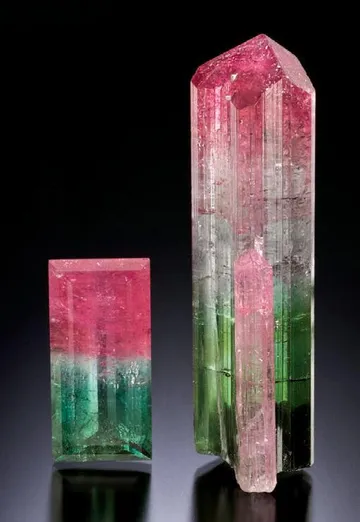
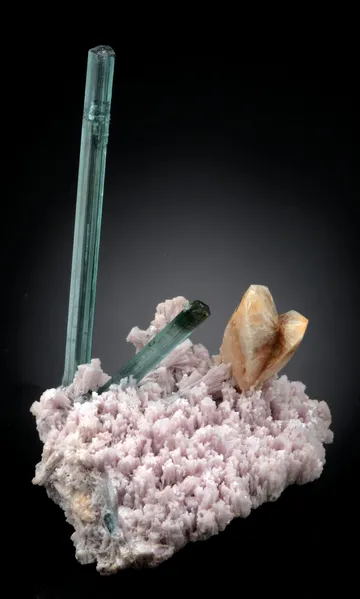
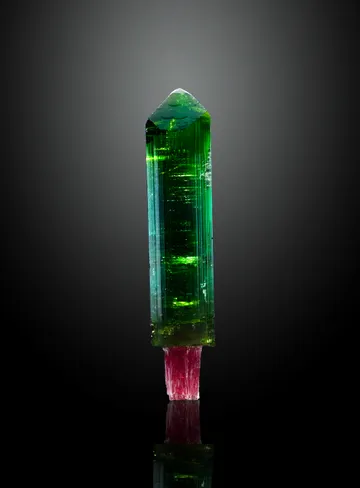
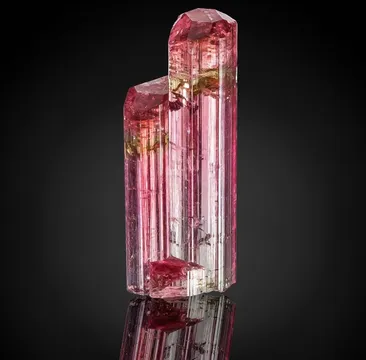
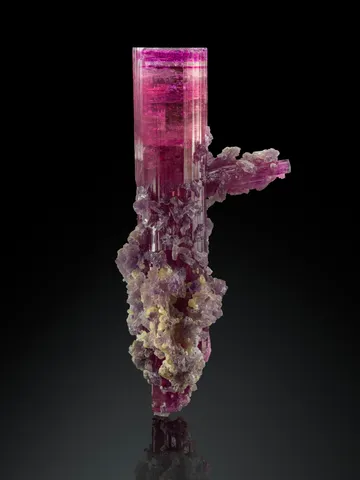
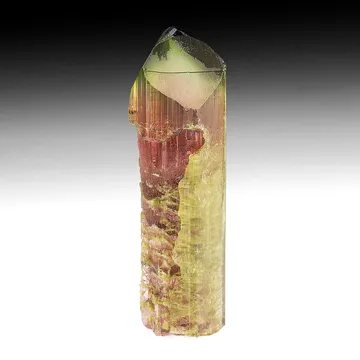
The best specimens from São José da Safira have a distinctly “Brazilian pegmatite” visual grammar: glassy green, teal-blue, pink, cranberry-red and multicolored tourmaline prisms rising from white cleavelandite, smoky or citrine quartz, lavender lepidolite, microcline and muscovite. Pederneira gave the collecting world sharply zoned elbaites, natural scepters, “rocket” forms, watermelon crystals and museum-scale matrix groups. Cruzeiro supplied enormous quantities of gem tourmaline and is also the type locality, jointly with the Urubu mine, for fluor-elbaite. Chiá added a quieter but highly desirable specialty: colorless to pale euclase, including doubly terminated crystals with schorl inclusions and feldspar-muscovite associations.
Regional View
Country View
The district’s importance is partly geological and partly cultural. The geology is a superb natural demonstration of pegmatite differentiation: thin quartz-feldspar-mica bodies swelling into thicker, better-zoned, more chemically evolved sectors, with pocket planes near quartz-rich cores and albitized/lepidolitized zones. The cultural importance comes from the way these pockets entered the collector market with names, narratives and identities. A São José da Safira label is not merely a regional label; for high-end tourmaline collectors it often invites the next question: which mine, which tunnel, which pocket?

Photo: Rob Lavinsky, iRocks.com / Wikimedia Commons
Search for specimens: View all specimens from São José da Safira, Brazil
São José da Safira lies in the Governador Valadares gem region of Minas Gerais, in the central-western part of the Araçuaí Orogen. The district belongs to the Eastern Brazilian Pegmatite Province, one of the world’s most productive provinces for gem and rare-element pegmatites. Its pegmatites are hosted mainly by biotite-quartz schists and related metasedimentary rocks of the Salinas Formation and adjacent units, with regional metamorphic assemblages that include garnet, staurolite, kyanite and sillimanite. The pegmatites themselves are undeformed relative to the host schists, a key field relationship: they were emplaced after the main regional metamorphic event, during late- to post-collisional evolution of the orogen.
Modern petrographic work classifies representative São José da Safira pegmatites as miarolitic, LCT, Group 1 and RMG bodies. In practical specimen terms, the important architecture is a series of primary zones—border, wall, intermediate and quartz-rich core—overprinted or accompanied by secondary albitization. The border and wall zones are dominated by quartz, K-feldspar, plagioclase and muscovite, with tourmaline, garnet and accessory oxides. Intermediate zones become coarser and may host spodumene, beryl, lepidolite, muscovite and tourmaline. Core zones are quartz-rich, and the most desirable pockets tend to occur near the boundary between intermediate and core zones, especially where albite, cleavelandite and lepidolite mark late, highly evolved fluids.
Pederneira is a textbook example of the district’s specimen potential. Its principal Dilo and Dada pegmatite bodies are subparallel tabular dikes, broadly concordant with the host-rock schistosity and separated by a schist septum. Much of the body is comparatively thin, but locally it swells into thick inclined columns, and those swollen sectors produced the great gem tourmaline pockets. In the less evolved portions, the rock is chiefly quartz, feldspar, biotite, muscovite, black tourmaline and garnet. In the enriched, pocket-bearing volumes, biotite drops out, tourmaline and garnet become far more conspicuous, and the pocket assemblage shifts to quartz, cleavelandite, lepidolite-group mica, gem elbaite and accessory species.
Cruzeiro is the district’s best-known commercial gem-tourmaline engine. The mine exploits multiple roughly parallel granitic pegmatite bodies along the Serra Safira. The bodies strike roughly northwest and dip steeply, with vein-like pegmatites that can be only a few meters thick in places but broaden dramatically in the productive sections. The gem crystals occur mainly in the intermediate zone and in peripheral parts of the quartz core, where lepidolite, milky quartz, large microcline, albite and other late-stage minerals accompany tourmaline. Historically, Cruzeiro was first important for mica, then for gem tourmaline; by the mid-20th century it had become one of the most consistent tourmaline producers in the world.
The district’s mining history begins with mica as much as with gems. During the World War I and World War II eras, muscovite was the commodity that justified mining in many Minas Gerais pegmatites, including Cruzeiro and Pederneira. At Pederneira, the traditional story begins in the 1940s when a farmer named Pacheco found a muscovite-rich outcrop after a storm and carried barrels of mica by mule to São José da Safira to sell to Americans working mica deposits in the area. At Cruzeiro, wartime mica production supported a large workforce, and tourmaline was initially a byproduct that gem dealers eagerly bought.
The modern specimen era is different. Pederneira’s great collecting period began around 1999 and accelerated through the early 2000s with named pockets such as Keké’s Pocket, Sharon Stone, Proud, Rocket, Afghan, Porcupine, Grandon, Azul Bien Grande and Bi-Color Steel. These pockets produced a spectrum of elbaite forms: short gemmy pencils, long color-zoned prisms, matrix sprays, scepters, doubly terminated crystals, watermelon sections, and large cabinet to museum specimens on quartz, cleavelandite and lepidolite. The work was not casual collecting. It required organized underground mining, diamond chain saws, careful pocket excavation, meticulous reconstruction and specialized laboratory preparation.
Chiá, by contrast, is far less famous to the general gem public but highly relevant to mineral collectors because of euclase. The mine is documented for albite, cookeite, elbaite, euclase, quartz, schorl, spodumene and columbite-series minerals. The euclase specimens that reached the market are typically small but choice: colorless, lustrous, prismatic to bladed crystals, in some cases doubly terminated and associated with K-feldspar, muscovite or included schorl. The Chiá euclases are not the big blue Brazilian euclases of older lore; their appeal is rarity, brightness, sharpness and pegmatite association.
Access today should be understood as commercial-mine access, not recreational collecting. The important localities are private or active/periodically active underground operations or former workings in rugged terrain, and the specimen material seen on the market has generally passed through miners, dealers, preparers and collections rather than amateur field collecting. For serious collectors, the safest “access” is provenance: mine name, pocket name where known, old collection labels, preparation history, and photographic or publication documentation.
Elbaite is the signature collector species of São José da Safira, especially from Pederneira, Cruzeiro and Chiá. The finest crystals are transparent to gemmy prisms in saturated green, teal-blue, blue-green, pink, rubellite-red and sharply zoned multicolored combinations, with watermelon and bicolor crystals particularly prized. At Pederneira the most distinctive elbaites came from named pockets in the Dilo and Dada workings, where second-generation “pencil” crystals grew on quartz, cleavelandite and lavender lepidolite, and where natural scepter and “rocket” forms resulted from corrosion, breakage, regrowth and preservation of differently resistant color zones. Crystals range from thumbnails of a few centimeters to cabinet and museum-scale pieces; the Rocket Pocket produced many crystals around 2 to 12 cm, while later pockets such as Grandon yielded crystals exceeding 30 cm. Good pieces from this district are judged by transparency, intensity of color zoning, crisp natural terminations, architectural placement on matrix, and well-documented repair or restoration when present; ordinary pieces are darker, more fractured, incomplete, or lack the unmistakable pocket aesthetics that make São José da Safira elbaite so collectible.
“Tourmaline” labels from São José da Safira often cover a complex group story rather than a single analyzed species: elbaite dominates the gem pockets, schorl is common in less evolved and wall-zone settings, fluor-elbaite is proven from Cruzeiro, and Pederneira studies have also identified rossmanite and foitite components in some zones. Collector specimens appear as prismatic crystals, pencil-like pocket crystals, scepters, radial aggregates, sprays, jackstraw groups and tourmaline-in-quartz combinations, with colors from black through green, blue, pink, red, colorless and multicolored. Cruzeiro is famous for volume and variety, producing green, pink/rubellite, blue and bicolored crystals, commonly with black terminations; Pederneira is famous for pocket identity and matrix aesthetics; Chiá contributes smaller but elegant blue-green crystals and tourmaline associations with quartz and euclase. The best “tourmaline” pieces here are those where the locality character is visible at a glance: a clean, lustrous, zoned prism with natural termination and either strong translucency as a single crystal or a coherent pocket composition on cleavelandite, quartz, lepidolite or feldspar.
Euclase from São José da Safira is chiefly associated with the Chiá mine, where it occurs as colorless to very pale, lustrous, prismatic to bladed crystals in a pegmatite assemblage rather than as the classic blue alluvial euclase for which Brazil is historically famous. Documented Chiá pieces include thumbnail to small-miniature crystals around 2 to 5 cm, some loose and others associated with K-feldspar, golden muscovite, schorl inclusions or smaller euclase offshoots; a notable 2020 find supplied doubly terminated examples, an uncommon habit for the species. Good Chiá euclase is bright, sharply terminated, transparent to translucent, and visibly mineralogical rather than merely gemmy—an attached feldspar or mica association, or fine schorl inclusion patterning, gives it locality identity. Ordinary examples are small single colorless crystals with indistinct form or damaged edges, still uncommon but less compelling to advanced collectors.
Schorl is the dark structural counterpoint to the district’s brightly colored elbaite. At Pederneira it is documented in border and intermediate-zone settings, as local enrichments, radial groups, quartz-tourmaline graphic aggregates, and large embedded black crystals; some underground exposures in Dilo’s Tunnel showed black tourmaline aggregates projecting from the border zone into the core of thick pegmatite sections, with individual crystals or aggregates reaching decimeter scale and, in some bands, very large sizes. At Chiá, schorl is important as both a recorded species and an inclusion or association in euclase specimens, giving otherwise colorless euclase a distinctly São José da Safira pegmatite look. Good schorl specimens from the district are not merely black sticks: they show intact terminations, radial or graphic growth, contrast against quartz or feldspar, or inclusion relationships with euclase; ordinary schorl is common, fractured, massive, or visually lost in dark pegmatite matrix.
Quartz is both the architectural core mineral of São José da Safira pegmatites and an important display partner for the district’s tourmalines. In the pegmatites it forms massive core zones, smoky to gray pocket crystals, milky quartz, hyaline quartz and, in celebrated Pederneira specimens, large smoky or citrine crystals carrying elbaite, cleavelandite and lepidolite; the Grandon specimen from Pederneira famously rested on three giant citrine quartz crystals, while Rocket Pocket matrix specimens are noted for nearly flawless, brilliant quartz crystals. Quartz from the district can also be valued as a specimen in its own right when doubly terminated, glassy, smoky, or dramatically pierced by teal-blue or green tourmaline. Good pieces show clean faces, strong transparency, undamaged terminations and a natural relationship to tourmaline, albite or lepidolite; mediocre examples are common core quartz or damaged smoky crystals without aesthetic mineral associations.
Kyanite at São José da Safira belongs to the metamorphic side of the district rather than to the classic gem-pocket assemblage. The pegmatites are hosted by schists and related metasedimentary rocks in which kyanite, staurolite, sillimanite, garnet and mica record the regional metamorphic framework into which the later pegmatite melts were emplaced. Collector kyanite from the broader São José da Safira area is far scarcer on the market than tourmaline, and documented examples tend to be valued for unusual locality provenance as much as for form: blades or blade aggregates, sometimes pale greenish, bluish, gray or darker depending on inclusions and host-rock context. Good pieces should have sharp bladed habit, visible crystal faces, stable matrix or intact single-crystal form, and a credible label separating metamorphic kyanite from pegmatitic tourmaline material; ordinary pieces are merely broken blades without diagnostic association or provenance.
Muscovite is historically central to São José da Safira: before the district became famous among gem and specimen collectors, mica helped justify mining at Cruzeiro and introduced Pederneira to prospectors. At Pederneira, muscovite occurs in the wall and intermediate zones, in mica-rich levels near the upper core zone, and as large books; one documented Pederneira mica sheet measured about 30 cm across and contained a spessartine inclusion. At Chiá, muscovite is a desirable association for euclase, especially where golden layered mica backs or frames colorless crystals. Good muscovite specimens from the district have large, lustrous books or sharp books integrated with tourmaline, euclase, quartz, feldspar or garnet; ordinary mica is plentiful, cleaved, industrial-looking and of interest mainly when it carries a pocket or historical context.
Lepidolite-labelled mica is one of the visual signatures of São José da Safira specimens, especially from Pederneira, where lavender to purple flakes, stacks and granular masses form the soft-colored matrix beneath green, blue, pink and multicolored elbaite. In the pegmatite structure it is concentrated in highly evolved core and replacement environments, commonly with cleavelandite, quartz, albite and multicolored tourmaline; at Pederneira it appears as flakes around pockets, fine-grained violet masses in Dilo’s Tunnel, and attractive lavender “flowers” on major matrix specimens. Collectors should understand that “lepidolite” is often used in the traditional specimen-market sense for lithian mica of the polylithionite–trilithionite series, not always as a rigorously analyzed single species. Good examples are richly colored, textural and compositionally important to the specimen, providing contrast and provenance; ordinary examples are granular purple mica masses with no sharp tourmaline or pocket association.
Other documented minerals from São José da Safira make the district much more than a tourmaline locality. Fluor-elbaite, Na(Li1.5Al1.5)Al6(Si6O18)(BO3)3(OH)3F, has Cruzeiro as one of its type localities, a major mineralogical distinction for the district. Pederneira has produced or recorded albite including cleavelandite, beryl including morganite and aquamarine, spodumene, fluorapatite, hydroxylherderite, helvine, orthoclase or microcline, spessartine, cassiterite and Nb-Ta oxides, with tourmaline compositions that include elbaite, rossmanite, foitite and probable dravite in exocontact settings. Modern petrographic work on the district also documents columbite-tantalite, microlite, uraninite, euxenite-(Y), xenotime-(Y), monazite-(Ce), autunite, zircon, garnet, nontronite and Fe-Mn oxide/hydroxide phases in representative pegmatites. Chiá adds cookeite and columbite-series minerals to the municipality’s specimen picture, while Golconda contributes a classic southern-sector example of a complex miarolitic rare-element pegmatite.
São José da Safira specimens are widely traded, but the best examples are locality- and pocket-sensitive. A label that says only “Minas Gerais” or “Doce Valley” is inadequate for high-value material; a serious label should identify São José da Safira and, where possible, the mine—Pederneira, Cruzeiro, Chiá, Golconda, Aricanga—and the pocket name. For Pederneira tourmaline, named-pocket provenance can be a large part of value, and old photographs, dealer labels, publication references and repair records are worth preserving with the specimen.
Repairs are common and not automatically negative. Pederneira pockets were often found collapsed, with crystals and matrix fragments scattered in clay or rubble; many world-class specimens required reassembly. The distinction collectors should make is between honest restoration to original contacts and deceptive construction. Published Pederneira notes specifically warn that although natural scepter and “rocket” tourmalines are well documented, fakes from other mines are known in which a termination has been attached to the wrong stem. On a high-value scepter, inspect the junction under magnification: the stem should fit the termination precisely, with compatible surface luster, color zoning, growth lines and fracture pattern.
Condition issues are typical of lithium pegmatite pocket minerals. Elbaite prisms may have bruised terminations, rehealed fractures, etched zones, base cleaves, missing side crystals or repaired contacts. Slender second-generation tourmalines are especially vulnerable. Euclase is brittle and has perfect cleavage, so even small Chiá specimens should be checked for edge nicks and cleavage flashes. Lepidolite-rich matrix can shed flakes, cleavelandite can be delicate, and quartz points can hide tiny bruises along sharp edges.
Treatment concerns vary by species. Tourmaline specimens from these mines are normally valued for natural color zoning and pocket character, but any loose gem rough or cut stones should be evaluated separately for standard gem-treatment disclosure. Quartz from the São José da Safira region has been noted in the gem trade for material that can be irradiated to produce “green gold” or “lemon gold” colors; for specimen collectors, unusually colored quartz should therefore be bought with treatment disclosure in mind. Fluorescent response is not a major selling point for the classic tourmaline assemblage, although accessory phosphates or uranium-bearing secondary minerals such as autunite can occur in the district and should be handled and stored with normal caution for fragile and potentially radioactive accessory species.
Market availability is uneven. Cruzeiro tourmaline remains far more available than most historic Brazilian tourmaline localities because the mine has been a long-running commercial producer. Pederneira is available mainly through older dealer stock, collections and named-pocket material; the finest specimens are expensive and often already in major private or institutional collections. Chiá euclase is far scarcer and tends to appear in small bursts from specific finds, especially the modern colorless, doubly terminated material. High-end São José da Safira pieces reward patience: buy the specimen, but also buy the documentation.
The district’s name carries an old mineralogical misdirection. Serra Safira and São José da Safira preserve the memory of blue stones once thought of as “sapphire.” The “sapphires” that gave the range its romance were not corundum but blue tourmalines, and the misunderstanding is wonderfully appropriate: São José da Safira became famous precisely because its pegmatites could produce tourmaline in colors intense enough to confuse, seduce and commercialize.
At Cruzeiro, the road into the mine became part of the legend. From Governador Valadares, travelers went north on BR-116, turned at Frei Inocêncio, drove northwest to São José da Safira, and then climbed a narrow, steep, difficult road into the Serra Safira. The pegmatites sat on the east slope near the top of a long north-south range dividing the Rio Suaçuí Grande and Rio Urupuca watersheds. In 1914, green and blue tourmalines were rediscovered and primitive mining began, but commercial mining did not start with gems. Mica paid the bills. During World War II, Cruzeiro’s mica was important enough that hundreds of garimpeiros worked dozens of places in the pegmatites, and the region supplied a significant share of Brazil’s wartime mica production. While American efforts focused on mica, German gem buyers reportedly came from Teófilo Otoni to buy tons of tourmaline crystals produced incidentally.
Cruzeiro’s modern story pivots on belief. José Neves was warned by the great Brazilian gem figure Julius Sauer not to risk too much, because gem mining is uncertain and a miner never truly knows what the next meter will bring. Neves ignored the cautious wisdom. He sold everything he owned, partnered with his brother Antonio De Assis Neves, and bought the mine in 1982. Soon afterward, Cruzeiro hit major pink tourmaline and then large quantities of red, pink, green, blue and bicolored crystals. One reported early production episode included 26 kilos of very clean rubellite. That is the kind of number that changes a family mine into a world locality.
Pederneira begins more humbly, with a storm and a mule. In the 1940s, a farmer named Pacheco walked the mountain after a huge storm and found an outcrop rich in muscovite. World War II had made mica valuable, and Americans were mining mica nearby at Cruzeiro. Pacheco filled barrels with muscovite, hauled them by mule to São José da Safira, and sold them. The Americans investigated whether the mica justified a larger operation, decided it did not, and left the deposit to local hands. Decades later, the same mountain would yield some of the most photographed tourmaline specimens in the world.
The Pederneira specimen era arrived suddenly in 1999. A local miner named Dada found a new pegmatite outcrop roughly 100 meters above older workings, and work began in what became the Dada tunnel. The early pockets were enough to bring dealers running. Daniel Trinchillo later described seeing photographs that made him “drop everything and take off for Brazil.” The mine soon developed not as a single discovery but as a succession of pocket personalities: Keké’s Pocket, Sharon Stone, Proud, Rocket, Afghan, Porcupine, Grandon, Azul Bien Grande, Bi-Color Steel and others.
The Rocket Pocket of 2001 is the one collectors still talk about with a kind of shorthand awe. The pocket was small—about half a cubic meter to a little more—but it yielded more than 350 crystals, many in the 2 to 12 cm range, with red rubellite cores that changed upward into gemmy green-blue and greenish tones. Many crystals had antilogous pyramidal terminations. The famous “rocket” and scepter forms were natural, not fantasy constructions: selective corrosion and breakage removed portions of the outer zone and left narrower stems beneath wider original terminations. Some crystals looked almost engineered. The published warning is equally memorable: the genuine rockets came out that way, but collectors must still beware of wrong stems and wrong terminations married together later.
Shortly after Rocket came the Afghan Pocket, a pocket reportedly no larger than a small beach ball. It yielded only about a dozen specimens, but their colors were unlike the rest of Pederneira—pastel, vibrant, and reminiscent enough of Dara-i-Pech tourmalines that the pocket earned its name. Its crystals could show a colorless transparent zone a few centimeters below the pyramidal terminations, a small detail that makes a collector lean closer to the case.
The Proud Pocket supplied a very human business story. A great specimen was reserved: almost a meter across, nearly 40 cm tall, with a main tourmaline crystal approaching 14 cm long and 7 cm in diameter projecting from quartz, albite and lepidolite. It was too important to leave and too expensive to buy casually. The solution, reached over meals and negotiation, turned a buyer into a partner. In Pederneira’s history, specimens did not merely move from mine to market; they changed relationships, investments and the direction of the mine.
Then came Grandon. The Grandon Pocket, discovered in early 2004, measured more than 2 cubic meters. Its greatest specimen, nicknamed “Grandon,” loosely “the Big Boss,” became the largest intact specimen recovered from Pederneira. It was found lying on its side so that a person looking into the pocket was effectively looking “down” at the tops of three giant citrine quartz crystals forming the specimen’s foundation. José Menezes was central to saving it, and extraction took more than two weeks. After removal, the work was still not finished: the specimen went to Governador Valadares for months of cleaning and reconstruction, with small stickers marking where loose tourmaline crystals fit their original contacts. The result became one of the iconic museum-scale Pederneira specimens.
Chiá’s story is quieter, but serious collectors appreciate it for that reason. In a district famous for color-saturated tourmaline, Chiá produced a very different aesthetic: colorless euclase, sharp and bright, sometimes doubly terminated, sometimes with schorl inclusions or attached to feldspar and muscovite. These are not the loudest São José da Safira specimens, but they have the charm of surprise. A collector who already knows the district for elbaite sees a Chiá euclase and realizes that the same geological system had another, rarer voice.