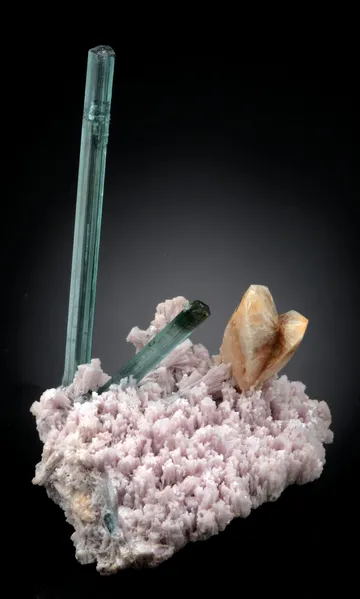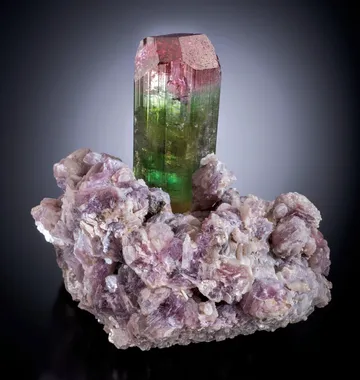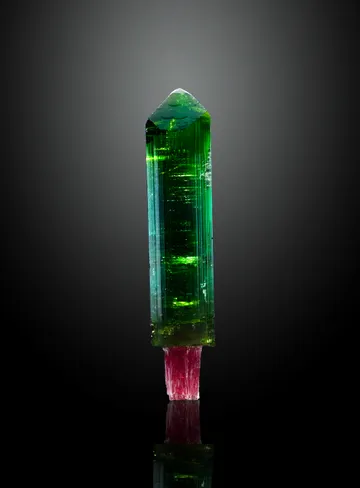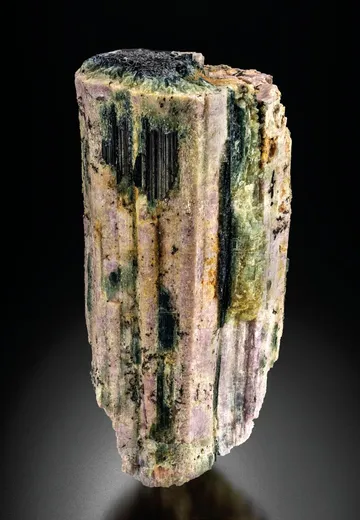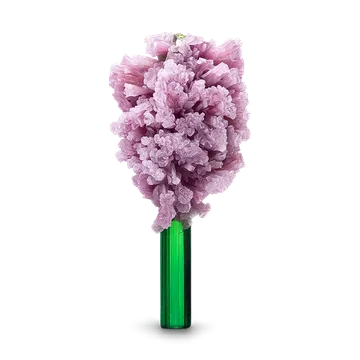
Lepidolite from Pederneira Mine, Brazil — lavender to pink mica in sparkling rosettes with elbaite tourmaline; Keké’s Pocket and vivid combination specimens.
Key facts
At Pederneira, lepidolite is not merely the lavender mica that happens to sit beneath the tourmaline. In the best pieces it is part of the composition: sparkling lilac to hot-pink mica books and rosettes against white cleavelandite, smoky or citrine quartz, and brilliantly zoned elbaite. The mine’s reputation rests on tourmaline, but many of its most memorable specimens owe their visual charge to lepidolite—its soft purple-pink color makes the greens, blues, and cranberry reds of Pederneira elbaite look even more electric.

Photo: Wikimedia Commons
The Pederneira mine lies near São José da Safira in Minas Gerais, within the Eastern Brazilian Pegmatite Province and the São José da Safira pegmatite district. Its productive bodies are evolved, complex granitic pegmatites enriched in boron, beryllium and lithium—exactly the chemical environment in which elbaite, cleavelandite, quartz, beryl, phosphates and lithium micas can crystallize in open pockets. The two principal pegmatite bodies, known from the mining literature as Dilo and Dada, are thin tabular bodies for much of their extent but locally swell into much thicker inclined columns; those enlarged zones yielded the classic gem crystals and specimen pockets.
Lepidolite from Pederneira is most famous in combination specimens. It occurs as lavender to pink mica clusters, books, sparkling granular rosettes, and matrix coatings, commonly with elbaite tourmaline and cleavelandite. The most celebrated lepidolite-rich pocket is Keké’s Pocket of 1999, where chrome-green gem tourmaline grew with hot-pink lepidolite so attractive that the published Pederneira monograph says the lepidolite “rivals the associated tourmaline in beauty.” A later Lepidolite and Blue Pocket in 2005 echoed the look of Keké’s Pocket, pairing hot-pink lepidolite with tourmalines that shift from chrome-green bases to blue near the terminations and opaque yellow-green caps.
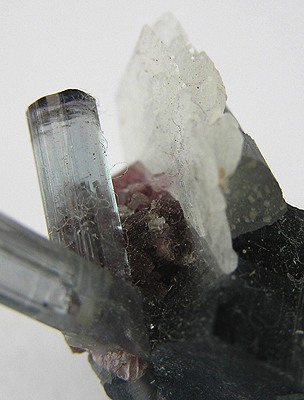
Photo: Wikimedia Commons
For collectors, the appeal is threefold. First is color harmony: purple-pink lepidolite, white cleavelandite and gem tourmaline form one of the classic palettes of modern Brazilian pegmatite specimens. Second is provenance: Pederneira pocket names—Keké’s, Proud, Rocket, Afghan, Azul Bien Grande, Bi-color Steel, Lunch Break, Lepidolite and Blue, and others—matter to serious collectors because each pocket has a distinctive style. Third is preservation: mica edges are soft and easily bruised, while Pederneira matrix tourmalines were often reconstructed after pocket breakage, so clean, well-documented, honestly prepared examples are far scarcer than casual abundance suggests.
Search for specimens: View all lepidolite specimens from Pederneira Mine, Brazil
Pederneira is a mine locality in São José da Safira, Minas Gerais, Brazil, historically also called the Pederneira claim or Lavra da Pederneira. Mindat places it at 18° 13' 35" S, 42° 11' 17" W and identifies the locality as part of the Safira pegmatite district of the Eastern Brazilian Pegmatite Province. The mine has been worked for gemstones and mineral specimens, and its recorded mineral list includes albite and cleavelandite, elbaite, fluorapatite, hydroxylherderite, lepidolite, microcline, muscovite, quartz, schorl, spessartine, beryl including morganite, and several less common accessory minerals.
Geologically, Pederneira belongs to the São José da Safira district, one of the important pegmatite districts of the Araçuaí Orogen. The regional rocks include garnet-mica schists, paragneisses and quartzites, with pegmatites related to post-collisional granitic magmatism. At the mine, the Dilo and Dada pegmatite bodies crop out in a small side valley of the Córrego da Pederneira at about 700–750 meters elevation. They are sub-parallel tabular bodies, broadly concordant with the schistosity of the host rocks and separated by a mica-schist septum roughly 20 to 30 meters thick.
The deposit is a complex, zoned granitic pegmatite system rather than a simple vein. In flatter sections, the bodies may be only about 50 centimeters to 2 meters thick and are dominated by quartz and feldspar with biotite, muscovite, sparse black tourmaline and garnet. In the enlarged inclined columnar zones, thickness can reach approximately 15 meters or more, and the mineralogy changes abruptly: tourmaline becomes a major constituent with garnet and muscovite, and the cavities capable of producing specimen-quality tourmaline, quartz, cleavelandite and lepidolite are concentrated in those swollen productive zones.
The mine’s origin story begins in the 1940s, during World War II, when a farmer named Pacheco found muscovite exposed after a major storm. Wartime demand for mica was high, and Pacheco reportedly gathered barrels of muscovite and hauled them by mule to São José da Safira, where they were sold to Americans working nearby at the Cruzeiro mine. The Americans inspected Pederneira for possible larger-scale muscovite production, but the deposit did not justify that kind of operation, and the mine was left to local miners.
The modern specimen history is usually divided into eras. The early Dilo workings produced fine tourmaline, quartz, cleavelandite and lepidolite specimens, but documentation from that first era is thin compared with the later period. The mine’s modern international reputation began around 1999–2000, when Dada and his sons opened a new upper adit—Dada’s Tunnel—and the small but spectacular Keké’s Pocket brought chrome-green tourmaline with hot-pink lepidolite to Tucson and to major collections. From there Pederneira became one of the world’s great modern tourmaline specimen mines.
Collecting access is not casual field collecting. Pederneira is a working private mine with controlled underground access, professional extraction, security, specimen preparation and commercial distribution through mine partners and dealers. Published descriptions of collecting emphasize careful pocket removal, reconstruction and laboratory preparation rather than weekend collecting. The road from Governador Valadares includes a long unpaved stretch through rural terrain; earlier accounts mention an old ridge-top airstrip and, for high-value specimen transport, the occasional use of aircraft or helicopter rather than risking overland movement.
The named pockets are central to Pederneira collecting history. Keké’s Pocket in 1999 is the lepidolite benchmark: a small pocket, only a few kilograms of specimens, but with gem chrome-green tourmaline and vivid pink lepidolite. The Proud Pocket of 2000 produced major matrix groups with tourmaline on lepidolite, cleavelandite and quartz, including a gigantic 90 cm specimen nicknamed “the Giant.” The Bi-color Steel Pocket of 2004 yielded some of the mine’s most important pieces, including the 28 cm “Bi-color Steel” tourmaline cluster on cleavelandite and lepidolite, described in the Mineralogical Record as the finest specimen then recovered from Pederneira. The Lunch Break Pocket of 2004 produced a 33 cm tourmaline on lepidolite and quartz, the only tourmaline in the pocket. The Lepidolite and Blue Pocket of 2005 produced a small but memorable group of hot-pink lepidolite specimens with color-zoned tourmaline. The Blue-Green Pocket of 2005 produced matrix combinations of quartz, lepidolite and cleavelandite with slender blue-green tourmalines. Later pockets, including Thiago’s Pocket in 2012, continued to yield important tourmaline groups, some on lepidolite.
Pederneira lepidolite is best understood as pocket lepidolite in a tourmaline-rich lithium pegmatite. It forms mica books, scaly masses, rosette-like clusters, drusy coatings, and granular to sparkly aggregates on matrix. On fine specimens it may appear as rich lilac, lavender, rose-pink, hot pink, or deeper reddish-purple patches, commonly seated on or around cleavelandite and quartz. The contrast can be striking: soft micaceous lepidolite below rigid, vitreous elbaite prisms; pearly mica beside snowy feldspar blades; purple-pink matrix under green, blue, red or multicolored tourmaline.
The most desirable Pederneira lepidolite is crisp and visibly crystallized rather than dull massive mica. Collectors look for sharp, reflective edges; clean rosettes or books; bright satiny to pearly luster; saturated lavender to pink color; and a balanced role in the overall composition. When the mica merely fills gaps it is an accent. When it forms a coherent mound, cluster or carpet that visually supports tourmaline or quartz, it becomes a decisive value factor.
Size varies widely because the lepidolite is usually part of a matrix specimen. Miniatures around 4 cm with tourmaline, cleavelandite and lepidolite are well documented, as are small-cabinet to cabinet pieces in the 8–20 cm range. Major Pederneira tourmaline combinations can exceed 25–30 cm, and exceptional museum-scale matrix specimens are much larger. In such pieces, the lepidolite may be a patch, a partial matrix, or a broad micaceous base rather than a single isolated crystal.
The associations are diagnostic for the mine’s best pieces. Elbaite is the star species, present as green, blue, red, bicolored and multicolored prisms, sometimes with sharp zoning that collectors associate with specific pockets. Albite as cleavelandite gives the white bladed matrix so characteristic of Pederneira specimens. Quartz, including smoky quartz and pale citrine, is common in important combinations. Other associated minerals recorded from the locality include fluorapatite, hydroxylherderite, beryl and morganite, microcline, muscovite, schorl and spessartine.
Keké’s Pocket material is the classic lepidolite style: chrome-green tourmaline with brilliant hot-pink lepidolite. The pocket was small and yielded only a limited number of significant specimens, which is why fine examples with convincing Keké’s provenance carry a premium. The later Lepidolite and Blue Pocket shares the hot-pink lepidolite aesthetic but differs in the associated tourmaline, which grades from chrome-green at the base into blue near the termination and ends in a narrow opaque yellow-green cap. Blue-Green Pocket pieces tend to show lepidolite as part of a quartz-cleavelandite matrix supporting slender blue-green tourmalines. Bi-color Steel Pocket examples may show deep red to purple lepidolite beneath high-quality gem tourmaline. These pocket distinctions matter because Pederneira collectors often build suites by pocket as much as by species.
The best lepidolite-bearing Pederneira specimens have a natural, unforced architecture. A single gemmy tourmaline rising from lavender mica may be more desirable than a crowded plate if the proportions are right. Equally, a mat of cleavelandite and lepidolite can elevate a quartz or tourmaline piece by giving it color contrast and a believable pocket context. On the highest-end pieces, lepidolite is not an afterthought; it is the visual bridge between the tourmaline and the matrix.
The first collecting issue is nomenclature. “Lepidolite” is a traditional collector and trade name for lithium mica in the polylithionite–trilithionite field, not a currently approved IMA species name. That does not make the label wrong in the collector market, but it does mean that strict mineralogical labeling may require analysis if an exact species name is desired. For Pederneira specimens, most established labels and publications use the familiar name lepidolite.
The second issue is repairs. Pederneira is famous for matrix tourmalines, and the published locality literature is frank that pocket specimens were often broken, reattached, reconstructed or professionally prepared. That is not automatically a defect; it is part of how many world-class pegmatite matrix specimens survive. But it must be disclosed. On lepidolite-bearing pieces, inspect the junctions where tourmaline enters the mica, feldspar or quartz; look for glue lines, color mismatch, unnatural gaps, glossy resin in mica, or crystals that do not seat convincingly into the matrix. Ultraviolet light, magnification and side lighting are useful, but provenance and seller disclosure are just as important.
Lepidolite itself is soft and perfectly cleavable. Edges bruise, books split, rosettes shed flakes, and pressure from packing can flatten or dull an otherwise attractive cluster. On Pederneira pieces, common condition issues include abraded mica edges, missing mica scales around the tourmaline base, contacted tourmaline terminations, broken or repaired elbaite prisms, and detached cleavelandite blades. Because the mica is visually delicate, even small edge damage can affect aesthetics when the lepidolite is a major component of the display face.
No prominent, well-documented Pederneira-specific fake-lepidolite problem dominates the literature. The more realistic concerns are repaired associations, poor disclosure, misassigned pocket provenance, and generic “Brazil” lepidolite-tourmaline pieces upgraded to Pederneira without proof. Pocket names should be treated seriously: Keké’s Pocket, Lepidolite and Blue, Bi-color Steel, Rocket, Afghan and other named finds have distinct documented styles, but a verbal pocket attribution without old labels, publication history, mine-source paperwork, or a trusted dealer chain should not be valued like a documented piece.
Market availability is selective. Modest Pederneira pieces with lepidolite accents appear regularly through dealers and auctions, especially as tourmaline combinations. Fine lepidolite-forward pieces from named pockets are much less common, and the best examples tend to reside in major private collections or appear in high-end dealer inventories rather than in ordinary mineral-show flats. For advanced collectors, a small but pristine miniature with honest provenance can be more desirable than a larger repaired or visually confused cabinet specimen.
Care is simple but important. Handle Pederneira lepidolite pieces by the matrix, not by mica books or tourmaline prisms. Avoid ultrasonic cleaners, steam, aggressive brushing and prolonged soaking. Dust with a soft brush or air puffer, and transport with enough void space that no pressure is placed on lepidolite rosettes, cleavelandite blades or tourmaline terminations. Store these pieces away from harder specimens that can scratch or crush the mica.
The mine begins, fittingly, with weather and mica. In the 1940s, after a major storm stripped enough cover from the hillside to expose pegmatite, a farmer named Pacheco noticed muscovite in the outcrop. World War II had turned mica into a strategic material, and Americans were working nearby at Cruzeiro. Pacheco collected barrels of muscovite, loaded them by mule, and took them to São José da Safira to sell. That practical wartime errand became the first chapter of Pederneira. The Americans examined the deposit, found that it did not justify a larger muscovite operation, and moved on. The locality did not vanish, but its future would not be sheet mica; it would be pockets.
The modern story takes a dramatic turn in early 2000 in Whitestone, New York, where Daniel Trinchillo, then 26 and already eight years into professional dealing, was shown a small photographic print by Michel Jactat, who had just returned from two months in Brazil. The photograph showed a newly recovered Pederneira tourmaline specimen that would later be nicknamed “Sharon Stone.” Trinchillo’s first response was simply “WOW!” When told the piece might be reserved or possibly sold, he pushed to find out immediately. Jactat did not want to return to Brazil after such a long trip, so Trinchillo said, “I’ll go!” The whole modern Pederneira adventure, as he later told it, began with that little print and the sense that something extraordinary was breaking open in Minas Gerais.
Behind that moment was a local discovery. Dada, who had once worked in the older lower adit known as Dilo’s Tunnel, prospected higher on the hill, about 100 meters above the older workings, and found a new pegmatite outcrop. He and his sons cut a simple road up the slope and began digging with hand tools. When they needed equipment to follow the pegmatite, Dada brought in Eustacio Neves, who had both machinery and a relationship with José Oliveira Rocha, known as Deca, the landowner and rights holder. The first working partnership—Deca, Eustacio and Dada—opened what became Dada’s Tunnel. Toward the end of 1999, that tunnel yielded Keké’s Pocket, a small pocket that made the mine’s reputation almost at once.
The partnership expanded in the rough-and-tumble way of Brazilian specimen mining. Renato Tomich heard of the new material through a chain of dealers and found a Governador Valadares dealer named Lezito with a small piece of the same unmistakable tourmaline. Lezito said it was from Pederneira. Tomich went straight to the mine, met Dada, learned of Eustacio’s role, and negotiated his way into the project by waiving old debts in exchange for an interest. Because Miranda had put Tomich on the trail, Tomich gave him half of the shares he had acquired. Then Tomich wanted trusted eyes underground every day. He respected José Menezes de Sousa—Zé Menezes—and wanted the senior miner Claudino as well, but Claudino was then working for Menezes at Santa Rosa. Miranda, in turn, wanted to include his friend Saint-Clair Fonseca Jr., known as Keké, because Keké could run a cutting house and maximize gem rough. From that tangle emerged the unlikely five-man M. Pederneira Limited partnership: Tomich, Menezes, Keké, Miranda and Eustacio, working with Dada and Deca.
Keké’s Pocket was not large. Its fame rests on intensity, not volume. It yielded only a few kilograms of specimens and only about half a dozen major pieces from the lot Keké bought, but the combination was unforgettable: chrome-green gem tourmaline with hot-pink lepidolite. In ordinary pegmatite specimens, lepidolite often supports the main crystal politely from the matrix. In this pocket, the mica had enough color and form to compete with the tourmaline. Several of the best pieces were photographed in Governador Valadares before shipment to the United States, and later collectors could recognize them in major collections: Laura Thompson’s chosen specimen, the double crystal with lepidolite illustrated in Wayne Thompson’s Ikons book, a Marcus Budil group, reconnected crystals that later entered a private collection, and a gemmy triple crystal with just a touch of lepidolite.
Travel to the mine had its own lore. The route began with flights to Rio de Janeiro or São Paulo, then Belo Horizonte, then Governador Valadares. From there came a three-hour drive north-northwest, passing São José da Safira, Aricanga, Cruzeiro mine and the small town of Cruzeiro before the Pederneira gate. The last 50 kilometers were unpaved, with cattle crossings, bumps and occasional landslides. An old airstrip, cut during the earliest period of mining, once served a practical purpose: it could bring people in quickly and, more importantly, help move valuable specimens out without exposing them to road hijacking. Later accounts mention helicopters for urgent visits or specimen transport.
The mine’s pockets demanded patience. They ranged from the size of a tangerine to the size of a 1960s Volkswagen bus, but the most important lesson was speed: the slower a pocket was collected, the better the result. Small pockets could be emptied in a day or two. Large pockets might require a week or more, and one took nearly a month. In a pegmatite like Pederneira, a few impatient minutes could undo millions of years of growth.
The Lunch Break Pocket shows the point almost painfully. Discovered in 2004, it was about 2 cubic meters and nearly barren except for one exceptional tourmaline on a mound of cleavelandite, lepidolite and quartz. The specimen was still attached to the hanging wall, exactly where it had grown. It was around 40 cm and probably about 30 kg, awkwardly placed and dangerous to remove. José Menezes and the miners spent days peeling rock away, drilling nearly 100 holes and preparing to use a pneumatic splitter to free the matrix without bruising the piece. After about a week, the specimen began to move by lunchtime. Menezes called a break, telling the team to return afterward and finish the extraction.
One young miner stayed behind. Seeing that the specimen was loose, he decided to finish the job alone. He put a heavy pry bar into one of the holes near the base and rocked it back and forth for about 30 minutes. Then he walked into the house and announced proudly, “I collected the piece, I did a great job.” Menezes nearly choked on his coffee and asked, “What piece?” The reply was the one he feared: “the large piece, I collected it for us!” Menezes ran for the tunnel. The specimen had indeed fallen, but by sheer luck it landed on a quartz crystal below, which stopped it from crashing into the bottom of the pocket. No one was killed. The tourmaline suffered a small termination chip, far less than it could have, and the specimen was later restored in the lab. The miner, needless to say, did not continue at Pederneira.
The Lepidolite and Blue Pocket of 2005 brought the story back toward Keké’s Pocket, almost as a closing rhyme. By then the miners were following a zone that was becoming poorer. The pegmatite grew coarse and unpromising, and they believed they were entering the core zone, where tourmaline pockets were rare. Then they hit a pocket with the visual flavor of Keké’s material—hot-pink lepidolite and tourmaline of similar habit. Because of that resemblance and because the drift looked so unpromising, the miners regarded it as “the end of the line.” The pocket was about half a cubic meter, not opened favorably, and it produced only a few important specimens: several matrix pieces and about a dozen fine crystals. The four best were displayed in the Pederneira house after reconstruction. Its best example was a double tourmaline crystal on a small knob covered with hot-pink lepidolite crystals climbing up the prism zone—an echo of the 1999 pocket that had first made the mine famous, but with tourmalines grading green to blue and ending in opaque yellow-green caps.