A collector's guide to Aricanga mine, Brazil: its geology, mining history and notable minerals, illustrated with the 97 specimens documented from this locality on EarthWonders.
Key facts
Aricanga is one of the essential names in the São José da Safira tourmaline belt of Minas Gerais, a hard-rock pegmatite locality tied historically and geologically to the great Cruzeiro–Aricanga pegmatite system on the Serra do Cruzeiro. For collectors, its importance is not simply that it produced gem rough, but that it produced tourmaline specimens with the high-chroma, high-contrast look that made northeastern Minas Gerais the classic world province for colored elbaite: green and blue-green crystals, red-to-green zoned crystals, rubellite sections, and matrix pieces on pale lavender lepidolite or quartz. The mine sits in the Safira pegmatite district of the Eastern Brazilian Pegmatite Province, where evolved, lithium-bearing, boron-rich granitic pegmatites have supplied tourmaline, mica, feldspar, quartz, beryl-group material, tantalum minerals, spodumene, topaz, and collector-grade pocket specimens.
The old literature treats Aricanga in close association with Cruzeiro: one end of the approximately 1.3-kilometer pegmatite area on the brow of the Serra Safira ridge was mined by the Aricanga Company, while the larger Cruzeiro workings occupied the same famous pegmatite trend. The most often repeated Aricanga number is its 1982 pocket, which yielded more than 700 kilograms of mostly clean tourmaline “pencils”; about 90 percent were attractive green crystals, with the remainder blue-green and red. That single strike explains why Aricanga matters to gem people, but the better surviving collector pieces explain why it matters to specimen people: well-terminated, lustrous, gemmy prisms, commonly with saturated green bodies, red caps or cores, and lavender mica contrast.
Regional View
Country View
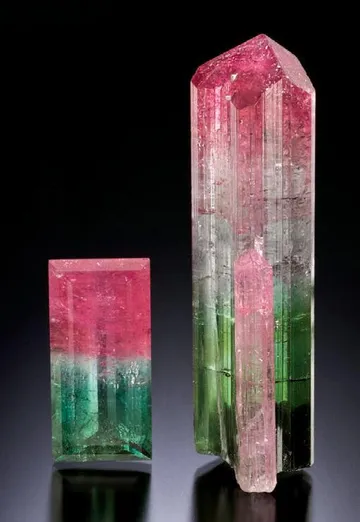
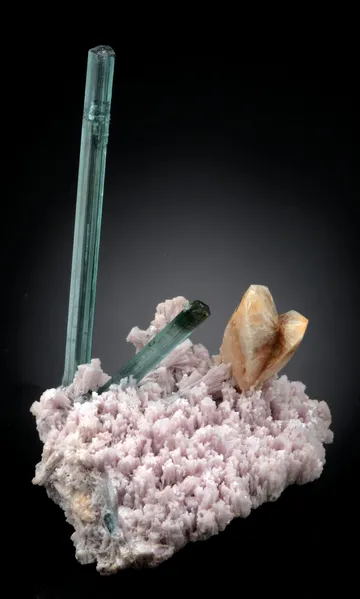
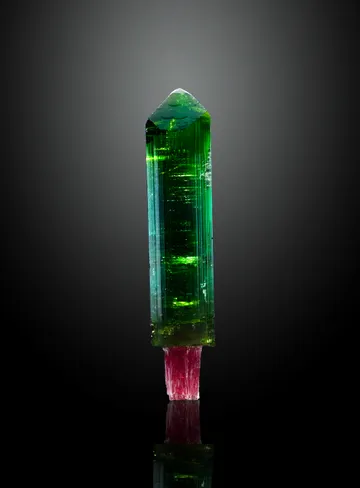
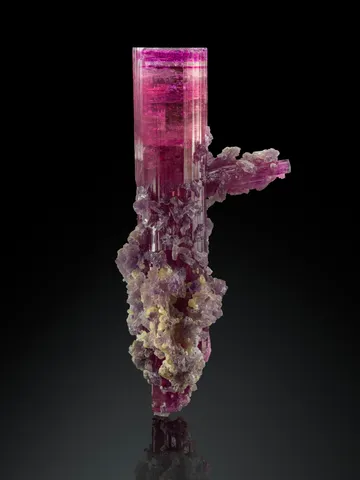
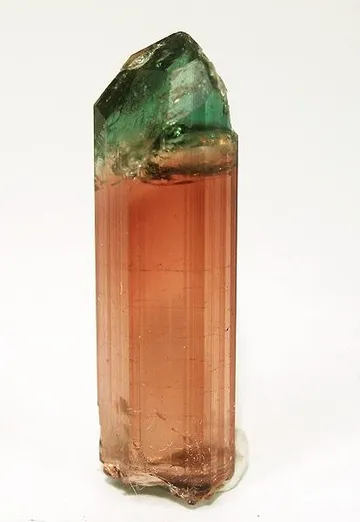
The strongest Aricanga specimens have the unmistakable Minas Gerais balance of color and architecture: isolated “rocket” crystals rising from lepidolite, green terminations over red or raspberry cores, mint-to-blue transition zones, and enough transparency to make the crystal glow under a display light. Matrix pieces are more desirable than loose pencils, especially where the tourmaline is fully terminated, unrepaired or minimally repaired, and compositionally set off by pale mica or white quartz. The mine’s locality identity is worth preserving carefully because Aricanga material is easily blurred in the market with Cruzeiro, Pederneira, and other São José da Safira tourmalines.
Search for specimens: View all specimens from Aricanga mine, Brazil
The Aricanga mine is in rural São José da Safira, Minas Gerais, at Fazenda Aricanga on Morro do Cruzeiro, within the Safira pegmatite district of the Eastern Brazilian Pegmatite Province. Locality databases place it at the Aricanga mine, São José da Safira, Minas Gerais, Brazil, with decimal coordinates close to -18.27570, -42.17765; state licensing documents for the operating company give the Fazenda Aricanga/Morro do Cruzeiro operation at approximately -18.2711, -42.1747 and identify the mineral-rights process as ANM/DNPM 830.573/1979. The discrepancy is minor at collecting-map scale and reflects different ways of locating a mine complex rather than different collecting districts.
Geologically, Aricanga belongs to the evolved granitic pegmatites of the eastern Minas Gerais tourmaline province. The broader São José da Safira–Malacacheta–Itambacuri belt is one of the great tourmaline-producing regions of the world, characterized by large, fractionated pegmatites enriched in sodium, boron, beryllium, and lithium. Older descriptions of the Cruzeiro–Aricanga system describe several steep, vein-like pegmatite bodies, striking roughly N20°W and dipping steeply southwest, intruding a thick sequence of quartzite and mica schist. Within these pegmatites, the tourmalines occur in sodium-rich replacement bodies, widened parts of the veins, pockets, and white alteration lenses. Prospecting indicators in the system include schorl, altered spodumene laths, lepidolite, Fe-Mn hydroxides, and quartz-pocket features.
Aricanga is best understood as a lithium-tourmaline pegmatite mine rather than a single-species gem pit. Modern environmental licensing lists the authorized mineral substances as beryllium ore, tantalum ore, lepidolite, spodumene, topaz, tourmaline, aquamarine, and quartz. Mindat’s formal mineral list for the Aricanga locality is conservative, recording elbaite, fluorapatite, K-feldspar, muscovite, and tourmaline, with elbaite being the collector species that gives the locality its reputation. The license is for underground mining of pegmatites and gems, with no beneficiation of the extracted material at the mine site; production is described as manual, mechanical, and by explosives in underground workings using chamber-and-pillar and cut-and-fill methods.
The historical arc of Aricanga is unusually strong for a Brazilian pegmatite mine. The Serra do Cruzeiro area is traditionally linked to early exploratory routes and to the 1674 expedition of Fernão Dias Paes Leme, when the mountain was associated with supposed emeralds and sapphires before its tourmaline identity became clear. Mineração Aricanga traces its foundation to 1944 and to Dr. Jamil Kahey, a central figure in the company’s modern identity. By the mid-1980s, the Aricanga Company was described as aggressively mining one end of the 1,300-meter-long Cruzeiro pegmatite area on the ridge. A current official company presence continues to present Aricanga as a São José da Safira operation focused on rare natural tourmalines for collectors, cutters, jewelers, and the international gemstone trade, now associated publicly with the leadership of Marcos Saraiva.
The best-known production event is the 1982 pocket that produced more than 700 kilograms of mostly clean tourmaline pencils. That find was overwhelmingly green, with subordinate blue-green and red material, and it remains the benchmark historic Aricanga strike in the published gem literature. Later market records show that Aricanga also produced vivid red-and-green zoned crystals and rare matrix specimens. A well-documented Mindat specimen, acquired from Brazil around 1998, carries a 4.5-centimeter red-capped green tourmaline crystal in quartz and was described by its owner as an exceptional matrix survivor from its pocket. Recent dealer material from a named “Chameleon Pocket” has been described as having a vibrant red rubellite core, a delicate yellow transition zone, and a glassy green termination on lepidolite, a color combination very much in keeping with the high-end Aricanga aesthetic.
Collecting access should be regarded as closed unless arranged directly and legally with the mine. Aricanga is a private, licensed underground mining operation, not a fee-collecting locality. The modern license, issued in 2021, authorizes underground pegmatite-and-gem mining at a gross production level of 4,800 cubic meters per year and is valid for ten years, with an expiration date in May 2031, subject to environmental conditions. Collectors today generally encounter Aricanga material through the mine, Brazilian exporters, specialist dealers, auction records, and older collections rather than by field collecting.
Elbaite from Aricanga is the species-level name behind most of the locality’s best colored tourmalines: green, blue-green, red, pink, and polychrome prisms from lithium-rich pegmatite pockets and replacement zones. The classic material includes long, mostly clean “pencils,” but specimen collectors prize terminated crystals with saturated green bodies, red caps or rubellite cores, sharp trigonal prism form, and natural matrix of lepidolite or quartz. Historic descriptions of the Cruzeiro–Aricanga system note thickset to pencil-like crystals and color ranges from pale green and blue through emerald-green, greenish-blue, pink, and ruby-red; Aricanga’s 1982 pocket is the defining event, yielding more than 700 kilograms of mostly clean pencils, 90 percent green with the rest blue-green and red. Ordinary Aricanga elbaite can be attractive loose cutting rough, but a truly good specimen is well-terminated, lustrous, gemmy in at least part of the prism, visibly zoned or unusually saturated, and preferably still attached to lepidolite, quartz, or pocket matrix.
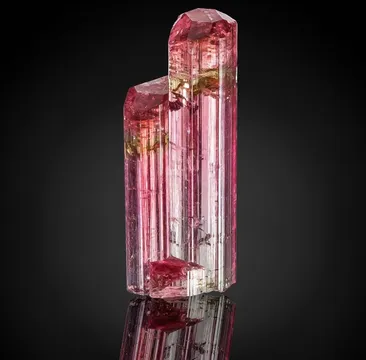
“Tourmaline” is a common and useful market label for Aricanga specimens because many pieces have not been analyzed to the species level, even when their chemistry and color strongly suggest elbaite-group material. Aricanga tourmaline is seen as single terminated crystals, loose gem pencils, divergent groups, and showy matrix pieces on lepidolite or quartz; the most desirable examples show a vivid red-to-green or raspberry-to-mint zoning, occasionally with a blue or aquamarine cast in transition zones. The mine’s best-known production was the 1982 pencil pocket, but later collector pieces show the locality’s capacity for sculptural matrix specimens rather than merely gem rough. The strongest Aricanga tourmalines combine display-scale size, clean termination, strong luster, bright transmitted color, and a balanced composition; less important pieces tend to be broken pencil sections, included cutting fragments, or crystals whose exact São José da Safira source has been blurred in commerce.
Lepidolite at Aricanga is chiefly a matrix and pocket-zone mineral rather than the locality’s headline species, but it is crucial to the look and value of the best specimens. Lavender to lilac mica aggregates provide the soft contrasting base for red-and-green tourmaline crystals, and modern licensed commodity lists for the mine specifically include lepidolite among the substances of interest. In the Cruzeiro–Aricanga style of pocket mineralization, lepidolite commonly occurs with tourmaline in evolved, lithium-rich replacement zones, sometimes near altered spodumene and quartz; the mica may appear as granular to platy masses, sparkling coatings, or compact lavender matrix. Good Aricanga lepidolite pieces are not judged as mica specimens alone, but by how well the lepidolite supports and frames the tourmaline—stable, attractive lavender matrix, minimal bruising, and enough contrast to make a green or rubellite crystal read clearly from across a case.
Rubellite from Aricanga represents the red to raspberry-red end of its elbaite production, usually encountered as red zones, cores, caps, or complete red crystals associated with green tourmaline and lepidolite. The finest Aricanga rubellite material is valued for saturation and translucency rather than sheer abundance: recent matrix specimens have been described with intense red cores passing through yellowish transition zones into glassy green terminations, while older São José da Safira descriptions note pink to ruby-red tourmaline in the same pegmatite system. The locality should not be confused with the Jonas mine, whose 1978 rubellite pocket dominates Brazilian rubellite lore, but Aricanga can produce superb red accents in polychrome crystals and occasional matrix pieces with legitimate cabinet impact. Good rubellite here has a vivid, even red or raspberry body, visible gemminess under backlight, a clean termination, and little internal shattering; ordinary pieces are commonly fractured, overly dark, or represented only by broken cutting fragments.
Other minerals documented from Aricanga and its operating records include fluorapatite, K-feldspar, muscovite, quartz, topaz, aquamarine or beryl-group material, spodumene, and tantalum- and beryllium-bearing ores. The formal public species list is short compared with the mineral diversity suggested by the mine’s licensed commodities, and no valid type-locality mineral is documented for Aricanga in the verified locality records. Its rarities, therefore, are mostly rarity-of-specimen rather than rarity-of-species: a complete tourmaline-on-matrix, a red-capped green pencil still attached to quartz, an especially sharp rubellite-and-lepidolite combination, or a clean blue-green crystal with reliable Aricanga provenance.
The main authenticity issue with Aricanga is locality precision. Aricanga, Cruzeiro, Pederneira, Chiá, and other São José da Safira mines have all produced colored tourmaline, and older labels may use “Cruzeiro,” “São José da Safira,” “Minas Gerais,” or “Aricanga” in overlapping ways. Because Aricanga was historically treated as part of the Cruzeiro–Aricanga pegmatite area, a specimen described simply as “Cruzeiro area” may be geologically close but not necessarily from the Aricanga workings. Conversely, some attractive São José da Safira tourmalines are upgraded in the market with famous-mine attributions. For serious collection records, give weight to old mine labels, documented dealer histories, mine-direct acquisition, and specimens published with photo IDs or exhibition records.
Repairs are common and should not surprise buyers of Aricanga matrix tourmaline. Tourmaline prisms are brittle, pocket recovery is difficult, and crystals on lepidolite or quartz commonly separate along contacts, keys, healed fractures, or matrix seams. A recent dealer-described Chameleon Pocket specimen explicitly noted two professional repairs and a contact where another crystal had grown against it. That is normal for showy matrix tourmaline, but it must be disclosed, and pricing should distinguish a cleanly repaired matrix specimen from an unrepaired floater or a loose single crystal.
Condition problems follow the usual Minas Gerais tourmaline pattern: bruised terminations, sawn or broken bases, rubs on prism edges, internal tension cracks perpendicular to the c-axis, small chips hidden by lepidolite, and color zones that are better under transmitted light than in normal case lighting. Rubellite zones can be highly included and may not tolerate heat or careless ultrasonic cleaning. Lepidolite matrix is soft, cleavable, and easily bruised; avoid soaking pieces, aggressive brushing, ultrasonic tanks, and sudden temperature changes. For display, use a mount that supports both the tourmaline and the mica matrix rather than stressing a single crystal attachment point.
Treatments are more of a gem-rough concern than a mineral-specimen norm, but they matter when evaluating loose Aricanga crystals. Brazilian tourmaline has a long history of heat treatment and irradiation in the gem trade: green and blue stones may be heated to improve appearance, and pink material can be affected by irradiation. Matrix specimens with natural lepidolite and pocket surfaces are less likely to have been treated after recovery, but loose pencils and cuttable crystals should be bought with the same caution applied to any Brazilian gem tourmaline. Ask whether the seller is describing a mineral specimen, an untreated gem crystal, or simply attractive rough.
Market availability is intermittent. Aricanga is active as a private mining and commercial gemstone operation, but high-end matrix specimens are far scarcer than loose tourmaline pencils and fragments. The most desirable pieces—saturated red-and-green crystals on lavender lepidolite, large balanced cabinet specimens, unrepaired terminated singles, and historical 1980s or 1990s specimens with reliable labels—move through specialist dealers and collections rather than in bulk. Compared with Cruzeiro or Pederneira, the Aricanga name appears less often, and that makes provenance discipline especially important.
The Aricanga story begins with a mountain that was misunderstood before it was famous. In the tradition repeated by museum and company sources, the Serra do Cruzeiro was part of the old search landscape of Fernão Dias Paes Leme’s 1674 expedition, a place imagined through the language of sapphires and emeralds before the real treasure of the district was recognized as tourmaline. That confusion is fitting: the best green tourmalines of Minas Gerais were often compared to emerald in color, and the old gem trade repeatedly borrowed names from better-known stones before mineralogy caught up with commerce.
The company story narrows the scene from a legendary mountain to a legal mine. In 1944, Mineração Aricanga was founded in the Serra do Cruzeiro region, publicly associated with Dr. Jamil Kahey, whose name remains central in the mine’s own account of its origins. Later descriptions present Aricanga not as a forgotten garimpo but as a continuing operation that connects mine, gem market, collectors, cutters, and export trade. That continuity is part of the locality’s appeal: it belongs to the old Brazilian pegmatite world of hand work, pockets, mica, and sudden discovery, yet it remains a modern, named source whose specimens can still enter the market with mine identity intact.
The most vivid Aricanga episode is the 1982 pocket. Published gem literature records it in the practical language of weight and color: more than 700 kilograms of mostly clean tourmaline “pencils,” with roughly 90 percent green and the balance blue-green and red. A number like that is easy to flatten into a statistic, but for a collector it implies a room or cavity lined with recoverable crystals rather than a few scattered gems—enough material for cutters, exporters, and dealers, yet still only a small fraction likely to survive as first-rate mineral specimens. Most clean pencils go to the gem trade. The collector’s survivors are the exceptions: crystals too sculptural, too well terminated, too vividly zoned, or too dramatically perched on matrix to be sacrificed to the saw.
A later collector record gives the other side of the story: rarity not by kilogram, but by composition. One documented Aricanga specimen, bought directly out of Brazil around 1998, carried a sharp 4.5-centimeter crystal in a natural quartz groove, with a gemmy green body, a deep red cap, and a liquid-red tourmaline nodule at the base. Its owner described it as the only good matrix example he knew from that pocket, noting that the other pieces he had seen were matrixless singles. That is exactly how Aricanga should be judged in a serious cabinet: not merely by the reputation of the mine, but by whether the specimen preserves the pocket environment that most gem crystals lose on their way to the cutting bench.
The modern collecting story continues in named contemporary pockets such as the dealer-reported Chameleon Pocket, where red cores, yellow transition zones, and glassy green terminations on lepidolite made the material instantly recognizable in the high-end specimen market. These pieces show why Aricanga has remained relevant: the mine can still produce the fully Brazilian combination of color zoning, gem translucency, and lavender mica contrast that made the Governador Valadares–São José da Safira district famous.