






Novo Horizonte, Brazil - a classic locality for golden rutile in hydrothermal quartz, epitaxial on hematite with starbursts, plus rare-earth associations.
Key facts
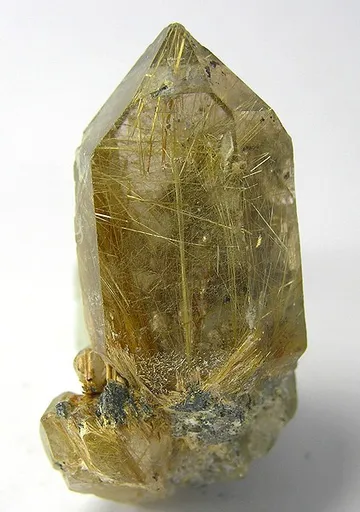
Novo Horizonte, in the central Bahia portion of Brazil’s Chapada Diamantina, is one of the modern classic localities for golden rutile. Its reputation rests on a very particular geological and aesthetic pairing: acicular to bladed yellow-gold rutile grown with black, metallic hematite and clear to smoky quartz in hydrothermal vein systems cutting metavolcanic rocks of the Rio dos Remédios Group. The best specimens are instantly recognizable. Rutile sprays rise from mirror-bright hematite plates in strict crystallographic orientation, often forming starbursts, fans, and “sun” patterns; in the quartz material, the same golden rutile may be sealed inside transparent crystals as dramatic internal needles, trilling-like sprays, or radiating groups tied to hematite nuclei.
Regional View
Country View
For collectors, Novo Horizonte is not simply another rutilated-quartz source. The district gave the market an entire specimen style: golden rutile epitaxial on platy hematite, sometimes with quartz as a transparent window into the growth sequence. Early labels often used “Ibitiara, Bahia,” especially for material from the Remédios area, but modern locality work places the famous workings south of Vila dos Remédios within Novo Horizonte municipality. The district also matters scientifically. The same family of quartz veins and altered metavolcanic rocks has produced rare-earth minerals and two valid type-locality species, almeidaite and parisite-(La), tying the familiar golden rutile specimens to a much more complex hydrothermal rare-earth assemblage.

Photo: Wikimedia Commons
The deposit sits in a region long worked by garimpeiros for gold, barite, quartz crystal, and later rutilated quartz. Specimen production has come from small-scale workings rather than a single industrial mineral mine. The famous collector pieces therefore vary widely: thumbnail starbursts on hematite plates, miniature “hedgehog” sprays, cabinet quartz groups with included needles, and rarer combination specimens carrying xenotime-(Y), hyalite, bastnäsite-group minerals, monazite, fluocerite, or almeidaite. The finest pieces combine three virtues that are rarely all present together: intact rutile tips, brilliant hematite faces, and clean quartz or attractive open space that lets the crystallographic geometry read clearly.

Photo: Wikimedia Commons
Search for specimens: View all specimens from Novo Horizonte, Brazil
Novo Horizonte lies in Bahia’s Chapada Diamantina region, within the broader Serra do Espinhaço geologic province. The specimen-producing systems are hydrothermal quartz veins, vein breccias, and stockwork-style veinlets hosted by low-grade metavolcanic rocks of the Rio dos Remédios Group, especially metarhyolite and metadacite of the Novo Horizonte Formation. These felsic volcanic rocks are part of an ancient peraluminous to alkaline magmatic package associated with continental rifting around 1.75 billion years ago. Much later, during Brasiliano deformation and fluid activity in the Neoproterozoic to early Paleozoic, the rocks were fractured, altered, kaolinized in places, and cut by swarms of quartz veins.
The collectible mineralization is therefore best understood as a hydrothermal vein assemblage rather than a simple pegmatite occurrence. Quartz is the dominant vein mineral; rutile and hematite supply the distinctive iron-titanium association; and rare-earth phosphates, carbonates, fluorocarbonates, and fluorides appear locally where the fluids interacted with altered metavolcanic host rocks. In the type-mineral literature, the Mula mine or Mula claim near Tapera village is described as a pit of brecciated quartz veins cemented by chalcedony, partially kaolinized, and cutting metarhyolite. Later locality correction on Mindat notes that the site long called “Mula” is properly the Paulo de Mudo claim, named for Paulo, son of a man nicknamed Mudo. The older name remains deeply embedded in the literature for almeidaite and parisite-(La).
The most famous specimen-producing area for rutilated quartz and rutile-on-hematite material is the Remédios district, with workings just south of Vila dos Remédios, west-northwest of Novo Horizonte and south of Ibitiara. This explains why older specimens, dealer labels, and even museum labels may say “Ibitiara” or simply “Bahia” when the more precise modern locality is Novo Horizonte, Bahia. Caí Bom is another key name on collector labels, especially for rutile with hematite from the important early-2000s production that reached the European market with great impact.
Mining has been artisanal and small-scale. Local accounts describe Novo Horizonte’s economy as rooted first in gold, later in quartz crystal and barite, and then in the international demand for golden rutilated quartz. Barite production was important around Juazeiro in the late 1970s and early 1980s, while the rise of rutilated quartz from about the 1980s onward gave Remédios and Novo Horizonte an international gem and specimen identity. The Cooperativa dos Garimpeiros de Novo Horizonte was founded in 2011 at the request of Brazil’s former DNPM to help regularize mineral extraction, licensing, safety, environmental management, and commercialization.
Collector access today should be regarded as claim-based and local-permission based, not a casual open collecting area. Specimens normally reach collectors through miners, cooperatives, established dealers, and gem channels rather than through public fee digging. The district is still represented in the market by numerous small rutile-hematite pieces, rutilated quartz crystals, and occasional larger cabinet specimens, but the best undamaged starbursts and well-composed quartz combinations remain selective buys. Good old-label pieces from Caí Bom, early European-show material, and rare-earth combinations from the Mula/Paulo de Mudo area deserve careful provenance retention.
Notable specimen pockets have produced several distinct styles. The classic Caí Bom material shows golden to honey-yellow rutile needles standing on black hematite plates in epitaxial orientation, often with 60-degree geometry imposed by the hematite substrate. Remédios rutilated quartz pockets produced clear, smoky, or slightly citrine quartz with internal golden needles, hematite centers, and occasional star-shaped inclusions. At the Mula/Paulo de Mudo workings near Tapera, the quartz-vein system yielded almeidaite, parisite-(La), xenotime-(Y), and associated rare-earth species in addition to rutile, hematite, and quartz.
Rutile is the signature mineral of Novo Horizonte, and the best specimens are yellow-gold, honey, or orange-gold acicular to finely prismatic crystals either enclosed in quartz or grown epitaxially on metallic hematite. On hematite, rutile commonly forms radiating starbursts, fan sprays, and tiered clusters, with the needles following the crystallographic directions of platy hematite and often meeting at precise angular relationships. Specimen sizes range from tiny thumbnail suns to miniatures and small cabinet pieces, with notable examples around 3–5 cm and larger quartz-rich combinations extending to cabinet size. The finest pieces show bright, intact, well-terminated rutile needles, strong golden color, and uncluttered architecture on lustrous black hematite; ordinary pieces have broken sprays, dull or muddy color, crushed hematite edges, or rutile so dense that the star geometry is lost.
Hematite from Novo Horizonte is most prized as the dark metallic foundation for the rutile, occurring as lustrous platy to lamellar crystals, stacked plates, floater-like groupings, and mirror-bright black to steel-gray blades. In the classic rutile-hematite specimens, hematite is not merely matrix: it controls the display, providing the crystallographic template on which rutile grows as golden rays and starbursts. Collectors look for hematite plates with sharp edges, high reflectivity, complete form, and balanced rutile distribution; the strongest examples show a black metallic “sun center” or plate with golden needles rising cleanly from its faces or margins. Common flaws include edge bruising, bent or missing rutile, hidden contact points, and plates dulled by iron staining, clay, or poor cleaning.
Quartz is the main vein mineral at Novo Horizonte and the transparent stage on which many of the district’s most desirable rutile specimens are displayed. It occurs as hyaline, smoky, slightly citrine, and locally chalcedonic material, in single crystals, small clusters, and larger cabinet groups, commonly carrying golden rutile needles and black hematite inclusions. Good Novo Horizonte quartz is glassy enough to reveal the rutile clearly, with sharp terminations, minimal internal fracturing, and well-positioned inclusions rather than a random haze of needles. Particularly desirable pieces show rutile entering and exiting quartz, starbursts frozen around hematite, or doubly terminated quartz with rutile and hematite arranged in a readable three-dimensional composition.
Xenotime-(Y) from Novo Horizonte is a much rarer collector mineral than rutile or hematite, but it gives the locality scientific depth and specimen variety. It appears as brown, yellow-orange, translucent to lustrous tetragonal crystals associated with quartz, hematite, and rutile, especially in rare-earth-bearing quartz-vein material from the Mula/Paulo de Mudo area. Fine combination specimens may show xenotime perched between quartz spires and hematite plates, with rutile needles included in or attached to adjacent quartz. For this locality, quality is judged by crystal identity and isolation: sharp form, visible tetragonal habit, good luster, and a position that is not overwhelmed by rutile or hematite are far more important than size alone.
Smoky quartz from Novo Horizonte occurs in the same hydrothermal vein environment as the clearer quartz, generally as light smoky to brownish transparent crystals containing golden rutile and, in many specimens, small hematite inclusions or attached hematite plates. The smoky tone can improve contrast dramatically: golden rutile stands out against the warm gray-brown body color, especially where the needles are arranged in sprays or parallel bundles. The best pieces remain transparent enough to see into the crystal, with intact terminations and rutile inclusions that are aesthetically placed rather than crowded; low-grade examples are cloudy, internally shattered, or so dark and included that the rutile pattern disappears.
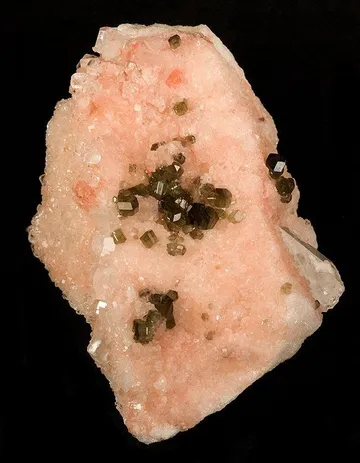
Beyond the headline species, Novo Horizonte has a notable rare-earth suite. Mindat lists almeidaite and parisite-(La) as type-locality minerals, along with anatase, bastnäsite-(La), brockite, ferripyrophyllite, fluocerite-(Ce), hydroxylbastnäsite-(Ce), kaolinite, monazite-(Ce), monazite-(La), muscovite, rhabdophane-(La), chalcedony, rutilated quartz, smoky quartz, and xenotime-(Y). Almeidaite is a black, submetallic, platy crichtonite-group oxide first recognized from this district; parisite-(La) is a rare lanthanum-dominant fluorocarbonate occurring as residual nuclei and pseudo-hexagonal crystals altered in part to other La-rich phases. Hyalite opal also appears on some collector specimens as bubbly, glassy coatings with rutile and hematite, adding another texture to the district’s familiar gold-and-black palette.
Novo Horizonte rutile and hematite specimens invite close condition inspection. The rutile needles are brittle and exposed sprays are easily shortened, bent, or rubbed; a piece that looks dramatic in a front photograph may have obvious missing tips when viewed from the side. For hematite-based specimens, inspect the star centers and ray ends under magnification. Fresh breaks on rutile often show as tiny dark or pale blunt ends rather than sharp golden points, while bruised hematite edges lose the mirrorlike surface that gives the best pieces their contrast.
The most common authenticity issues are not sophisticated mineral fakes but mislabelling, repair, enhancement, and assembly risk. Older “Ibitiara” labels may be historically understandable for Remédios material, but “Novo Horizonte, Bahia” is the preferred locality for many of the classic pieces. Be alert to generic “Brazil” or incorrect “Minas Gerais” labels on rutile-hematite material that visually matches Novo Horizonte. Some decorative rutilated-quartz objects on the broader market are glass or resin imitations with metallic fibers; these are rarely convincing to a mineral collector but can appear in metaphysical or jewelry channels. Natural rutilated quartz should show rutile embedded within quartz growth, not loose foil-like strips, bubbles, or fibers suspended in a soft resin.
Repairs and mounts are worth checking. Small sprays are often fixed into Perky boxes or acrylic bases, and adhesive putty is common; that is not a problem if disclosed and external. More concerning are reattached hematite plates, glued rutile sprays, or composite “stars” placed onto unrelated matrix. Natural epitaxy should show rutile emerging from the hematite surface in consistent crystallographic orientation, with multiple needles sharing the same growth logic. Randomly oriented gold fibers or rutile bundles sitting on glue at the hematite surface should be questioned.
Cleaning is another issue. Clay, iron oxides, and kaolinized wall rock are part of the vein environment, but aggressive acid or mechanical cleaning can reduce the soft metallic sheen of hematite and leave fragile rutile arrays abraded. Avoid ultrasonic cleaning. Store the best pieces in lidded boxes, not open trays, and lift them by the matrix or box rather than by quartz points or hematite plates. Rutilated quartz cabochons and polished objects from the district are popular, but specimen collectors should distinguish lapidary-grade included quartz from natural, unrepaired crystal groups.
Rarity varies sharply by style. Small rutile-on-hematite thumbnails and miniatures are readily available in the market, including many modest pieces with partial sprays. Attractive, undamaged starbursts on sharp hematite plates are much scarcer. Cabinet quartz groups with transparent crystals, strong rutile inclusions, and hematite in good composition are genuinely selective. Xenotime-bearing combinations, almeidaite, parisite-(La), and other rare-earth species from the Mula/Paulo de Mudo area are specialist material and should be purchased with reliable labels, analytical context where appropriate, and preserved provenance.
Xenotime-(Y), monazite, and rare-earth fluorocarbonates can contain trace radioactive elements, particularly thorium in some rare-earth minerals. Normal cabinet-specimen handling is not a practical concern for most collectors, but avoid grinding, cutting, or inhaling dust from rare-earth-bearing material, keep small fragments contained, and label such specimens accurately. The major occupational health concern documented for the mining community is silica dust from quartz mining and processing, not specimen display.
Novo Horizonte’s mineral story begins well before the rutile made it famous in collector circles. Local history remembers José Firmiano de Souza, known as Zé Salão, as an early builder of the modern town. In 1937 he put up a barracão where he and his family spent the day buying gold from nearby mines such as Marcelino and Beta. He later built his house and store there, bought land belonging to a man named Marcelino, and helped turn an isolated trading spot into a planned povoado. The town’s own account preserves a practical little detail that feels like the beginning of a mining camp becoming a municipality: Zé Salão and his son-in-law Deocleciano Manoel dos Santos, called Béu, chose Friday for the local market because the nearby towns held Saturday markets. They rode out on horseback in opposite directions for a week, telling sellers that if their goods did not sell, Zé Salão would buy them. The guarantee was never needed; the first market sold out.
For much of that early history, gold mattered and quartz did not. Zé Salão’s store sold the essentials of a mining settlement — rapadura, dried meat, lard, kerosene, lamps — and also handled gold. Local memory is explicit that “os cristais não tinham importância” at first: crystals had no importance until later, when quartz gained value. That reversal is central to Novo Horizonte. The district’s identity moved from gold, to quartz crystal, to barite, and finally to the golden rutilated quartz that made Remédios known to gem dealers, mineral collectors, and jewelry designers far beyond Bahia.
The international chapter has a named protagonist: Brian Cook. As a geology student in 1983, Cook first reached the remote rutilated-quartz area in Chapada Diamantina after a trip from Salvador that took two and a half days. He was shown golden rutilated quartz at a time when it was still relatively rare in the gem market. Decades later, after road and regional infrastructure improved, the same journey from Salvador had shrunk to about ten hours. Cook became an exporter and advocate for the material, and with Kendra Cook worked with miners in Remédios and Novo Horizonte on formalization, mine safety, cutting, polishing, certificates of origin, and community development. GIA reported their 2017 plan to develop a collective with 2,500 miners from the region, supported by a warehouse, cutting facilities, a visitor center, and organic community farming.
That effort is not abstract. The hazards of quartz mining are painfully concrete. In 2023, Gem-A reported a $1,500 donation for dust-protection PPE for the Novo Horizonte rutilated-quartz mining collective. Brian Cook’s explanation was blunt: he had grown worried about more mining activity and more mechanized tools, then “really concerned once my friends started dying.” For collectors holding a pristine spray of golden rutile or a polished rutilated-quartz jewel, that detail matters. The same silica that makes the quartz brilliant can become breathable dust underground and at the saw, linking specimen beauty to mine safety in the most literal way.
There is also a discovery story hidden inside the rare-earth mineralogy. Almeidaite and parisite-(La) were not found in a grand exploration campaign; they were discovered by chance in 2011 on the dump of an abandoned shaft at the Garimpo da Mula, where the miners were primarily seeking rutilated quartz. In 2013, another shaft was opened only about 10 meters from the first, allowing the new minerals to be collected in place rather than merely from dump material. That second shaft showed the critical setting: altered dacite or metarhyolite close to hydrothermal quartz veining, with rutile, hematite, rutilated quartz, xenotime-(Y), and rare-earth phases marking a more complex fluid history than the commercial rutile story alone would suggest.
One field-note account from Brazilian mineralogists captures the physicality of the place: they descended by rope into the Bicano pit to see quartz veins with rutile set in porphyritic rhyolite, the host rock. The accompanying images showed the pit entrance and a vein of rutile-bearing quartz enclosed in the rhyolite porphyry. That is the scene behind the cabinet pieces: not an abstract “Brazilian rutile locality,” but narrow vein systems in altered volcanic rock, opened by garimpeiros, then sorted into gem rough, mineral specimens, scientific samples, and sometimes overlooked fragments that later become type-mineral material.
Luiz A. D. Menezes Filho, Nikita V. Chukanov, Ramiza K. Rastsvetaeva, Sergey M. Aksenov, Igor V. Pekov, Mário L. S. C. Chaves, R. Peter Richards, Daniel Atencio, Paulo R. G. Brandão, Ricardo Scholz, Klaus Krambrock, Roberto L. Moreira, Frederico S. Guimarães, Antônio W. Romano, Aba C. Persiano, Luiz C. A. de Oliveira, and José D. Ardisson. “Almeidaite, Pb(Mn,Y)Zn2(Ti,Fe3+)18O36(O,OH)2, a new crichtonite-group mineral, from Novo Horizonte, Bahia, Brazil.” Mineralogical Magazine 79, no. 2, 269–283, 2015. The primary description of almeidaite, a Novo Horizonte type-locality crichtonite-group oxide.
Almeidaite, Handbook of Mineralogy. Concise mineral data for the type species, including crystal habit, physical properties, X-ray data, association, and type-locality reference.
Luiz A. D. Menezes Filho, Mário L. S. C. Chaves, Nikita V. Chukanov, Daniel Atencio, Ricardo Scholz, Igor Pekov, Geraldo Magela da Costa, Shaunna M. Morrison, Marcelo B. Andrade, Erico T. F. Freitas, Robert T. Downs, and Dmitriy I. Belakovskiy. “Parisite-(La), ideally CaLa2(CO3)3F2, a new mineral from Novo Horizonte, Bahia, Brazil.” Mineralogical Magazine 82, no. 1, 133–144, 2018. The formal description of parisite-(La), the La-dominant analogue of parisite-(Ce), from the Mula mine/Tapera area.
Parisite-(La), Handbook of Mineralogy. Useful summary of parisite-(La) crystal data, habit, occurrence, associations, and type material.
“New minerals and nomenclature modifications approved in 2016,” CNMNC Newsletter No. 32, Mineralogical Magazine 80, 915–922. IMA approval notice for parisite-(La), giving the Mula mine, Tapera village, Novo Horizonte coordinates and type-material information.
Mário L. S. C. Chaves and coauthors, “Idades U-Pb em xenotímio-(Y) de um veio de quartzo com almeidaíta e parisita-(La), novos minerais encontrados na Serra do Espinhaço (Novo Horizonte, Bahia).” Geociências 37, no. 2, 225–236, 2018. Study tying xenotime-(Y), almeidaite, and parisite-(La) to the quartz-vein system and regional Espinhaço geologic history.
Daniel Atencio, “Type Mineralogy of Brazil, a book in progress.” Includes entries and images for Brazilian type minerals, with Novo Horizonte coverage for almeidaite and parisite-(La).
Ricardo Scholz, “Minerais do grupo da crichtonita em veios de quartzo da Serra do Espinhaço (Minas Gerais e Bahia).” Context for crichtonite-group minerals in Espinhaço quartz veins, including Novo Horizonte almeidaite material.
Mariana Souza dos Santos, “Caracterização dos minerais de terras raras de Novo Horizonte, Bahia.” Universidade Federal de Ouro Preto, 2018. Undergraduate monograph focused on rare-earth-bearing minerals in the Novo Horizonte hydrothermal quartz veins, identifying monazite-(Ce), parisite-(La), and bastnäsite-(Ce).
D. Filiuță and coauthors, “Multi-method characterization of rare blue quartz-bearing metavolcanic rocks of the Rio dos Remédios Group, Paramirim Aulacogen, NE Brazil.” Brazilian Journal of Geology, 2022. Regional petrologic context for Novo Horizonte Formation metarhyolites and their Ti-Fe oxide-bearing assemblages.
Fabre Minerals, Brazil Reference Specimens: Rutile and Hematite from Novo Horizonte. Dealer archive documenting the Ste. Marie 2004 appearance of important Novo Horizonte rutile-hematite specimens and multiple Caí Bom examples.
“Rutile with Hematite from Caí bom Mine, Novo Horizonte, Brazil” — Fabre Minerals. Short specimen video of a Caí Bom rutile-hematite piece with bright golden acicular rutile on lamellar hematite.
“JHG1548 RUTILE on HEMATITE, Novo Horizonte, Brazil” — Crystal Classics. Rotating specimen video showing the classic golden rutile on black hematite association.
Mindat: Novo Horizonte, Bahia, Brazil — Core locality page with mineral list, sublocalities, photos, and type-locality status for almeidaite and parisite-(La).
Mindat: Rutilated quartz localities, Remédios, Novo Horizonte, Bahia, Brazil — The most precise public locality page for the famous Remédios rutilated-quartz and rutile-on-hematite workings, including the older “Ibitiara” labelling note.
Mindat: Paulo de Mudo claim, Novo Horizonte, Bahia, Brazil — Sublocality record for the claim long cited in literature as the Mula claim or Mula mine.
Mindat: Rutile from Novo Horizonte, Bahia, Brazil — Species-locality page with extensive photo statistics and associated-mineral data for rutile.
Mindat: Xenotime-(Y) from Novo Horizonte, Bahia, Brazil — Useful for documenting the rarer xenotime-(Y) association at the locality.
GIA Gems & Gemology: “Golden Rutilated Quartz Artisanal Mining Community” — Report on the Remédios mining community, Brian and Kendra Cook’s work, and the effort to organize a sustainable rutilated-quartz collective.
Gems & Jewellery Summer 2023: Brazilian Rutilated Quartz, page 24 — Accessible magazine coverage of Novo Horizonte, Remédios, Brian Cook’s Pyramid mine, and the history of rutilated quartz in the district.
Gems & Jewellery Summer 2023: Brazilian Rutilated Quartz, page 26 — Important occupational-health context on silica dust, PPE, and mining safety in Novo Horizonte.
Cooperativa dos Garimpeiros de Novo Horizonte — Local cooperative history, including the 2011 founding, legalization work, environmental efforts, and timeline of gold, barite, and rutilated-quartz mining.
Prefeitura Municipal de Novo Horizonte: História — Municipal history page with local accounts of Zé Salão, the early gold trade, the town market, and the community’s mineral roots.
Wikimedia Commons: Rutile-Hematite-118946.jpg — Freely licensed Rob Lavinsky photo of a classic rutile-hematite specimen from Novo Horizonte.
Wikimedia Commons: Rutilated quartz from Novo Horizonte — Freely licensed James St. John photo illustrating rutile included in quartz from the Novo Horizonte area.
Wikimedia Commons: Parisite-(La)-Bastnäsite-(La)-771286.jpg — Public-domain image of an important parisite-(La) and bastnäsite-(La) specimen from the Mula claim/Tapera area.

_4_(34479905202).jpg)
-Bastn%C3%A4site-(La)-771286.jpg)