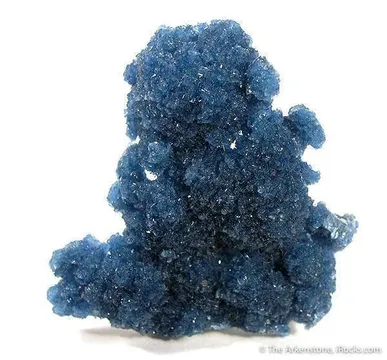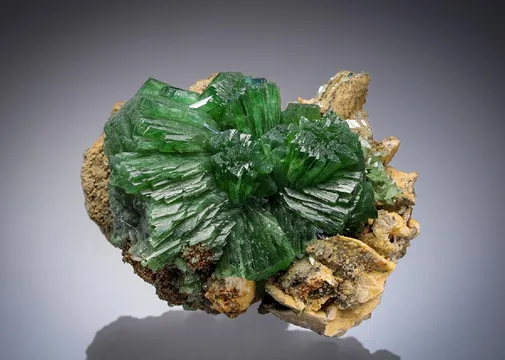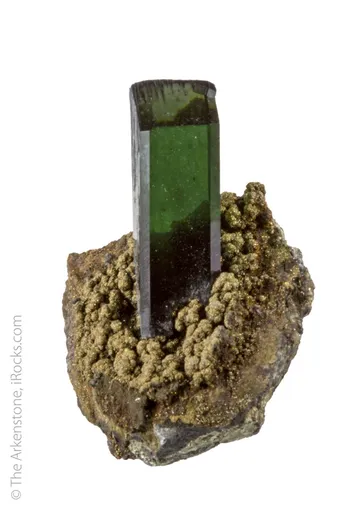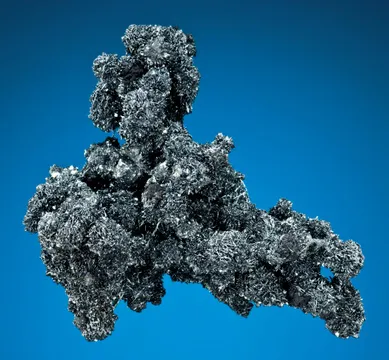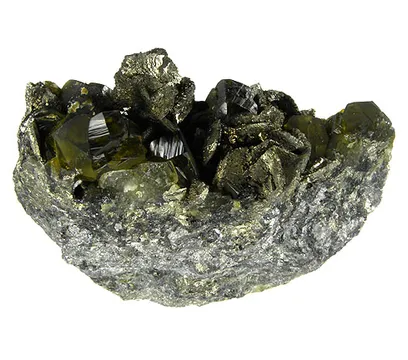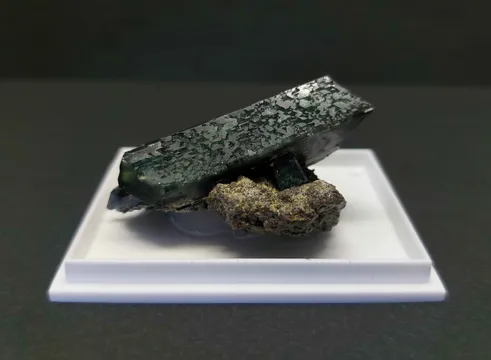
Huanuni mine, Bolivia — classic collector locality in the Tin Belt, prized for vivid green ludlamite, blue-green vivianite, rare phosphates, and cassiterite.
Key facts
Huanuni is one of the great names of the Bolivian Tin Belt: an active, state-controlled tin mine on and beneath Cerro Pozokoni in the Oruro highlands, and at the same time a classic collector locality for vivid iron phosphates. Economically, the mine is famous for cassiterite in a large Sn–W–Pb–Ag–Zn hydrothermal system. Mineralogically, it is loved for an altogether different face of the deposit: late, low-temperature phosphate seams and pockets that yielded apple- to bottle-green ludlamite, transparent blue-green vivianite, rare vauxite, wavellite, aheylite, nikischerite, and a suite of unusual supergene and hydrothermal species over pyrite, siderite, quartz, cassiterite, and altered sulfides.
The setting is textbook central Andes but not at all simple. Huanuni lies in the central part of the Eastern Cordillera, where Paleozoic quartzites, shales, siltstones, and related metasedimentary rocks are cut by a dense swarm of veins and breccias around the Pozokoni anticline. The deposit is organized around a central Huanuni–Pozokoni domain and more peripheral Bonanza and La Suerte areas. In the central zone, tin-bearing stages are rich in cassiterite, quartz, tourmaline, pyrite, arsenopyrite, pyrrhotite, schorl, siderite, stannite-kësterite, and related species; the more distal parts emphasize sphalerite, galena, chalcopyrite, and silver-bearing sulfosalts.
For collectors, the memorable Huanuni look is the contrast: lustrous, fresh green phosphate crystals on sombre metallic or brown carbonate matrices. The best ludlamite forms sharp sprays, sheaves, layered “butterfly” clusters, and individual crystals that are large for the species. The finest vivianite appears as transparent, prismatic to bladed blue-green crystals on sparkling siderite or pyrite, often with ludlamite. Cassiterite specimens from the mine are very different aesthetically—black, brilliant, prismatic, sometimes “drill-bit” twinned aggregates—but they connect the specimen world directly to the ore body that made Huanuni a national mining institution.
Regional View
Country View
Huanuni specimens matter because they are not simply attractive examples of common species; they record the late-stage chemistry of one of the world’s major tin systems. The phosphate suite developed in a deposit better known for cassiterite, sulfides, sulfosalts, and critical-element-bearing minerals. That combination—an industrially important tin mine producing world-class phosphate specimens—is what gives Huanuni its distinctive position among Bolivian localities.

Photo: Wikimedia Commons

Photo: Wikimedia Commons

Photo: Wikimedia Commons
Search for specimens: View all specimens from Huanuni mine, Bolivia
Huanuni mine is at Huanuni, Pantaleón Dalence Province, Oruro Department, Bolivia, roughly southeast of La Paz and east-southeast of Oruro in the central Eastern Cordillera. It belongs to the Bolivian Tin Belt, the Andean metallogenic province that includes many of the world’s classic tin and polymetallic deposits. The Huanuni system is usually described as a polymetallic Sn–W–Pb–Ag–Zn deposit, with cassiterite as the principal tin ore and with important sulfide, sulfosalt, phosphate, sulfate, carbonate, clay, and oxide assemblages.
The mine is centered on the Pozokoni hill and anticline. Host rocks are mainly Paleozoic quartzites, shales, and siltstones of the Llallagua, Uncía, and Cancañiri formations, with lesser mineralization in Miocene volcanic rocks of the Morococala Formation. The district also contains Miocene porphyritic dikes, and a blind intrusion beneath Cerro Pozokoni has been inferred as a likely heat and fluid source. The veins and breccias form a dense, roughly radial and concentric array rather than a single simple lode system. Named veins in the central mine include Veta Grande, Oriente, Nueva, Chuallani, Progreso, Norteña, Cruzera, Esperanza, and Amarilla. Many veins are narrow—commonly less than a meter thick—but richly mineralized, and several vein tops lie well below the summit of Pozokoni rather than cropping out prominently at surface.
The paragenesis explains why Huanuni can produce such different kinds of specimens. Early to main hypogene stages introduced quartz, tourmaline, cassiterite, pyrite, arsenopyrite, pyrrhotite, sphalerite, chalcopyrite, siderite, schorl, wolframite, stannite-kësterite, native bismuth, and bismuthinite. Later silver-rich assemblages added galena, freibergite, matildite, proustite-pyrargyrite, cervelleite, teallite, and related sulfosalts, especially toward the Bonanza and La Suerte peripheral zones. Supergene and late hydrothermal events then produced the phosphate and sulfate species prized by collectors: vivianite, ludlamite, vauxite, wavellite, variscite, aheylite, faustite, chalcosiderite, plumbogummite, pyromorphite, drugmanite, nikischerite, and others.
Huanuni’s modern history is inseparable from Bolivia’s tin industry. The mine passed through private ownership in the early twentieth century, including consolidation by Simón Patiño’s interests and operation through Patiño Mines and the Bolivian Tin and Tungsten Corporation. After Bolivia’s 1952 Revolution, the nationalized mining sector was placed under COMIBOL, the Corporación Minera de Bolivia. Huanuni later passed through restructuring and joint-venture phases, including a 2000 risk-sharing agreement with Allied Deals PLC and the RBG Minera Huanuni period, before returning to direct state control. A decisive modern turning point came after the violent October 2006 conflict between salaried miners and cooperativists over Cerro Posokoni: Supreme Decree 28901 placed Huanuni under full COMIBOL administration and called for the hiring of cooperative miners into the state company.
Production has remained nationally important. Huanuni is routinely cited as Bolivia’s largest tin producer, and recent studies describe it as one of the largest tin resources in the world. Published figures for 2017 record 8,415 tonnes of tin from Huanuni, and even with a subsequent decline below 7,000 tonnes in 2018 the mine still accounted for more than half of Bolivia’s total tin production. COMIBOL planning documents list the Santa Elena mill at 1,200 tonnes per day and the Lucianita mill at 3,000 tonnes per day, underscoring the industrial scale of the operation.
Collecting access today should be treated as closed, controlled, and hazardous. Huanuni is an active underground mine and a strategic state tin operation, not a recreational collecting site. Collector-quality phosphates entered the market through miners, dealers, older stocks, and occasional dispersals of historic collections, not through casual field collecting. Several specimen descriptions and dealer accounts note that fine vivianite and ludlamite became much scarcer after the state reorganization of the mine and tighter control of underground levels. Serious collectors should buy through reputable sources, preserve old labels, and avoid assuming that a vague “Bolivia” or “Huanuni area” label is equivalent to a documented Huanuni mine specimen.
The best-known specimen production is associated with late phosphate pockets and seams rather than the normal cassiterite ore. Significant vivianite production is documented from the mid-1990s and again in later limited releases, with crystals reported to 4 cm, 5 cm, and even 12 cm in Mineralogical Record index entries. Ludlamite from the mine occurs on siderite, pyrite, quartz, limonite, and locally with vivianite; better specimens have individual crystals over 1 cm and rich coverage over contrasting matrix. Cassiterite specimens are more directly tied to the ore stages, forming lustrous black prismatic and twinned crystals in quartz-sulfide-carbonate vein material. Rare-species collectors prize Huanuni for aheylite, the turquoise-group type-locality mineral, and nikischerite, a sulfate described from later low-temperature veins cutting the cassiterite-bearing system.
Huanuni ludlamite is the locality’s signature collector mineral: sharp, lustrous, bright to smoky green Fe3(PO4)2·4H2O crystals in sprays, fans, stacked blades, and compact layered clusters on siderite, pyrite, limonite, quartz, and sometimes vivianite. Many specimens are thumbnails and miniatures, but the mine is famous because individual crystals and clustered aggregates can be unusually robust for ludlamite; dealer records and specimen descriptions repeatedly note Huanuni crystals around 5 mm to over 1.5 cm, with exceptional groups around 2 cm across. The best pieces are fresh, translucent, well isolated, and three-dimensional, with saturated green color against sparkling pyrite or brown siderite; ordinary examples are flatter, duller, more scattered, or partly bruised along the delicate crystal edges. Huanuni’s strongest ludlamites are not just “good for Bolivia”—they are routinely compared with the best worldwide examples of the species.
Huanuni vivianite occurs as transparent to translucent prismatic, bladed, and wedge-like Fe3(PO4)2·8H2O crystals, typically blue-green, sea-green, bottle-green, or darker green as oxidation advances, on siderite, pyrite, pyrrhotite, and phosphate-bearing matrix, commonly with ludlamite. The best-known collector finds produced sharp crystals from miniature size to several centimeters; Mineralogical Record index entries record Huanuni vivianite as transparent crystals to 4 cm, gemmy sea-green crystals to 5 cm on siderite, and crystals to 12 cm on pyrite with ludlamite. Fine pieces have strong transparency, sharp terminations, clean attachment, and color that remains lively rather than blackened; lesser examples are cleaved, scuffed, edge-damaged, cloudy, or too dark from light exposure. Huanuni vivianite is especially desirable when the crystal is perched on sparkling siderite or pyrite and accompanied by crisp ludlamite rather than merely massive green phosphate.
At Huanuni, siderite is both an ore-stage carbonate and one of the most important display matrices for the phosphate suite. In the central part of the deposit it is common with cassiterite and is interpreted in part as an alteration product related to earlier pyrrhotite; polished-section studies also record siderite intergrown with rare otavite. Collector specimens generally show brown to tan, lustrous, drusy to rhombohedral siderite crusts that provide a sparkling base for vivianite and ludlamite, while some cassiterite-bearing vein pieces contain siderite in the tin assemblage itself. Good siderite specimens from Huanuni are judged less as standalone carbonate classics than as matrix pieces: the most desirable examples have bright, undamaged siderite supporting sharp, contrasting green phosphates or black cassiterite, while dull brown massive carbonate or friable iron-stained crusts are much less compelling.
Cassiterite is Huanuni’s economic heart, occurring through the central tin-rich stages as euhedral to subhedral SnO2 crystals with quartz, pyrrhotite, arsenopyrite, siderite, pyrite, schorl, stannite-kësterite, and related sulfides. Specimen-quality cassiterite from the mine is typically black to very dark brown, highly lustrous, and prismatic, locally in sharp twinned “drill-bit” habits or dense crystal groups; one well-documented specimen shows black prismatic twins to about 12 mm on a 7.6 cm matrix. The best cabinet and miniature pieces have distinct, undamaged terminations, glossy faces, and visible crystal architecture rather than ore-like massive black aggregates. Huanuni cassiterite is especially meaningful when accompanied by quartz, pyrite, siderite, or late phosphates because it ties the collector specimen directly to the long-lived paragenesis of the tin system.
Pyrite is widespread at Huanuni and appears in multiple roles: as part of the hypogene sulfide assemblage, as matrix for cassiterite and phosphate specimens, and as an alteration or replacement product in the complex sulfide history of the deposit. In the central area, pyrite occurs with arsenopyrite, sphalerite, siderite, cassiterite, schorl, and later stannite-kësterite associations; in specimen material it is most familiar as bright to brassy granular, drusy, or crystalline matrix beneath ludlamite and vivianite. The strongest collector pieces use pyrite as contrast—metallic sparkle beneath transparent green phosphate crystals—whereas pyrite-only pieces from Huanuni are usually of locality interest unless they show unusually sharp crystals or intimate association with cassiterite, siderite, or rare phosphates. Condition is important because pyrite matrices can be bruised, oxidized, or iron-stained, and phosphate crystals attached to them are often more fragile than the sulfide base.
Vauxite from Huanuni is a scarce and specialist phosphate, far less commonly encountered than ludlamite or vivianite and much more dependent on good provenance and, ideally, analysis. Published mineral data record vauxite at Huanuni in association with marcasite and wavellite, while classic vauxite habits are small blue tabular crystals, radial to subparallel aggregates, and nodular groups generally only millimeters across. Huanuni pieces should be expected as small blue to blue-green crystal aggregates or coatings in late phosphate assemblages rather than large showy crystals; the best examples show recognizable vauxite habit, pleasing blue color, and credible association with the mine’s documented phosphate suite. Because Bolivian vauxite labels are often confused with Llallagua/Siglo XX material and related phosphates, locality confidence and mineral identification matter more for value than size alone.
Quartz is present throughout the Huanuni system and is one of the structural and visual threads connecting the ore and specimen assemblages. In the central area, early open-space linings include quartz with cassiterite, arsenopyrite, and pyrrhotite, and later stages again introduce drusy quartz with sulfides, stannite-kësterite, and other minerals. Collector quartz from Huanuni is rarely valued as a standalone quartz specimen; its importance is as matrix, vein filling, or contrast for cassiterite, ludlamite, siderite, tourmaline, pyrite, and rare phosphates. Good pieces show clean drusy or small prismatic quartz that frames black cassiterite or green phosphate without overwhelming them, while massive white vein quartz with sparse ore is commoner and less desirable.
Beyond these headline species, Huanuni has an unusually deep mineral list for a tin mine. The type-locality minerals are aheylite, a pale blue to gray-blue turquoise-group phosphate found as tiny spherical to botryoidal aggregates on matrix, and nikischerite, a green micaceous sulfate described as plates to 4 mm forming radiating balls and aggregates to nearly 1 cm in late low-temperature seams. Other documented species include wavellite, variscite, faustite, chalcosiderite, plumbogummite, pyromorphite, drugmanite, monazite-(Ce), fluorapatite, schorl, arsenopyrite, sphalerite, chalcopyrite, galena, pyrrhotite, stannite-kësterite, bismuthinite, native bismuth, wolframite-group minerals, rutile, gersdorffite, cobaltite, cervelleite, matildite, freibergite, teallite, cylindrite, franckeite, rhodostannite, stetindite, otavite, dickite, kaolinite, goethite, jarosite, and several clay or alteration minerals. The rare-species suite is not decorative in the usual cabinet-specimen sense, but it makes Huanuni a serious locality for systematic collectors who value paragenesis, analysis, and old labels.
Huanuni specimens should be bought with locality discipline. Fine ludlamite and vivianite from the mine are legitimate classics, but “Bolivian vivianite” and “Bolivian ludlamite” labels are not automatically Huanuni; Morococala, Llallagua/Siglo XX, and other Bolivian localities have also produced phosphate specimens. Huanuni pieces most often show siderite, pyrite, pyrrhotite, limonite, quartz, cassiterite, or mixed late phosphate matrix. Old labels from dealers, collections, or mindat-linked specimens are especially valuable because casual collecting access is not realistic and much of the finest material predates current market circulation.
The most important authenticity issue is analytical rather than synthetic. No widespread manufactured fake Huanuni ludlamite or vivianite problem is documented, but misidentification among blue-green phosphates, sulfates, chlorites, and iron-rich alteration minerals is a real concern. Recent material sold or offered as nikischerite from Huanuni has been reported by knowledgeable collectors as chlorite-group material after analysis, so expensive “nikischerite” should not be accepted on color and locality alone. Vauxite is another mineral where a Huanuni label should be treated cautiously unless the specimen has convincing provenance or analytical support, because Bolivian vauxite material from other districts and related phosphate species can be visually similar.
Vivianite needs careful light management. Fresh vivianite may be pale, blue-green, or green, but it darkens with oxidation and light exposure; good Huanuni crystals can lose much of their transparency and color appeal if left in strong sunlight or intense display lighting. Store vivianite in low light, avoid prolonged UV exposure, and use gentle, cool LED lighting for display. The mineral is also soft and cleaves easily, so loose thumbnails should be handled by the matrix and never by the crystals. Ludlamite is harder than vivianite but still delicate in the Huanuni habit: thin blades, spray tips, and layered aggregates chip readily.
Matrix condition deserves attention. Pyrite and pyrrhotite-bearing matrices can show oxidation, rusting, and friable areas, especially if stored in damp conditions. Brown siderite and limonite matrices may shed grains, and older repairs or trims are not unusual on phosphate specimens because the crystals commonly occur on irregular, crumbly seam material. Check the contact between crystal and matrix under magnification; an attractive vivianite crystal standing from siderite or pyrite is vulnerable to old glue repairs, edge bruising, and cleavage cracks. Cassiterite is far more durable, but sharp Huanuni twins can still show chipped terminations and contact damage.
Market availability is uneven. Small ludlamite and vivianite specimens appear regularly enough that Huanuni remains obtainable, especially as thumbnails and miniatures, but truly fine examples—transparent vivianite on sparkling siderite, large ludlamite crystals on clean matrix, or combination pieces with both species—are much scarcer and command strong prices. Cassiterite from Huanuni is less rare as a species but desirable when the crystals are sharp, lustrous, and aesthetic rather than ore-like. Aheylite and nikischerite are specialist rarities; when they appear, documentation and analysis are often more important than visual beauty.
The most dramatic modern Huanuni story is not a mineral-pocket discovery but a two-day battle for the hill itself. On October 5 and 6, 2006, rival groups of salaried state miners and cooperative miners fought for control of the tin deposits at Cerro Posokoni. Reports from the time describe dynamite, firearms, sticks, stones, and miners advancing and counterattacking on the barren slopes above town. Death tolls in contemporary reports ranged from at least 12 to 17, with more than 80 wounded in some accounts. One local mine workers’ leader, Ever Choque, said that when cooperativists advanced throwing dynamite, “we couldn’t stand there with our arms crossed.” A presidential spokesman called the fighting “demented and fratricidal,” words that still read like an epitaph for the event.
The aftermath changed the mine. On October 31, 2006—exactly 54 years after Bolivia’s historic nationalization of the big mines—Supreme Decree 28901 placed Cerro Posokoni and the nationalized Huanuni mining center under full COMIBOL administration. The decree also opened the way to bring thousands of cooperative miners into the state company. For collectors, that political and labor history helps explain why fine Huanuni phosphate specimens are not a casually renewable supply. The mine is a strategic national tin operation, and the colorful pocket minerals sit within a world of labor conflict, ore control, and state policy rather than the gentler romance of a weekend collecting quarry.
Huanuni also entered Bolivian cinema. Jorge Sanjinés’ 1965 short film ¡Aysá!—Derrumbe—was filmed with views of the mining city and the dark underground world of the pirquiñeros, independent workers who attacked rock with chisel and hammer in dangerous abandoned workings. The film’s story turns on a miner who begins to hear and feel the earth moving before a collapse. Decades later, Huanuni became the setting for Kiro Russo’s Viejo Calavera, known in English as Dark Skull. Visitors to town see a bright highland plaza and a large miner’s helmet monument; Russo’s film turns instead toward dark alleys, cold nights, alcohol, grief, and the mine interior. Its protagonist, Elder Mamani, is forced into mine work at 16 after his father’s death, and the actor Julio César Ticona spoke of the role from the radio station in Huanuni itself.
More recent reporting adds another chapter: the problem of “jukus,” ore thieves whose name is commonly explained as “owls” in Quechua because of their nocturnal work. Huanuni has been described as the Bolivian state mine most affected by these thefts. Reports in 2025 and 2026 described apprehensions, illegal entry, explosives, and armed or organized groups moving ore from the final link of the metal boom. To a specimen collector holding a quiet green ludlamite on siderite, this may feel remote; at the locality, however, the same underground passages that produced world-class phosphates remain part of a live industrial and social struggle.